Skip to content
April 22:First Poison Gas Attack at Ypres111yr ago

Why Every Modern Military Fears the Same Weapon: A $500 FPV Drone With a Grenade

Alex Carter · · 10 min read
Save
Share:
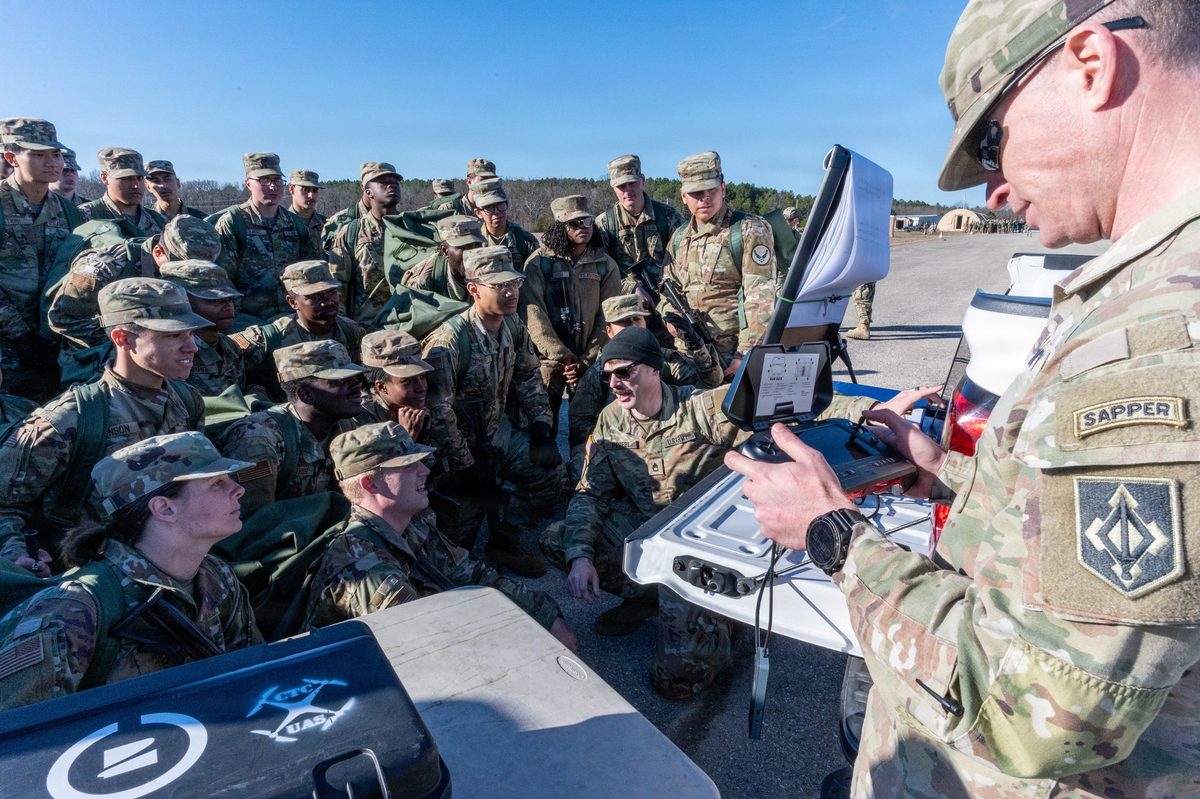
U.S. Army soldiers examining FPV drone technology during a demonstration of new capabilities
Alex Carter
Alex Carter

Modern Warfare & Defense Technology Contributor

Alex Carter writes about modern warfare, emerging military technology, and how doctrine adapts to new tools. His work focuses on what changes in practice -- command, control, targeting, and risk -- when systems like drones and autonomous platforms become routine.

A $500 drone carrying a grenade just destroyed a $4 million armored vehicle. The operator is a 22-year-old wearing racing goggles, sitting in a basement two kilometers behind the front line. He built the drone himself from commercially available parts — a carbon fiber racing frame, brushless motors, a lithium polymer battery, and a first-person view (FPV) camera that streams video directly to his headset. The grenade is taped to the bottom. The entire weapon system costs less than a decent laptop. And it is changing warfare more profoundly than any weapon system introduced in the past thirty years.

What an FPV Drone Actually Is

An FPV drone is, at its core, a racing drone. The technology was developed by hobbyists — drone racing pilots who fly custom-built quadcopters at 100+ mph through obstacle courses, controlling them through goggles that display a live video feed from a camera mounted on the drone. The pilot sees what the drone sees, in real time, with minimal latency. The control inputs are intuitive: tilt the stick, the drone rolls; push forward, it accelerates. Skilled FPV pilots can navigate through windows, under bridges, and between tree branches at full speed.

The military application was inevitable. Take a racing drone, replace the GoPro with a live video transmitter, attach an explosive charge — a repurposed RPG warhead, a hand grenade, or an improvised shaped charge — and you have a guided munition that can fly at 60-100 mph, navigate through doorways, and impact a target with precision measured in centimeters. The pilot guides the drone all the way to impact, adjusting course right up until detonation. There is no countermeasure for human judgment in the terminal phase.
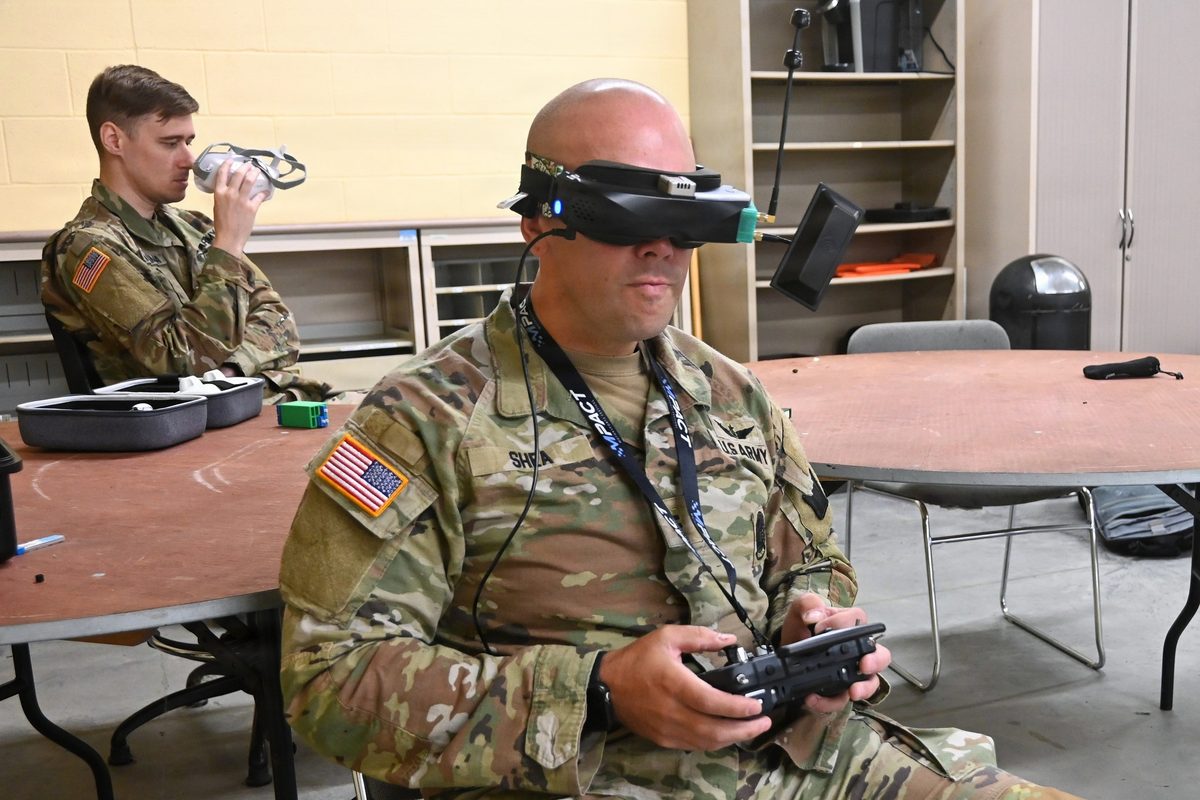
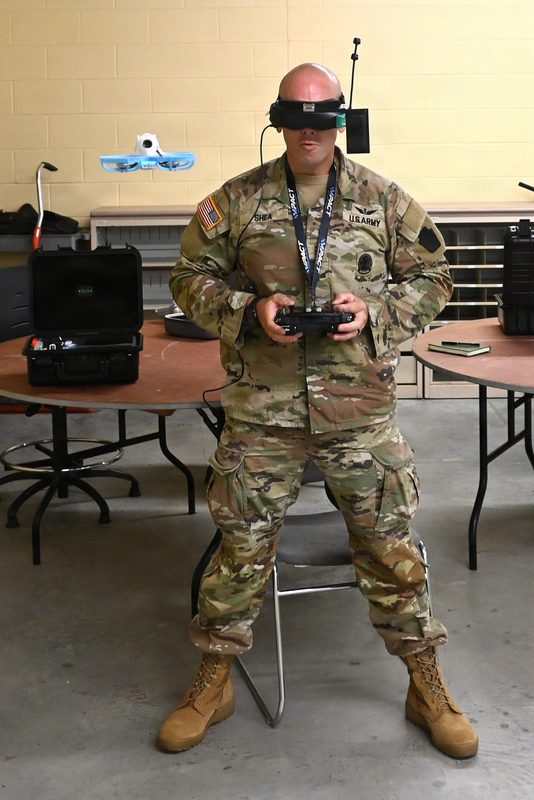
Soldier operating an FPV drone wearing goggles and using a controller for drone piloting
An FPV drone operator using goggles and a controller — the same equipment used by civilian drone racers, adapted for combat. The skill curve is steep but the results are devastating. (DVIDS / Public Domain)

The Cost Equation That Terrifies Every Military

The math is what makes defense planners lose sleep. An FPV drone costs $200-500 in parts. A skilled operator can build one in a few hours from commercially available components. The explosive payload — often a modified RPG-7 warhead or a 3D-printed shaped charge — costs another $50-200. Total cost per kill vehicle: under $1,000.

The targets these drones destroy cost orders of magnitude more. A T-72 tank: $1-2 million. A BMP infantry fighting vehicle: $500,000-$1 million. A self-propelled howitzer: $3-5 million. An armored personnel carrier: $500,000-$2 million. Even a supply truck loaded with ammunition represents $50,000-$100,000 in equipment and irreplaceable logistics value.

A single FPV drone operator with a $5,000 inventory of parts and explosives can destroy millions of dollars in enemy equipment in a single day. No other weapon system in history has achieved this cost-exchange ratio. Anti-tank missiles like the Javelin ($178,000 per round) or NLAW ($30,000 per round) were considered revolutionary for giving infantry a cheap way to kill tanks. The FPV drone is 100-350 times cheaper.

Ukraine: The Laboratory

The war in Ukraine has become the world's largest real-time experiment in FPV drone warfare. Both sides now produce and deploy FPV drones in staggering quantities. Ukraine's drone production — across military factories, volunteer workshops, and individual operators — reached tens of thousands of FPV drones per month by 2024. Russian production has scaled similarly. The frontline is saturated with these weapons.

U.S. soldiers training with small drones as part of modern drone warfare preparation
U.S. soldiers training with drone technology — every major military is now developing FPV drone capabilities and counter-drone tactics based on lessons from Ukraine. (DVIDS / Public Domain)

The tactical impact has been transformative. Armored vehicles that once could advance across open ground with relative impunity now face a swarm threat. A single tank attempting to move across an open field within FPV range of enemy positions might face 5-10 drone attacks in a single movement. Some get through. Some are intercepted by electronic warfare. But the sheer volume means that enough get through to make unprotected movement extremely dangerous.

FPV drones have extended the kill zone beyond the traditional direct-fire engagement range. A sniper can engage targets at 800-1,200 meters. An ATGM can reach 2-5 kilometers. An FPV drone, depending on battery capacity and radio link, can fly 5-15 kilometers — and navigate around obstacles, over terrain features, and into positions that line-of-sight weapons cannot reach. A tank parked behind a building is safe from ATGMs. It is not safe from an FPV drone that can fly over the building and dive onto it from above.

The Skill Curve

FPV drone piloting is not easy. Unlike larger military drones that fly pre-programmed routes, FPV drones are manually piloted for the entire flight. The pilot must navigate to the target, identify it through the camera, adjust for wind and obstacles, and guide the drone to impact — all while flying at 60-100 mph with a video feed that has noticeable latency and limited field of view.

Training a competent FPV combat pilot takes 2-4 weeks of intensive practice — significantly less than training a tank crew, a fighter pilot, or an artillery crew. But the skill differential between a novice and an expert is enormous. Expert pilots achieve hit rates of 60-80% against moving targets. Novices might hit 10-20%. The most skilled operators can thread a drone through a vehicle's open hatch, strike the gap between reactive armor panels, or hit a specific component like an engine compartment or antenna.

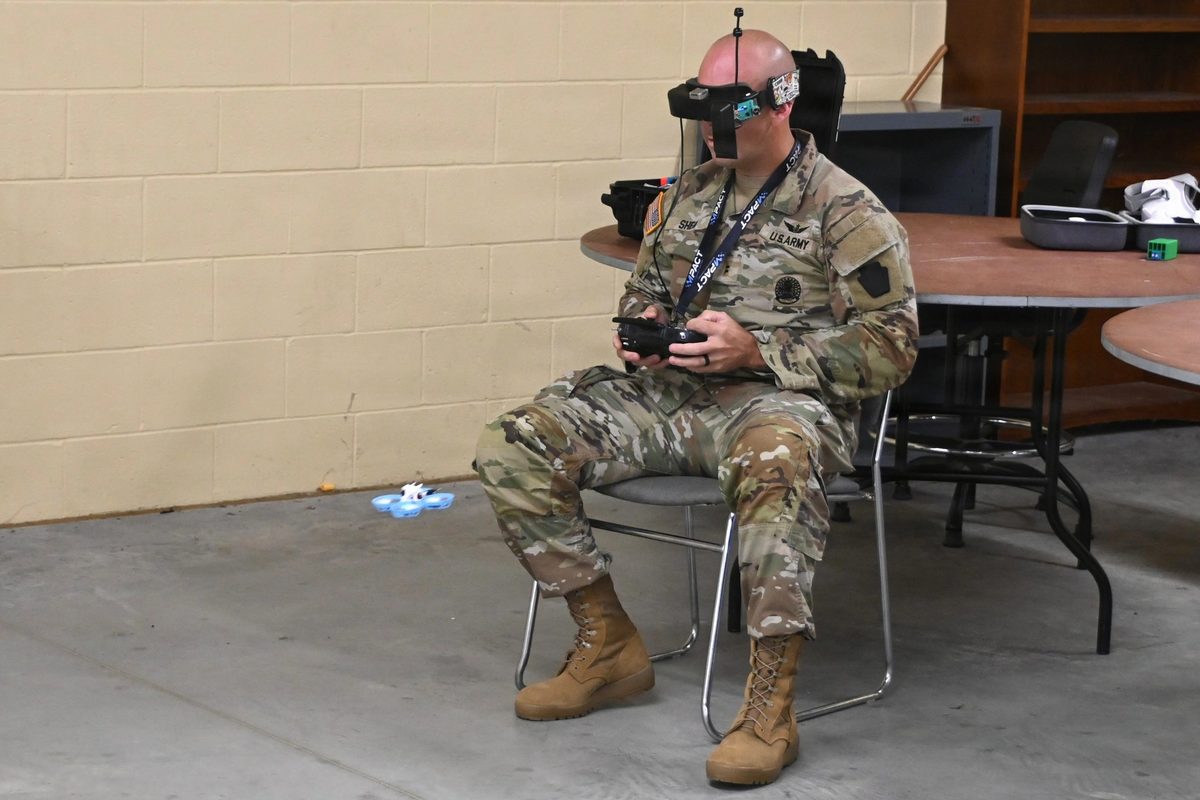
Close-up of a small FPV-style drone being prepared for flight during military exercises
An FPV-type drone being prepared for launch — these small, agile platforms are cheap to produce and devastatingly effective in trained hands. (DVIDS / Public Domain)

Ukrainian units have developed systematic training programs that use simulators (modified versions of civilian drone racing simulators) for initial skill development, then progress to live practice flights with inert warheads before advancing to live combat missions. Some units maintain kill-to-sortie statistics for each pilot, tracking effectiveness and identifying operators who need additional training.

Counter-FPV: The Arms Race

Every new weapon creates a counter-weapon, and FPV drones are no exception. The primary defense against FPV drones is electronic warfare — jamming the radio link between the pilot and the drone. Both sides in Ukraine have deployed increasingly powerful and sophisticated jamming systems, creating an electromagnetic battlespace that is as contested as the physical one.

The jamming-versus-link arms race follows a predictable pattern. Defenders deploy jammers on specific frequencies. Attackers switch to different frequencies. Defenders deploy broadband jammers. Attackers use frequency-hopping protocols. Defenders increase jamming power. Attackers develop fiber-optic tethered drones that cannot be jammed at all (the control signal travels through a physical cable, immune to electromagnetic interference).

Fiber-optic FPV drones — which trail a thin fiber-optic cable behind them as they fly — represent the latest escalation. They are unjammable, have zero-latency video, and can operate in the most intense electronic warfare environments. Their limitation is range (the cable length, typically 5-15 kilometers) and the requirement to avoid snagging the cable on obstacles. Both Ukraine and Russia have deployed fiber-optic FPV drones in combat.

Soldiers preparing small drone systems for deployment during training operations
Preparing drone systems for deployment — the proliferation of FPV technology means every infantry unit now requires drone operators and counter-drone capabilities. (DVIDS / Public Domain)

Physical countermeasures include vehicle-mounted shotgun-type systems designed to intercept drones at close range, wire mesh and cage armor ("cope cages") that detonate the warhead before it reaches the vehicle's hull, and active protection systems originally designed for anti-tank missiles that are being adapted for the drone threat. None of these are fully effective. The diversity of drone approach angles, speeds, and attack profiles makes a single defensive solution inadequate.

The Production Revolution

What makes FPV drones uniquely dangerous isn't just their cost — it's how fast they can be produced. A modern main battle tank takes months to build in a specialized factory. A precision-guided missile requires controlled manufacturing environments, specialized electronics, and extensive quality control. An FPV drone can be assembled by a trained technician in 2-4 hours using parts ordered online. The production bottleneck is batteries and motors, not specialized defense manufacturing.

Ukraine has demonstrated that FPV drone production can scale to wartime demand using distributed manufacturing. Hundreds of small workshops — some operated by volunteers, some by military units, some by private companies — produce drones in parallel. Each workshop might build 20-50 drones per day. Across hundreds of workshops, the total output reaches tens of thousands per month. This distributed production model is virtually impossible to disrupt with strategic strikes — destroying one workshop has no effect on the hundreds of others.

The industrial implications for traditional defense contractors are significant. A $200 million fighter jet production line takes years to establish. An FPV drone production line takes weeks and costs a few thousand dollars in tools and workspace. Nations that have traditionally been unable to compete in advanced weapons manufacturing can now produce effective precision-guided munitions at scale. The barrier to entry for precision strike capability has dropped from billions of dollars to millions.

Why This Changes Force Structure

The FPV drone doesn't just add a new weapon to the battlefield — it challenges fundamental assumptions about force structure and equipment investment. If a $500 drone can reliably destroy a $4 million tank, does it make sense to continue building $4 million tanks? The question is more nuanced than it appears (tanks provide capabilities beyond simple survivability), but it's being asked in every defense ministry in the world.

The broader implication is that every military platform without active protection against small drones is now vulnerable to destruction by an adversary with minimal resources. This applies to tanks, APCs, artillery pieces, radar systems, logistics vehicles, command posts, and even individual fighting positions. The cost of defending against FPV drones — electronic warfare systems, active protection, physical countermeasures, counter-drone drones — may exceed the cost of the drones themselves, creating an asymmetric cost advantage for the attacker.

The $500 drone with a grenade is not a curiosity or a niche weapon. It is a structural change in the economics of warfare, comparable to the machine gun's effect on cavalry charges or the anti-tank missile's effect on unsupported armor operations. Every military on earth is scrambling to integrate FPV capabilities into its force structure and develop defenses against them. The armies that figure this out first will have a decisive advantage. The armies that don't will lose equipment at exchange ratios that make conventional warfare economically unsustainable.

Share this article

Share:

Recommended

Ace of The Skies: Can You Identify These Military Aircraft Throughout The Years?
Test Yourself

Ace of The Skies: Can You Identify These Military Aircraft Throughout The Years?

Can you identify these aircraft?

Take the Quiz

On This Day in Military History

April 22

First Poison Gas Attack at Ypres (1915)

German forces released 168 tons of chlorine gas from 5,730 cylinders along a four-mile front near Ypres, Belgium. The yellowish-green cloud killed thousands of French and Algerian troops and opened a four-mile gap in the Allied line. Only the Canadian 1st Division's desperate stand prevented a complete breakthrough.

1944Allied Landings at Hollandia, New Guinea

1951Battle of Kapyong, Korea

See all 4 events on April 22

Get Military News & History in Your Inbox

Join thousands of readers receiving our weekly digest of military technology, history, and analysis.

Test Your Knowledge