Skip to content
April 22:First Poison Gas Attack at Ypres111yr ago

Gallipoli at 111: How 500,000 Troops Fought for 8 Months Over a Peninsula That Led Nowhere

Daniel Mercer · · 12 min read
Save
Share:
ANZAC troops landing at Gallipoli beach on April 25, 1915 during the ill-fated campaign
Daniel Mercer
Daniel Mercer

Military History Editor

Daniel Mercer writes about military history with a focus on the 20th century, including World War II, the Cold War, and Vietnam. His work looks at how decisions made decades ago still influence doctrine, planning, and assumptions today.

473,000 casualties over a peninsula 30 miles long. And in the end, nothing changed. The Dardanelles remained in Ottoman hands. Constantinople stayed out of Allied reach. The supply route to Russia stayed closed. After eight months of fighting — trench warfare on cliffsides, in summer heat and winter storms, with inadequate water and constant shellfire — the Allies withdrew in an evacuation so perfectly executed that it became the campaign's only unqualified success. The Gallipoli campaign of 1915-16 was a catastrophe by any military measure. But it created something no battle plan intended: the national identities of Australia, New Zealand, and modern Turkey.

Churchill's Grand Idea

By early 1915, the Western Front had frozen into the trench stalemate that would define the war. Winston Churchill, then First Lord of the Admiralty, proposed a solution: force the Dardanelles Strait with the Royal Navy, sail into the Sea of Marmara, threaten Constantinople, and knock the Ottoman Empire out of the war. If successful, the plan would open a supply route to Russia through the Black Sea, relieve pressure on the Eastern Front, and potentially bring neutral Balkan states into the war on the Allied side.

The strategic logic was sound. The execution was not. Churchill envisioned a primarily naval operation — battleships forcing their way through the narrow strait, destroying Ottoman forts with naval gunfire. But the Dardanelles is a natural fortress: a narrow waterway bounded by high ground on both sides, fortified with artillery batteries, and seeded with mines. The Royal Navy would discover that ships alone could not force the passage.

The Naval Attack: March 18, 1915
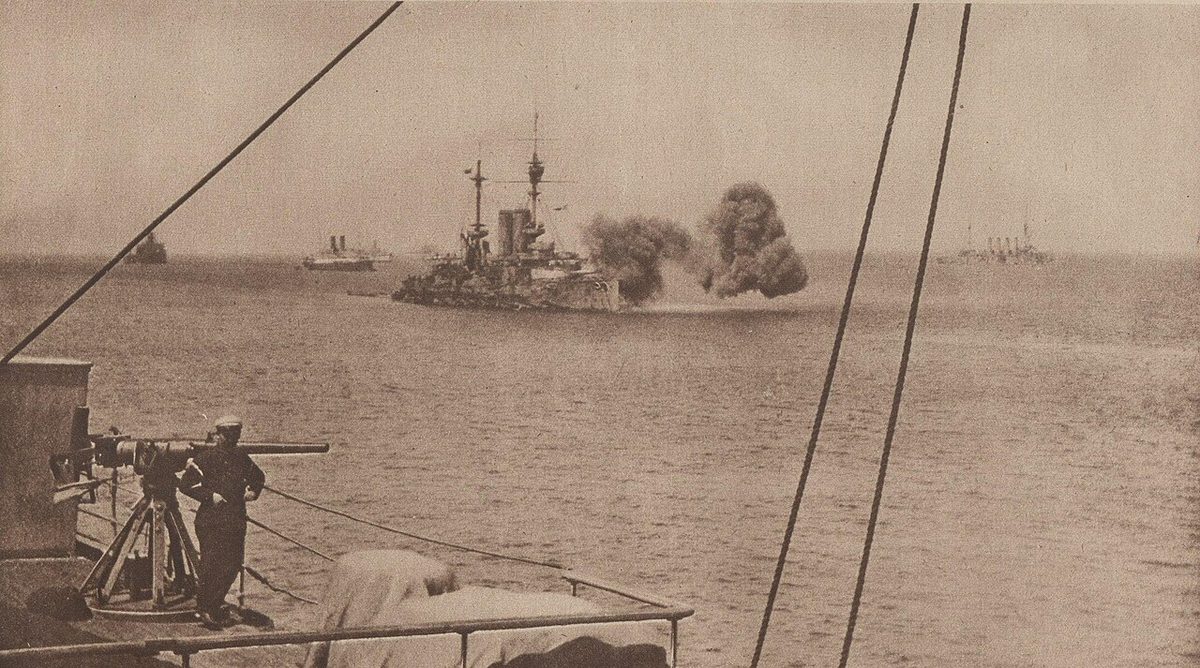
Allied warship bombarding Ottoman positions at Gallipoli during the Dardanelles naval campaign
An Allied warship bombards Ottoman positions at Gallipoli — the naval attack of March 18, 1915, lost three battleships to mines and convinced the Allies that ground forces were necessary. (Wikimedia Commons / Public Domain)

On March 18, 1915, a combined British and French fleet of 18 battleships attempted to force the Dardanelles. The result was a disaster. Ottoman mines — many laid in patterns the Allies hadn't detected — sank three battleships (the British HMS Irresistible and HMS Ocean, and the French Bouvet) and severely damaged three more. The fleet withdrew. Churchill's naval-only approach had failed.

The decision that followed would shape the rest of the campaign: rather than abandon the Dardanelles operation, the Allies committed to a ground assault. Troops would land on the Gallipoli peninsula, seize the high ground overlooking the strait, and silence the Ottoman batteries so the fleet could pass. The plan required something the Allies didn't have at Gallipoli: surprise, adequate maps, sufficient water supply, and a realistic assessment of Ottoman fighting capability.

April 25, 1915: The Landings

The landings on April 25, 1915, occurred at two main points: Cape Helles at the peninsula's southern tip (British forces) and a cove on the western coast (Australian and New Zealand Army Corps — the ANZACs). The ANZAC landing was supposed to occur on a beach with relatively easy access to the heights above. Instead, currents and navigation errors pushed the boats approximately one mile north, landing the troops at a cove backed by steep, almost vertical cliffs.

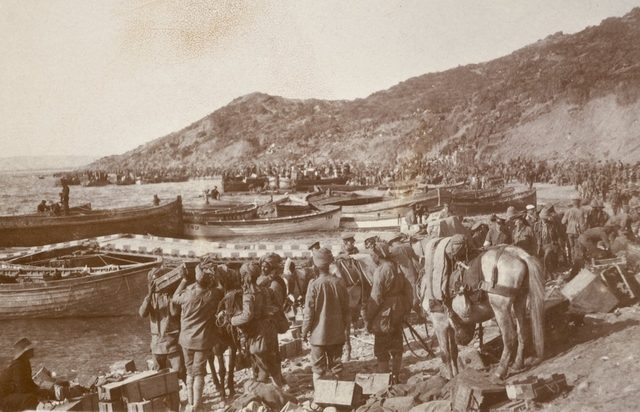
Indian and ANZAC troops crowded at Anzac Cove with supplies on the narrow beach in 1915
ANZAC Cove — the narrow beach where Australian and New Zealand troops landed, backed by cliffs that made any advance inland a near-vertical climb under fire. (Wikimedia Commons / Public Domain)

What the ANZACs found at what became known as ANZAC Cove was a nightmare of terrain. The beach was barely 50 meters wide. Behind it, steep ridges rose 100-300 feet, covered in dense scrub. Ottoman defenders held the heights. The ANZACs scrambled up the cliffs under fire, gained a precarious foothold on the ridgelines, and clung to it. They never advanced significantly beyond the positions they seized on the first day.

At Cape Helles, the British landings were equally costly. At V Beach, troops disembarking from the converted collier SS River Clyde were slaughtered by Ottoman machine guns. At W Beach, the Lancashire Fusiliers lost so many men wading ashore that they earned "six VCs before breakfast." The Allies established beachheads, but they were shallow — in some places barely a few hundred meters deep — overlooked by Ottoman positions on every ridge.

Eight Months of Trench Warfare on a Mountainside

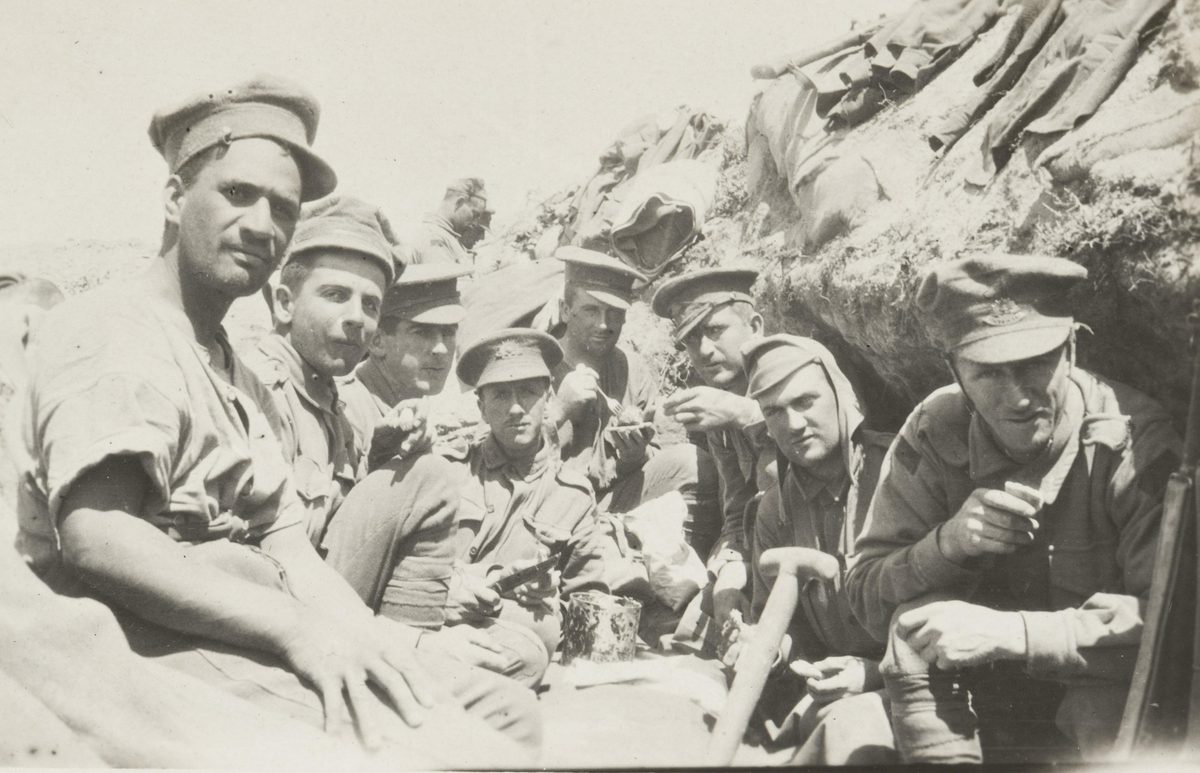
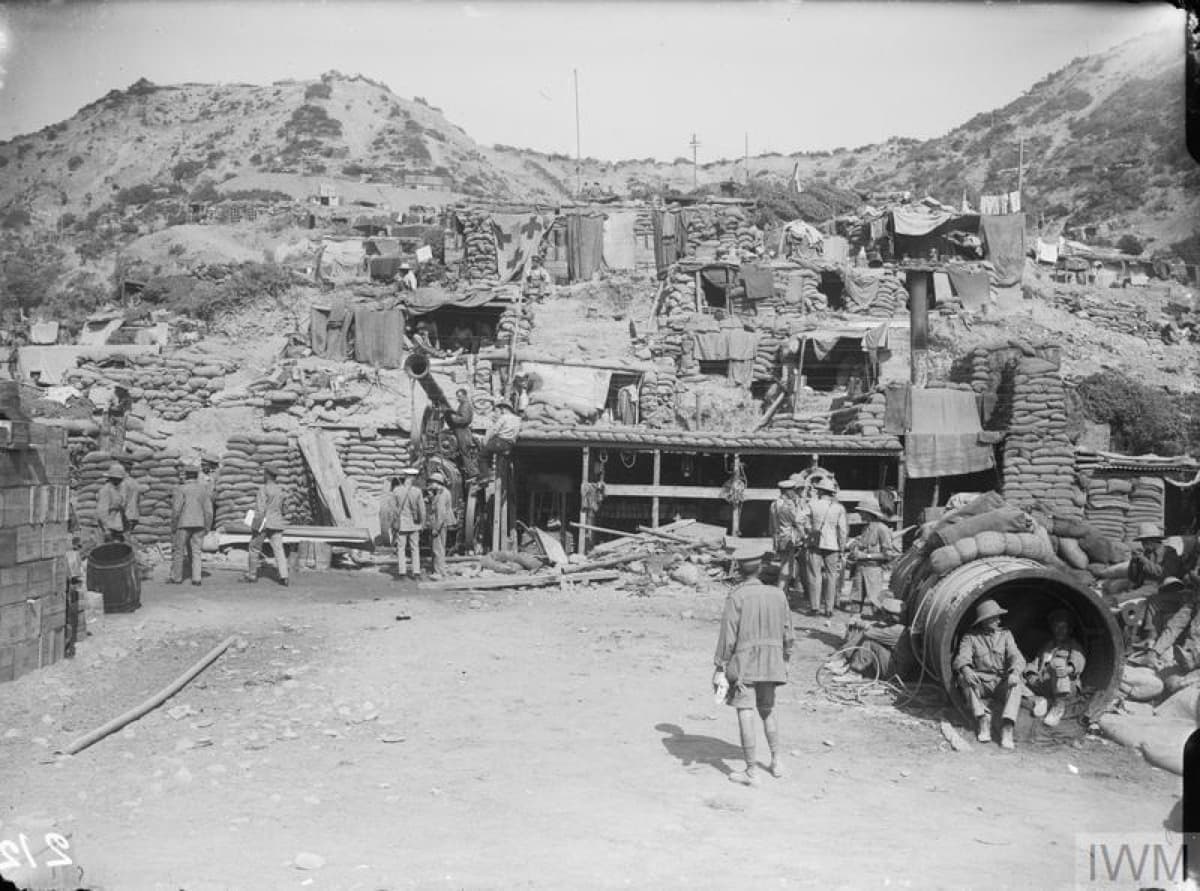
Allied soldiers in the cramped trenches at Gallipoli with the harsh conditions visible
The trenches at Gallipoli — unlike the flat fields of France, these positions were carved into cliffsides and ridgelines, often within grenade-throwing distance of Ottoman lines. (Wikimedia Commons / Public Domain)

Gallipoli became a vertical version of the Western Front. Trenches were dug into hillsides, sometimes only meters apart from Ottoman positions. At Lone Pine in August 1915, Australian and Ottoman trenches were so close that soldiers threw grenades into each other's positions by hand. The fighting was intimate, brutal, and constant.

The conditions were appalling. Summer temperatures exceeded 100°F. Fresh water was desperately short — troops received as little as one pint per day. Flies covered everything, spreading dysentery that incapacitated more soldiers than combat wounds. The dead could not be buried in the rocky ground and decomposed in the trenches. The stench was overwhelming. By autumn, disease was evacuating more soldiers than enemy fire.

In August 1915, the Allies attempted to break the stalemate with a new landing at Suvla Bay, north of ANZAC Cove. The landing was virtually unopposed — the troops got ashore easily. Then nothing happened. The commander, Lieutenant General Sir Frederick Stopford, allowed his troops to rest on the beach instead of advancing to seize the undefended high ground inland. By the time the British moved, Ottoman reinforcements had arrived. The opportunity — the last real chance to change the campaign's outcome — was lost to indecision.

Mustafa Kemal: The Commander Who Saved the Ottoman Defense

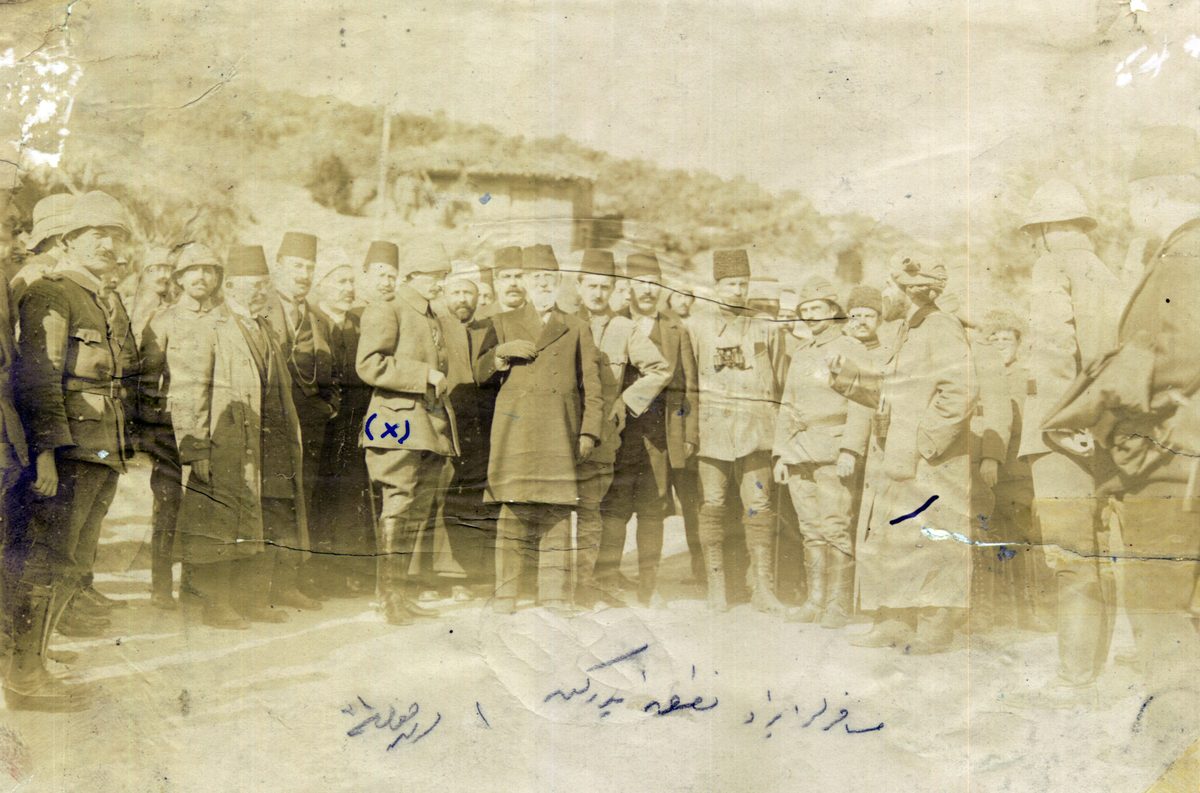
Mustafa Kemal meeting with officers during the Gallipoli campaign in 1915
Mustafa Kemal (later Atatürk) during the Gallipoli campaign — his leadership at critical moments prevented the Allied forces from seizing the heights above ANZAC Cove. (Wikimedia Commons / Public Domain)

On the Ottoman side, one commander's actions on April 25 arguably decided the entire campaign. Lieutenant Colonel Mustafa Kemal, commanding the 19th Division in reserve, recognized immediately that the ANZAC landing threatened the high ground that controlled the peninsula. Without waiting for orders from higher headquarters, he marched his division toward the sound of fighting. When his soldiers hesitated, he gave what became one of the most famous orders in military history: "I do not order you to attack. I order you to die. In the time that passes until we die, other troops and commanders can come and take our places."

Kemal's counterattack pinned the ANZACs on the ridgeline and prevented them from seizing the heights that would have overlooked the strait. His personal leadership — he was hit by shrapnel that stopped on a pocket watch, saving his life — became a foundational legend of the Turkish Republic. Gallipoli made Kemal a national hero. A decade later, as Atatürk, he would found the modern Turkish state. The campaign that destroyed the Ottoman Empire also produced the man who replaced it.

The Evacuation: The Only Thing That Went Right

Allied forces evacuating from Suvla Bay at Gallipoli in January 1916
The evacuation of Suvla Bay, January 1916 — the withdrawal was executed so skillfully that the Ottoman forces didn't realize the Allies had left until it was over. (Wikimedia Commons / Public Domain)

By October 1915, it was clear that the campaign could not succeed. The British government authorized evacuation. Military commanders feared it would produce catastrophic casualties — the conventional wisdom held that a retreating army under fire from higher ground would suffer 50% losses. The evacuation planners defied that assumption with one of the most brilliantly executed withdrawals in military history.

At ANZAC Cove and Suvla Bay, the evacuation occurred between December 15-20, 1915. At Cape Helles, it continued until January 8-9, 1916. Over 140,000 men were withdrawn from positions within rifle range of the enemy — and the total casualties during the evacuation were zero at ANZAC and Suvla, and fewer than a dozen at Helles. The Allies used self-firing rifles (rigged with cans of water that dripped onto triggers, creating random fire that convinced the Ottomans the trenches were still manned), gradually thinned their lines over multiple nights, and timed the final withdrawal to coincide with low visibility.

The Ottomans didn't realize the Allies had left until they entered the abandoned trenches the next morning. The evacuation was the campaign's masterpiece — and its most bitter irony. The one operation executed flawlessly was the retreat.

The Cost

The Gallipoli campaign produced approximately 473,000 casualties. The Allies suffered roughly 250,000 (killed, wounded, missing, and evacuated sick), including 44,000 dead. The Ottomans suffered approximately 218,000-251,000 casualties, including at least 86,000 dead. For eight months of fighting over a peninsula 30 miles long and 5 miles wide, both sides paid a price that defies comprehension.

Australia lost 8,709 killed and over 19,000 wounded — from a total population of fewer than 5 million. New Zealand lost 2,721 killed and over 4,700 wounded from a population of barely one million. These losses, relative to national population, were devastating. And they occurred in a campaign that achieved nothing — the Dardanelles remained closed, the supply route to Russia stayed blocked, and the Ottoman Empire fought on until 1918.

Why Gallipoli Still Matters

April 25 — ANZAC Day — is the most significant national commemoration in both Australia and New Zealand. In 2026, 111 years after the first landing, dawn services will be held at ANZAC Cove and in every Australian and New Zealand town. The campaign that failed militarily succeeded in forging national identities that endure to this day. Before Gallipoli, Australia and New Zealand were distant dominions of the British Empire. After Gallipoli, they were nations.

In Turkey, Gallipoli holds equal significance. The defense of the peninsula is a founding myth of the Turkish Republic — the moment when a dying empire produced the leader and the spirit that would create a modern nation-state. Mustafa Kemal's words to the ANZACs' mothers, inscribed at the memorial at ANZAC Cove, remain one of the most generous gestures ever extended from victor to vanquished: "You, the mothers who sent their sons from faraway countries, wipe away your tears. Your sons are now lying in our bosom and are in peace. After having lost their lives on this land they have become our sons as well."

Gallipoli changed nothing on the map. It changed everything about the people who fought there.

Share this article

Share:

Recommended

Ace of The Skies: Can You Identify These Military Aircraft Throughout The Years?
Test Yourself

Ace of The Skies: Can You Identify These Military Aircraft Throughout The Years?

Can you identify these aircraft?

Take the Quiz

On This Day in Military History

April 22

First Poison Gas Attack at Ypres (1915)

German forces released 168 tons of chlorine gas from 5,730 cylinders along a four-mile front near Ypres, Belgium. The yellowish-green cloud killed thousands of French and Algerian troops and opened a four-mile gap in the Allied line. Only the Canadian 1st Division's desperate stand prevented a complete breakthrough.

1944Allied Landings at Hollandia, New Guinea

1951Battle of Kapyong, Korea

See all 4 events on April 22

Get Military News & History in Your Inbox

Join thousands of readers receiving our weekly digest of military technology, history, and analysis.

Test Your Knowledge