Skip to content
April 22:First Poison Gas Attack at Ypres111yr ago

The NLAW Costs $40,000 and Destroys $4 Million Tanks. Here's How It Works.

David Kowalski · · 10 min read
Save
Share:
NLAW anti-tank missile being fired, showing the disposable launcher and backblast
David Kowalski
David Kowalski

Missile Systems & Air Defense Contributor

David Kowalski writes about missile systems, air defense networks, and the technology behind precision strike warfare. His work examines how offensive and defensive missile capabilities shape the balance of power between nations.

A $40,000 disposable tube versus a $4 million main battle tank. That's a 100-to-1 cost ratio, and it's not theoretical. In the first weeks of Russia's 2022 invasion, Ukrainian infantry armed with British-supplied NLAWs destroyed hundreds of Russian armored vehicles, stopping entire armored columns north of Kyiv with a weapon that a single soldier can carry, ready in under five seconds, and fire with almost no training. The NLAW didn't just perform well in Ukraine. It fundamentally challenged the assumption that tanks dominate the modern battlefield.

What the NLAW Is
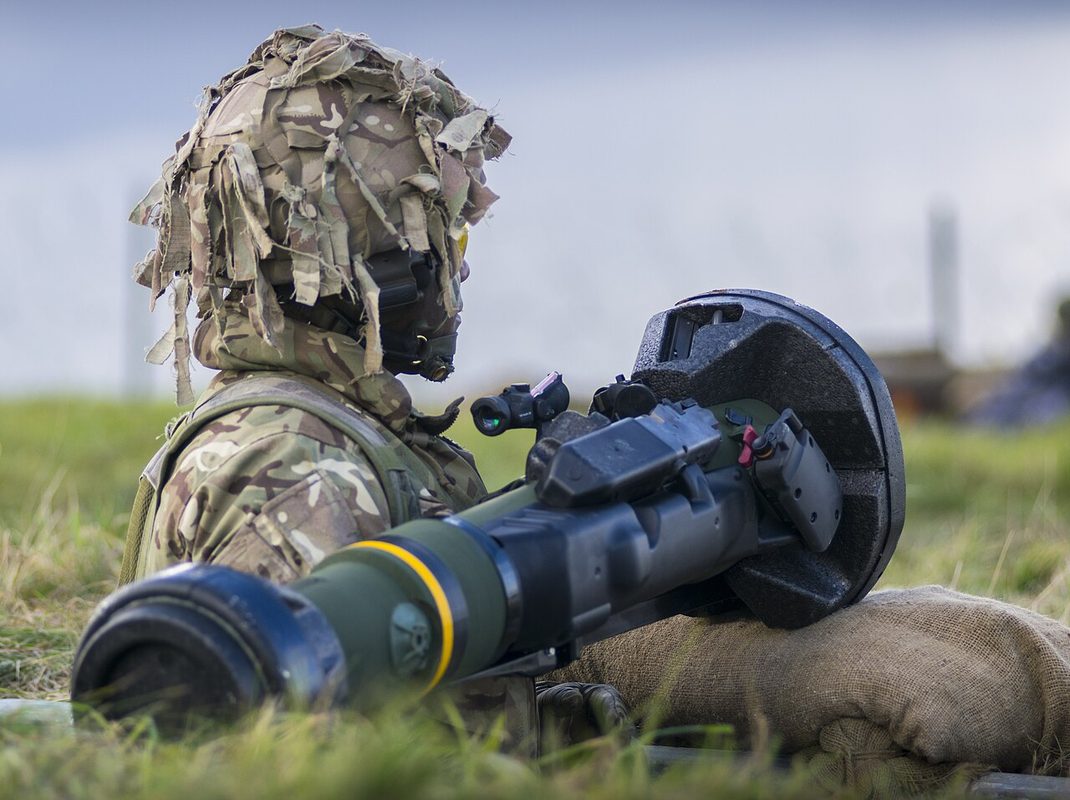
Soldier carrying an NLAW anti-tank missile system on his shoulder
A soldier carries an NLAW launcher. The complete system weighs just 12.5 kg and is fully disposable after a single shot. (UK Ministry of Defence)

The NLAW (Next generation Light Anti-tank Weapon) is a shoulder-fired, single-shot, disposable anti-tank missile jointly developed by Saab Bofors Dynamics of Sweden and Thales Air Defence of the United Kingdom. It entered service with the British Army in 2009 and has since been adopted by Finland, Sweden, Luxembourg, Indonesia, and, most significantly, Ukraine.

The numbers are straightforward. The NLAW weighs 12.5 kilograms, light enough for a single infantryman to carry in addition to a personal weapon. It fires a 150mm warhead effective from 20 to 800 meters. The launcher is disposable: fire once, discard the tube. Total ready time from carrying position to firing is under five seconds. A soldier with minimal anti-armor training can pick up an NLAW and use it effectively after a brief orientation, a critical advantage when you're arming reservists and territorial defense volunteers in the middle of an invasion.

PLOS Guidance: The Engineering That Makes It Lethal
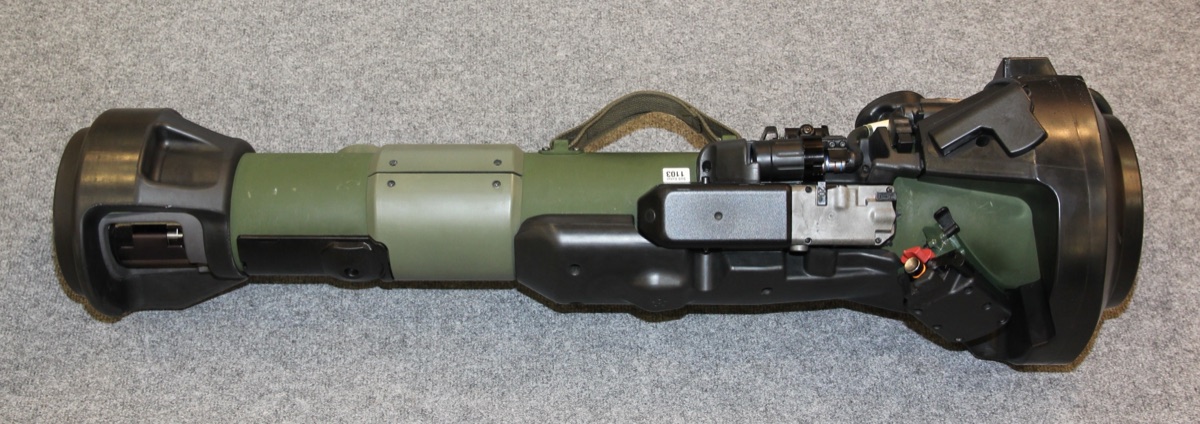
NLAW anti-tank missile system on display showing its compact launcher design
An NLAW on display, showing the compact optics and fire-and-forget launcher system. (Saab / UK MoD)

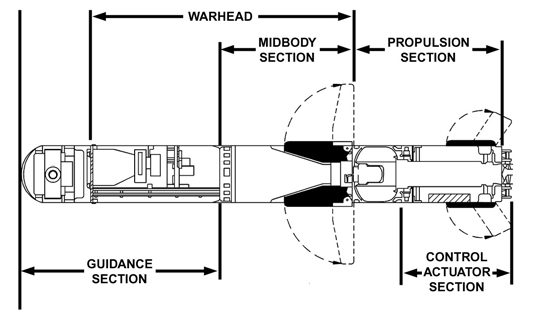
What makes the NLAW genuinely different from other anti-tank weapons is its PLOS (Predicted Line of Sight) guidance system, and understanding how PLOS works is the key to understanding why the NLAW is so effective and so difficult to counter.

Here's the sequence. The operator acquires a target, say a T-72B3 moving across an open field at 30 km/h. The operator tracks the tank through the NLAW's optic for a few seconds, keeping the crosshairs on the target. During this tracking phase, the NLAW's onboard computer is doing the critical work: it's measuring the target's angular rate of movement across the operator's field of view and calculating the target's speed, direction, and predicted future position at the moment of intercept.

When the operator fires, the missile launches and immediately flies autonomously, with no further input from the operator required. The NLAW's computer has already calculated where the target will be, and the missile flies to that predicted intercept point using inertial navigation. The operator can drop the tube and take cover the instant after firing.

This is the critical distinction. The NLAW uses no laser designator, no infrared seeker, no wire guidance, and no radar. There is nothing for the target to detect, jam, or spoof. Infrared countermeasures like the Russian Shtora system, designed to blind IR-seeking missiles, are useless against an NLAW because there's no IR seeker to blind. Laser warning receivers can't detect a laser that doesn't exist. Smoke screens deployed after launch are ineffective because the missile isn't tracking the tank. It's flying to where the tank will be. The only way to defeat PLOS guidance is to change speed or direction unpredictably after the missile is fired, and the missile's short flight time at close range makes that nearly impossible.

Top Attack: Hitting Where Armor Is Thinnest

The NLAW offers two attack modes. In OTA (Overfly Top Attack) mode, the default against armored vehicles, the missile flies approximately one meter above the target and detonates its warhead downward onto the tank's roof. The roof is the thinnest armor on any main battle tank, typically 20 to 40mm on Soviet-era designs compared to 800mm+ of composite armor on the frontal arc. A warhead that might bounce off a T-90's turret front will slice through its roof armor with ease.

In DA (Direct Attack) mode, the missile flies straight to the target, used against buildings, bunkers, fortifications, or vehicles where top attack isn't optimal. The operator selects the mode before firing based on the target type.

The combination of PLOS guidance and top attack is what makes the NLAW so lethal against modern tanks. The missile approaches from an angle the tank's heaviest armor doesn't cover, using a guidance method the tank's countermeasures can't defeat. It's an engineering solution to the problem of killing heavily armored vehicles without needing an expensive seeker head or a sustained guidance link that keeps the operator exposed.

Ukraine: Combat Proof

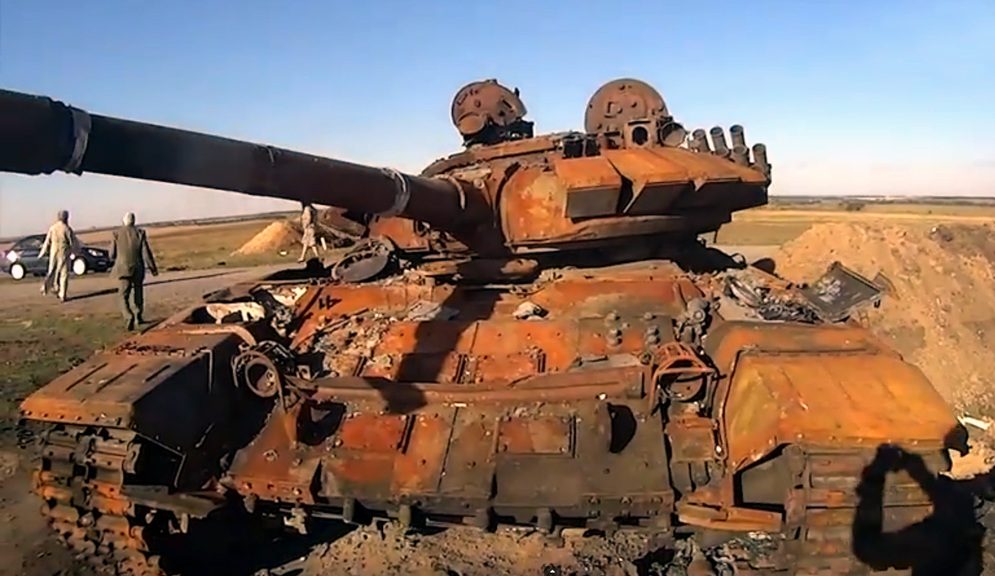
Destroyed Russian tank in Ukraine showing the effects of top-attack anti-tank weapons
A destroyed Russian tank in Ukraine. Anti-tank missiles like the NLAW devastated Russian armored columns in the early weeks of the invasion. (Ukrainian Armed Forces)

The United Kingdom began shipping NLAWs to Ukraine before the February 2022 invasion. Approximately 2,000 launchers arrived in January 2022 as part of Operation Orbital. By March 16, the UK had delivered over 4,000 NLAWs, and total deliveries eventually exceeded 10,000 units.

The timing was critical. When Russian armored columns advanced south from Belarus toward Kyiv in late February, they encountered Ukrainian infantry armed with NLAWs in forests, villages, and suburban areas along the approach routes. The terrain north of Kyiv, wooded and built-up, with narrow roads flanked by soft ground that channelized armored movement, was ideal for anti-tank ambushes. Russian tanks couldn't maneuver off-road, and NLAWs gave Ukrainian soldiers the ability to engage them at ranges where the tanks' superior firepower couldn't respond effectively.

A senior Ukrainian military officer credited the NLAW with 30 to 40 percent of Russian tank kills during the initial phase of the war. The weapon's simplicity was as important as its lethality: territorial defense volunteers with days of military training could employ NLAWs effectively, multiplying Ukraine's anti-armor capability far beyond what its professional military could have achieved alone. A squad of four soldiers carrying three or four NLAWs, at a total cost of $120,000 to $160,000, could destroy a tank platoon worth $12 to $20 million.

NLAW vs. Javelin vs. AT4 vs. RPG-7

Specification NLAW FGM-148 Javelin AT4 RPG-7
Weight 12.5 kg 22.3 kg (with CLU) 6.7 kg 7 kg (+ rounds)
Effective Range 20–800 m 75–2,500 m Up to 300 m Up to 200 m (moving)
Cost per Shot ~$40,000 ~$178,000 (missile only) ~$1,500 ~$500–2,000
Guidance PLOS (fire and forget) IR seeker (fire and forget) Unguided Unguided
Top Attack Yes (OTA mode) Yes (top-attack default) No No
Reusable No (disposable) CLU reusable, missile single-use No (disposable) Yes (launcher reusable)
Armor Penetration 500mm+ RHA (est.) 800mm+ RHA 420mm RHA 260–750mm RHA (varies by warhead)
Training Time Hours Days to weeks Minutes to hours Hours

The comparison reveals why the NLAW filled a critical gap. The Javelin is the more capable system, with longer range, better penetration, and a reusable command launch unit with a powerful thermal sight, but it costs four times as much per shot, weighs nearly twice as much, and requires significantly more training. The AT4 and RPG-7 are cheaper and lighter, but they're unguided weapons that require a direct hit on the target and can't attack the vulnerable roof armor.

FGM-148 Javelin anti-tank missile system for comparison with the NLAW
The FGM-148 Javelin, a more capable but heavier and far more expensive alternative to the NLAW. (U.S. Army)

The NLAW sits in the sweet spot: guided, fire-and-forget, top-attack capable, and cheap enough to issue in quantity. You can equip ten soldiers with NLAWs for the cost of two Javelin missiles. In a war where Ukraine needed to arm hundreds of thousands of defenders quickly, that math mattered more than any specification on a data sheet.

The Economics of Anti-Tank Warfare

The strategic implications of the NLAW go beyond any single weapon system. The fundamental question the NLAW poses is this: what happens when a $40,000 disposable tube can reliably kill a $4 million main battle tank?

The cost asymmetry is staggering. A single Russian T-90M costs approximately $4 million. The NLAW that destroys it costs $40,000, roughly one percent of the tank's value. A country can buy 100 NLAWs for the price of a single modern MBT. Even assuming a generous hit rate of one kill per four or five shots fired, the economics still overwhelmingly favor the missile. Spending $160,000 to $200,000 in NLAWs to destroy a $4 million tank is a trade any military would take every time.

This cost ratio doesn't mean tanks are obsolete. They still provide mobile protected firepower that no other platform can match. But it does mean that armored warfare has changed. Tanks can no longer advance without extensive infantry screening, electronic warfare support, and active protection systems. The days of massed armored thrusts across open ground, the kind of attack Russia attempted north of Kyiv in February 2022, are over. Not because tanks are ineffective, but because the weapons that kill them have become too cheap, too portable, and too easy to use.

The NLAW is a case study in how engineering simplicity can create strategic impact. No exotic sensors. No complex guidance link. No massive logistics tail. Just a clever prediction algorithm, a shaped-charge warhead, and the cold mathematics of cost asymmetry that make every tank commander in the world think twice before advancing without support.

Share this article

Share:

Recommended

Ace of The Skies: Can You Identify These Military Aircraft Throughout The Years?
Test Yourself

Ace of The Skies: Can You Identify These Military Aircraft Throughout The Years?

Can you identify these aircraft?

Take the Quiz

On This Day in Military History

April 2

Argentina Invades the Falkland Islands (1982)

Argentine special forces launched Operation Rosario, invading the British-held Falkland Islands with roughly 600 commandos who overwhelmed a garrison of 57 Royal Marines. The invasion sparked a 10-week war with Britain that ended in a decisive British victory, the fall of Argentina's military junta, and the reassertion of British sovereignty.

1801, Battle of Copenhagen

1865, Fall of Petersburg

1917, Wilson Asks Congress for Declaration of War

See all 7 events on April 2

Get Military News & History in Your Inbox

Join thousands of readers receiving our weekly digest of military technology, history, and analysis.

Test Your Knowledge