Charles Bash covers military culture, global defense forces, and the human side of armed services around the world. His work explores how militaries shape the lives of the men and women who serve in them.
Every revolutionary weapon started as something people said couldn't work. Engineers were told their ideas were impractical, too expensive, or simply insane. But the machines on this list prove a consistent pattern in military history: the craziest concepts almost always become standard, the only question is how long it takes. These 10 machines arrived decades before the rest of the world caught up, pioneering technologies that wouldn't become mainstream for 30, 50, or even 90 years.
10. Brennan Torpedo (1877)
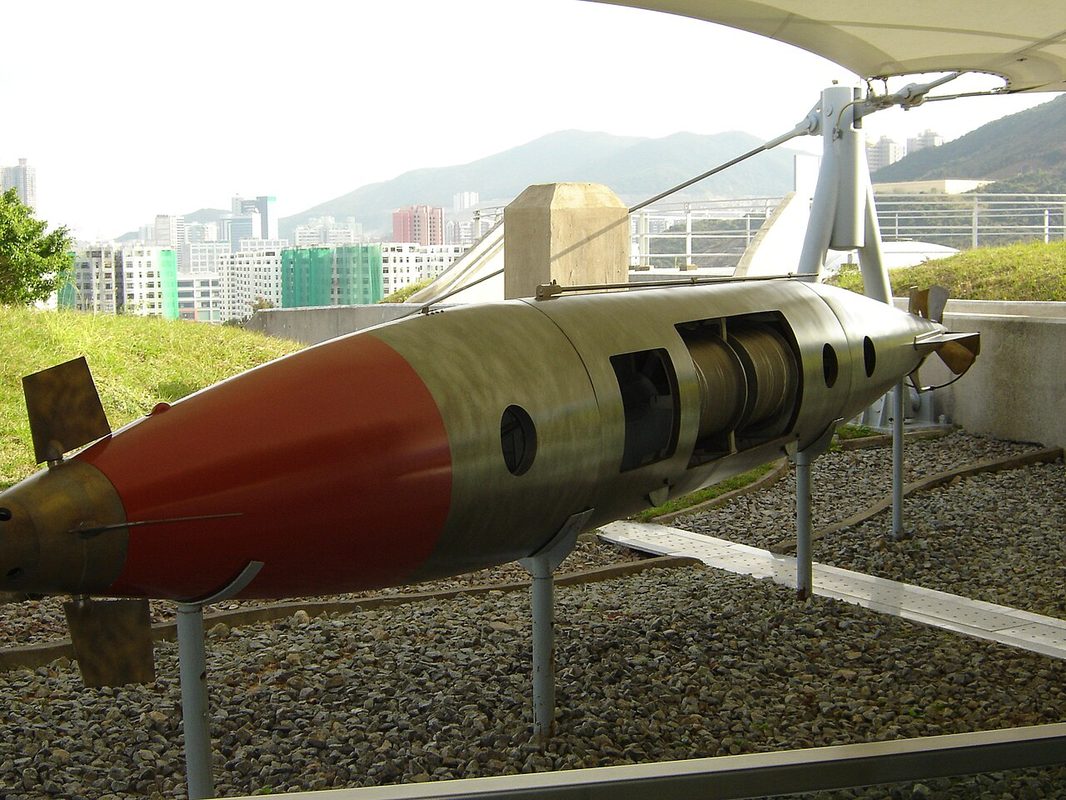
The Brennan torpedo, a wire-guided weapon invented in 1877, eight decades before the concept became standard. (Wikimedia Commons)
In 1877, Irish-Australian inventor Louis Brennan patented something that wouldn't become standard naval weaponry until the 1960s: a torpedo that an operator could steer after launch using wires. The Brennan torpedo used two counter-rotating propellers, each connected to a wire spooled from a shore station. By reeling the wires at different speeds, the operator could change the torpedo's direction in real time, steering it toward moving ships with remarkable precision for the era.
The British government was so impressed that they bought the patent for £100,000, a staggering sum in the 1880s, and deployed Brennan torpedoes at harbor defenses across the Empire, from Portsmouth to Hong Kong. The weapon was accurate, reliable, and could engage targets at ranges beyond what any fixed mine could reach.
But the concept of wire-guided torpedoes then disappeared for nearly 80 years. It wasn't until the 1960s that the U.S. Navy introduced the Mark 37 wire-guided torpedo, followed by the iconic Mark 48 in the 1970s. Modern wire-guided torpedoes use the same fundamental principle Brennan pioneered: a physical wire connection that allows mid-course correction without the electromagnetic emissions that an enemy could detect or jam. Brennan solved a problem in 1877 that the rest of the world didn't think about until the Cold War.
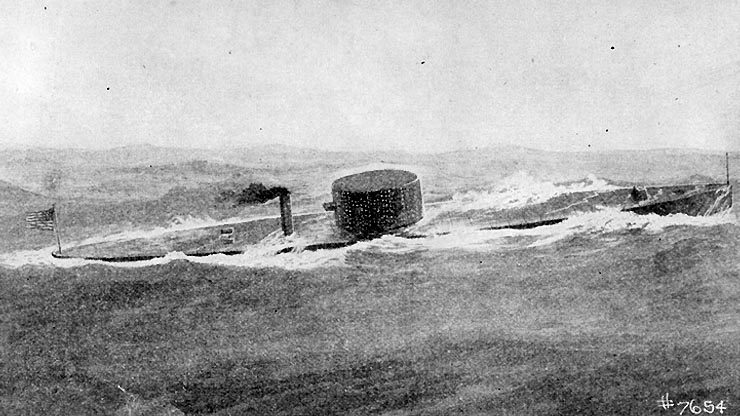
USS Monitor's revolving turret changed warship design forever. Every modern warship still uses the concept she pioneered. (Wikimedia Commons)
When the USS Monitor steamed into Hampton Roads in March 1862, she looked like nothing anyone had ever seen, a low-slung iron raft with a single rotating cylinder on deck. That cylinder was John Ericsson's revolving gun turret, and it was about to make every warship in the world obsolete overnight. Before Monitor, warships fired broadsides: you aimed the entire ship to aim your guns. Monitor could aim her two 11-inch Dahlgren guns in any direction, independently of the ship's heading.
The concept was so obviously superior that within a decade, every major navy was building turreted warships. But what's remarkable is how little the fundamental concept has changed. Walk aboard a modern Arleigh Burke-class destroyer or a Zumwalt-class stealth ship, and the main gun still sits in a revolving turret, a direct descendant of Ericsson's 1862 design. The Mk 45 5-inch gun on today's destroyers rotates on the same axis principle that Monitor introduced more than 160 years ago.
Monitor's influence extends beyond gun turrets. Her low freeboard, armored construction, and engine-driven propulsion anticipated every design trend in naval warfare for the next century. She was so far ahead that she rendered thousands of wooden warships, including the most powerful ships afloat, into museum pieces in a single afternoon.
8. Kettering Bug (1918)
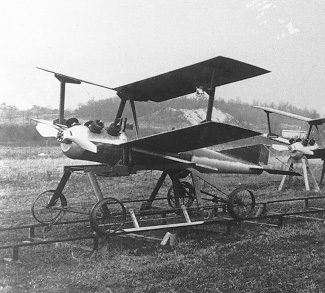
The Kettering Bug, a cardboard-and-wood "aerial torpedo" that anticipated the cruise missile by 70 years. (U.S. Air Force)
In 1918, Charles Kettering and Orville Wright designed a small biplane built from papier-mâché and cardboard that would fly a preset distance using a mechanical counter that tracked engine revolutions, then cut its engine and dive into the target. The Kettering Bug was, in every meaningful sense, the world's first cruise missile. It could carry 180 pounds of explosives up to 75 miles at 50 mph, navigating autonomously using nothing but a pre-calculated engine revolution count and a pneumatic gyroscope for stability.
The U.S. Army built about 45 Bugs before the Armistice ended World War I, and the weapon never saw combat. The concept was shelved, too unreliable for the technology of the era, and the war was over anyway. But 26 years later, Germany proved the concept worked with the V-1 flying bomb, which used almost the same approach: a preset distance counter and a gyroscope to hold course. And 73 years after the Bug, the BGM-109 Tomahawk cruise missile entered service, a weapon that does exactly what Kettering envisioned, just with GPS instead of revolution counters and a jet engine instead of a 40-horsepower Ford.
Kettering had the right idea in 1918. It just took the rest of the world seven decades to build the guidance technology that could make it reliable.
7. Soviet Teletank (1930s)
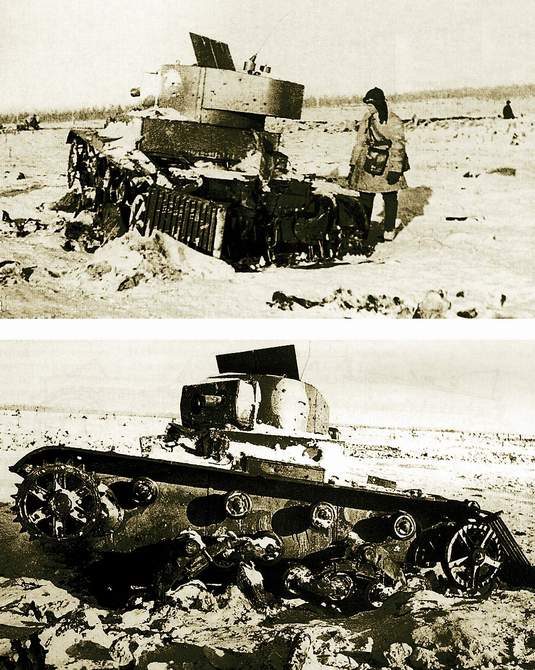
The Soviet Teletank, a radio-controlled T-26 light tank operated remotely from a command vehicle. (Wikimedia Commons)
Ninety years before the U.S. Army began fielding robotic combat vehicles, the Soviet Union was already driving tanks by remote control. The Teletank program of the 1930s converted standard T-26 light tanks into radio-controlled unmanned vehicles, operated from a paired command tank driving 500 to 1,500 meters behind. The operator could steer the Teletank, fire its machine guns, deploy smoke screens, and even release chemical weapons or flamethrowers, all without a crew inside the vehicle.
The Soviets deployed Teletanks in combat during the Winter War against Finland in 1939-40. Two battalions of radio-controlled tanks attacked Finnish fortifications on the Karelian Isthmus, using their flamethrowers and explosive charges against bunkers while their operators stayed safely behind armor. The concept worked, but the radio control technology of the 1930s was too crude: limited range, vulnerable to interference, and the operator couldn't see what the Teletank "saw", there were no cameras. They had to drive while watching from a separate vehicle.
Fast forward to today, and the concept the Soviets pioneered is everywhere. The U.S. Army's Robotic Combat Vehicle program, the Estonian THeMIS UGV, and dozens of armed ground robots operating in Ukraine all descend from the same idea: take a human out of the vehicle, control it remotely, and send it into danger instead of a crew. The Soviets had the concept right in 1935. The technology just needed 90 years to catch up.
6. Fritz X (1943)
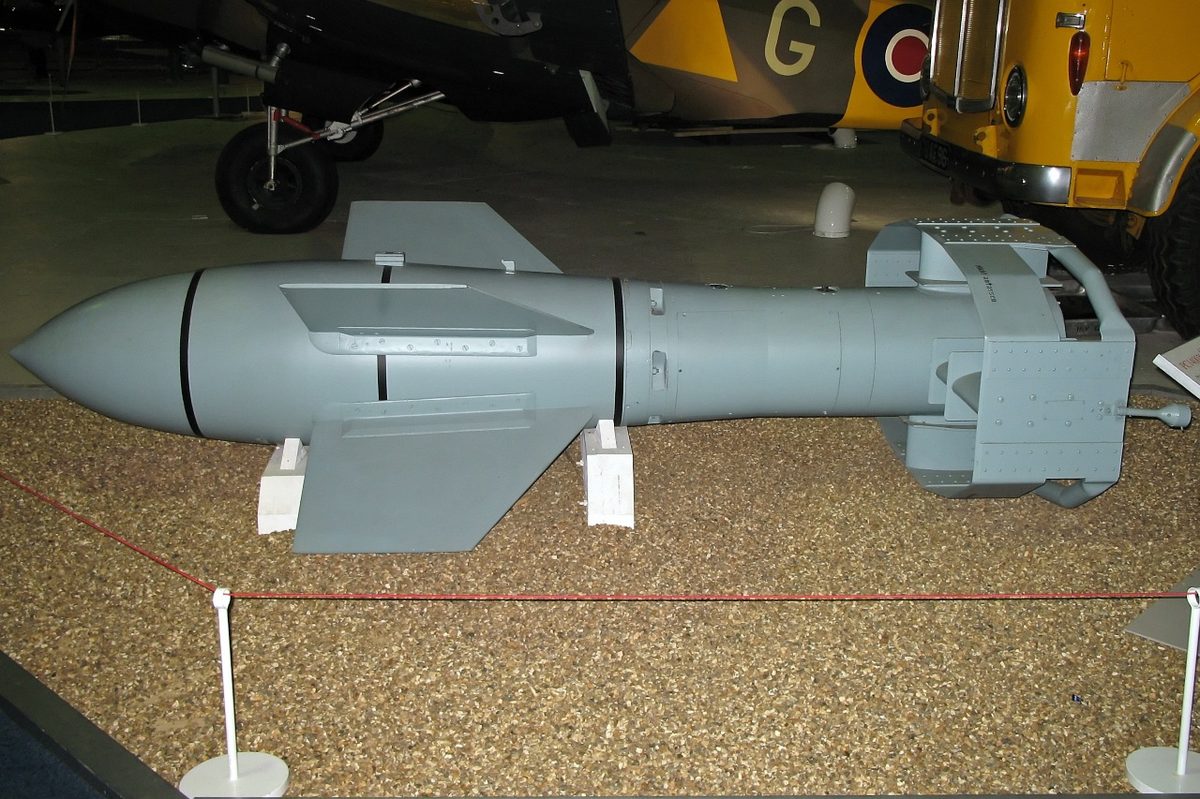
The Fritz X, history's first precision-guided bomb, which sank the Italian battleship Roma in 1943. (Wikimedia Commons)
On September 9, 1943, a Dornier Do 217 bomber dropped a 1,362-kilogram bomb on the Italian battleship Roma as she sailed to surrender to the Allies. The bomb punched through Roma's armored deck, detonated a magazine, and sank the 46,000-ton battleship in minutes, killing 1,393 sailors. The Fritz X wasn't an ordinary bomb, it was history's first precision-guided munition, steered by radio commands from the bombardier who watched it fall through a flare mounted on its tail.
The Fritz X used a Kehl-Strasbourg radio control system: the bombardier used a joystick to transmit corrections that adjusted spoilers on the bomb's tail fins, guiding it onto the target. It was crude by modern standards, but devastatingly effective against large, slow-moving targets like battleships. In addition to Roma, Fritz X bombs severely damaged the British battleship HMS Warspite and sank or damaged multiple other Allied vessels during the Italian campaign.
But precision-guided munitions then largely disappeared from warfare for nearly 50 years. The technology existed, laser-guided bombs were used in Vietnam, but PGMs didn't become the standard way of delivering ordnance until Desert Storm in 1991, when coalition aircraft demonstrated that precision bombs could destroy bridges, bunkers, and vehicles with single shots. The Fritz X proved the concept in 1943. It took until the 1990s for every air force in the world to agree that guided bombs were the future.
5. Goliath Tracked Mine (1940-44)
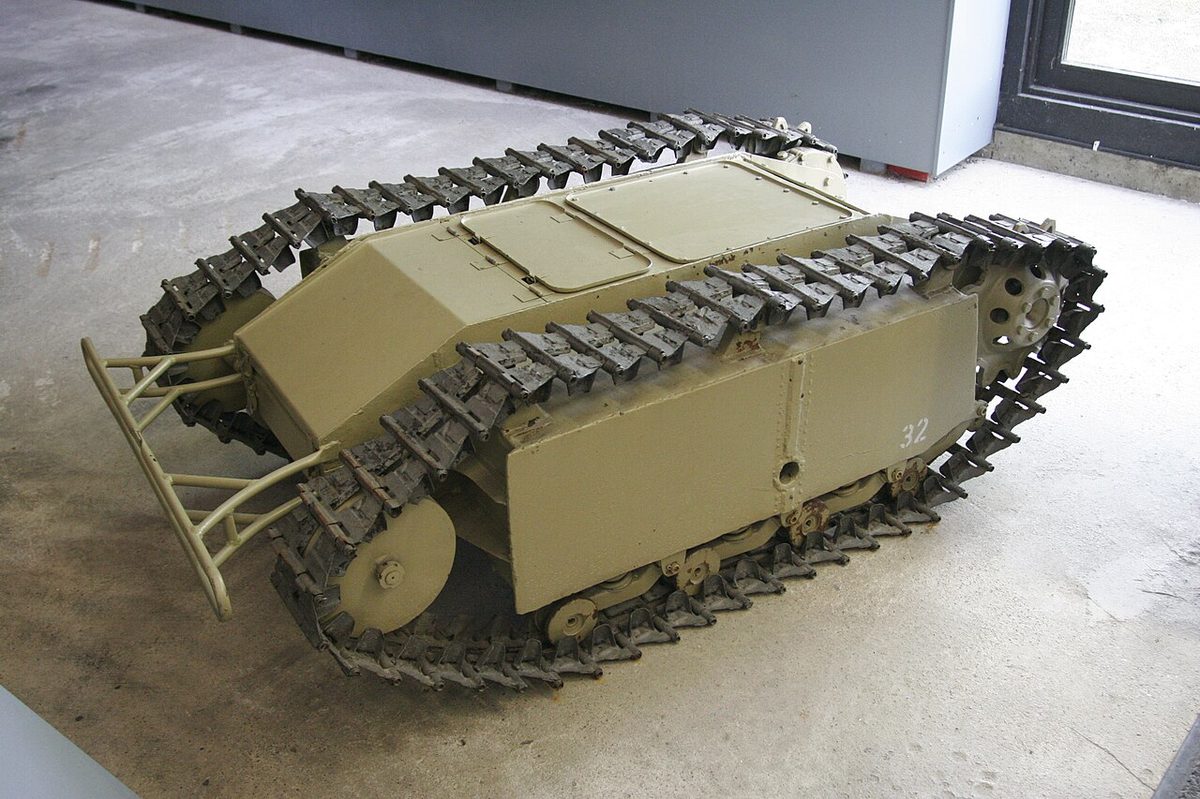
The Goliath tracked mine, a disposable, remote-controlled UGV that anticipated modern kamikaze drones by 80 years. (Wikimedia Commons)
The Goliath looks almost comical, a knee-high miniature tracked vehicle carrying 60 to 100 kilograms of explosives, steered by an operator unreeling a joystick-controlled wire up to 650 meters long. Germany built over 7,500 of them between 1942 and 1945, using them against tanks, infantry positions, bridges, and bunkers. The operator would drive the Goliath to its target and detonate it, destroying both the weapon and whatever it hit.
The concept was a remote-controlled, expendable ground vehicle that delivered an explosive payload to a target, which is exactly the concept behind today's kamikaze drones and loitering munitions. Replace the wire with a radio link and the tracks with a quadcopter frame, and the Goliath is functionally identical to the FPV kamikaze drones devastating armored vehicles in Ukraine right now. The operational logic is the same: a cheap, disposable, operator-guided weapon that trades itself for a target worth many times its cost.
The Goliath was considered a failure in its time, too slow, too expensive for a single-use weapon, and the wire was vulnerable to being cut by artillery fragments. But the core concept of a cheap, expendable, remotely controlled explosive vehicle was sound. It just needed better control technology. Eighty years later, FPV drones costing a few hundred dollars are doing exactly what the Goliath did, and they're changing the face of ground warfare.
4. Me 262 (1944)
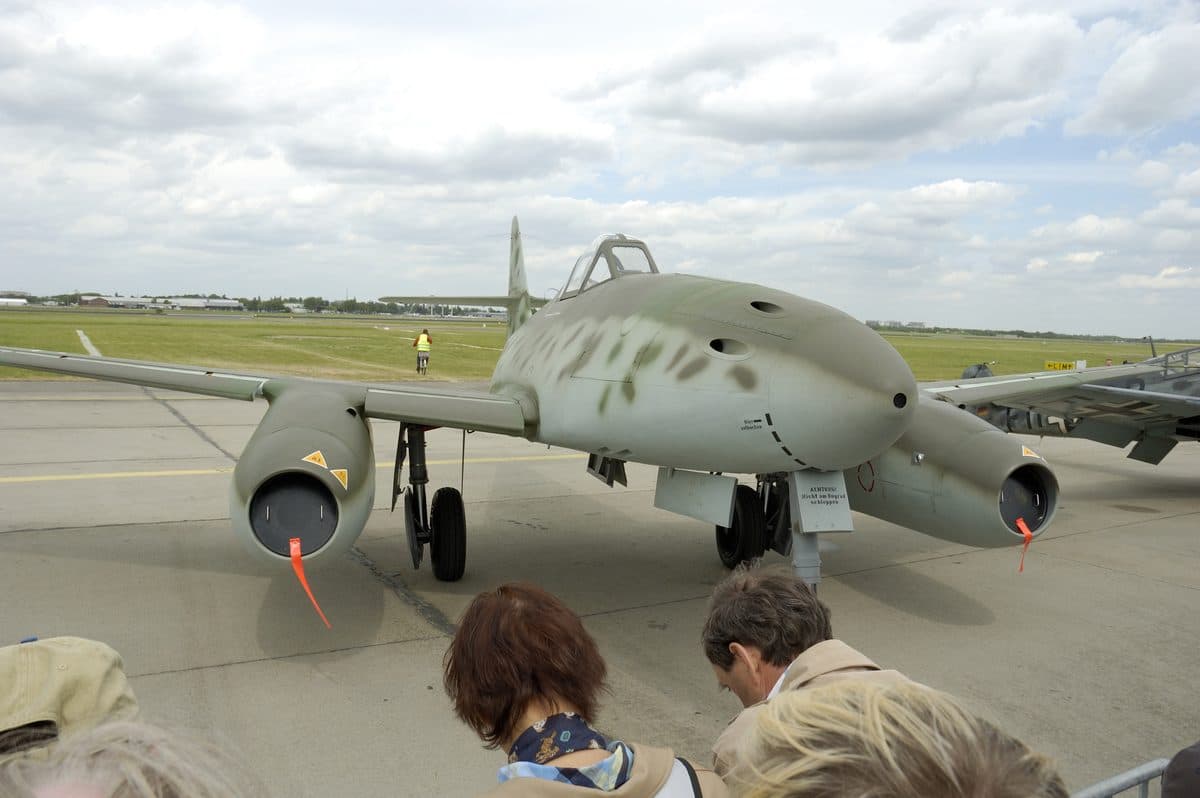
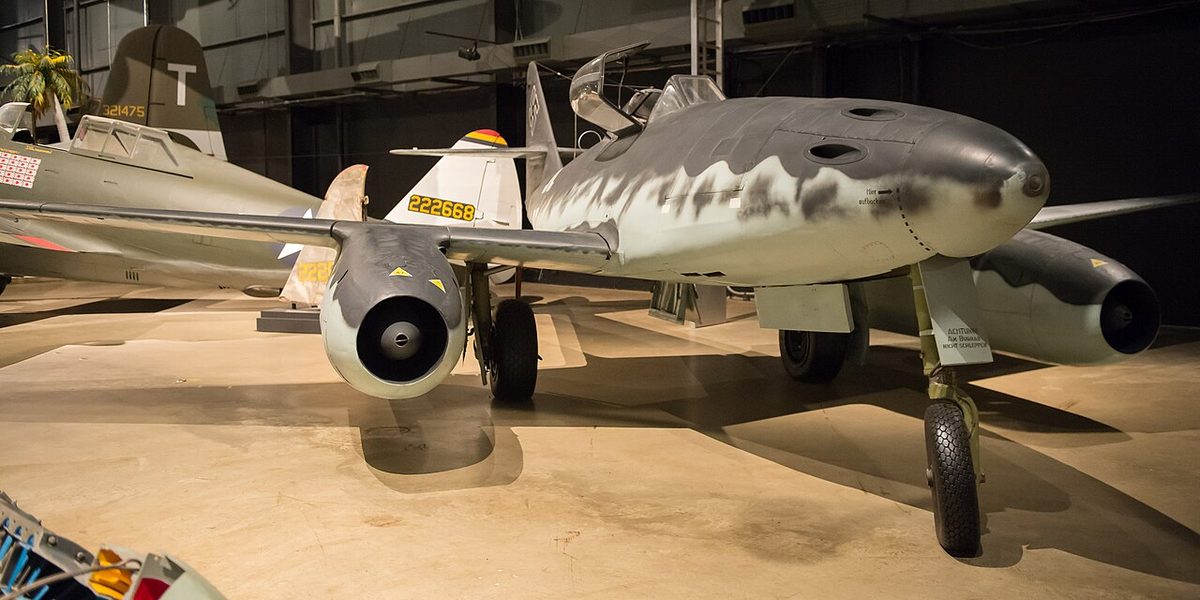
The Messerschmitt Me 262, the first operational jet fighter, which outran everything in the sky when it entered combat in 1944. (Wikimedia Commons)
The Me 262 Schwalbe wasn't just faster than every Allied fighter, it was faster by a margin that made interception nearly impossible. With a top speed of 870 km/h (541 mph), the Me 262 was roughly 150 km/h faster than the best piston-engine fighters of 1944. Allied pilots reported that attacking Me 262s was like "trying to shoot a sports car from a horse." The twin Junkers Jumo 004 turbojet engines represented a complete break from everything aviation had known since the Wright Brothers.
Germany fielded about 1,400 Me 262s before the war ended, and the aircraft proved devastatingly effective as a bomber interceptor. Armed with four 30mm MK 108 cannons and later R4M rockets, an Me 262 could shred a B-17 in a single pass. But jet engines in 1944 were fragile, the Jumo 004's turbine blades lasted only 10 to 25 hours before needing replacement, and the engines were sensitive to rapid throttle changes that could cause flameouts during combat.
The Me 262's lead time over the rest of the world was shorter than other entries on this list, the British Gloster Meteor flew combat missions in 1944 as well, and by the Korean War in 1950, jets were the standard for every major air force. But the Me 262 proved a fundamental truth: jet propulsion wasn't the future of aviation, it was the present. Within 15 years, piston-engine fighters were museum pieces, and every frontline combat aircraft in the world was jet-powered, exactly as the Me 262 predicted.
3. V-2 Rocket (1944)
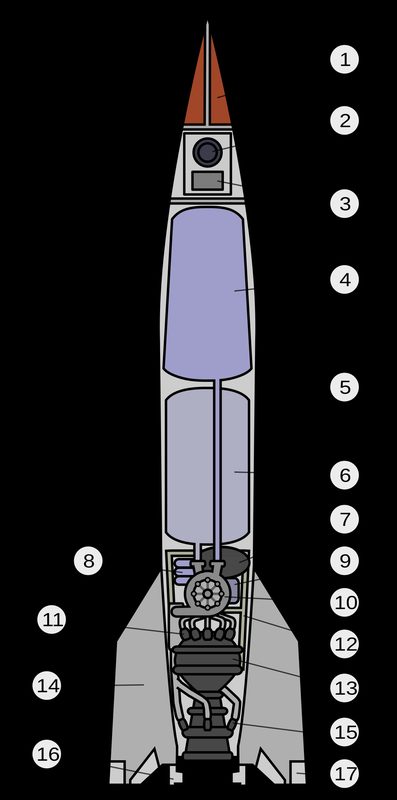
The V-2 rocket, the first object to reach space and the ancestor of every ballistic missile and space launch vehicle in existence. (U.S. Army / Wikimedia Commons)
The V-2 is the most influential weapon ever built, and it's not particularly close. Designed by Wernher von Braun's team at Peenemünde, the V-2 was the world's first long-range ballistic missile, the first man-made object to reach the boundary of space, and the direct ancestor of every rocket that followed, from the Redstone that put Alan Shepard into space to the ICBMs that still form the backbone of nuclear deterrence today.
The numbers alone were staggering for 1944. The V-2 carried a 980-kilogram warhead to a range of 320 kilometers, reaching an altitude of 88 kilometers and a speed of 5,760 km/h, roughly five times the speed of sound. There was no defense against it. Unlike the V-1, which could be intercepted by fighters or anti-aircraft guns, the V-2 arrived faster than the speed of sound. You heard the explosion before you heard the rocket coming. Between September 1944 and March 1945, Germany launched over 3,000 V-2s against London, Antwerp, and other targets.
After the war, both the United States and the Soviet Union scrambled to capture V-2 technology and the engineers who built it. The entire Cold War missile race, Atlas, Titan, R-7, Minuteman, grew directly from V-2 technology. NASA's Saturn V, which put humans on the moon, was designed by the same man who designed the V-2. The foundational technology of ballistic missiles, space launch, and rocket propulsion all trace back to a single weapon from 1944.
2. Horten Ho 229 (1945)
When Northrop Grumman unveiled the B-2 Spirit stealth bomber in 1988, aviation historians immediately noticed something: it looked almost identical to an aircraft the Horten brothers had designed in Germany 43 years earlier. The Horten Ho 229 was a jet-powered flying wing, no fuselage, no tail, just a swept wing with two Junkers Jumo 004 engines buried inside it. The design offered inherently low radar signature because a flying wing has fewer surfaces to reflect radar energy than a conventional aircraft.
Whether the Horten brothers intentionally designed for radar stealth is debated. What's not debated is that the Ho 229's shape produced a dramatically smaller radar cross-section than any contemporary aircraft. Northrop Grumman tested a full-scale reproduction of the Ho 229 in 2008 and confirmed that the design would have been significantly harder to detect on British Chain Home radar than conventional German bombers, potentially reducing detection range by 20% or more.
The Ho 229 flew only as a prototype. The sole surviving airframe sits in the Smithsonian's Udvar-Hazy Center, unrestored, a monument to an idea that was 45 years too early. The flying wing concept the Horten brothers pioneered didn't become operational until the B-2 Spirit entered service in 1997, a $2 billion aircraft that uses the same fundamental planform as a wooden prototype built in a German workshop in the final months of World War II.
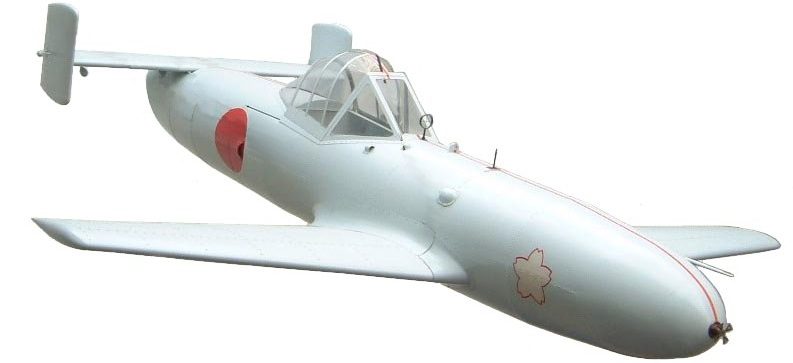
The Yokosuka MXY-7 Ohka, a rocket-powered, purpose-built anti-ship weapon that anticipated the modern anti-ship missile by decades. (U.S. Navy / Wikimedia Commons)
The Ohka is the most uncomfortable entry on this list, because it was piloted, a fact that has understandably dominated its historical legacy. But strip away the human element and look purely at the engineering: the Ohka was a rocket-powered, purpose-built anti-ship weapon designed to approach at high speed from altitude, dive on a warship, and destroy it with a 1,200-kilogram warhead. Functionally, it was an anti-ship missile, one that used a human being as its guidance system because the electronics of 1945 couldn't do the job.
The Ohka's three solid-fuel rocket motors pushed it to speeds exceeding 900 km/h in its terminal dive, faster than any Allied fighter could follow and too fast for anti-aircraft guns to reliably track. It was carried to within range by a twin-engine G4M "Betty" bomber, released at altitude, and then accelerated toward the target. The concept was identical to what the French Exocet, the Chinese YJ-18, or the Russian P-800 Oniks does today: a fast, sea-skimming or diving weapon designed to overwhelm a warship's defenses through speed.
The Ohka proved that a small, fast, purpose-built anti-ship weapon could threaten even heavily defended warships, a lesson that the anti-ship missile industry would rediscover 30 to 40 years later. The modern anti-ship missile does everything the Ohka did, just without requiring a human pilot. The technology the Ohka lacked, terminal radar homing, inertial guidance, GPS, eventually replaced the pilot, but the tactical concept was proven in 1945.
The Pattern Is Always the Same
Look at this list and a clear pattern emerges. The Brennan torpedo, the Kettering Bug, the Teletank, the Goliath, the Fritz X, every one of them was technically sound but limited by the electronics, communications, and materials of its era. The concepts were right. The execution had to wait for technology to catch up.
That pattern hasn't stopped. Somewhere right now, an engineer is designing a weapon system that seems impractical, too expensive, or ahead of its time. History says they're probably right about the concept, and the rest of the world will spend the next 30 to 50 years proving it.