Michael Trent covers military aircraft, weapons systems, and defense technology with an emphasis on cost, maintenance, and real-world performance. He focuses less on specifications and more on how systems hold up once they are deployed, maintained, and operated at scale.
There is no aircraft in the United States Air Force inventory with a more paradoxical existence than the A-10 Thunderbolt II. It has flown combat sorties in every American conflict since 1991, Desert Storm, Bosnia, Kosovo, Afghanistan, Iraq, and the campaign against ISIS. It has destroyed more enemy armor than any other platform in the post-Vietnam era. It has brought pilots home with catastrophic battle damage that would have killed any other airframe. Ground troops call it by name when they need close air support, and have testified before Congress to keep it flying.
And yet the Air Force has tried to kill it, not once, not twice, but repeatedly across three decades. The service that flies the A-10 has spent more institutional energy trying to retire it than most nations spend developing new aircraft.
That tension, between the plane's combat record and the bureaucracy that wants it gone, is the defining story of the Warthog. It is also a story about what happens when a weapon system does one thing so well that no replacement can match it, and no amount of PowerPoint slides can make that fact disappear.
Desert Storm: The War That Proved Everything
When Iraq invaded Kuwait in August 1990, the A-10 was already a decade old and already facing its first round of institutional skepticism. The Air Force had always been ambivalent about the close air support mission, preferring fast, high-altitude strike platforms to the slow, low-flying attack aircraft that the Army wanted overhead. The A-10 was built for a mission the Air Force didn't particularly want to own.
A-10 Warthogs flew more than 8,100 combat sorties during the Gulf War, more than any other aircraft type in the coalition. They destroyed 987 tanks, 926 artillery pieces, and 1,355 combat vehicles, staggering numbers that accounted for a disproportionate share of Iraqi ground force attrition. The A-10 fired 90 percent of all AGM-65 Maverick missiles employed during the conflict, proving that precision-guided munitions and the gun weren't mutually exclusive.
On February 25, 1991, two A-10s operating together destroyed 23 Iraqi tanks in a single day. In a war defined by precision strike video from F-117s and Tomahawk missiles, the Warthog was quietly dismantling Saddam Hussein's armored divisions at a rate nothing else could match.
The A-10 also scored air-to-air kills, two Iraqi helicopters shot down by Warthog pilots using the GAU-8 cannon. It was a footnote in the broader air war, but a telling one: the aircraft designed exclusively for ground attack was versatile enough to shoot down aircraft when the situation demanded it.
Every Conflict, Every Time
After Desert Storm, the A-10's combat deployments never stopped. When the United States enforced the no-fly zone over southern Iraq from 1992 to 2003 under Operation Southern Watch, A-10s were part of the rotation. They patrolled Iraqi airspace for over a decade, responding to provocations and maintaining the coalition's stranglehold on Saddam's remaining military capability.
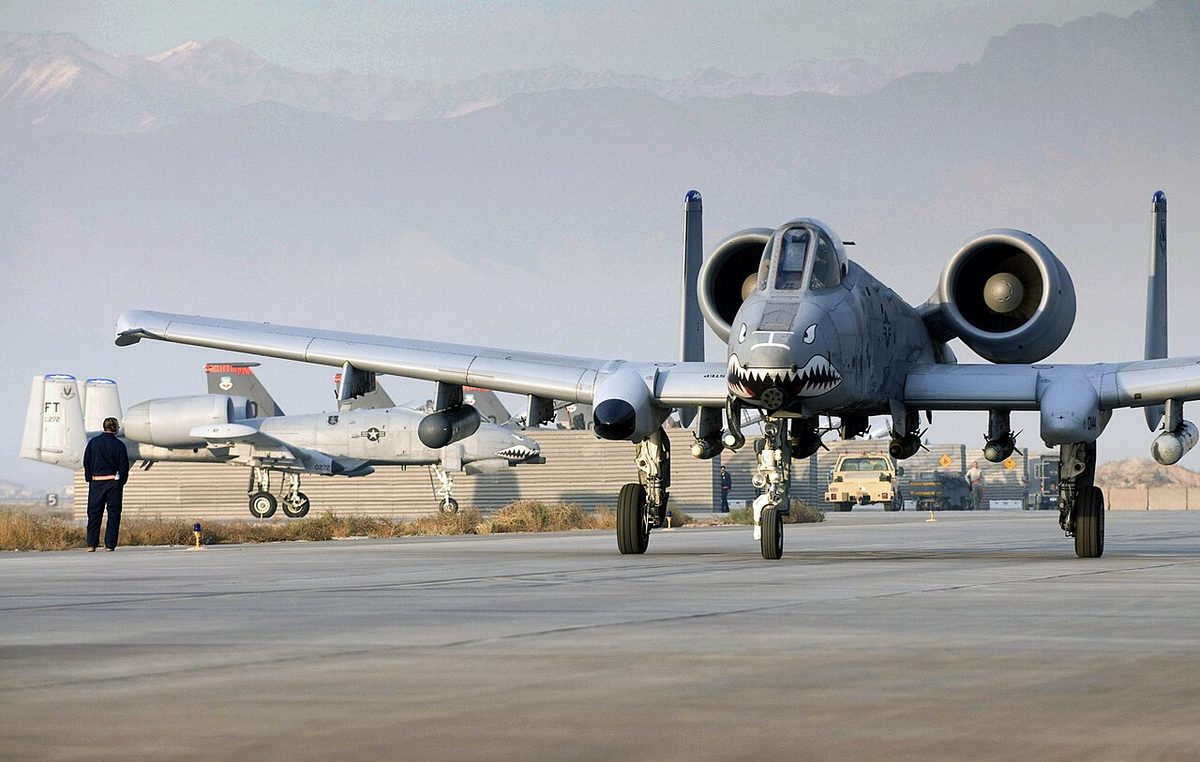
A-10s on the flightline, ready for tasking. The aircraft's high sortie rate and rapid turnaround time make it a workhorse during sustained combat operations.
In 1995, during Operation Deliberate Force in Bosnia, A-10s provided close air support against Serbian forces shelling civilian populations. In 1999, they returned to the Balkans for Operation Allied Force over Kosovo, flying low-altitude attack missions against Serbian armor and artillery in terrain that made precision bombing from high altitude extremely difficult. The mountainous, forested landscape of the former Yugoslavia was exactly the kind of environment the A-10 was built for, close to the ground, slow enough to identify targets visually, and tough enough to absorb the ground fire that came with operating in the weeds.
When the United States invaded Afghanistan after September 11, A-10s deployed to Bagram and Kandahar and stayed for nearly two decades. In a counterinsurgency war where the enemy wore no uniforms and hid among civilians, the A-10's ability to loiter over a target area for extended periods, visually identify threats, and deliver proportional firepower made it the most requested close air support platform among ground commanders. Special operations teams working in remote valleys came to rely on the Warthog's distinctive sound, the low rumble of those TF34 turbofans followed by the unmistakable buzz of the cannon, as a guarantee that help was overhead.
Operation Iraqi Freedom in 2003 brought the A-10 back to the desert where it had first proven itself. During the initial invasion and the long counterinsurgency that followed, the Warthog flew thousands of CAS sorties. And when ISIS swept across Syria and Iraq in 2014, the A-10 deployed again under Operation Inherent Resolve, striking targets in an urban warfare environment where precision and persistence mattered more than speed.
Seven major operations across thirty years. No other aircraft in the Air Force fleet can claim that kind of sustained combat employment in the specific mission it was designed to perform.
The Retirement Attempts: A Bureaucratic War of Attrition
The first serious effort to retire the A-10 came in the early 1990s, almost immediately after Desert Storm. The logic was circular in a way that would become familiar: the Cold War was over, the Soviet tank threat the A-10 was designed to counter had evaporated, and multirole fighters like the F-16 could handle whatever close air support missions remained. The fact that the A-10 had just demonstrated its combat value more dramatically than any platform in the war seemed not to register.
That effort fizzled, but the institutional pressure never went away. In fiscal year 2015, the Air Force made its most aggressive push yet, proposing to retire the entire A-10 fleet as a cost-saving measure to fund the F-35 Joint Strike Fighter. The argument was familiar: the F-35 would eventually assume the CAS mission, and the A-10 was too old, too slow, and too specialized to justify in a modern force structure. The savings from retiring the Warthog would help pay for the next-generation fighter the Air Force actually wanted.
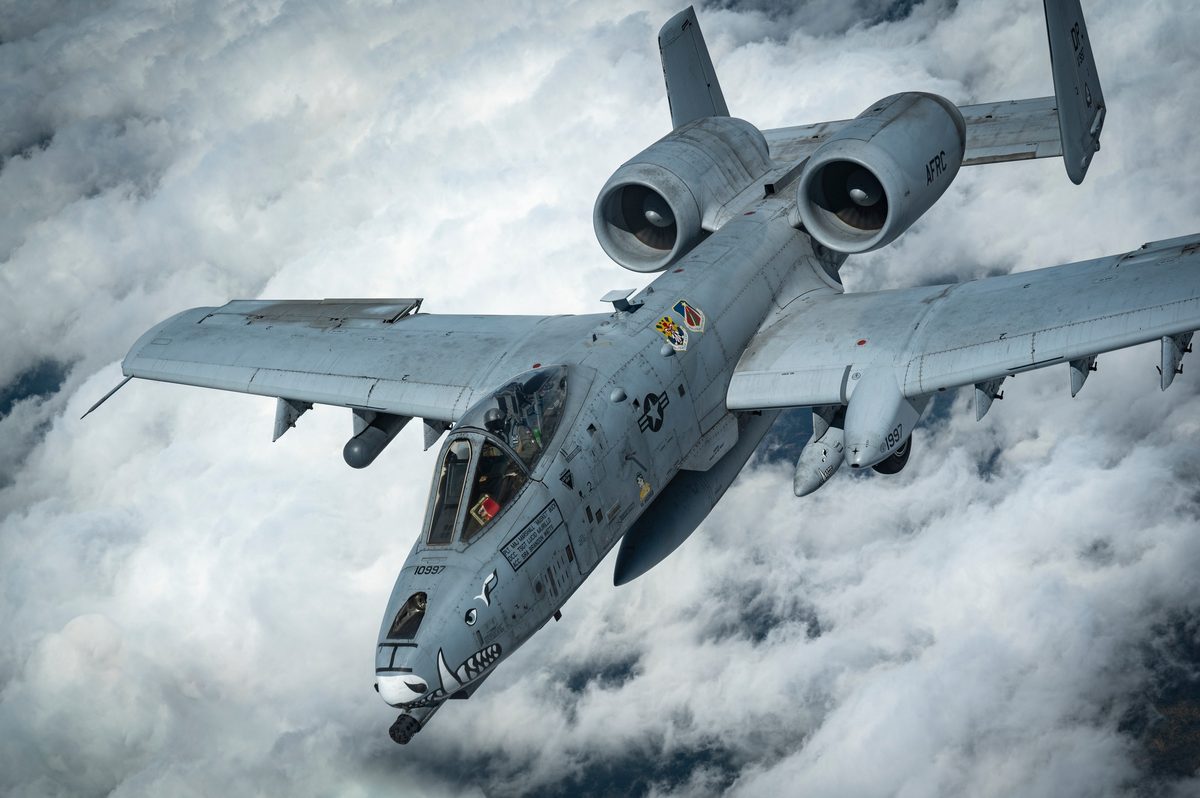
An A-10 takes on fuel during a mission. Aerial refueling extends the Warthog's already impressive loiter time, allowing it to remain on station for hours in support of ground forces.
Congress blocked the retirement. The deciding factor, repeatedly cited by members of both parties, was testimony from ground troops, Army soldiers, Marines, and special operators who had called in A-10 strikes and watched the aircraft save lives in situations where nothing else could have responded the same way. When a sergeant from the 75th Ranger Regiment tells a Senate Armed Services Committee hearing that the A-10 is the difference between his team coming home and not coming home, that carries weight that no Air Force budget briefing can overcome.
The Air Force tried again in fiscal year 2023, and this time achieved partial success. Congress authorized phased retirements, allowing the service to begin drawing down the fleet. But even then, lawmakers imposed conditions and floors. In fiscal year 2026, when the Air Force proposed retiring all 162 remaining A-10s, Congress pushed back again, blocking the retirement of 102 aircraft and setting a minimum fleet floor of 103 Warthogs. The Air Force could thin the herd, but it could not kill the plane.
The pattern has held for three decades: the Air Force proposes retirement, ground forces push back, Congress listens to the people who have actually been in combat with the A-10, and the fleet survives. It is a remarkable testament to an aircraft's combat reputation that its continued existence depends not on the service that flies it, but on the services it supports.
1,200 Pounds of Titanium and One Extraordinary Pilot
The A-10's survivability is not an accident. Fairchild Republic designed the aircraft around a simple premise: it was going to get hit, and it needed to keep flying anyway. The result is the most physically resilient tactical aircraft ever built.
The centerpiece of that design philosophy is the titanium "bathtub," a 1,200-pound enclosure of titanium armor plating, between half an inch and an inch and a half thick, that surrounds the cockpit and critical flight systems. That tub can absorb direct hits from 23mm cannon fire and fragments from 57mm anti-aircraft shells. In practical terms, it means that ground fire capable of downing any other aircraft in the inventory bounces off the A-10's belly.
The aircraft's redundancy goes beyond armor. It has dual engines mounted high on the rear fuselage, separated and shielded from each other so that damage to one doesn't cascade to the other. It has dual hydraulic flight control systems with a manual reversion mode, a backup system of cables and mechanical linkages that allows the pilot to fly the aircraft with no hydraulic pressure at all. The landing gear is designed to extend by gravity if hydraulic power fails. The fuel tanks are self-sealing and filled with reticulated polyurethane foam to suppress explosions.
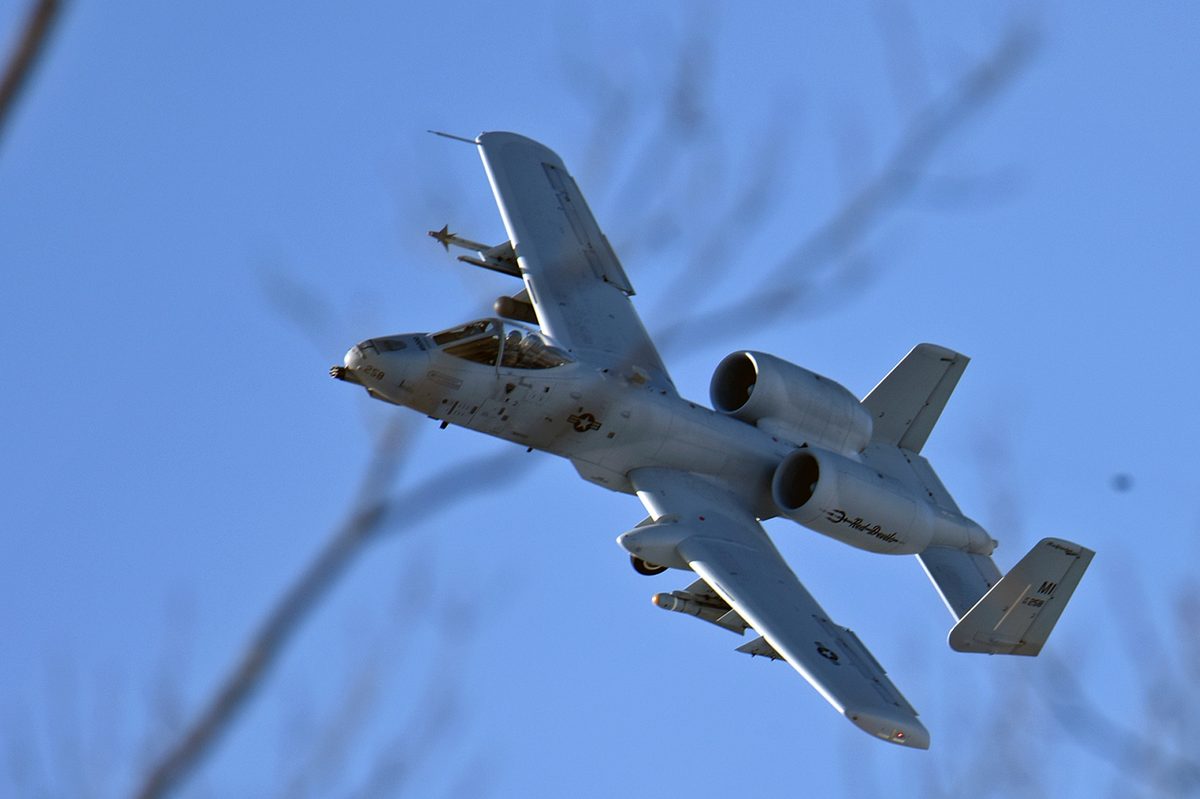
An A-10 at dawn. Many CAS missions launch at first light, when ground troops transitioning from night operations are most vulnerable to enemy counterattack.
On April 7, 2003, Captain Kim Campbell proved every one of those design decisions correct over Baghdad. Flying a close air support mission during the initial invasion of Iraq, Campbell's A-10 was hit by a barrage of anti-aircraft artillery. The damage was severe: one engine was hit, and the aircraft's entire hydraulic system was destroyed. In any other tactical jet, the pilot would have ejected immediately, without hydraulics, modern fly-by-wire aircraft are unflyable.
But the A-10 is not a modern fly-by-wire aircraft. Campbell switched to manual reversion. The mechanical backup system that connects the control stick directly to the flight surfaces through cables and cranks. She flew the crippled Warthog for over an hour, nursing it back to a coalition air base, and landed safely on a battle-damaged aircraft that by any reasonable standard should not have been flyable. She received the Distinguished Flying Cross for what remains one of the most remarkable demonstrations of pilot skill and aircraft durability in modern combat aviation.
Campbell's flight is the A-10 story distilled to its essence: an aircraft designed to survive punishment that would destroy anything else, flown by a pilot who trusted the machine enough to stay in it when every instinct said to punch out.
The Gun That Built the Airplane
Most aircraft carry weapons. The A-10 was built around one.
The GAU-8/A Avenger is a 30mm, seven-barrel rotary cannon that fires at 3,900 rounds per minute. The aircraft carries 1,350 rounds of ammunition, primarily armor-piercing incendiary rounds built around a depleted uranium penetrator. When the trigger is pulled, the GAU-8 produces approximately 10,000 pounds of recoil force. A figure that is not academic. Each of the A-10's two TF34-GE-100 turbofan engines produces 9,065 pounds of thrust. The cannon's recoil force exceeds the thrust of each individual engine. If the gun were fired continuously, it would theoretically slow the aircraft in flight.
The entire aircraft was designed around this weapon. The nose landing gear is offset to the right of the aircraft centerline because the cannon occupies the center. The engines are mounted high and aft partially because the gun's exhaust gases, laden with depleted uranium particulates, needed to be kept away from the engine intakes. The A-10 is, in a very literal sense, a flying gun with wings attached.
Against armored vehicles, the GAU-8's depleted uranium rounds penetrate steel plating that would defeat conventional ammunition. Against soft targets (trucks, artillery pieces, bunkers, defensive positions) the effect is devastating at ranges where the pilot can visually confirm what they're shooting at. That last point matters enormously. In a close air support mission, positive target identification is the difference between protecting friendly forces and committing fratricide. The A-10 operates at altitudes and speeds where the pilot can see the target with the naked eye. That is not a limitation. It is the entire point.
What Nothing Else Can Do
The Air Force's argument for retiring the A-10 has always rested on the claim that other platforms can perform the CAS mission. The F-16, the F-35, and the B-1B have all been proposed as replacements. Each of those aircraft can deliver precision-guided munitions to a ground coordinate. None of them can do what the A-10 does.
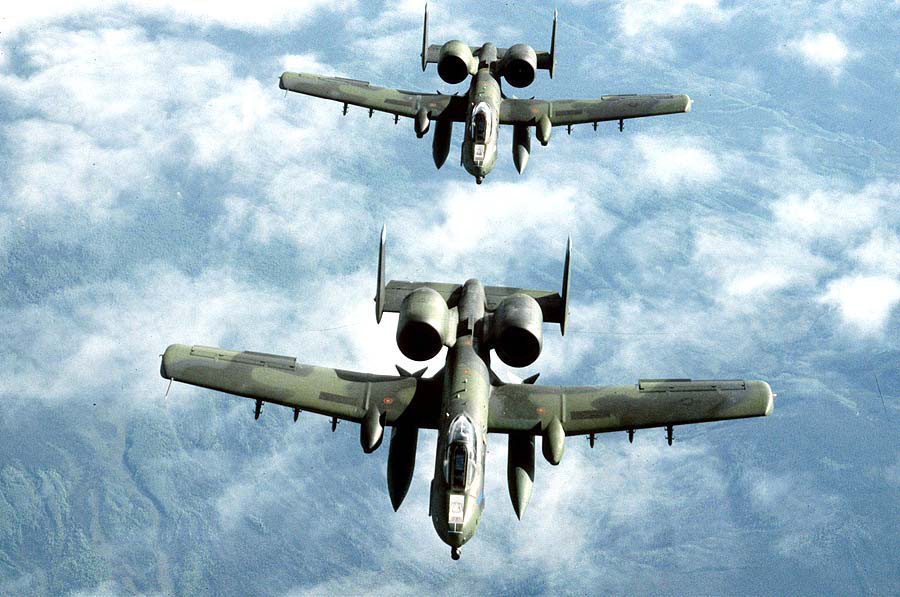
The A-10's straight wing and low wing loading give it exceptional low-speed maneuverability and the ability to operate from short, austere airstrips close to the front lines.
The A-10 can loiter over a target area for hours, not minutes. Its fuel-efficient turbofan engines and large internal fuel capacity give it an endurance that fast-moving fighters cannot match. When a ground unit is in sustained contact with the enemy and needs persistent overhead coverage, the A-10 stays. An F-16 arrives, drops ordnance, and leaves for the tanker. The Warthog is still circling when the F-16 comes back.
The A-10 can operate from austere forward airfields, short, unimproved runways close to the front lines that would be unusable by any fast jet in the inventory. Its straight wing design gives it the low-speed handling characteristics to land and take off from strips that fighters would overshoot. In a distributed operations environment, where bases may be under threat and logistics chains stretched thin, the ability to operate from a highway or a compacted dirt strip is not a relic of Cold War thinking. It is exactly the kind of capability that modern operational concepts demand.
The A-10 can survive ground fire that would down a single-engine fighter. An F-35 hit by a 23mm round in the engine or fuselage is coming home in pieces, if it comes home at all. An A-10 absorbs that hit and keeps flying. That is not theoretical. It is what Kim Campbell demonstrated over Baghdad, what dozens of other pilots have demonstrated in lesser-known incidents across every deployment the Warthog has flown.
And the A-10 can deliver the gun. No other platform in the inventory carries anything like the GAU-8, and no precision-guided munition can replicate the psychological and tactical effect of a sustained cannon run on an enemy position. Ground troops know the difference, which is why they keep testifying.
The Question That Won't Go Away
Today, approximately 270 A-10s remain in the Air Force inventory, drawn from the 716 originally built between 1972 and 1984. Congress has set a floor of 103 aircraft for fiscal year 2026, a number that ensures the Warthog community survives but acknowledges that the fleet is shrinking. Many of the remaining aircraft have been re-winged under the A-10 Thunderbolt Enhanced Wing Assembly program, extending their structural life by thousands of flight hours. They are old, but they are not worn out.
The fundamental tension remains unresolved. The Air Force wants to invest in platforms designed for great power competition, F-35s, B-21 Raiders, collaborative combat aircraft, and autonomous systems that can penetrate integrated air defense networks in a fight against China or Russia. The A-10 was not designed for that war, and the service argues, with some legitimacy, that every dollar spent maintaining Warthogs is a dollar not spent on the future force.
But the A-10's combat record makes a counterargument that budget slides cannot answer. The United States has fought seven distinct air campaigns since 1991. The A-10 flew in all of them. The F-35, the aircraft the Air Force wants to replace it with, has yet to demonstrate the same sustained close air support capability in a contested environment. The Warthog's advocates in Congress and on the ground do not argue that the A-10 should fly forever. They argue that you do not retire the most combat-proven aircraft in your inventory until you have something that can actually replace what it does.
No one has produced that replacement yet. And until someone does, the ugliest, slowest, most battle-scarred aircraft in the United States Air Force will keep doing what it has done since 1991: answering the call, taking the hits, and surviving, in combat and in the Pentagon's budget wars alike.