Skip to content
May 3:British Recapture of Rangoon: The Burma Campaign Ends81yr ago

How Aircraft Carriers Launch and Recover Jets

Michael Trent · · 14 min read
Save
Share:
Fighter jet launching from an aircraft carrier catapult with steam visible on the flight deck
Michael Trent
Michael Trent

Defense Systems Analyst

Michael Trent covers military aircraft, weapons systems, and defense technology with an emphasis on cost, maintenance, and real-world performance. He focuses less on specifications and more on how systems hold up once they are deployed, maintained, and operated at scale.

An aircraft carrier's flight deck is the most dangerous workplace on earth. On a space smaller than many high school running tracks, dozens of aircraft are simultaneously fueled, armed, launched, recovered, taxied, and parked, all while jet engines blast at full afterburner power, arresting cables snap taut with the force to stop a freight train, and catapult shuttle returns slam back to the starting position at violent speeds. Every cycle, every launch and recovery, is a precisely choreographed act of engineering, physics, and human coordination that would seem impossible if it weren't happening hundreds of times a day on carriers around the world. Understanding how it works reveals one of the most remarkable feats of engineering in military history.

The Catapult: Zero to 170 in Two Seconds

A modern carrier-based fighter like the F/A-18E Super Hornet weighs approximately 48,000 pounds when loaded for a combat mission. The aircraft's engines, even at full afterburner, cannot accelerate it to flying speed in the 300 feet of flight deck available for takeoff. A conventional runway takeoff requires 4,000 feet or more. The solution is the catapult, a machine that supplements the aircraft's engines with enough additional energy to achieve flying speed in approximately 300 feet and two seconds.

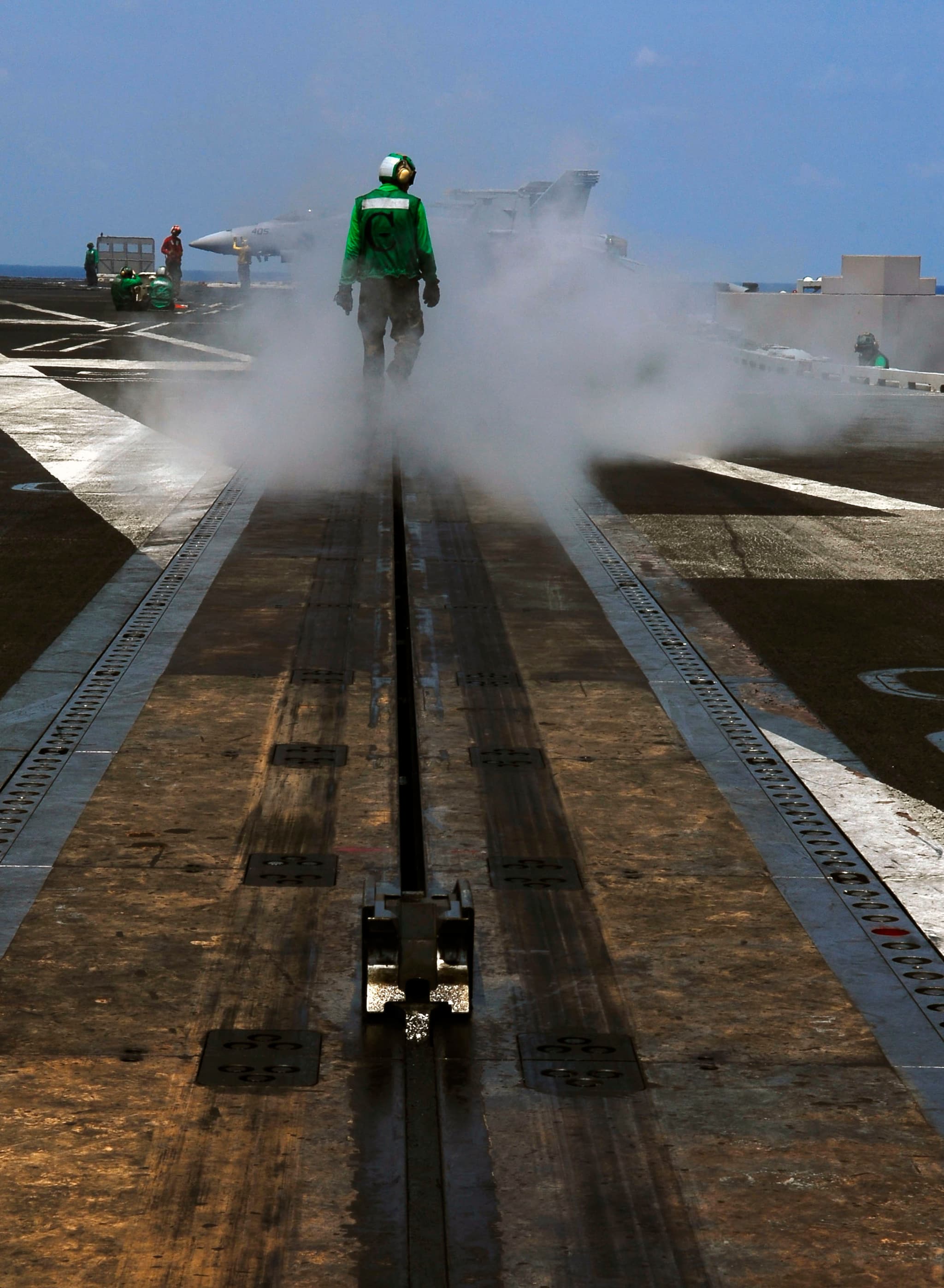
The Nimitz-class carriers use C13-2 steam catapults. These are essentially giant steam-powered pistons. Steam from the ship's nuclear reactor, at approximately 520 psi, is stored in accumulator tanks below the flight deck. When the catapult fires, valves open and the steam drives a pair of pistons along a track that runs the length of the catapult stroke (approximately 310 feet). The pistons are connected to a shuttle, a metal fixture that protrudes through a slot in the flight deck surface. The aircraft's nose gear is attached to the shuttle via a launch bar.

The catapult must be precisely calibrated for each launch. Too much energy and the aircraft will be accelerated beyond structural limits, or worse, the sudden deceleration at end-of-stroke will damage the aircraft. Too little energy and the aircraft will leave the deck below flying speed, potentially settling into the water ahead of the carrier. The catapult officer, known as the "shooter," calculates the steam pressure required based on the aircraft's type, weight, and the wind conditions over the deck. The ship's captain typically turns the carrier into the wind for launch operations, adding 20-30 knots of effective wind speed over the deck that reduces the catapult energy required.

The launch sequence is rapid and violent. The aircraft runs up to full power (or military power, depending on the aircraft type and launch weight) while held in place by a holdback bar, a frangible fitting designed to break at a specific tension. When the catapult fires, the holdback bar breaks, and the aircraft accelerates from zero to approximately 170 mph in about two seconds. The pilot experiences approximately 3-4 G of acceleration, the equivalent of being rear-ended by a truck while sitting in a stationary car. At end-of-stroke, the shuttle disconnects and the aircraft flies off the bow of the carrier.

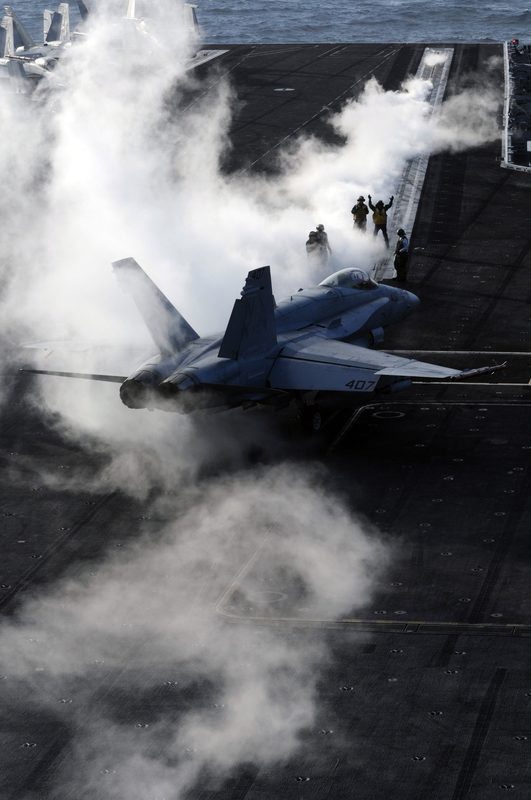
F/A-18 Hornet launching from an aircraft carrier with steam rising from the catapult track
An F/A-18 Hornet launches from a Nimitz-class carrier, with steam from the C13-2 catapult visible along the flight deck. U.S. Navy photo.

EMALS: The Electromagnetic Revolution

The USS Gerald R. Ford (CVN-78), the lead ship of America's newest carrier class, replaces steam catapults with the Electromagnetic Aircraft Launch System (EMALS). EMALS uses a linear induction motor (essentially a flattened electric motor that produces linear force instead of rotational force) to accelerate the shuttle along the catapult track.

EMALS offers several advantages over steam catapults. The electromagnetic system can precisely control the energy delivered throughout the stroke, providing a smoother, more consistent acceleration profile that reduces stress on the aircraft. Steam catapults deliver a sharp initial impulse followed by declining force, whereas EMALS can maintain constant force or even increase it as the shuttle accelerates, optimizing the energy transfer. This precision means EMALS can launch lighter aircraft (like unmanned drones) that would be damaged by the abrupt impulse of a steam catapult, as well as heavier aircraft that need more end-of-stroke energy.

EMALS also eliminates the massive steam plumbing, accumulators, and maintenance infrastructure required by steam catapults. The steam catapult system on a Nimitz-class carrier requires extensive below-deck machinery: hundreds of feet of high-pressure steam piping, massive accumulator drums, and sealing systems that require constant maintenance to prevent steam leaks. EMALS replaces all of this with electrical generators, energy storage systems, and the linear motor itself.

The Ford-class has experienced significant developmental challenges with EMALS, including reliability issues during initial testing. These problems have been steadily resolved, and the system has demonstrated the ability to launch all current carrier aircraft types at operational rates.

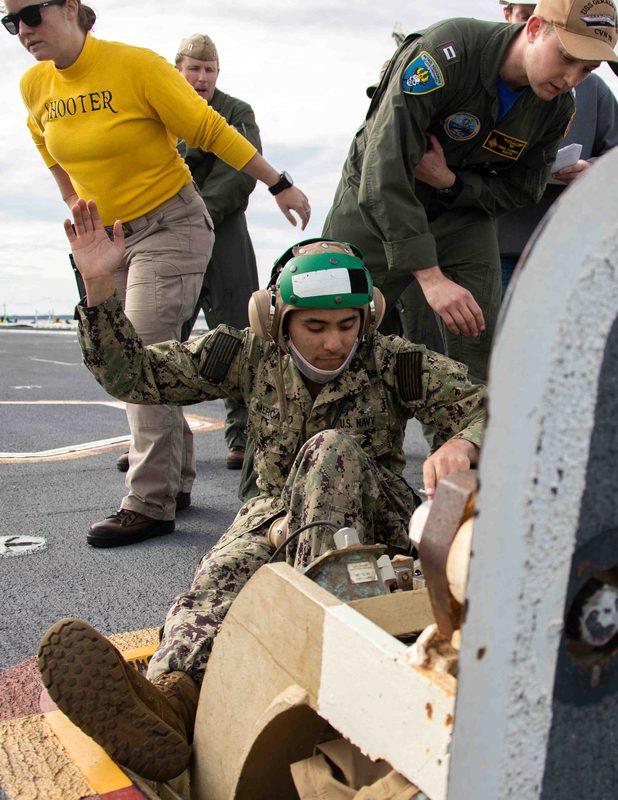
Flight deck crew operating the EMALS electromagnetic catapult system aboard USS Gerald R. Ford
The EMALS electromagnetic catapult system aboard USS Gerald R. Ford (CVN-78), replacing the steam catapults used on Nimitz-class carriers. U.S. Navy photo.

The Angled Deck: The Most Important Innovation

Before the 1950s, aircraft carriers had a straight flight deck. The catapults pointed straight forward, and landing aircraft approached from straight behind, landing over the stern. This created an obvious problem: if a landing aircraft missed the arresting cables and failed to stop, it would crash into aircraft parked forward on the deck, or into aircraft being prepared for launch. The entire forward portion of the deck had to be cleared for every recovery cycle, and a barrier (a net or cable system) was erected across the deck to stop aircraft that missed the cables. Barrier engagements were violent, frequently damaging aircraft, and occasionally killing pilots and deck crew.

The angled deck, invented by Royal Navy Captain Dennis Cambell in 1951, solved this problem elegantly. By angling the landing area approximately 9-10 degrees to port (left) of the ship's centerline, a missed approach (called a "bolter") would take the aircraft off the port side of the flight deck rather than into parked aircraft forward. The pilot simply added power and flew off the angled deck back into the landing pattern for another attempt. The forward deck could remain loaded with parked and staged aircraft without interference from landing operations, and launches could occur simultaneously with recoveries.

The angled deck is arguably the single most important innovation in carrier aviation. It made simultaneous launch and recovery operations possible, dramatically increasing the carrier's sortie rate. It eliminated the barrier, which had been responsible for extensive aircraft damage and crew casualties. And it gave pilots a safe option for missed approaches, reducing the psychological pressure of carrier landings.

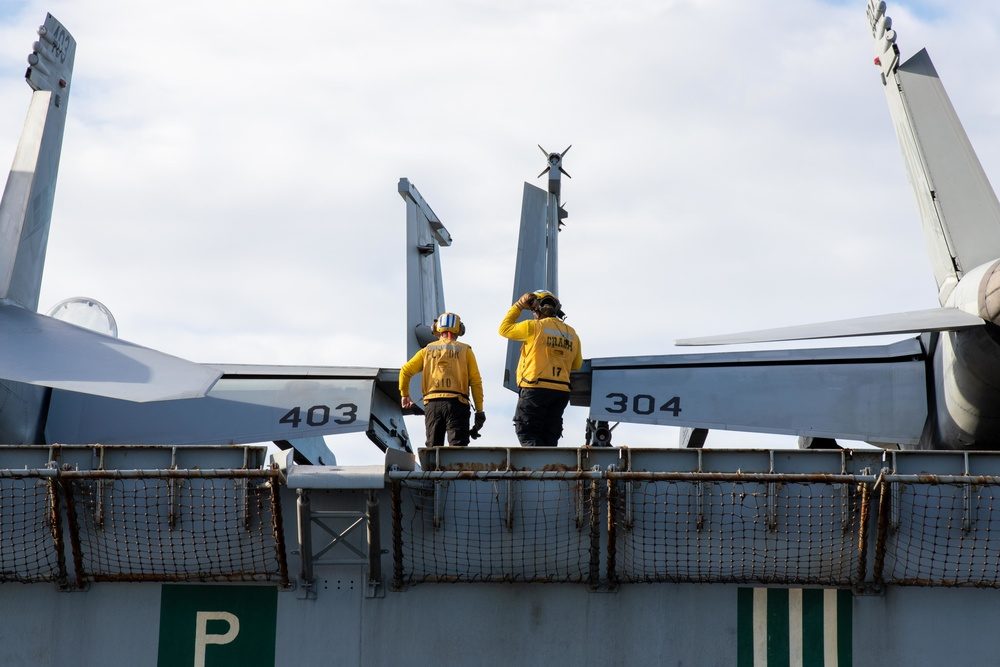
Aircraft carrier flight deck showing the angled landing area with F/A-18s parked on deck
The angled flight deck allows simultaneous launch and recovery operations, with aircraft parked safely forward while landings occur on the offset landing area. U.S. Navy photo.

The Arrested Landing

Landing on an aircraft carrier is universally described by pilots as the most demanding task in aviation. The pilot must fly a precise approach to a landing area that is approximately 550 feet long and 100 feet wide, while that area is moving forward at 20-30 knots and pitching, rolling, and heaving with the sea state.

The arresting gear system consists of four steel cables (called cross-deck pendants) stretched across the landing area, spaced approximately 40 feet apart. Each cable is connected to a hydraulic engine below deck, a massive piston and cylinder assembly that absorbs the kinetic energy of the landing aircraft. When the aircraft's tailhook catches one of the cables, the cable pays out from the hydraulic engine, which provides controlled resistance that decelerates the aircraft from approximately 150 mph to a full stop in roughly 300 feet and 2-3 seconds.

The deceleration is intense, approximately 3-4 G, and it hits the pilot with no warning. Unlike a catapult shot, where the pilot braces for the acceleration, the arrested landing is sudden: one instant the aircraft is flying at 150 mph, and the next the cable catches and the aircraft decelerates violently. Pilots describe the sensation as being thrown forward against their harness straps with enough force to leave bruises.

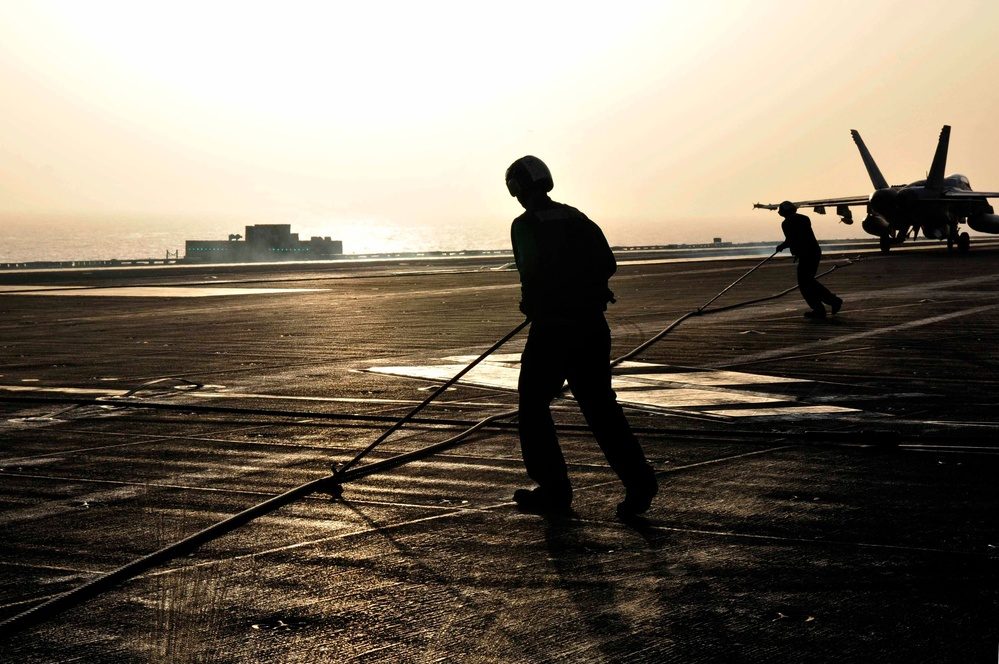
Sailors handling the cross-deck arresting wire on a carrier flight deck at sunset
Sailors manage the cross-deck arresting cables that bring aircraft from 150 mph to a full stop in roughly 300 feet. U.S. Navy photo.

The pilot approaches the carrier at a precisely controlled speed and angle of attack, following a 3.5-degree glideslope indicated by the Improved Fresnel Lens Optical Landing System (IFLOLS). The "meatball," a yellow light that moves relative to green datum lights, tells the pilot whether they are on glideslope (meatball centered), too high (meatball above the datum), or too low (meatball below the datum). A Landing Signal Officer (LSO) monitors every approach from a platform on the port side of the landing area, providing verbal guidance by radio and waving off unsafe approaches.

T-45 Goshawk training aircraft on approach during carrier landing qualification
A T-45 Goshawk on approach during carrier qualification. Pilots follow the IFLOLS "meatball" and LSO guidance to maintain the precise 3.5-degree glideslope. U.S. Navy photo.

When the aircraft touches down, the pilot does not flare or reduce power. They fly the aircraft into the deck at full approach power. If the hook catches a wire, the hydraulic engine stops the aircraft. If the hook misses all four wires (a bolter), the aircraft is already at full power and simply flies off the angled deck for another attempt. This "fly it into the deck" technique is counterintuitive for pilots trained on land-based approaches, where the goal is a smooth, gradual touchdown. On a carrier, the goal is a controlled collision with the deck that ensures the hook engages a wire.

Night Carrier Operations

Daytime carrier landings are difficult. Nighttime carrier landings are terrifying. At night, the pilot approaches a small cluster of lights in a vast black void. There is no horizon, no visual references, just the IFLOLS meatball and the deck lights growing slowly larger. The approach is flown almost entirely on instruments until the final seconds, when the pilot transitions to the visual references of the meatball and the deck lights.

The difficulty is compounded by the fact that the ship is in constant motion. Even in calm seas, the carrier's stern rises and falls with the swells, changing the position of the landing area relative to the approaching aircraft. In rough weather, the stern can move 10-15 feet vertically during an approach, a variation that must be corrected by the pilot in real time. The IFLOLS stabilization system partially compensates for deck motion, but the pilot must still account for the ship's movement in the final seconds of the approach.

Carrier pilots who qualify for night carrier landings, called "night traps," have earned one of the most difficult qualifications in military aviation. The stress is enormous. Even experienced carrier pilots describe night landings as the most demanding thing they do, and the accident rate during night operations is measurably higher than during daylight operations.

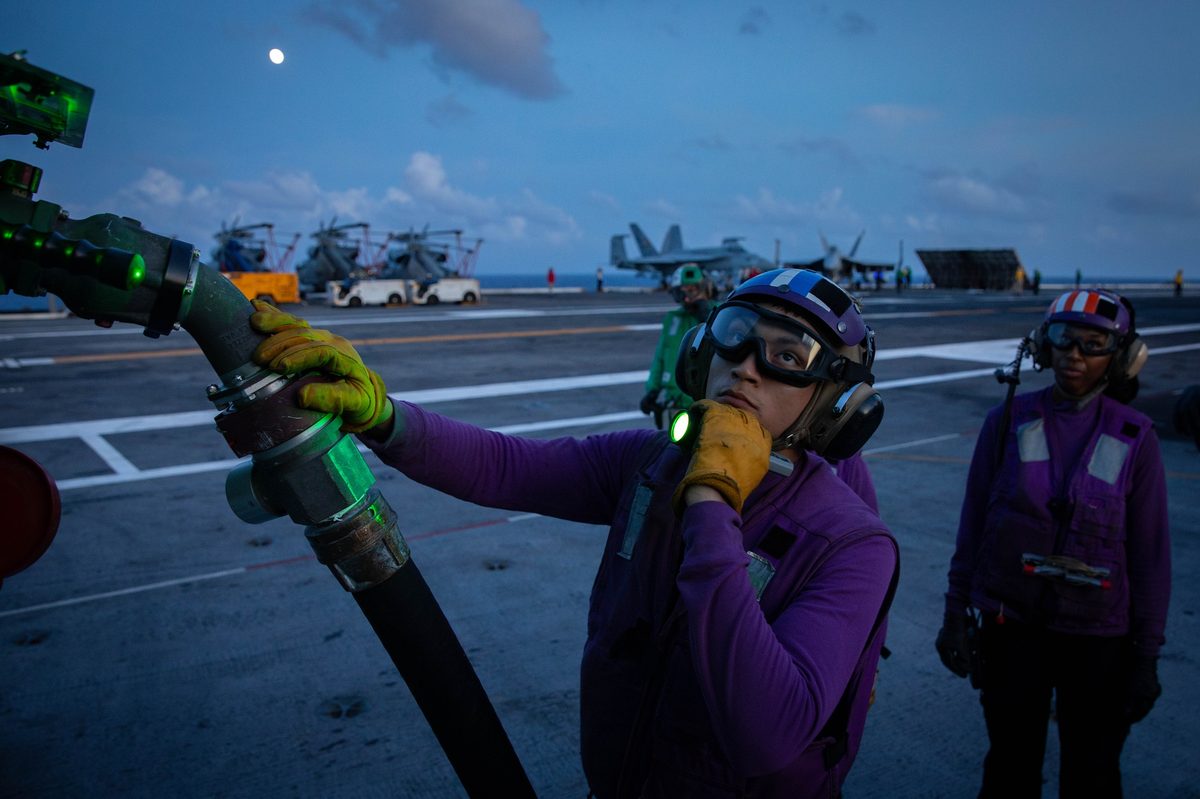
Flight deck crew conducting fueling operations during nighttime carrier operations
Flight deck crew conduct operations under low-light conditions. Night carrier landings are universally regarded as the most demanding task in military aviation. U.S. Navy photo.

The Flight Deck Crew

The human component of carrier operations is as impressive as the engineering. The flight deck crew, typically 150-200 sailors, operates in a color-coded system where each crew member's role is identified by the color of their jersey:

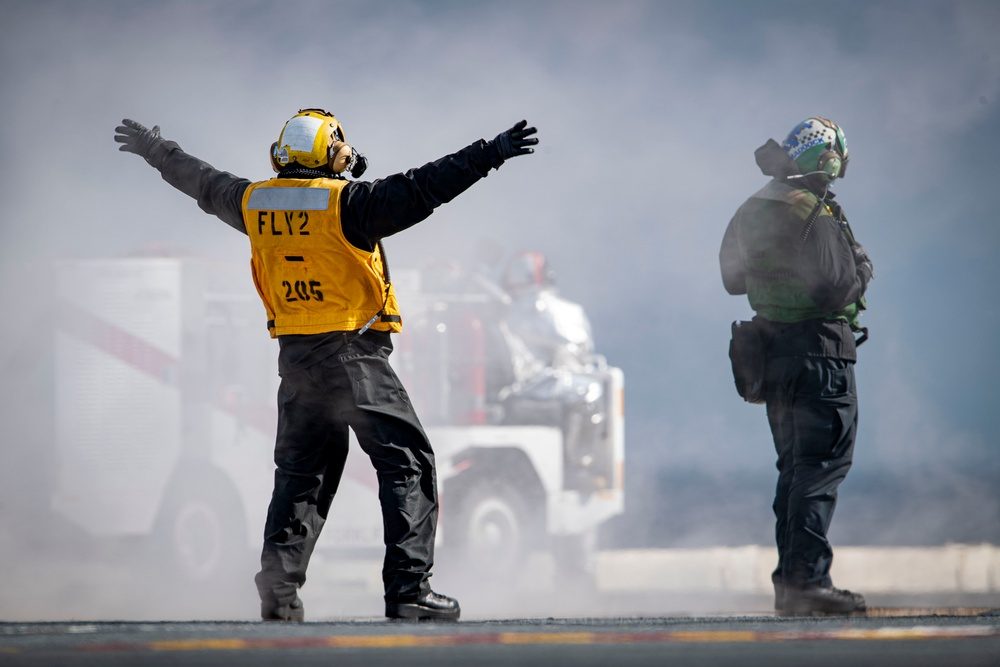
Yellow shirts: Aircraft handlers and directors who control the movement of all aircraft on the flight deck, directing taxi, parking, and positioning using standardized hand signals. The yellow shirts choreograph the complex ballet of aircraft movements that prevents collisions and keeps operations flowing.

Green shirts: Catapult and arresting gear crews who operate, maintain, and reset the launch and recovery equipment between cycles. The catapult crew retracts the shuttle, recharges the steam or electromagnetic system, and prepares for the next launch.

Red shirts: Ordnance handlers who load, arm, and de-arm weapons on aircraft. Red shirts handle some of the most dangerous materials on the ship, and their work areas are subject to the strictest safety protocols on the carrier.

Purple shirts: Fuelers who handle aviation fuel, operating the fueling stations and fuel lines that crisscross the flight deck. Aviation fuel is extremely flammable, and fuel handling during active flight operations requires extraordinary care.

Brown shirts: Plane captains. Each aircraft is assigned a plane captain who is responsible for the aircraft's condition, performs pre-flight checks, and ensures the aircraft is safe for flight.

White shirts: Safety observers, medical personnel, and landing signal officers. White shirts also include the quality assurance inspectors who verify that maintenance and ordnance handling are performed correctly.

Blue shirts: Aircraft handlers and elevator operators who move aircraft between the flight deck and the hangar deck below.

Yellow-shirted flight deck handler directing aircraft amid catapult steam with green-shirted crew alongside
Yellow-shirted aircraft handlers and green-shirted catapult crew coordinate on the flight deck. The color-coded jersey system identifies each crew member's role at a glance. U.S. Navy photo.

The average age of the flight deck crew is 19-20 years old. They work in extreme conditions: jet blast, noise levels that cause permanent hearing damage without protection, fuel vapors, weather, and the constant risk of being struck by a moving aircraft or blown overboard by jet exhaust. Despite the dangers, carrier flight deck operations maintain a safety record that is remarkable given the inherent hazards of the environment.

Engineering at the Edge

Carrier launch and recovery operations represent one of the most complex engineering achievements in military history. Every component (the catapult, the arresting gear, the angled deck, the optical landing system, the choreographed crew) must work in perfect coordination for every launch and every recovery. A malfunction in any element can result in the loss of a $70 million aircraft and the death of a pilot.

The U.S. Navy launches and recovers approximately 140 aircraft per day during sustained combat operations, or one launch or recovery every five to seven minutes, around the clock. This tempo has been maintained for weeks at a time during major operations, with carrier air wings flying hundreds of combat sorties while simultaneously conducting training flights, maintenance test flights, and logistic support missions.

No other nation operates carriers at this tempo. The technology, training, and institutional experience required to sustain around-the-clock carrier flight operations are so demanding that only the United States has achieved it consistently. Other carrier-operating nations, including France, Britain, China, and India, are developing these capabilities, but the U.S. Navy's seven decades of continuous carrier operations represent an institutional knowledge base that cannot be replicated quickly. Carrier aviation is not just a technology. It is a culture, and it is one of the most impressive human-machine systems ever created.

Share this article

Share:

Recommended

Ace of The Skies: Can You Identify These Military Aircraft Throughout The Years?
Test Yourself

Ace of The Skies: Can You Identify These Military Aircraft Throughout The Years?

Can you identify these aircraft?

Take the Quiz

On This Day in Military History

March 24

Operation Varsity, The Largest Single-Day Airborne Assault (1945)

More than 16,000 Allied paratroopers from the British 6th Airborne Division and U.S. 17th Airborne Division launched Operation Varsity, the largest airborne operation ever conducted in a single day. Approximately 2,700 transport aircraft and 1,300 gliders dropped troops east of the Rhine near Wesel as part of Montgomery's Operation Plunder. All objectives were captured within hours, but at a cost of over 2,000 airborne casualties, the deadliest single day for Allied airborne troops in WWII.

1944, The Great Escape from Stalag Luft III

1944, The Ardeatine Caves Massacre in Rome

1999, NATO Launches Operation Allied Force Against Yugoslavia

See all 10 events on March 24

Get Military News & History in Your Inbox

Join thousands of readers receiving our weekly digest of military technology, history, and analysis.

Test Your Knowledge