Skip to content
May 3:British Recapture of Rangoon: The Burma Campaign Ends81yr ago

F-86 Sabre vs MiG-15: The First Jet Fighter Rivalry

Daniel Mercer · · 13 min read
Save
Share:
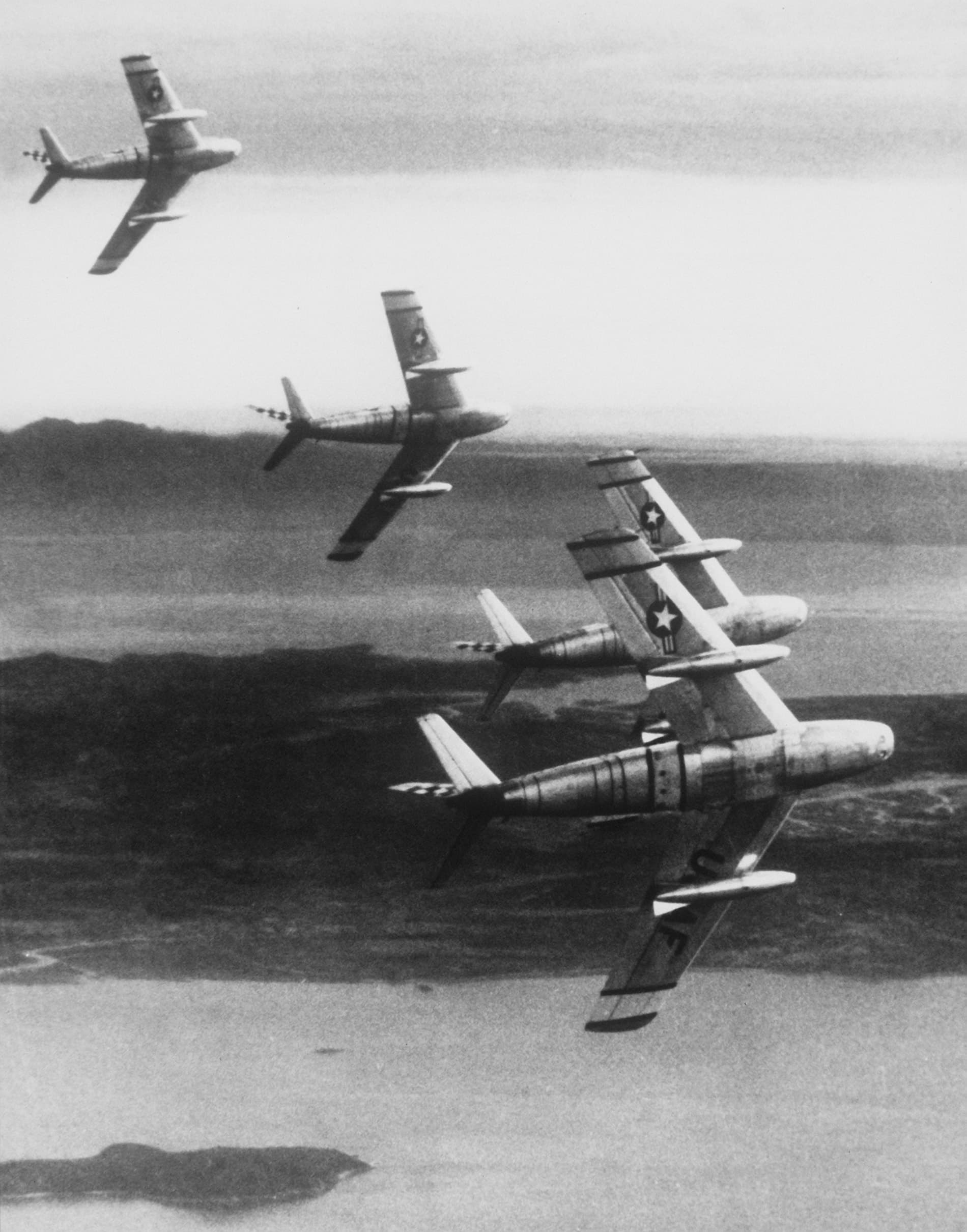
F-86 Sabre jet fighter in flight over Korea showing its swept wings and distinctive intake
Daniel Mercer
Daniel Mercer

Military History Editor

Daniel Mercer writes about military history with a focus on the 20th century, including World War II, the Cold War, and Vietnam. His work looks at how decisions made decades ago still influence doctrine, planning, and assumptions today.

On December 17, 1950, the 47th anniversary of the Wright Brothers' first flight, Lieutenant Colonel Bruce Hinton of the 336th Fighter-Interceptor Squadron spotted a flight of MiG-15s over the Yalu River and dove to attack. Minutes later, he had scored the first F-86 Sabre kill of the Korean War. It was the beginning of the most important air combat rivalry of the jet age. Over the next two and a half years, F-86 Sabres and MiG-15s would meet in a narrow corridor of northwest Korean airspace that American pilots called "MiG Alley", and their duels would establish the tactics, technologies, and doctrines that would govern aerial combat for the rest of the century.

Two Aircraft, One Problem

The F-86 and MiG-15 emerged from the same technological revolution: swept-wing aerodynamics captured from Germany at the end of World War II. Both the United States and the Soviet Union had seized German research data on swept wings, research that showed sweeping the wing backward delayed the onset of compressibility drag at transonic speeds, allowing much higher maximum speeds than straight-wing designs. Both nations applied these findings to produce fighters that could operate in the transonic regime, the speed range around Mach 1 where earlier jet fighters like the P-80 and MiG-9 became dangerously uncontrollable.

The North American F-86 Sabre first flew on October 1, 1947. Its 35-degree swept wing, combined with a General Electric J47 turbojet producing 5,910 pounds of thrust, gave it a maximum speed of 687 mph (Mach 0.9) at sea level. The aircraft was designed primarily as an air superiority fighter, with six .50-caliber M3 Browning machine guns mounted in the nose. It was beautifully proportioned, with a smooth, area-ruled fuselage and an intake in the nose that gave it a distinctive open-mouthed appearance.
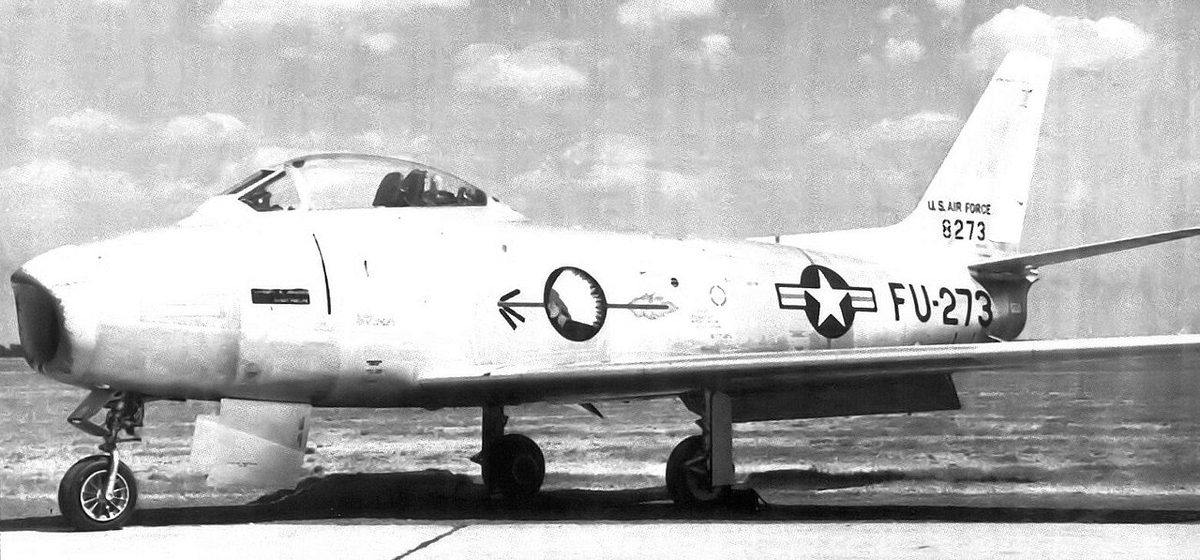
F-86A Sabre on the ground with USAF markings during the Korean War
(U.S. Air Force photo)

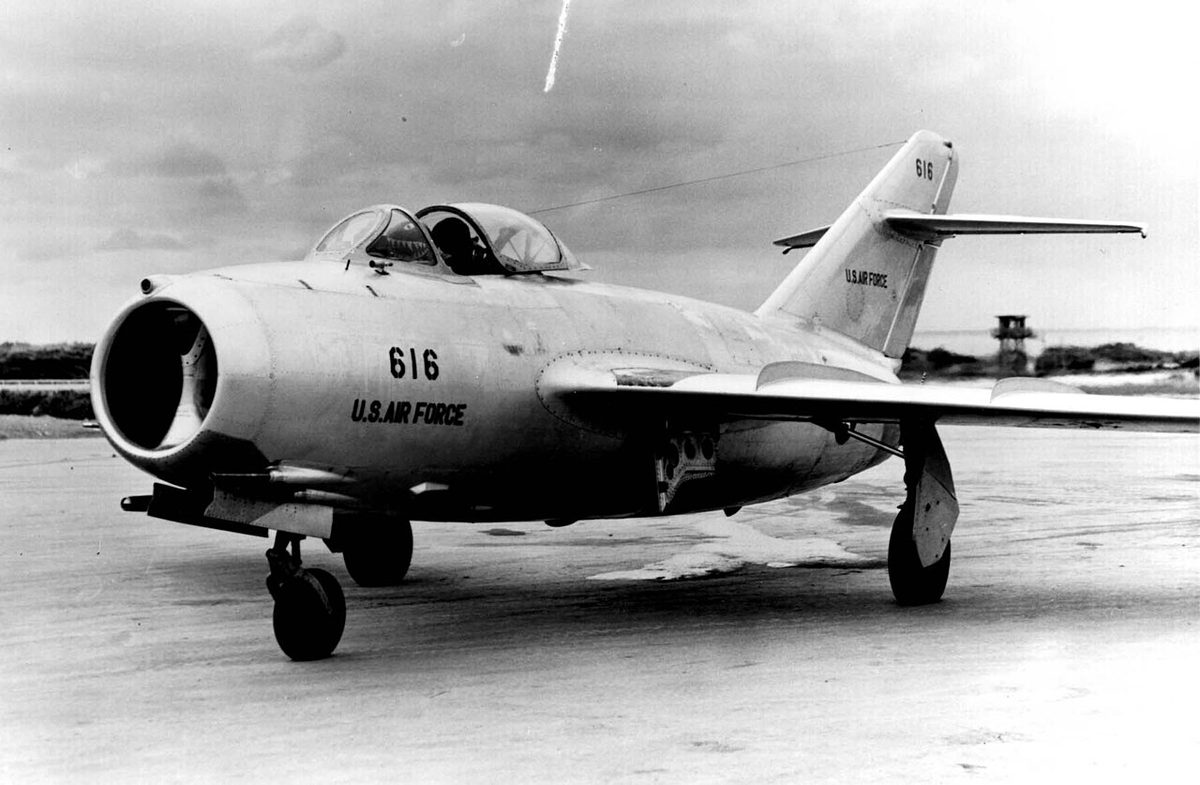
The Mikoyan-Gurevich MiG-15 first flew on December 30, 1947, less than three months after the Sabre. Its 35-degree swept wing was strikingly similar in concept to the F-86's, though the two designs were developed independently. The MiG-15 was powered by a Klimov VK-1 engine, a Soviet copy of the Rolls-Royce Nene turbojet, which the British Labour government had inexplicably sold to the Soviet Union in 1946. The VK-1 produced 5,952 pounds of thrust, nearly identical to the J47. The MiG-15's armament was dramatically different from the Sabre's: one 37mm N-37 cannon and two 23mm NR-23 cannons, mounted under the nose.

MiG-15 fighter jet in USAF test markings, a captured example used for evaluation
(U.S. Air Force photo)

Strengths and Weaknesses

The MiG-15 and F-86 were remarkably evenly matched, but each had distinct advantages that shaped the tactics pilots used to exploit them.

The MiG-15 was lighter and had a better thrust-to-weight ratio, giving it a superior rate of climb. A MiG-15 could zoom-climb away from an F-86 in a vertical maneuver, gaining altitude where the lighter Soviet fighter held the advantage. At high altitude, above 40,000 feet, the MiG-15 was the superior aircraft, maintaining its performance where the Sabre's heavier airframe began to struggle. The MiG also had a higher service ceiling, approximately 50,800 feet versus the Sabre's 48,000 feet.

The F-86 was superior at lower altitudes and in diving engagements. Its heavier weight was an advantage in a dive, the Sabre could build up speed faster and maintain control at higher Mach numbers. The F-86's flight controls were hydraulically boosted, providing precise, responsive handling throughout the speed range. The MiG-15's controls, by contrast, stiffened badly at high speeds, and the aircraft suffered from dangerous tendencies at high Mach numbers, including a pitch-up at transonic speeds that could throw the aircraft into an uncontrollable tumble.

The F-86 also had a crucial advantage in its gunsight. The A-1CM radar-ranging gunsight automatically calculated the correct lead angle for a target at any range within its envelope, displaying a computing pipper that the pilot simply placed on the target. The MiG-15 used a simpler fixed gyro gunsight that required more pilot skill to use effectively. In the fast-paced, high-deflection shooting of jet combat, the computing gunsight gave Sabre pilots a significant edge in accuracy.

The Gun Debate

The armament philosophies of the two fighters reflected fundamentally different tactical assumptions, and both had serious limitations.

The F-86's six .50-caliber M3 Browning machine guns provided a high rate of fire and excellent accuracy. The M3 fired at approximately 1,200 rounds per minute per gun, giving a combined rate of fire of 7,200 rounds per minute. The .50-caliber round was accurate at combat ranges and the large ammunition supply (1,602 rounds total) gave pilots extended engagement opportunities. But the .50-caliber round lacked the destructive power needed to quickly destroy the all-metal MiG-15. Multiple hits were often required to bring down a MiG, and the damage caused by .50-caliber rounds, while cumulative, often allowed damaged aircraft to escape.

The MiG-15's cannon armament took the opposite approach. The 37mm N-37 cannon fired a shell weighing over a pound, a single hit could tear apart an aircraft's structure, sever control cables, or destroy an engine. The two 23mm NR-23 cannons added to the destructive power. A one-second burst from all three weapons delivered a devastating weight of fire. But the cannons had a slow rate of fire, limited ammunition (40 rounds for the 37mm, 80 rounds each for the 23mm guns), and significant ballistic drop at range. The different trajectories of the 37mm and 23mm rounds made it difficult to score hits with all three weapons simultaneously. And the low ammunition count meant MiG pilots could fire for roughly three seconds of total trigger time before they were empty.

The lesson both sides eventually learned: the ideal fighter armament was somewhere between the two extremes, heavier than .50-caliber machine guns but with a higher rate of fire than the MiG's slow-firing cannon. The 20mm rotary cannon (M61 Vulcan), adopted by the next generation of American fighters, was the answer.

MiG Alley

The air war over Korea was fought primarily in a roughly 6,500-square-mile area in northwestern Korea, between the Yalu River (the Chinese border) and the Chongchon River. American pilots called it MiG Alley. The geography was dictated by politics: United Nations forces were prohibited from crossing the Yalu or attacking Chinese airfields in Manchuria, giving the MiGs a sanctuary from which they could launch, climb to altitude, cross the Yalu at high speed, engage the Sabres, and then dive back across the river to safety if the fight turned against them.

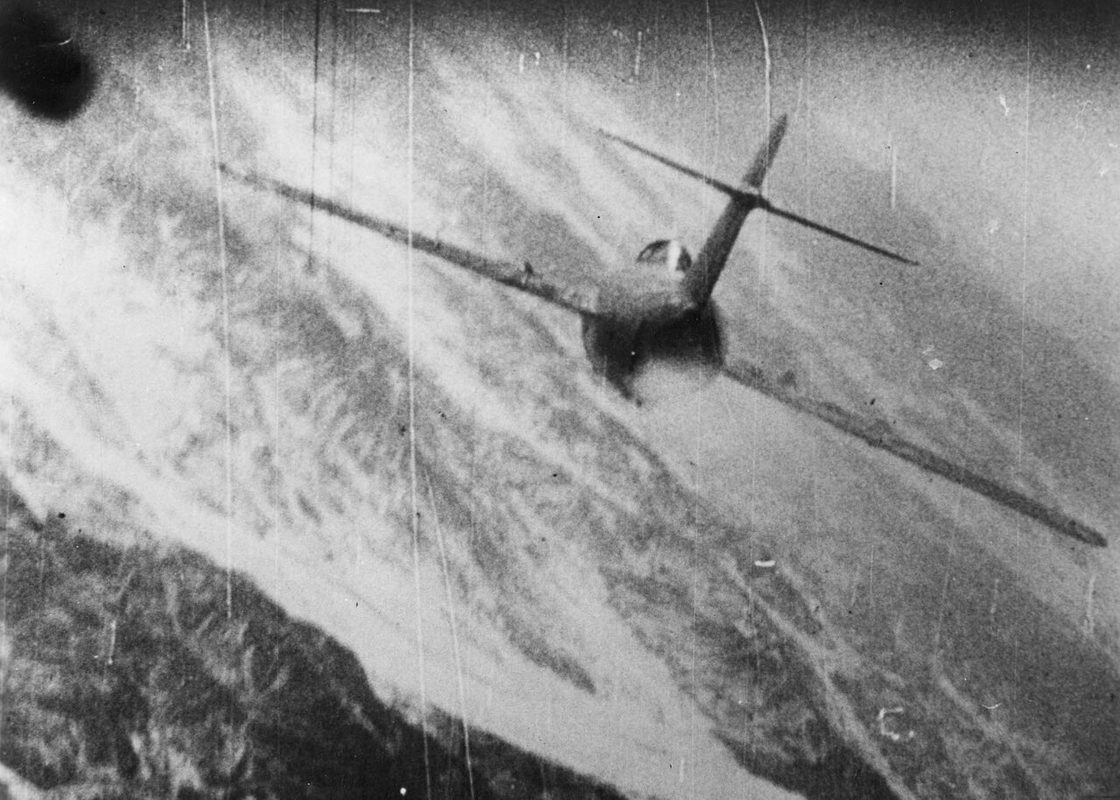
Gun camera footage showing a MiG-15 being hit during aerial combat over Korea in 1953
(USAF gun camera footage, 1953)

This sanctuary advantage was significant. MiG pilots could choose when and where to engage. They typically operated in large formations, sometimes 50 or more aircraft, launching from airfields at Antung (now Dandong), climbing to altitude over Chinese territory where they were untouchable, and then sweeping south across the Yalu to attack UN fighter-bombers or engage Sabre patrols. If engaged by Sabres, MiGs that were losing the fight could simply turn north and run for the border. Sabre pilots who crossed the Yalu in pursuit risked court-martial.

The rules of engagement were further complicated by the open secret that many of the MiG pilots were not Chinese or North Korean but Soviet. The Soviet Union deployed experienced fighter pilots, many of them World War II veterans, to fly MiG-15s with Chinese or North Korean markings. Soviet pilots communicated in Russian over unsecured radio frequencies, and American intelligence was well aware of their presence. Both sides maintained the fiction that Soviet pilots were not involved, because acknowledging it would have risked escalating the Korean War into a direct U.S.-Soviet conflict.

The Kill Ratio Debate

The U.S. Air Force claimed a kill ratio of approximately 10:1 in favor of the F-86 during the Korean War, 792 MiGs destroyed versus 78 Sabres lost in air-to-air combat. This ratio became one of the most cited statistics in military aviation history, and it shaped American fighter doctrine for decades. If the Sabre was that dominant, the reasoning went, then American pilot training and tactics were decisively superior to those of the Communist bloc.

Post-Cold War research, however, has significantly revised these figures. Soviet records, made available after the collapse of the USSR, documented Sabre losses substantially higher than the 78 claimed by the USAF. Similarly, Soviet MiG losses were lower than American claims suggested, a common pattern in aerial warfare, where both sides tend to overclaim kills and underreport losses. Modern estimates suggest the actual ratio was closer to 2:1 or 3:1 in favor of the Sabre, still a significant advantage, but not the overwhelming dominance that the original 10:1 ratio implied.

The revised ratio makes more sense given how closely matched the two aircraft were. The Sabre's advantages, better flight controls, superior gunsight, better trained pilots, were real and meaningful, but they were not so overwhelming as to produce a 10:1 kill ratio against competent opposition. When the MiGs were flown by experienced Soviet pilots rather than hastily trained Chinese or North Korean pilots, the engagements were much more closely contested.

Aces of MiG Alley

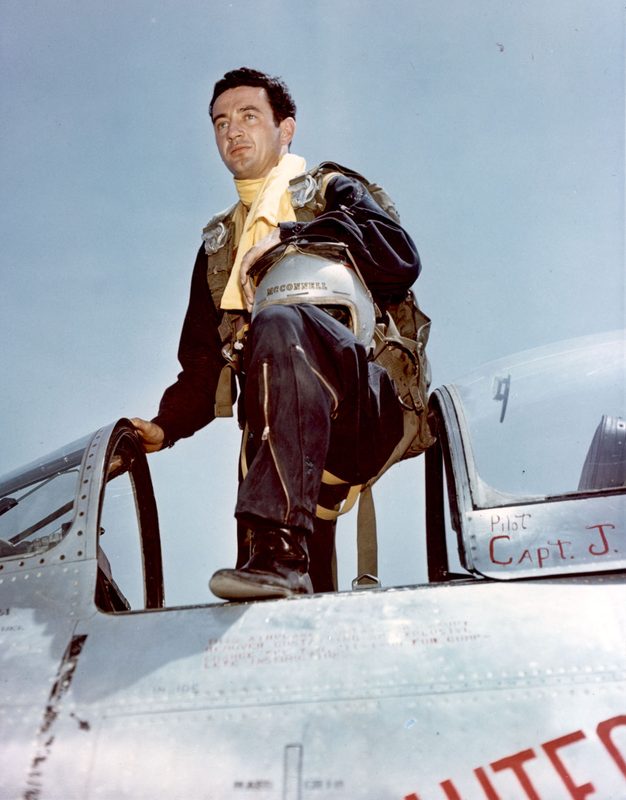
Captain Joseph McConnell, top American ace of the Korean War, climbing into his F-86 Sabre
(U.S. Air Force photo)

The Korean War produced the last generation of American fighter aces. Captain Joseph McConnell, with 16 confirmed kills, was the top-scoring American ace of the war. Major James Jabara became the world's first jet ace on May 20, 1951, when he scored his fifth and sixth kills. Captain Manuel "Pete" Fernandez scored 14.5 kills. These pilots became national celebrities, their exploits covered extensively by American media.

On the Soviet side, Colonel Yevgeny Pepelyaev was credited with 19 kills (later revised to 15), and Nikolai Sutyagin was credited with 22 (later revised). Several Soviet aces had extensive World War II combat experience, bringing a level of skill and tactical sophistication that challenged the best American pilots. The presence of these experienced Soviet pilots explains the periods during the war when MiG Alley became particularly dangerous for Sabre pilots.

Legacy

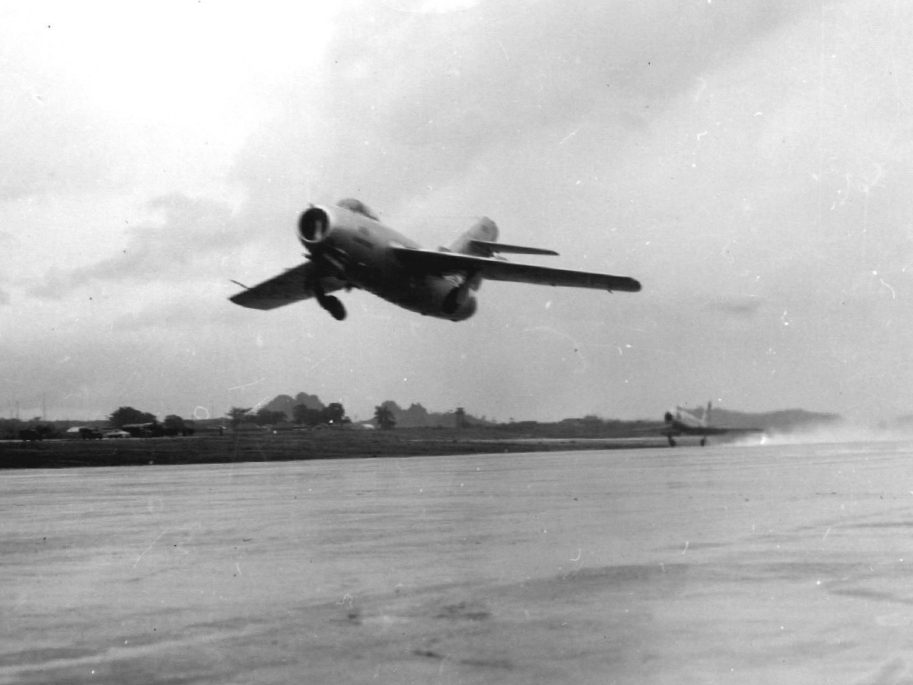
MiG-15 taking off with an F-86 Sabre visible in the background at a test facility
(U.S. Air Force photo, 1953)

The F-86 vs. MiG-15 rivalry established patterns that would define air combat for the rest of the century. It proved that the era of the propeller-driven fighter was definitively over, no piston-engine aircraft could compete in a sky dominated by swept-wing jets. It demonstrated the critical importance of pilot training, flight controls, and fire control systems, showing that the pilot-machine combination mattered more than raw aircraft performance. And it provided the combat laboratory in which the tactics of jet air combat, energy management, vertical maneuvering, the fluid-four formation, were developed and refined.

The armament lessons were equally important. The .50-caliber machine gun, which had served American fighters brilliantly from the P-47 to the F-86, was finally recognized as inadequate for the jet age. The next generation of American fighters, the F-100 Super Sabre, F-104 Starfighter, and F-4 Phantom, carried 20mm cannon or missiles. The MiG-15's heavy cannon approach was also refined, with later Soviet fighters adopting faster-firing 23mm and 30mm weapons with improved fire control.

The F-86 Sabre and MiG-15 were the last fighters designed purely around guns and the visual dogfight. The generation that followed introduced air-to-air missiles, radar-guided intercepts, and electronic warfare. But the fundamental lesson of MiG Alley, that air superiority is determined by the total system of aircraft, weapons, sensors, and pilot skill, not by any single factor, remains as true today as it was over the frozen skies of North Korea in 1951.

Share this article

Share:

Recommended

Ace of The Skies: Can You Identify These Military Aircraft Throughout The Years?
Test Yourself

Ace of The Skies: Can You Identify These Military Aircraft Throughout The Years?

Can you identify these aircraft?

Take the Quiz

On This Day in Military History

March 24

Operation Varsity, The Largest Single-Day Airborne Assault (1945)

More than 16,000 Allied paratroopers from the British 6th Airborne Division and U.S. 17th Airborne Division launched Operation Varsity, the largest airborne operation ever conducted in a single day. Approximately 2,700 transport aircraft and 1,300 gliders dropped troops east of the Rhine near Wesel as part of Montgomery's Operation Plunder. All objectives were captured within hours, but at a cost of over 2,000 airborne casualties, the deadliest single day for Allied airborne troops in WWII.

1944, The Great Escape from Stalag Luft III

1944, The Ardeatine Caves Massacre in Rome

1999, NATO Launches Operation Allied Force Against Yugoslavia

See all 10 events on March 24

Get Military News & History in Your Inbox

Join thousands of readers receiving our weekly digest of military technology, history, and analysis.

Test Your Knowledge