Michael Trent covers military aircraft, weapons systems, and defense technology with an emphasis on cost, maintenance, and real-world performance. He focuses less on specifications and more on how systems hold up once they are deployed, maintained, and operated at scale.
The F-22 Raptor entered service in 2005 as the world's first operational fifth-generation stealth fighter. The Chengdu J-20 Mighty Dragon followed in 2017, making China the second nation to field a stealth fighter. They are the only two heavy air superiority stealth fighters in operational service anywhere in the world. And they were designed to do fundamentally different things.
The F-22 was built to penetrate enemy airspace and dominate anything it encountered. It is faster, stealthier, and more maneuverable than any opponent. The J-20 was built to deny airspace across vast distances, with longer range, longer legs, and missiles that can reach targets far beyond the F-22's engagement envelope. One is a fencer. The other is a spearman. Comparing them requires understanding not just what each can do, but why it was designed to do it.
At a Glance: Quick Verdict
F-22 Raptor Advantages
Superior all-aspect stealth (smallest RCS of any fighter)
2D thrust vectoring for unmatched close-in agility
Supercruise at Mach 1.8 (fastest confirmed)
Proven, mature F119 engines
Faster top speed (Mach 2.25)
J-20 Mighty Dragon Advantages
2.5× longer combat radius (~1,200 mi vs ~470 mi)
Longer-range missiles (PL-15 at 200 km, PL-21 at 300-400 km)
300+ built and production accelerating
44% more internal fuel
Newer-generation electronics and radar
The F-22 was designed to fly into the most heavily defended airspace in the world and dominate everything it encounters through stealth, speed, and agility.
The J-20 was designed to deny airspace across vast distances, targeting the enablers of enemy air power (tankers, AWACS, and ISR platforms) at ranges beyond the reach of opposing fighters.
*The J-20 is transitioning to the WS-15 engine (36,000-40,000 lbf each), which would match or exceed the F119's thrust. WS-15 prototypes have flown but full-scale deployment is expected in 2026-2027.
The numbers tell an interesting story. The J-20 is over 13 feet longer, yet lighter when empty. It carries 44 percent more internal fuel, a direct reflection of its long-range interceptor mission. The F-22 is faster, both outright and in supercruise, and its F119 engines with two-dimensional thrust vectoring give it maneuverability the J-20 currently cannot match. But the J-20's combat radius, roughly 2.5 times the F-22's, is the single most striking performance difference.
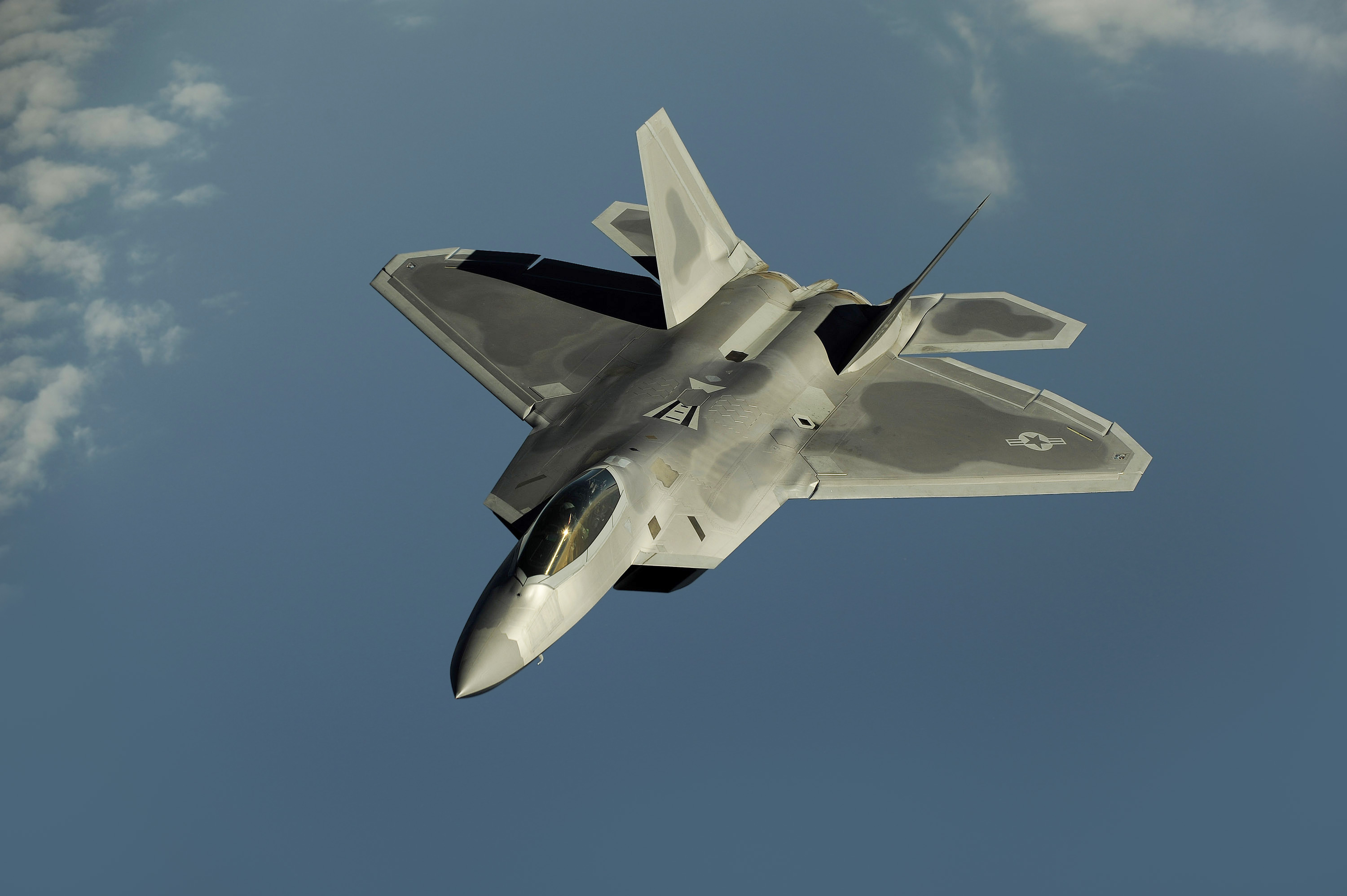
The F-22 Raptor's compact design and aligned edges produce the smallest radar cross-section of any operational fighter. Its two-dimensional thrust-vectoring nozzles are visible at the rear. (U.S. Air Force photo)
Stealth: Two Philosophies
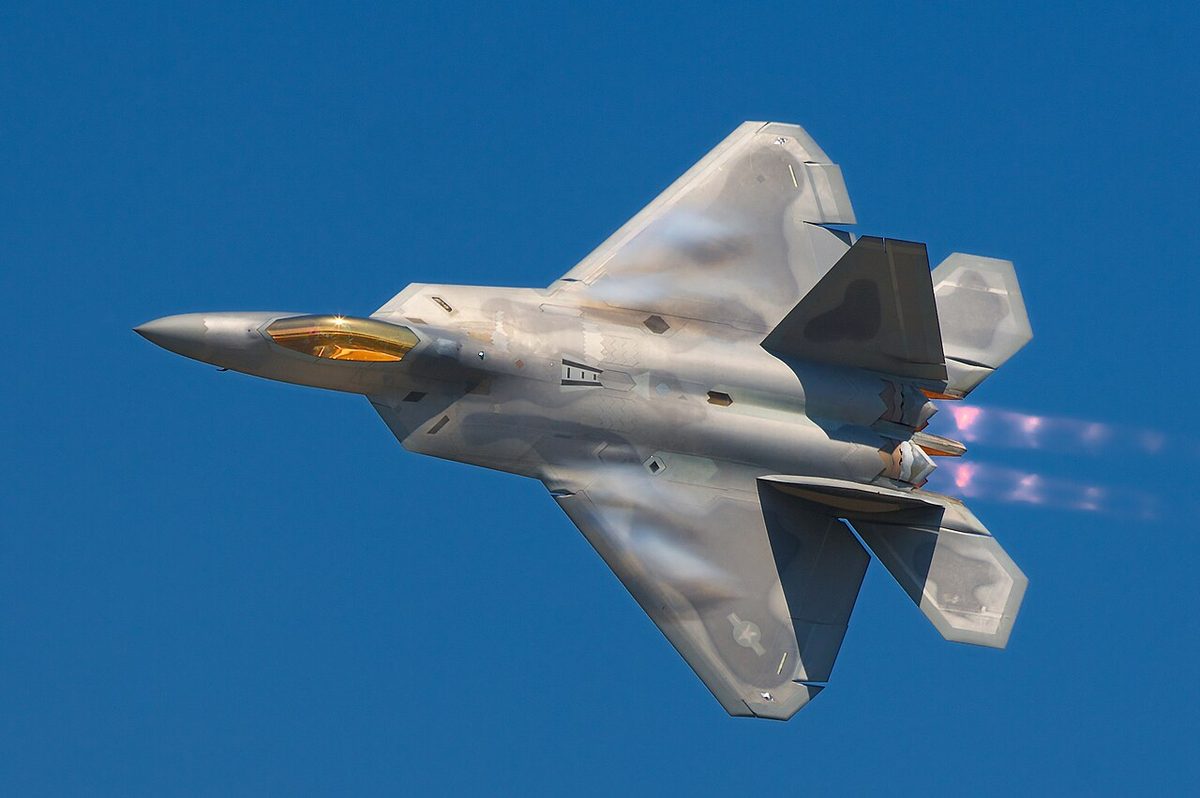
The F-22 remains the gold standard for all-aspect stealth. Its radar cross-section is estimated at approximately 0.0001 m², roughly the radar return of a marble. Every surface, edge, panel joint, and inlet was designed to minimize reflections from all angles. The canted twin tails, S-duct engine inlets, aligned panel edges, and extensive radar-absorbent coatings combine to make the F-22 extraordinarily difficult to detect from any direction.
The J-20 takes a different approach. Its frontal-aspect stealth is strong. Diverterless supersonic inlets, careful shaping, and radar-absorbent materials produce a small head-on radar signature. But the J-20 makes deliberate tradeoffs. Its forward canards (the most visually distinctive feature) add edges and surfaces that increase radar returns from off-boresight angles. The current round WS-10C engine nozzles are not optimized for rear-aspect stealth. RCS estimates for the J-20 range from 0.01 to 0.3 m² depending on aspect angle, potentially 100 to 3,000 times larger than the F-22.
This reflects different design priorities. The F-22 was designed to penetrate defended airspace from any direction, so it needs to be stealthy no matter where the radar is. The J-20 was designed primarily for head-on engagements at long range. It approaches targets from the front, so frontal stealth is what matters most. The first major RCS spike from the canards occurs at roughly 50 degrees off boresight, well outside the frontal engagement zone.
The Canard Debate
The J-20's forward canards are the subject of ongoing discussion in the defense analysis community. Traditional Western stealth doctrine holds that any forward control surface creates additional radar reflections, and the F-22 team specifically avoided them. But China made a deliberate engineering choice.
The canards provide enhanced pitch authority at high angles of attack, better sustained turn performance at altitude, and additional lift that supports the J-20's long range and payload. Radar scattering simulations suggest that the highly swept, low-aspect-ratio canards concentrate their radar return into narrow spikes rather than broad reflections, and these spikes blend with the main wing return at most aspect angles.
In essence, China accepted some stealth penalty from non-frontal aspects in exchange for aerodynamic performance that supports the J-20's mission profile. Whether that tradeoff is worth it depends entirely on how the aircraft is employed, and the J-20's doctrine is to engage from the front at long range, where the canard penalty is minimal.
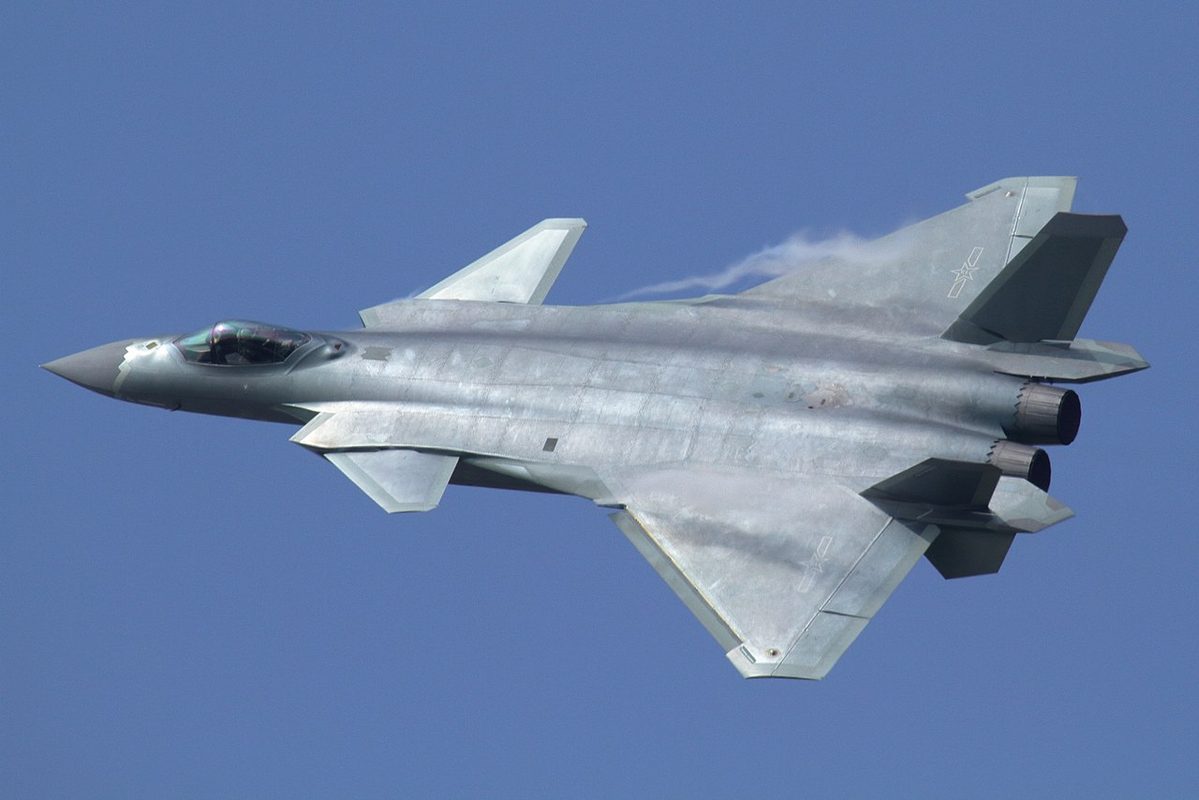
The J-20's distinctive canard-delta configuration is immediately recognizable. The forward canards provide aerodynamic advantages at the cost of some off-axis stealth performance. (Chinese state media)
Engines: Proven Power vs. Evolving Ambition
The F-22's Pratt & Whitney F119 is one of the most impressive military engines ever built. Each produces approximately 35,000 pounds of thrust with afterburner, and the two-dimensional vectoring nozzles enable the F-22's exceptional post-stall maneuverability. The F119 has been in service for two decades with a well-established reliability record. It enables the F-22's confirmed Mach 1.8 supercruise, faster than many fighters can achieve with afterburner.
The J-20's engine story is more complicated. Current production aircraft use the Chinese WS-10C, each producing approximately 32,000 pounds of thrust, adequate but not the aircraft's intended powerplant. The WS-15, estimated at 36,000 to 40,000 pounds of thrust per engine, is the target engine. J-20A prototypes have been photographed flying with WS-15s, and limited batch production is underway, with full-scale deployment expected in 2026-2027.
With the WS-15, the J-20's total thrust would match or exceed the F-22's. The F-22 would retain its advantage in thrust vectoring. The current WS-15 nozzles appear non-vectoring, though a vectoring variant is reportedly under development. Engine maturity remains a meaningful difference: the F119 is proven over decades of operational service, while the WS-15 is still in its early deployment phase.
Sensors and Radar
System
F-22
J-20
Radar
AN/APG-77(v)1 AESA (~1,500-1,900 T/R modules)
Type 1475 (KLJ-5) AESA (~2,000-2,200 T/R modules)
Detection Range
~220 km vs 1 m² target
Estimated to exceed 220 km (24 kW transmission power)
Passive Detection
ALR-94 EW suite (exceptional)
Distributed aperture system + EOTS
IRST
No dedicated IRST
Yes (plus EOTS under nose)
Data Link
IFDL (F-22-to-F-22 only, limited interop)
Integration with ground radar, KJ-500 AWACS
The F-22's AN/APG-77 was revolutionary when introduced, and its ALR-94 passive sensor suite, which can detect and geolocate emitters at ranges exceeding the radar's, is considered one of the most capable electronic warfare systems ever fitted to a fighter. But the system was designed in the 1990s and 2000s, and the F-22's data link is limited to F-22-to-F-22 communication with restricted interoperability with other platforms.
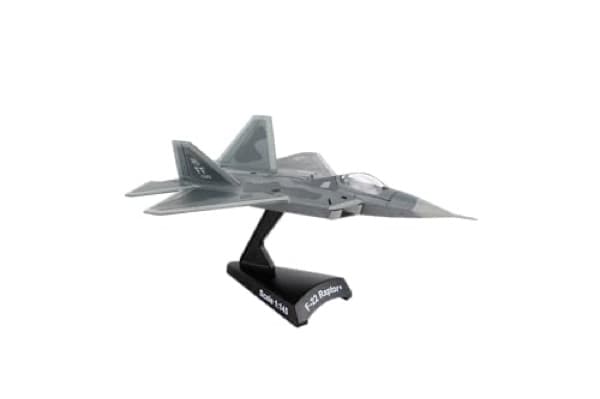
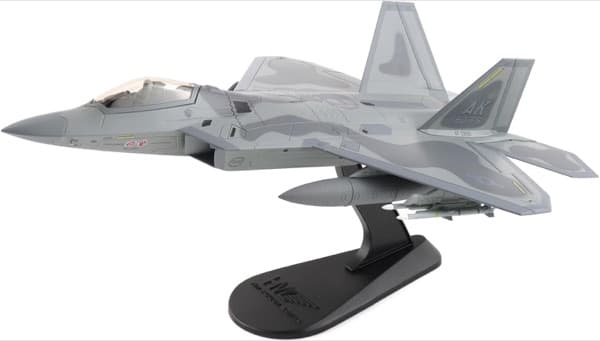
A compact desk-sized F-22 with the 1st Fighter Wing paint scheme. Die-cast metal body with a plastic display stand included. Around 4 inches nose to tail at 1:145 scale.
The J-20 benefits from being designed in an era where networked warfare and data sharing are foundational requirements. Its radar likely has more transmit/receive modules using newer gallium nitride technology, it carries both IRST and an electro-optical targeting system (concepts absent from the F-22), and its data links reportedly allow integration with ground-based radars, the KJ-500 AWACS aircraft, and other PLAAF assets. The twin-seat J-20S variant, announced in 2024, is specifically designed for enhanced sensor management and manned-unmanned teaming with loyal wingman drones.
Weapons: Reach vs. Versatility
Category
F-22
J-20
Internal BVR Missiles
6× AIM-120C/D AMRAAM
4-6× PL-15 (or PL-21 ramjet)
Internal WVR Missiles
2× AIM-9M/X Sidewinder
2× PL-10E
Key BVR Range
AIM-120D: ~160-180 km
PL-15: ~200 km / PL-21: ~300-400 km
Gun
M61A2 Vulcan 20mm (480 rounds)
None confirmed
Total Stealth Loadout
8 missiles
6-8 missiles
The J-20's missile range advantage is significant. The PL-15 outranges the AIM-120D, and the PL-21, if fully operational, is a ramjet-powered missile with 300 to 400 km range that has no direct US equivalent currently deployed on the F-22. This reach aligns with the J-20's mission of engaging high-value targets at extreme distance.
The F-22 carries a slightly higher total missile count in stealth configuration and retains the M61A2 cannon for close-in situations, a weapon the J-20 apparently lacks. The AIM-120D is a mature, combat-proven missile, while the PL-15 and PL-21's performance claims are largely unverified in real-world conditions.
The Numbers Problem
This may be the most strategically consequential comparison point.
The F-22 production line closed in 2011 after 195 aircraft, a decision driven by cost (over $150 million per unit) and post-Cold War budget pressures. The original requirement was 750 aircraft, later reduced to 381, then 187 production airframes. Congress banned export sales, so only the U.S. Air Force operates them. Approximately 180 remain operational today, with retirement expected to begin in the 2030s as the Boeing F-47 enters service.
China has taken the opposite approach. Over 300 J-20s have been built, with production estimated at 70 to 120 units per year and accelerating. Some projections suggest the fleet could reach 500 by 2027 and potentially 1,000 by 2030. The J-20 is not an exclusive, limited-production weapon. It is being built at industrial scale.
The implication is straightforward: China already has numerical superiority in heavy stealth fighters, and the gap is widening. The F-22's individual capabilities may be superior, but 180 aircraft cannot be everywhere at once. Quantity, backed by China's extensive ground-based radar and surface-to-air missile networks, becomes its own strategic advantage.
China has produced over 300 J-20 fighters with production accelerating, a stark contrast to the F-22's fixed fleet of 195. (Chinese state media)
Design Philosophy: Why They Are So Different
The F-22 was born from Cold War urgency. The Advanced Tactical Fighter program launched in 1981 to counter projected Soviet threats, and the design philosophy was uncompromising air dominance: penetrate the most heavily defended airspace on earth, detect the enemy before being detected, engage at range, and if forced into a close fight, win that too. Every design choice, from thrust vectoring and supercruise to all-aspect stealth and the internal cannon, serves this single mission. The F-22 was designed to go anywhere and dominate.
The J-20 reflects a different strategic reality. China does not need to project air superiority over Moscow or Berlin. It needs to control airspace across the Western Pacific: the Taiwan Strait, the South China Sea, the first and second island chains. The J-20's extraordinary range, long-range missiles, and frontal-aspect stealth all point to a platform designed to intercept the enablers of US air power at distance: aerial tankers, AWACS aircraft, ISR platforms, and potentially carrier-based fighters. The J-20 does not need to outfight the F-22 in a dogfight. It needs to make the entire US air operations architecture in the Pacific harder to sustain.
The Verdict: The Fencer and the Spearman
In a hypothetical one-on-one engagement, the F-22 holds significant advantages: better all-aspect stealth means it is likely to detect the J-20 first, thrust vectoring gives it superiority in any close-range maneuvering fight, and its supercruise advantage allows it to control the geometry of an engagement. The F-22 remains the most capable air superiority fighter in the world in terms of individual aircraft performance.
But modern air combat is not a duel. The J-20's advantages in range, missile reach, numbers, and newer electronics are designed to shape the battlefield before a one-on-one fight ever happens. If J-20s can threaten tankers 1,200 miles from their bases with PL-21 missiles at 300+ km range, F-22s operating at the edge of their 470-mile combat radius may not have the fuel to get to the fight. If there are 500 J-20s and 180 F-22s, numerical advantage compensates for individual capability gaps.
The F-22 is the better fighter. The J-20 may be the better strategic tool for the mission it was designed to perform. Both are extraordinary machines. The question is not which one is superior in a vacuum. It is whether the fencer's precision or the spearman's reach matters more in the specific conflict they are designed for.
Frequently Asked Questions
Which is stealthier, the F-22 or J-20?
The F-22 is significantly stealthier from all angles. Its estimated RCS of 0.0001 m² is potentially 100 to 3,000 times smaller than the J-20's, depending on aspect angle. The J-20 prioritizes frontal-aspect stealth for its long-range engagement mission.
How many F-22s and J-20s exist?
The F-22 fleet is fixed at 195 aircraft (approximately 180 operational), with the production line closed since 2011. China has produced over 300 J-20s with production estimated at 70-120 per year and accelerating. The numerical gap is widening.
Does the J-20 have thrust vectoring?
Not currently. Production J-20s use the WS-10C engine without thrust vectoring. The WS-15 engine entering service in 2026-2027 initially appears non-vectoring as well, though a thrust-vectoring variant is reportedly under development for a future J-20 upgrade.
Why does the J-20 have canards?
The J-20's forward canards provide enhanced pitch authority at high angles of attack, better sustained turn performance at altitude, and additional lift that supports the aircraft's long range. China accepted some off-axis stealth penalty in exchange for aerodynamic benefits that serve the J-20's long-range interceptor mission.
Can the F-22 be exported?
No. Congress passed the Obey Amendment in 1998 banning the export of the F-22, making the United States Air Force the sole operator. This decision, intended to protect the aircraft's stealth technology, has been criticized for limiting the F-22's strategic impact and spreading costs.
What will replace the F-22?
The Boeing F-47, America's sixth-generation fighter developed under the Next Generation Air Dominance (NGAD) program, is expected to begin replacing the F-22 in the 2030s. The F-47 will feature a significantly larger combat radius and will operate alongside CCA drone wingmen.