Marcus Webb writes about military ground vehicles, armored platforms, and the logistics of land warfare. His work covers everything from MRAPs and infantry carriers to the training pipelines that keep ground forces operational in contested environments.
Somewhere in eastern Ukraine in early 2024, a Ukrainian crew inside an M1A1 Abrams took four to six direct hits in rapid succession. Russian fire, a mix of guided munitions and anti-tank rounds, hammered the vehicle from multiple angles. The tank was disabled. Its tracks were mangled, its external systems wrecked. But the crew climbed out uninjured. Every single one of them. The armor did exactly what it was designed to do: absorb punishment that would have killed them instantly in almost any other tank on the battlefield.
That incident barely made the news cycle. It should have. What happened inside that hull, the physics of energy absorption, the blow-out panels channeling explosive force away from human bodies, the composite layers defeating penetrators, represents sixty years of armor engineering compressed into two feet of material between a tank crew and catastrophic violence.
What Abrams Armor Actually Is
The M1 Abrams does not rely on a single type of armor. Its protection system is a layered composite package originally developed under the British Chobham armor program in the 1960s and 1970s, then significantly improved by the United States. The exact composition remains classified, but the general structure is well understood from declassified test data and congressional reports.
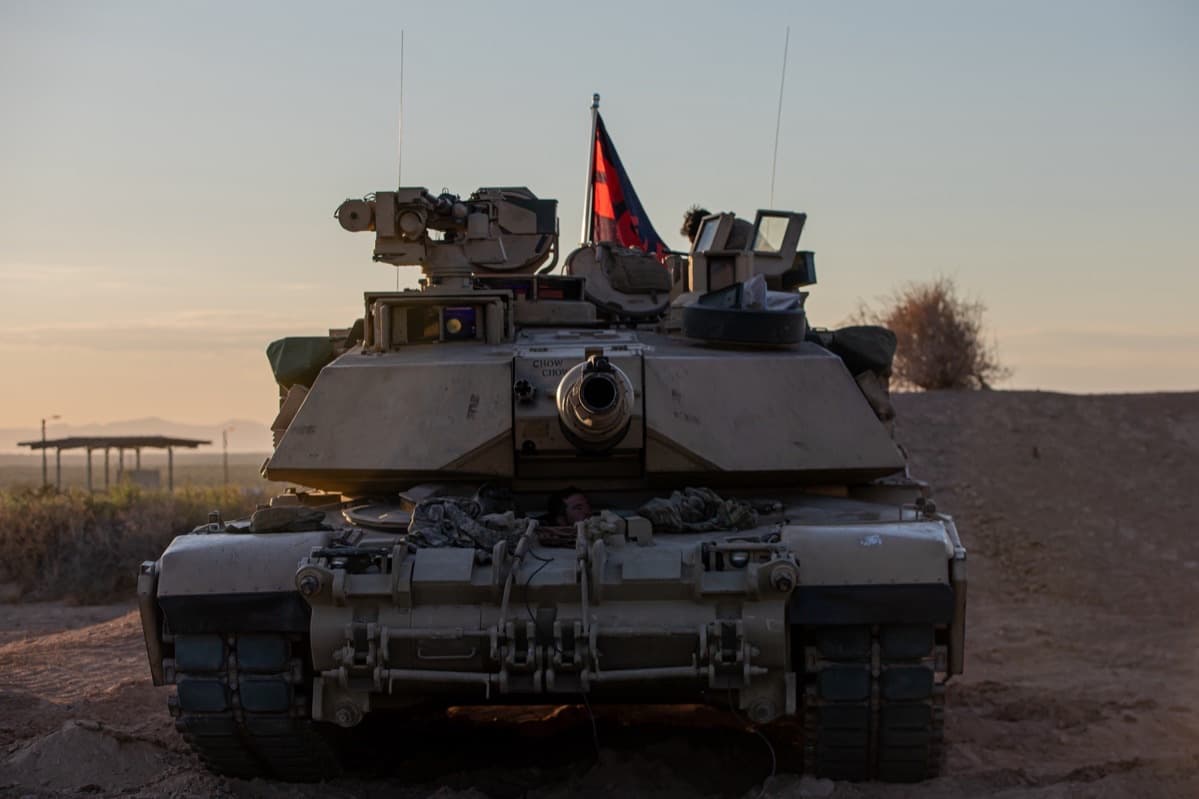
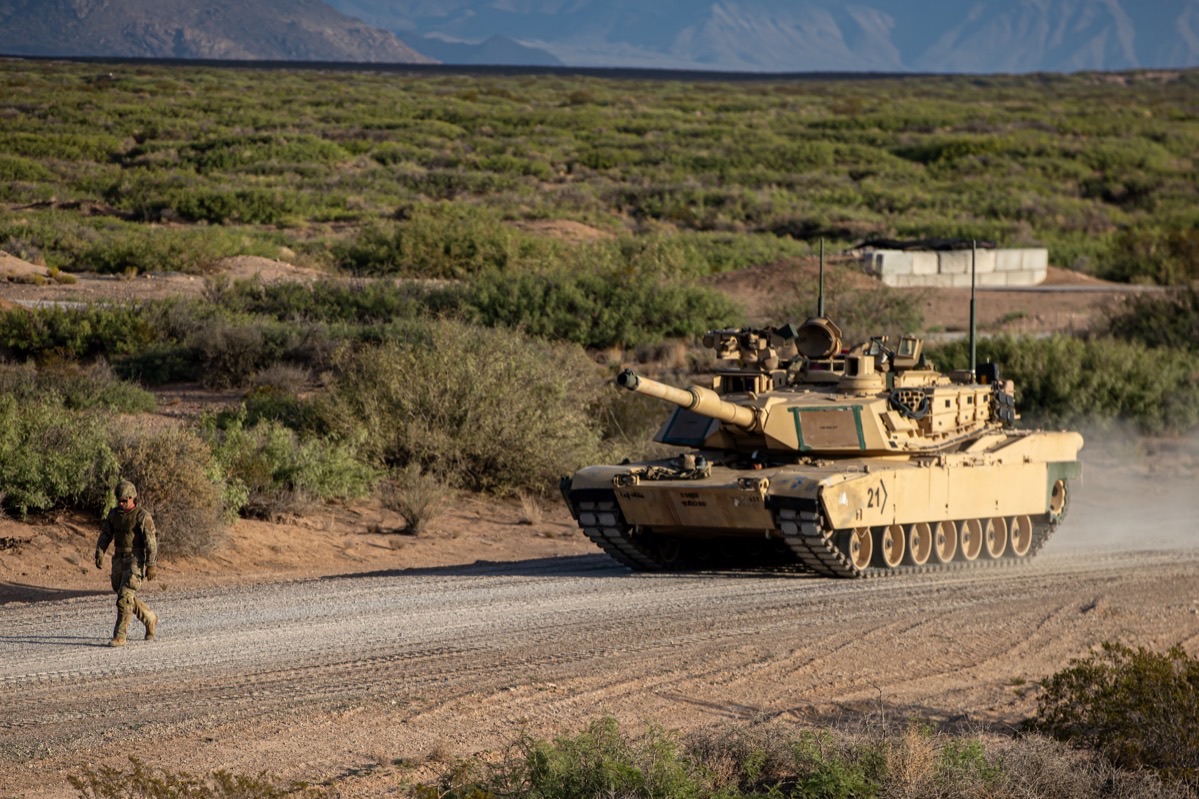
The Abrams turret cheeks house the thickest armor on the vehicle, a composite sandwich of steel, ceramics, and air gaps designed to defeat both kinetic penetrators and shaped charge warheads.
Chobham-type armor uses alternating layers of steel, ceramic tiles, and open space. The ceramic layers, typically aluminum oxide or boron carbide, are extremely hard. When a kinetic penetrator strikes them, the ceramic shatters and spreads the impact force across a wider area than steel alone. The steel layers catch fragments and absorb residual energy. The air gaps force incoming penetrators to destabilize and lose velocity before hitting the next barrier.
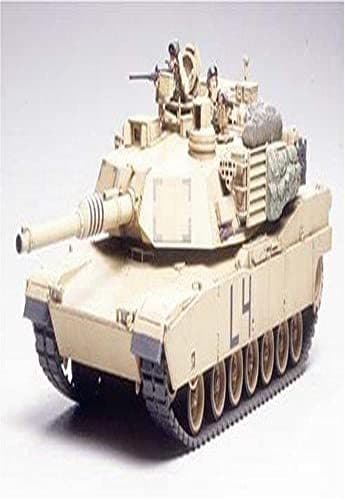
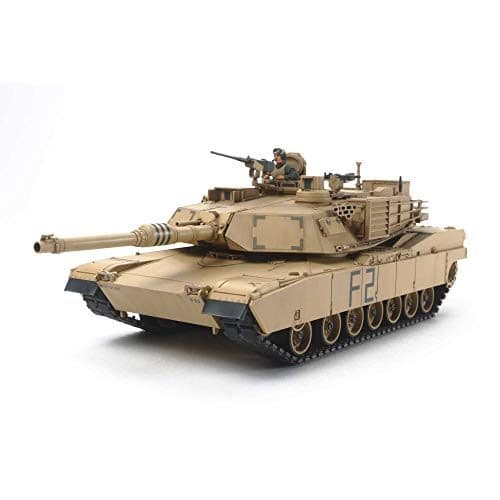
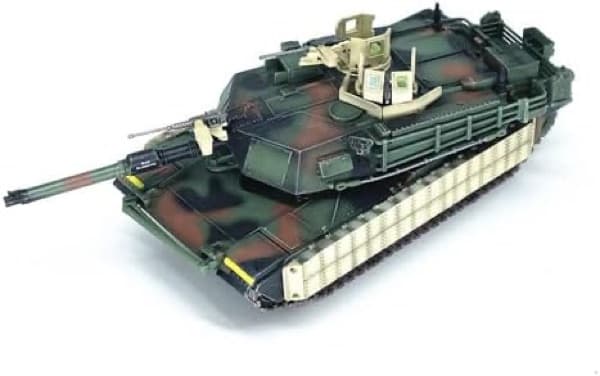
Tamiya's baseline M1A2 models the standard configuration before the TUSK urban warfare package. Clean lines, the distinctive wedge-shaped turret, and Tamiya's signature build quality. A strong pick for anyone who wants a "clean" Abrams without the bolt-on ERA and cage armor.
The frontal turret cheeks on an Abrams are approximately two feet thick. That is not two feet of steel, it is two feet of this composite sandwich, and the protection it provides far exceeds what two feet of solid steel would offer. In terms of Rolled Homogeneous Armor equivalent (RHAe), the standard measure for comparing armor effectiveness, the Abrams frontal arc provides between 940 and 960 millimeters of protection against kinetic energy threats. Against shaped charge warheads, the kind found in RPGs, ATGMs, and HEAT rounds, it provides between 1,320 and 1,620 millimeters of equivalent protection.
Those numbers mean that to penetrate the front of an Abrams with a kinetic round, you need a penetrator capable of punching through roughly a meter of solid steel. Very few weapons in any nation's inventory can do that reliably at combat ranges.
The Depleted Uranium Layer
Starting with the M1A1HA (Heavy Armor) variant introduced in 1988, the Abrams added a layer of depleted uranium (DU) mesh within its composite armor array. Depleted uranium is roughly 2.5 times denser than steel and extremely hard. When incorporated as a mesh layer inside the existing composite package, it dramatically increases resistance to both kinetic penetrators and shaped charge jets.
The DU mesh does not replace the ceramic-steel composite. It supplements it. The ceramic layers still shatter and spread incoming penetrators, but the DU mesh behind them provides an additional barrier that is exceptionally difficult to defeat. Shaped charge jets, which rely on a focused stream of superplastic metal, lose coherence rapidly when they encounter a material this dense.
This is critical for understanding the Abrams in Ukraine. The M1A1s provided to Ukraine were the M1A1SA variant, which lacks the depleted uranium armor insert. They are still well-protected by global standards, but they do not have the same frontal protection as the M1A1HA or M1A2 SEPv3 variants used by the U.S. Army. Every assessment of Abrams performance in Ukraine needs to account for this distinction.
How Blow-Out Panels Save Crews
Armor is only half the survivability equation. The other half is what happens when armor fails, when a round does penetrate, when ammunition catches fire, when something inside the tank starts to cook off. This is where the Abrams diverges most dramatically from Soviet and Russian tank designs, and it is arguably the single most important engineering decision in the vehicle's history.
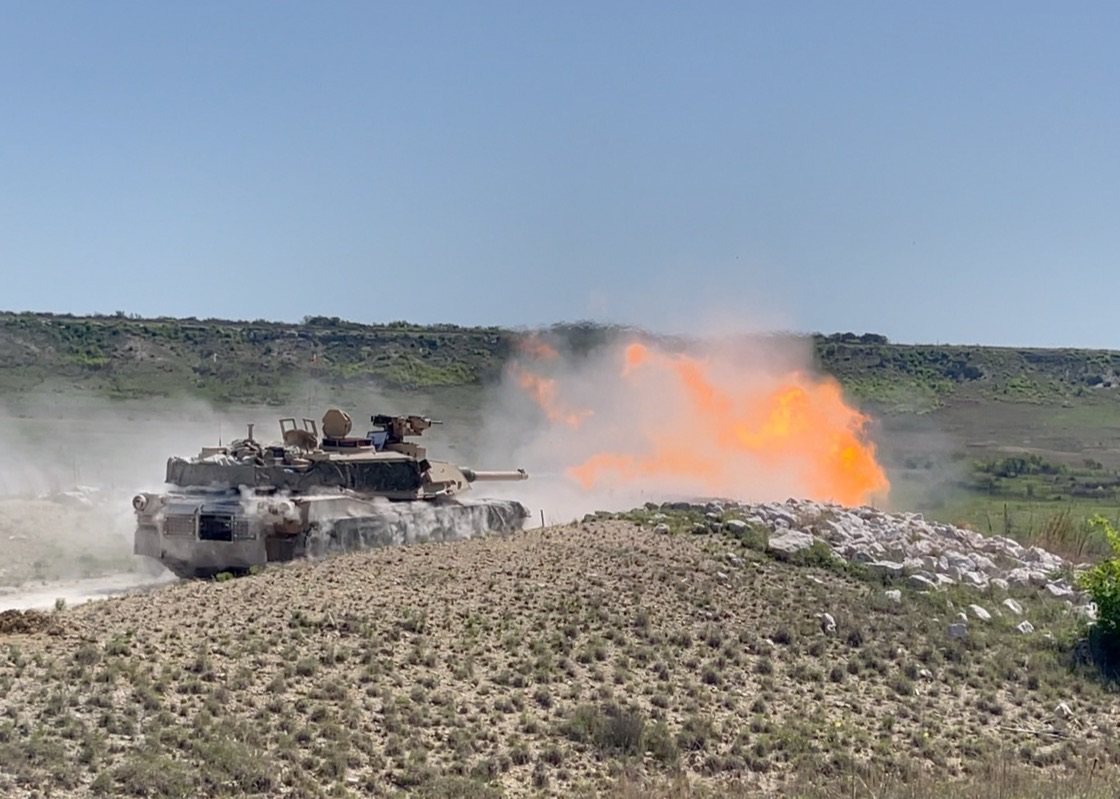
The Abrams stores its main gun ammunition in a compartment behind the turret, separated from the crew by armored blast doors. Blow-out panels on the roof vent explosive energy upward if the rounds detonate.
The Abrams stores its 120mm main gun rounds in a compartment in the turret bustle, behind the crew, separated from them by armored blast doors. If those rounds are hit and detonate, the explosion has only one easy path: upward, through blow-out panels built into the roof of the ammunition compartment. These panels are designed to rupture at a specific pressure threshold, channeling the blast and flame straight up and away from the crew compartment.
The blast doors between the ammo compartment and the crew area are spring-loaded. A loader opens them to grab a round, and they snap shut automatically. Even during active loading, the crew is separated from the ammunition by armored steel for all but a few seconds at a time. If a penetrator enters the ammo compartment while the blast door is closed, the crew may never know their rounds just cooked off, the blow-out panels vent everything skyward.
Tamiya's 1/48 Abrams packs serious detail into a smaller footprint. Around 130 parts, excellent fit, and the smaller scale means a faster build and less shelf space. A solid first "real" armor kit for someone stepping up from snap-fits.
There are photographs and video from both Iraq and Ukraine showing Abrams tanks with their bustle ammunition fully detonated, turret roof panels blown open, fire pouring straight up, where the crew walked away. The tank was destroyed, but the people inside were not. This is not luck. This is engineering.
The Abrams also carries an automatic fire suppression system that activates in under 200 milliseconds. Infrared sensors detect the flash of a penetration or internal fire and discharge halon before the crew can register what happened. This system has prevented numerous secondary fires and given crews time to evacuate penetrated vehicles.
Iraq: RPGs, IEDs, and Friendly Fire
The Abrams saw its most extensive combat during the 2003 invasion of Iraq and the subsequent occupation. Over the course of the war, Abrams tanks took hundreds of hits from RPGs, ATGMs, IEDs, and even friendly fire. The data from Iraq provides the clearest picture of what the Abrams can and cannot survive.
An M1 Abrams showing the aftermath of multiple RPG strikes during urban combat in Iraq. The frontal armor defeated every hit, the scorch marks are cosmetic, not structural.
RPG-7 hits against the frontal arc were completely ineffective. The standard PG-7V warhead generates roughly 300mm of RHAe penetration. Against an armor package rated for 1,300+ millimeters against HEAT, the RPG rounds simply splashed against the surface. Crews reported hearing a bang and feeling a slight vibration, but the rounds left nothing more than scorch marks on the exterior.
Side and rear hits were a different story. The Abrams, like every tank, has thinner armor on its flanks and rear. During the Battle of Baghdad in April 2003, at least one Abrams was penetrated through its rear fuel cell by an RPG, starting a fire, but the crew evacuated safely. Another was disabled by an RPG to the rear engine grill during fighting in Sadr City.
The most significant threat in Iraq turned out to be explosively formed penetrators (EFPs), sophisticated IEDs that fire a slug of molten copper at several thousand feet per second. EFPs could penetrate the side armor below the turret ring, and several vehicles were destroyed by these weapons. The U.S. response was to add reactive armor tiles and additional side skirts on later variants.
Only one Abrams was confirmed destroyed by another Abrams in a friendly fire incident, requiring a direct hit from a 120mm sabot round. The fact that it took an Abrams-level weapon to kill an Abrams tells you everything about the protection level.
Ukraine: A New Threat Environment
The 31 M1A1 Abrams provided to Ukraine beginning in late 2023 entered a fundamentally different combat environment. Instead of insurgents with RPGs, these tanks faced a near-peer adversary with guided anti-tank missiles, precision artillery, loitering munitions, and FPV kamikaze drones. As of early 2026, approximately 22 of the 31 tanks have been confirmed lost or damaged beyond battlefield repair.
The loss numbers look bad in isolation, but context matters. The majority of losses came from threats no tank's armor was designed to defeat: top-attack munitions like the Lancet loitering drone, guided 152mm Krasnopol rounds, and FPV drones diving onto thin roof armor. These weapons bypass the frontal composite entirely, striking the turret top where protection is measured in tens of millimeters rather than hundreds.
The Abrams (left) stores ammunition in a bustle compartment behind the turret with blow-out panels. The T-72 (right) stores rounds in a carousel autoloader beneath the turret, directly under the crew.
This is the same problem facing every tank in Ukraine. Russian T-72B3s, T-80BVMs, and even T-90Ms are being destroyed by the same classes of weapons. The difference is what happens to the crew after the hit. And this is where the Abrams design earns its reputation.
The Ukrainian crew that survived four to six direct hits is not an isolated case. Multiple reports from Ukrainian tankers describe taking hits that disabled the vehicle, broken tracks, destroyed optics, damaged engine, while the crew compartment remained intact. Crews were able to evacuate under fire from vehicles that were combat-ineffective but structurally sound enough to protect the people inside.
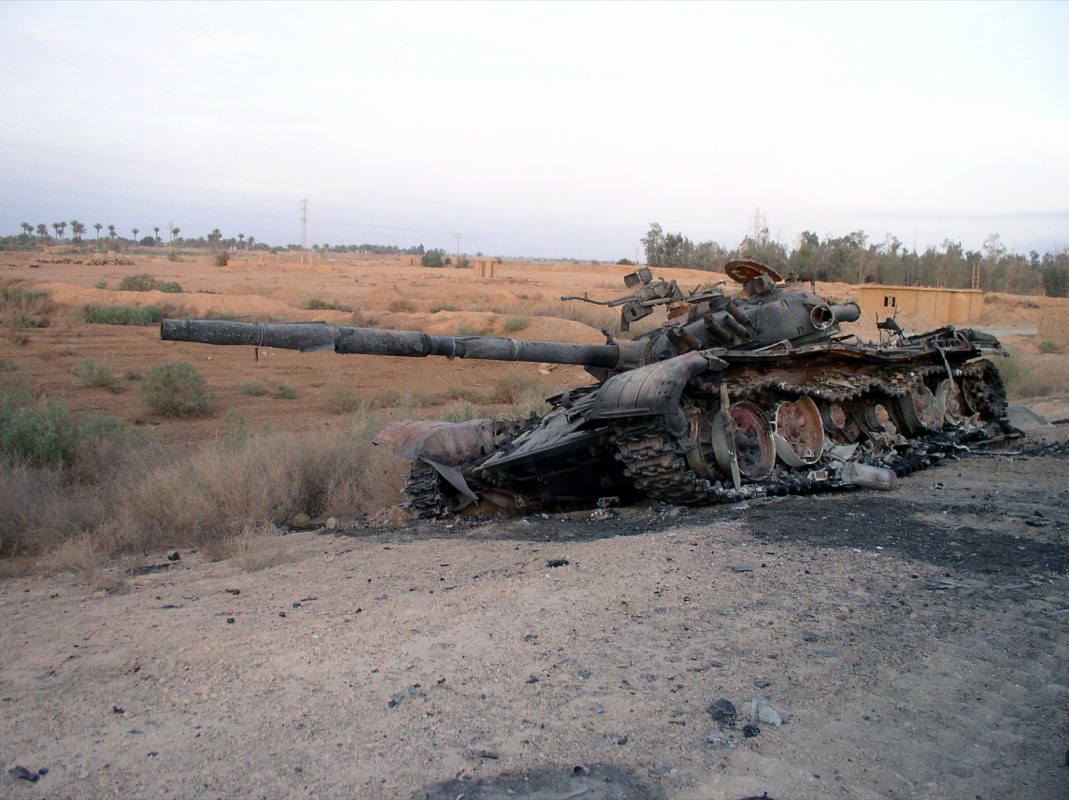
Compare this to Russian tank losses. The T-72, T-80, and T-90 families all use a carousel autoloader that stores ammunition in a ring beneath the turret floor, directly below the crew. When a penetrator strikes the ammunition, the entire carousel detonates. The explosion blows the turret off the hull, often sending it thirty feet into the air. This is the "jack-in-the-box" effect, and it is almost universally fatal.
Open-source tracking has documented hundreds of Russian tanks suffering catastrophic ammunition detonations. The turret separates from the hull. The crew never has a chance. The autoloader carousel, designed to eliminate the need for a human loader, turned out to be a lethal vulnerability that kills the very crew it was supposed to help.
Why Crews Survive: The Full Picture
Abrams crews train extensively on rapid evacuation. The tank features three top hatches and a belly escape hatch, giving crews multiple exit routes when the vehicle is disabled.
Crew survivability on the Abrams is not the result of any single feature. It is a system. The composite armor defeats direct penetration. The DU mesh adds density. The blow-out panels handle ammunition detonation by redirecting blast energy away from the crew. The automatic fire suppression system kills internal fires before they spread. The blast doors isolate the crew from stored ammunition. The hull escape hatch gives crews an exit even if the turret is burning.
Each layer matters because no single layer is perfect. Armor can be overwhelmed. Blow-out panels cannot help if the blast doors are open during loading. Fire suppression cannot stop a catastrophic structural failure. But layered together, these systems create redundancy. The crew does not need every system to work, they need enough of them to work.
This philosophy, survivability through redundancy rather than invulnerability through raw thickness, is the defining characteristic of Western tank design. The Abrams does not claim to be impenetrable. It claims to keep its crew alive even when penetration occurs. The combat data from Iraq and Ukraine suggests it works.
What Armor Cannot Do in 2026
The honest assessment of the Abrams in 2026 is that its armor remains among the best ever fielded, and it is no longer sufficient on its own. The battlefield has changed. FPV drones costing a few hundred dollars can strike the roof of a sixty-eight-ton tank from any angle. Loitering munitions can orbit overhead for hours waiting for the right moment. Precision-guided artillery can land a round within meters of a GPS coordinate from thirty kilometers away.
None of these threats challenge the frontal composite armor. They do not need to. They attack the top, the rear, the tracks, the optics, anywhere the armor is thin or absent. A $500 drone with a shaped charge warhead does not care about 960mm of RHAe on the turret cheeks if it is diving onto the engine deck.
This is why the next Abrams upgrades focus as much on active protection systems as passive armor. The Trophy APS, already being integrated onto U.S. Army Abrams, uses radar to detect incoming projectiles and fires a shotgun-like blast to destroy them before impact. It works against RPGs, ATGMs, and potentially some drone threats. But it cannot intercept top-attack munitions at extreme angles, and it has limited interceptors before needing reload.
The real answer is combined arms, tanks operating with infantry that can shoot down drones, electronic warfare systems that jam drone control links, air defense that keeps loitering munitions from reaching the battlespace, and reconnaissance that identifies anti-tank positions before the tanks roll into range. The Abrams was never designed to fight alone. No tank is.
What the Abrams proves, even in Ukraine, is that crew survivability engineering works. Tanks will be hit. Tanks will be destroyed. The question that matters is whether the crew walks away. For the Abrams, the answer is yes far more often than it should be.
The Ukrainian tankers who climbed out of their shattered Abrams after absorbing half a dozen hits are alive because engineers in the 1970s decided that ammunition should be stored behind blast doors with blow-out panels. That decision, made before most of those tankers were born, is the reason they went home. That is what good armor engineering looks like. Not invincibility, survivability.