Skip to content
April 24:Operation Eagle Claw Fails in Iran46yr ago

The MiG-31 Foxhound Can Fly Mach 2.83 and Fire Missiles at Targets 200 Miles Away

Michael Trent · · 10 min read
Save
Share:
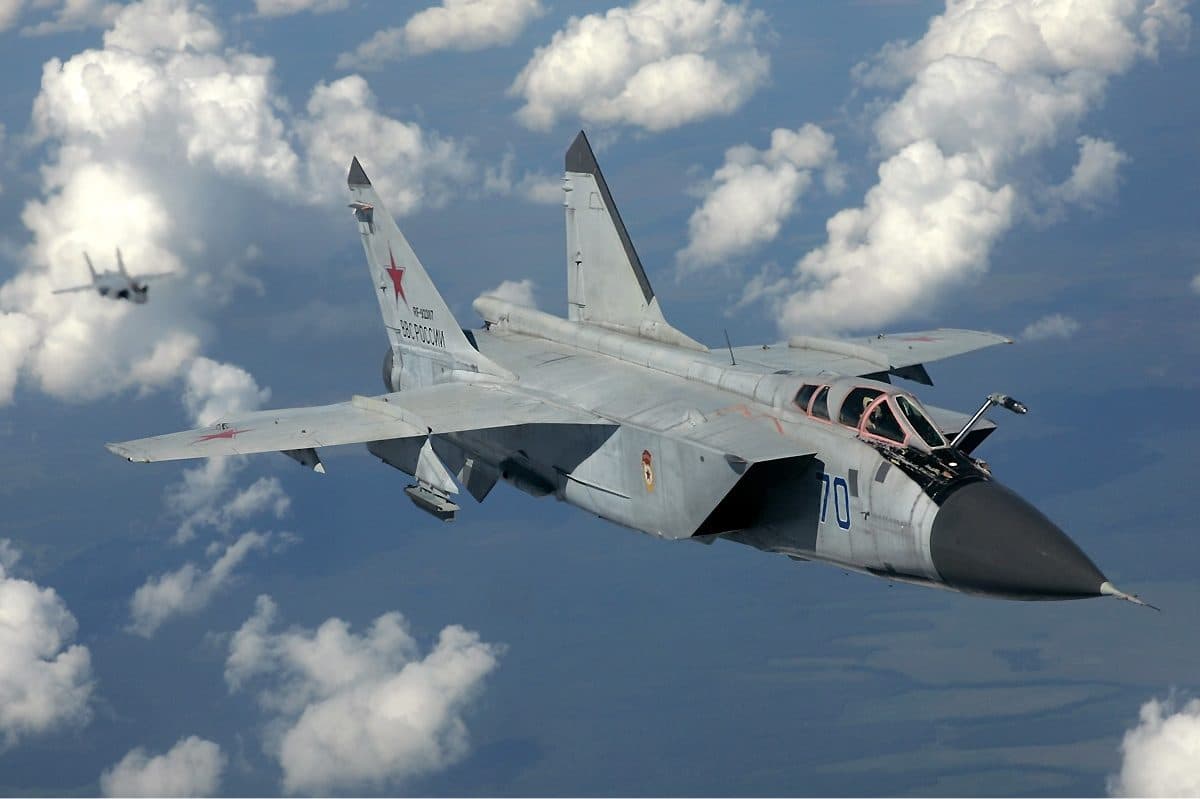
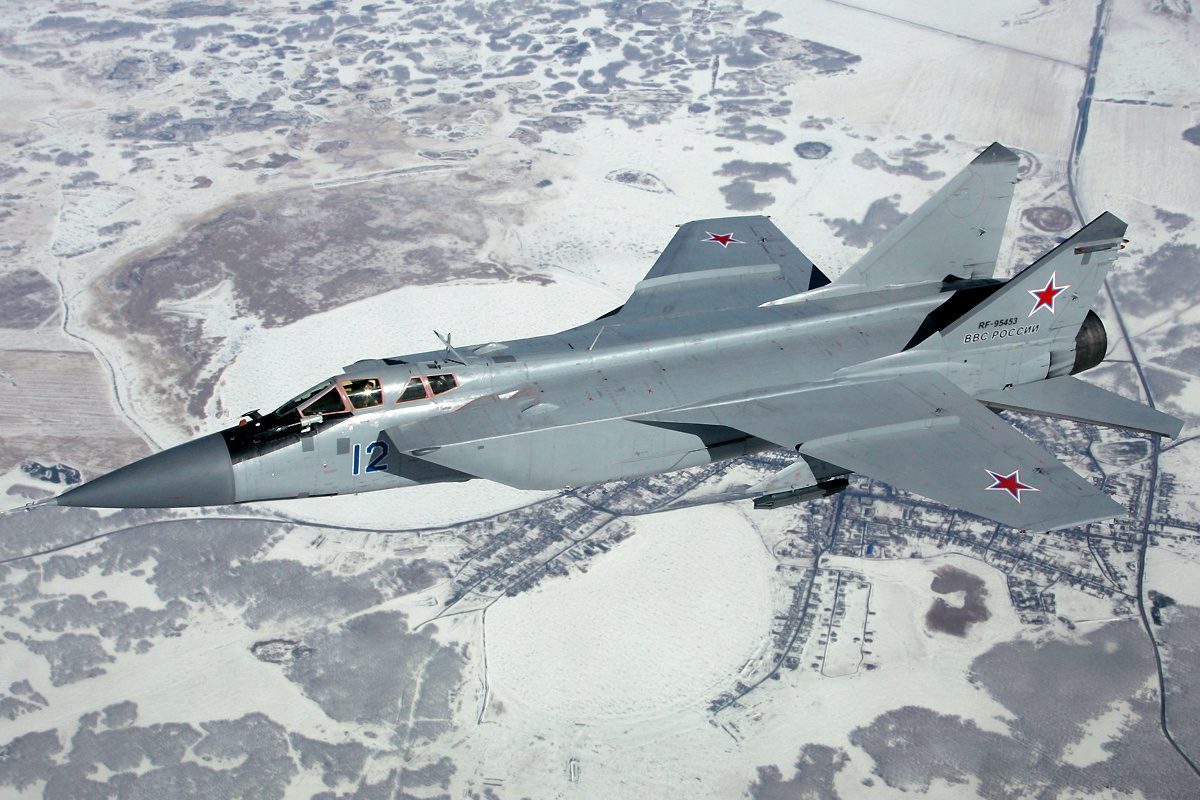
Russian Air Force MiG-31 Foxhound interceptor in flight showing its twin-engine configuration and large airframe
Michael Trent
Michael Trent

Defense Systems Analyst

Michael Trent covers military aircraft, weapons systems, and defense technology with an emphasis on cost, maintenance, and real-world performance. He focuses less on specifications and more on how systems hold up once they are deployed, maintained, and operated at scale.

The MiG-31 was designed to catch the SR-71 Blackbird. It is still the fastest fighter in any air force. At Mach 2.83, the Foxhound can outrun anything in the sky except the aircraft it was built to intercept, and that aircraft was retired 28 years ago. What remains is the most powerful interceptor ever built: a twin-engine, two-seat weapons platform that can detect targets at over 200 miles, fire missiles at four of them simultaneously, and cover more airspace than any other fighter in the world. Russia has never built a replacement because nothing else can do what the MiG-31 does.

Built to Kill the Blackbird

In the 1970s, the Soviet Union faced a reconnaissance threat it could not counter. The American SR-71 Blackbird operated at altitudes above 80,000 feet and speeds exceeding Mach 3.2. The existing Soviet interceptor, the MiG-25 Foxbat, could reach Mach 2.83 in a sprint but lacked the radar range, missile capability, and operational flexibility to reliably intercept targets at extreme altitude. The Foxbat was a brute-force solution, fast but limited, and the Soviet Air Defense Forces needed something fundamentally better.

The Mikoyan design bureau began work on the MiG-31 in 1975, using the MiG-25's airframe as a starting point but designing an entirely new aircraft around it. The result was larger, heavier, and far more capable than its predecessor. The MiG-31 first flew on September 16, 1975, and entered service in 1981. It was the Soviet Union's answer to a threat that was already pushing the limits of physics, and the aircraft they built turned out to be so capable that it outlived the threat it was designed to counter by decades.
Russian Air Force MiG-31 Foxhound on the ground showing its large airframe and twin vertical stabilizers
A Russian Air Force MiG-31 on the ground. The aircraft's massive airframe houses the Zaslon phased-array radar in the nose and two Soloviev D-30F6 turbofan engines in the fuselage. (Photo: Dmitriy Pichugin, via Wikimedia Commons)

The Zaslon Radar: First Fighter with Phased Array

The MiG-31's most revolutionary feature was its Zaslon (SBI-16) radar, the first electronically scanned phased-array radar ever installed in a fighter aircraft. While Western fighters of the era used mechanically scanned antennas that physically rotated to sweep the sky, the Zaslon used a fixed antenna with 1,700 elements that steered the radar beam electronically. This gave the radar several critical advantages.

First, the Zaslon could track 10 targets simultaneously while scanning the rest of the sky, a capability no Western fighter would match until the F-22 Raptor entered service in 2005. Second, the radar could engage 4 targets at once, guiding missiles to separate targets on different bearings, altitudes, and speeds. Third, the electronic scan meant the beam could jump between search and track modes in microseconds, maintaining situational awareness while prosecuting multiple engagements.

The radar's detection range was equally extraordinary. The Zaslon could detect a fighter-sized target at approximately 200 kilometers (124 miles) and a bomber-sized target at over 300 kilometers (186 miles). Against the SR-71, a very large target flying at extreme altitude, the detection range was even greater. For the first time, the Soviet Union had an interceptor that could detect and track an SR-71 before the American aircraft even knew it was being hunted.

The R-33 and R-37M: Killing at 200 Miles

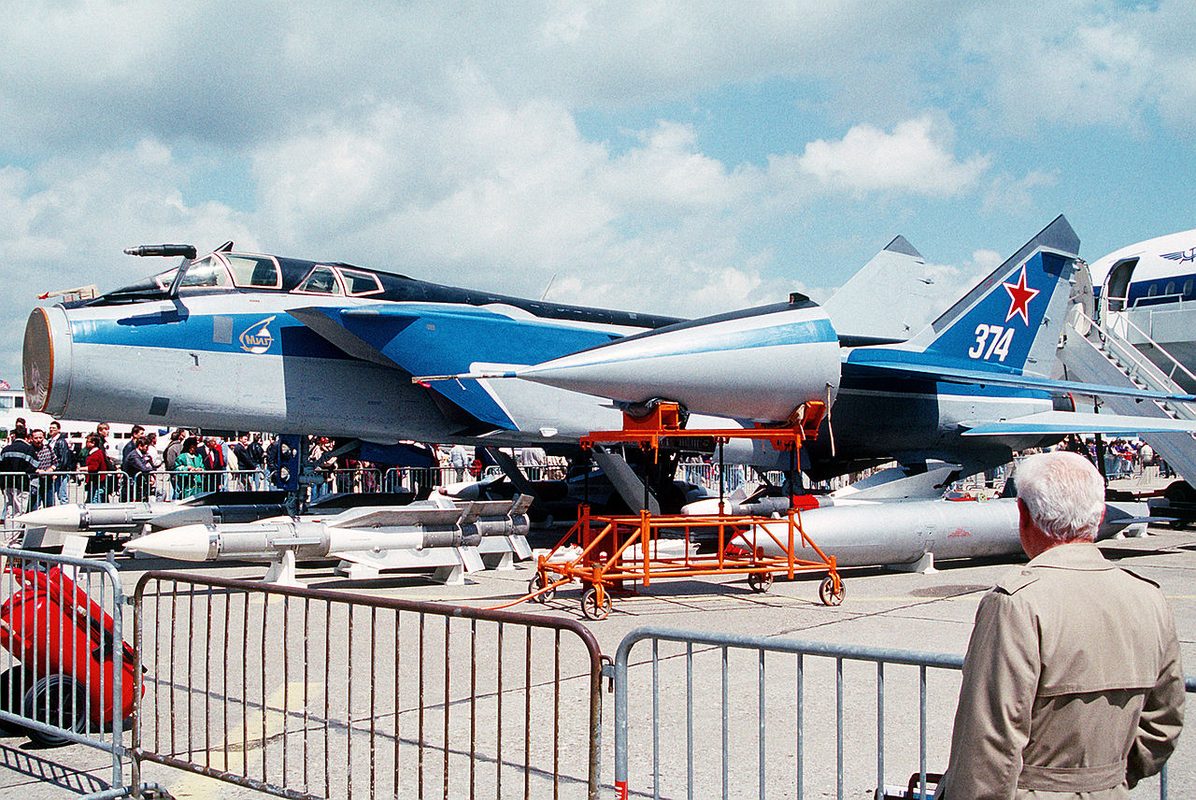
Soviet MiG-31 Foxhound interceptor at an airshow showing the aircraft's configuration and armament
A Soviet MiG-31 on display at the 1991 Paris Air Show, one of the first public appearances of the Foxhound in the West. (Photo via Wikimedia Commons)

The original MiG-31 carried the R-33 (AA-9 Amos), a long-range, semi-active radar-homing air-to-air missile with a range of approximately 160 kilometers (100 miles). The R-33 was the largest air-to-air missile in operational service, weighing over 1,100 pounds and measuring 4.15 meters in length. It was designed to destroy large, fast-moving targets at extreme range: specifically, cruise missiles and reconnaissance aircraft operating at high altitude.

The modernized MiG-31BM, which began entering service in 2011, carries the R-37M (AA-13 Arrow), a missile that pushed long-range air combat into entirely new territory. The R-37M has a reported range exceeding 300 kilometers (186 miles), making it the longest-range air-to-air missile in active service anywhere in the world. The missile uses inertial guidance with mid-course updates from the launch aircraft's radar, switching to active radar homing in the terminal phase. It can engage targets at altitudes from 15 meters to 25,000 meters at speeds up to Mach 6.

The R-37M's combat debut came during the war in Ukraine, where MiG-31BM aircraft reportedly fired R-37M missiles at Ukrainian aircraft from distances that placed the launch aircraft well outside the range of any Ukrainian air defense or fighter response. The combination of the MiG-31's speed, the Zaslon-M radar's detection range, and the R-37M's 300+ kilometer reach means the Foxhound can engage targets before they even know they are being tracked.

Mach 2.83 and the Limits of Speed

The MiG-31's maximum speed is Mach 2.83 at altitude, approximately 1,860 mph. This makes it the fastest combat aircraft in active service, faster than any Western fighter including the F-15 Eagle (Mach 2.5) and the Eurofighter Typhoon (Mach 2.0). Two Soloviev D-30F6 afterburning turbofan engines produce 34,170 pounds of thrust each, giving the aircraft a combined thrust of over 68,000 pounds, enough to push the 101,000-pound airframe past Mach 2.8 in a sustained cruise.

But Mach 2.83 is not a speed the MiG-31 uses routinely. At those velocities, the airframe heats from aerodynamic friction, fuel consumption is extreme, and engine life is significantly reduced. Normal intercept profiles are flown at Mach 1.5 to 2.0, with the full-speed sprint reserved for closing on a time-critical target. The aircraft's practical operational speed, the speed at which it can fly for extended periods without excessive wear, is approximately Mach 2.35.

The Two-Seat Advantage

Unlike most modern fighters, the MiG-31 carries a crew of two: a pilot in the front cockpit and a Weapons Systems Officer (WSO) in the rear. This division of labor is critical to the aircraft's interceptor mission. The WSO manages the Zaslon radar, tracks multiple targets, coordinates with other MiG-31s via the APD-518 data link, and directs missile engagements. The pilot focuses on flying the aircraft, maintaining the intercept geometry, and managing the engines and fuel system.

Four MiG-31s linked via datalink can coordinate their radars to cover a front of approximately 900 kilometers (560 miles). This networked capability was revolutionary in the 1980s and remains relevant today. A flight of four Foxhounds can establish a radar barrier across an entire military district, detecting and engaging any aircraft that attempts to penetrate the defended airspace. No other fighter in the world can cover this much airspace with this few aircraft.

The Kinzhal: From Interceptor to Hypersonic Strike Platform

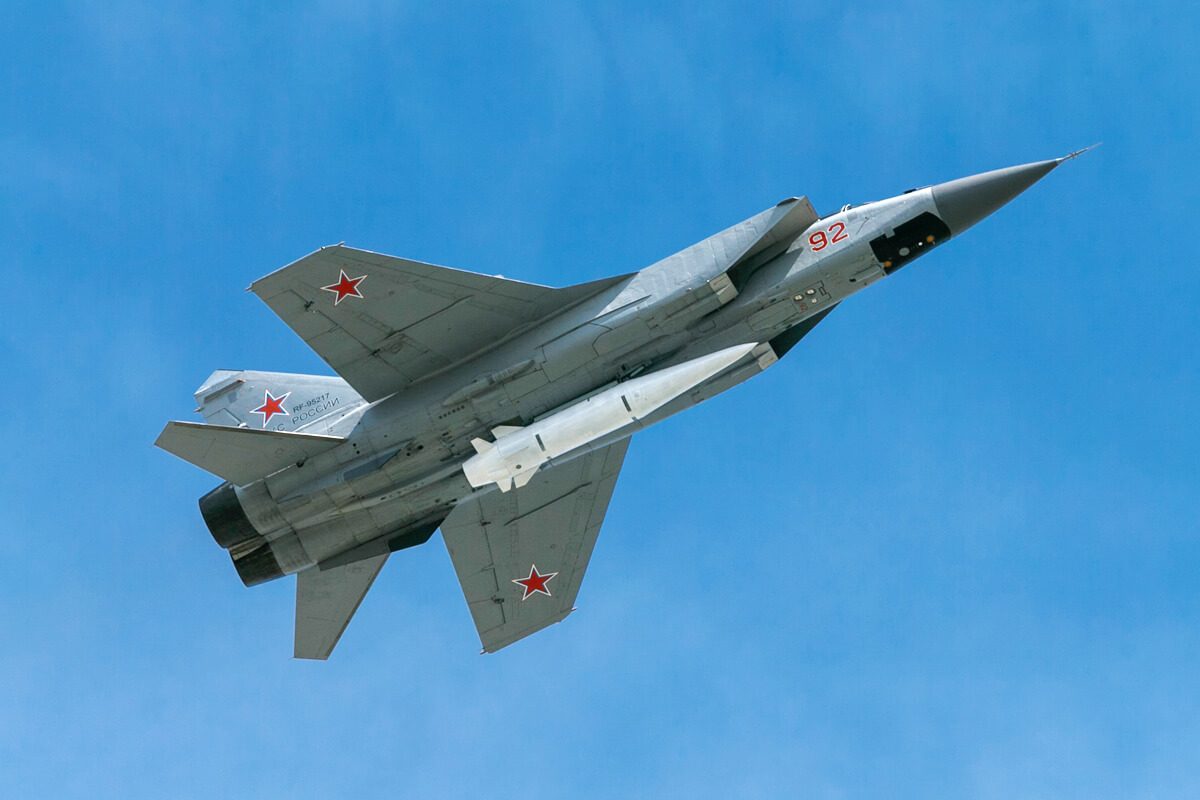
MiG-31K carrying a Kh-47M2 Kinzhal hypersonic missile during a military parade flyover
A MiG-31K carrying a Kh-47M2 Kinzhal hypersonic missile during a Victory Day parade flyover. The Kinzhal transforms the interceptor into a long-range strike platform. (Photo via Wikimedia Commons)

The MiG-31K variant carries the Kh-47M2 Kinzhal, a nuclear-capable hypersonic aeroballistic missile with a reported range of approximately 2,000 kilometers (1,240 miles) when launched from altitude. The Kinzhal is an air-launched derivative of the Iskander short-range ballistic missile, accelerated to speeds exceeding Mach 10. The MiG-31K serves as the launch platform because no other Russian aircraft can fly fast enough and high enough to give the Kinzhal its required launch parameters.

The Kinzhal was used in combat for the first time in March 2022, when Russia reported launching the weapon against a Ukrainian ammunition depot. The missile's extreme speed makes it extremely difficult to intercept with current air defense systems, though Ukraine has reported intercepting Kinzhal missiles using the Patriot system. Regardless of the Kinzhal's combat effectiveness debate, the MiG-31K variant represents a remarkable evolution: an aircraft designed in the 1970s to intercept reconnaissance planes has become the delivery platform for one of the most advanced weapons in Russia's arsenal.

Why Russia Still Flies a 1980s Interceptor

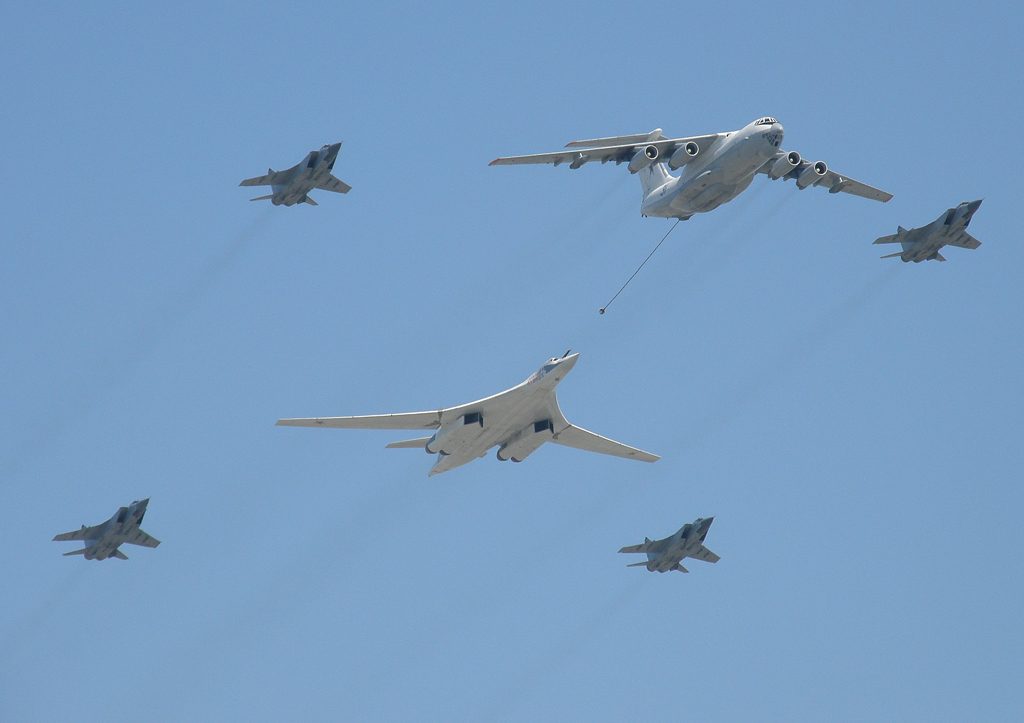
MiG-31 and other Russian military aircraft in formation flight
Russian Air Force aircraft including a MiG-31 in formation. Despite its age, the Foxhound remains in frontline service because no other aircraft can match its speed and radar coverage. (Photo via Wikimedia Commons)

Russia still flies the MiG-31 for the same reason it was built: nothing else covers as much airspace as fast. Russia's air defense challenge is fundamentally geographic. The country spans 11 time zones and has over 12,000 miles of borders, much of it in remote Arctic and Siberian regions where ground-based radar coverage is sparse. The MiG-31 can patrol these vast, empty frontiers at supersonic speed, covering gaps in radar coverage that no ground-based system can fill.

The planned replacement, the MiG-41 (sometimes called the PAK DP), has been discussed for over a decade but has not progressed beyond the conceptual stage. Meanwhile, Russia has continued to modernize existing MiG-31 airframes with the BM and BSM upgrade packages, extending their service life through at least the 2030s. Approximately 120 to 130 MiG-31s remain in Russian service, enough to maintain interceptor coverage across the country's most critical air defense sectors.

The MiG-31 Foxhound was built to catch an aircraft that no longer flies, carries a radar that was ahead of its time by 25 years, and now delivers a hypersonic missile that did not exist when the airframe was designed. It is a Cold War machine doing 21st-century work, and doing it because no one has built anything better for the mission it was designed to perform.

Share this article

Share:

Recommended

Ace of The Skies: Can You Identify These Military Aircraft Throughout The Years?
Test Yourself

Ace of The Skies: Can You Identify These Military Aircraft Throughout The Years?

Can you identify these aircraft?

Take the Quiz

On This Day in Military History

April 24

Operation Eagle Claw Fails in Iran (1980)

President Carter's mission to rescue 52 American hostages from the US Embassy in Tehran was aborted at Desert One staging area after three helicopters became inoperable. During withdrawal, a helicopter collided with a C-130, killing eight servicemen. The disaster led to the creation of US Special Operations Command.

1915, Armenian Genocide Begins

1916, Easter Rising in Dublin

See all 11 events on April 24

Get Military News & History in Your Inbox

Join thousands of readers receiving our weekly digest of military technology, history, and analysis.

Test Your Knowledge