
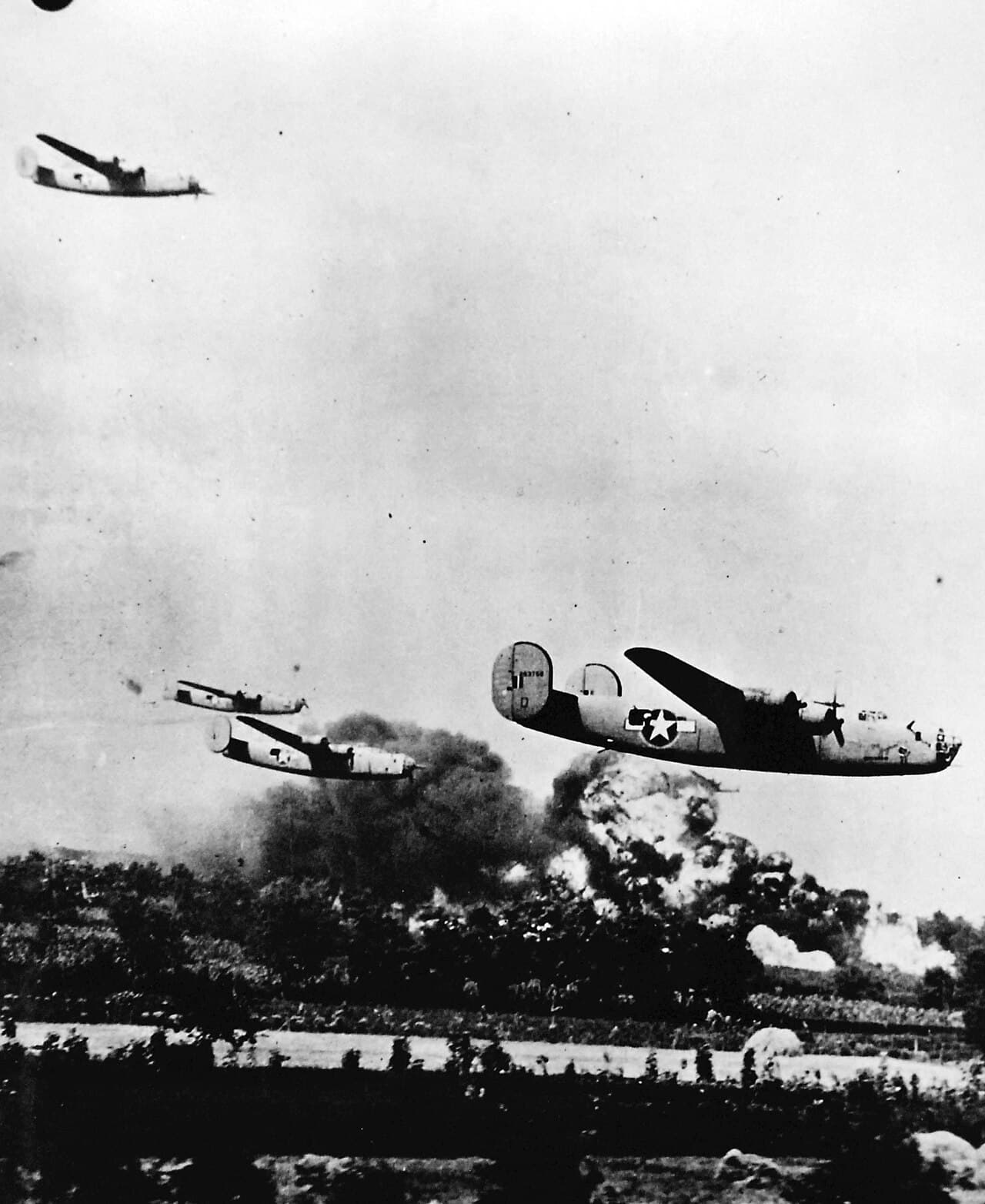
Consolidated B-24J Liberator
Consolidated Aircraft
How does the B-24J stack up?
CompareOverview
The Consolidated B-24 Liberator holds the distinction of being the most-produced American military aircraft in history, with 18,482 built, a record that stands to this day. It was also the most-produced heavy bomber and the most-produced multi-engine aircraft of any type in aviation history. Yet despite these superlatives, the B-24 has long lived in the shadow of the more photogenic B-17 Flying Fortress.
The Liberator's innovative Davis high-aspect-ratio wing gave it longer range and higher speed than the B-17, and its capacious bomb bay could accommodate a heavier payload. It served in every theater of the war and performed a wider variety of missions than any other American aircraft: strategic bombing, maritime patrol, anti-submarine warfare, cargo transport, tanker duties, and photo-reconnaissance. The B-24 was the only Allied bomber to operate from every continent during the war.
The aircraft demanded more from its pilots than the B-17. It was less forgiving of errors, harder to fly in tight formation, and more vulnerable to battle damage due to its high-mounted Davis wing and fuel-laden wing structure. But it was faster, flew farther, and carried more bombs, and the men who flew it were every bit as courageous as their B-17 counterparts.
Performance Profile
Max Speed
290 mph
at 25,000 ft
Range
2,100 miles
normal
Service Ceiling
28,000 ft
Rate of Climb
1,025 ft/min
Armament
10 guns
10x .50 BMG
Crew
10
Engine
Pratt & Whitney R-1830-65 Twin Wasp
1200 hp radial
Development History
The B-24 was designed by Consolidated Aircraft's chief engineer, Isaac "Mac" Laddon, in response to a 1938 Army Air Corps request for a heavy bomber superior to the B-17. Laddon's design featured the revolutionary Davis wing, a high-aspect-ratio, low-drag airfoil that promised greater speed and range than conventional wings. The XB-24 prototype first flew on December 29, 1939, only nine months after the contract was signed.
The B-24's design incorporated several innovations for its era: tricycle landing gear (unusual for a heavy bomber), roll-up bomb bay doors that minimized drag compared to the B-17's hinged doors, and the Davis wing that gave it a 300-mile range advantage over the B-17. However, the high-mounted wing and fuel tanks within the wing structure made the B-24 more vulnerable to catastrophic structural failure when hit by flak.
Production of the B-24 became one of the great industrial achievements of the war. Henry Ford's Willow Run plant in Michigan, the largest factory under one roof in the world, eventually produced one B-24 per hour. The aircraft was also built by Consolidated in San Diego and Fort Worth, Douglas in Tulsa, and North American in Dallas. At peak production, the five plants produced over 650 B-24s per month.
The B-24J was the most-produced single variant, standardizing the powered nose turret (either Consolidated or Emerson), an autopilot, improved bomb-release mechanism, and the C-1 autopilot for formation flying. It represented the mature Liberator, with most of the teething problems of earlier variants resolved.
Combat History
The B-24 first saw combat in June 1942 when Liberators of the HALPRO detachment staged a long-range raid against the Ploesti oil refineries in Romania from bases in Egypt, previewing a target that would become infamous. On August 1, 1943, 178 B-24s of the Eighth and Ninth Air Forces launched Operation Tidal Wave, the low-level attack on Ploesti that became one of the most costly and controversial raids of the war. Of the 178 Liberators that set out, 53 were lost and many more were damaged. Five Medals of Honor were awarded for the mission.
In England, the Second Air Division of the Eighth Air Force operated B-24s alongside the B-17-equipped divisions. Liberator groups bombed the same targets, oil refineries, ball-bearing plants, aircraft factories, marshaling yards, and suffered proportionally similar losses. The B-24's higher cruise speed made it slightly harder for fighters to intercept, but its Davis wing was more vulnerable to flak damage, and the aircraft was less able than the B-17 to absorb structural damage and keep flying.
In the Pacific and CBI theaters, the B-24 was the primary American heavy bomber. The Fifth, Seventh, Tenth, and Fourteenth Air Forces operated Liberators across the Pacific, India, and China. B-24s flew some of the longest over-water bombing missions of the war, exploiting their superior range. In the anti-submarine role, RAF Coastal Command and US Navy PB4Y-1 (Navy B-24) Liberators closed the mid-Atlantic gap and played a critical role in winning the Battle of the Atlantic.
The C-87 Liberator Express transport variant flew the dangerous "Hump" route over the Himalayas, delivering supplies from India to China. The B-24 was truly the most versatile heavy aircraft of the war, performing every mission asked of it from strategic bombing to maritime patrol to cargo hauling.
Variants
| Designation | Key Differences | Produced |
|---|---|---|
| B-24D | First mass-production variant, tunnel gun position, no nose turret, Ploesti veteran | 2,738 |
| B-24H | Emerson nose turret, improved tail turret, reduced crew blind spots | 3,100 |
| B-24J | Standardized nose turret, C-1 autopilot, improved bomb-release, most-produced variant | 6,678 |
| PB4Y-2 Privateer | Navy single-tail maritime patrol variant, lengthened fuselage, seven gun turrets | 739 |
| C-87 Liberator Express | Transport variant, seats for 25 passengers or cargo, flew the "Hump" | 287 |
| B-24M | Final production variant, lightweight tail turret, reduced weight | 2,593 |
Strengths & Weaknesses
+Strengths
- Longer range than the B-17, enabling missions to targets beyond the Fortress's reach
- Larger bomb bay accommodated heavier and bulkier loads than the B-17
- Higher cruise speed made formation flying more efficient and reduced exposure to defenses
- Roll-up bomb bay doors minimized drag and opened/closed faster than conventional doors
- Extreme versatility: served as bomber, maritime patrol, transport, tanker, and reconnaissance platform
-Weaknesses
- Davis wing was structurally more vulnerable to flak damage; a single hit could cause catastrophic wing failure
- Less forgiving to fly than the B-17, especially in formation and during emergency situations
- Lower service ceiling than the B-17 increased vulnerability to flak
- Could not sustain as much battle damage as the B-17 and still remain airborne
- Heavier control forces made long missions physically exhausting for pilots
Pilot Voices
“The B-24 was a harder airplane to fly than the B-17, but it went farther and carried more. The B-17 boys didn't like to hear that, but it was true.”
“You had to stay on top of a B-24 every minute. It would bite you if you got sloppy. But she'd get you there and bring you back if you treated her right.”
Did You Know?
The B-24 Liberator is the most-produced American military aircraft in history with 18,482 built, a record that has never been broken.
Henry Ford's Willow Run plant in Michigan eventually produced one B-24 per hour on a mile-long assembly line, one of the great industrial feats of the war.
The Operation Tidal Wave low-level attack on Ploesti on August 1, 1943, resulted in five Medals of Honor, more than any other single air action in history.
B-24s serving in RAF Coastal Command and with the US Navy were instrumental in winning the Battle of the Atlantic, their long range allowing them to patrol the mid-Atlantic gap where U-boats had previously operated with impunity.


