
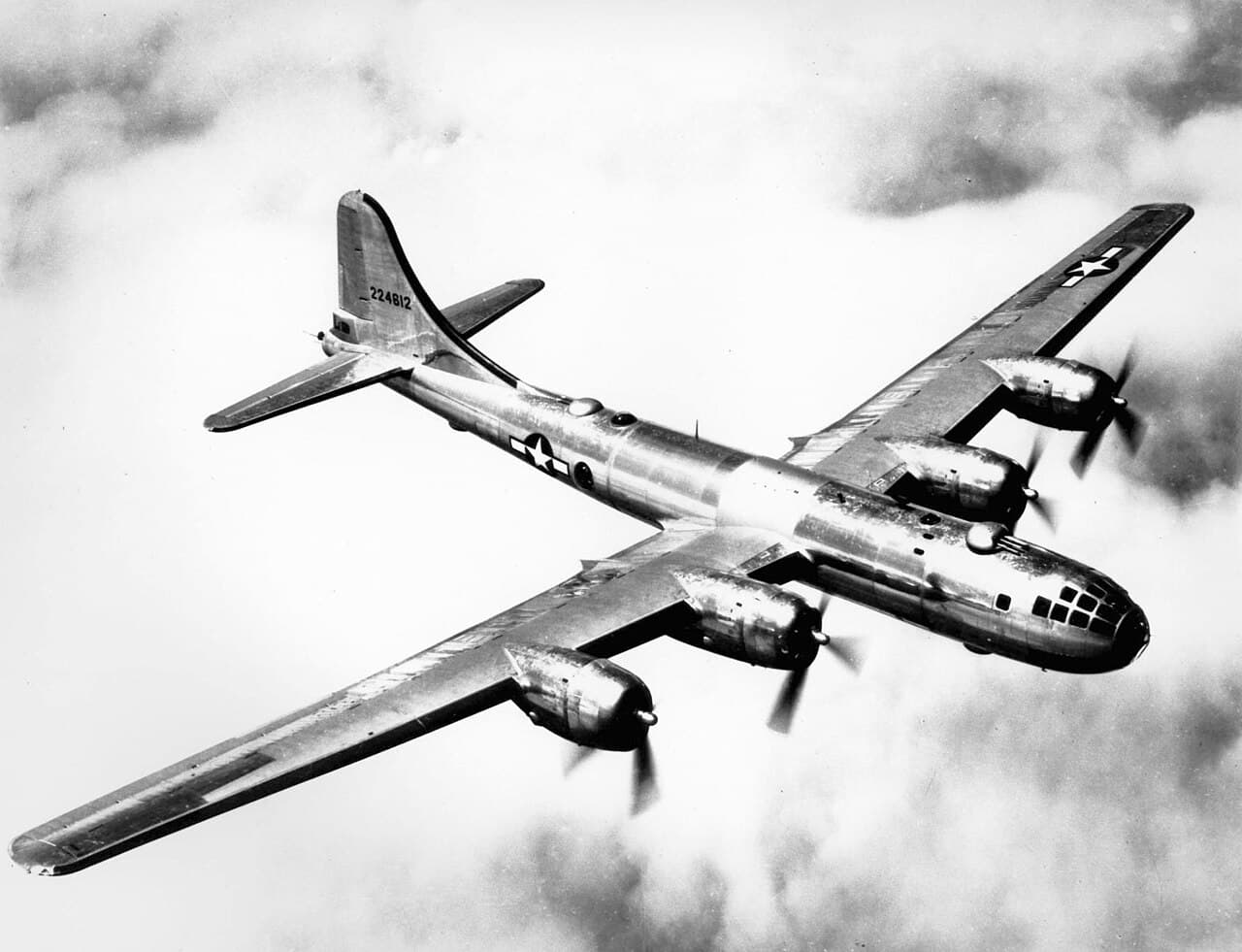
Boeing B-29 Superfortress
Boeing
How does the B-29 stack up?
CompareOverview
The Boeing B-29 Superfortress was the most technologically advanced aircraft of World War II and the weapon that ended the conflict. Incorporating pressurized crew compartments, remote-controlled gun turrets, advanced fire-control computers, and an innovative central station gunnery system, the B-29 represented a generational leap over every other bomber in the world. It was the most expensive weapons program of the war, more costly than the Manhattan Project itself.
From bases in the Mariana Islands, B-29s of the XXI Bomber Command conducted the strategic bombing campaign that burned Japan's cities, destroyed its industry, and brought the empire to its knees. General Curtis LeMay's decision to strip the B-29s of most defensive armament and send them in low-altitude incendiary raids transformed the air war. The March 9-10, 1945, firebombing of Tokyo killed an estimated 100,000 people and destroyed 16 square miles of the city, making it the single most destructive air raid in history.
On August 6, 1945, the B-29 "Enola Gay" dropped the uranium bomb "Little Boy" on Hiroshima. Three days later, "Bockscar" dropped the plutonium bomb "Fat Man" on Nagasaki. Japan surrendered on August 15. The B-29 thus holds the unique and somber distinction of being the only aircraft to deliver nuclear weapons in combat, forever changing warfare and world politics.
Performance Profile
Max Speed
357 mph
at 25,000 ft
Range
3,250 miles
normal
Service Ceiling
31,850 ft
Rate of Climb
900 ft/min
Armament
13 guns
12x .50 BMG, 1x 20mm
Crew
11
Engine
Wright R-3350-23 Duplex-Cyclone
2200 hp radial
Development History
Boeing began privately studying a "superbomber" concept in 1938, anticipating that the Army Air Corps would need a bomber capable of striking targets at intercontinental range. The official requirement, issued in January 1940, called for a bomber with a speed of 400 mph, a range of 5,333 miles, and the ability to carry 2,000 pounds of bombs. Boeing's Model 345 won the competition against designs from Consolidated, Douglas, and Lockheed.
The XB-29 prototype first flew on September 21, 1942, but the development program was plagued with problems, particularly the Wright R-3350 engines, which were prone to overheating and catching fire. The engine problems would plague the B-29 throughout its service life and were responsible for numerous losses. General Hap Arnold pushed the B-29 program with extraordinary urgency, ordering production before testing was complete, a "billion-dollar gamble" that was the most expensive weapons program of the war at $3 billion.
The B-29 incorporated technologies that were revolutionary for a production bomber. The pressurized crew compartments connected by a crawl tunnel over the bomb bays allowed crews to fly at high altitude without bulky flight suits and oxygen masks. The remote-controlled gun turrets were aimed via a central fire-control computer that calculated lead, range, and ballistic corrections, a system that would not be surpassed until guided missiles replaced guns decades later. The central fire-control officer could assign any turret to any gunner.
Four plants produced B-29s: Boeing in Wichita and Renton, Bell in Marietta (Georgia), and Glenn L. Martin in Omaha. The production ramp-up required the largest sub-contracting network ever assembled, with parts flowing from over 1,400 suppliers across the country.
Combat History
The B-29 entered combat on June 5, 1944, when the 58th Bombardment Wing, operating from bases in India and forward staging fields in China under the XX Bomber Command, struck the Makasan railroad shops in Bangkok. Operations from China and India were logistically nightmarish, with every drop of fuel and every bomb having to be flown "over the Hump" from India. The first raid on the Japanese home islands from China came on June 15, 1944, when 68 B-29s struck the Imperial Iron and Steel Works at Yawata.
The strategic situation transformed when the Mariana Islands (Saipan, Tinian, and Guam) were captured in mid-1944, placing the Japanese home islands within range of B-29s flying from fixed bases with reliable supply lines. The XXI Bomber Command, initially under General Haywood Hansell, began high-altitude daylight precision bombing operations against Japan in November 1944. Results were poor due to jet stream winds at altitude, persistent cloud cover, and engine unreliability.
In January 1945, General Curtis LeMay replaced Hansell and made the revolutionary decision to abandon high-altitude daylight precision bombing in favor of low-altitude nighttime incendiary raids. Stripping the B-29s of most defensive guns to save weight and loading them with M-69 incendiary clusters, LeMay sent 334 B-29s over Tokyo on the night of March 9-10, 1945. The resulting firestorm killed approximately 100,000 people, destroyed 267,000 buildings, and left a million people homeless. It was the single most destructive air raid in history, exceeding even the atomic bombings.
The firebombing campaign continued through the summer of 1945, systematically destroying Japan's major cities. On August 6, Colonel Paul Tibbets piloted the B-29 "Enola Gay" from Tinian to Hiroshima, dropping the "Little Boy" atomic bomb that killed approximately 70,000 people instantly. On August 9, Major Charles Sweeney piloted "Bockscar" to Nagasaki, dropping "Fat Man." Japan announced its surrender on August 15, 1945.
Variants
| Designation | Key Differences | Produced |
|---|---|---|
| B-29 | Standard production model, R-3350-23 engines, four gun turrets plus tail | 2,766 |
| B-29A | Renton-built, 12-inch wider wingspan, improved wing spars, four-gun forward dorsal turret | 1,119 |
| B-29B | Bell-built, stripped of all turrets except tail (APG-15 radar-aimed), reduced weight for speed | 311 |
| F-13/RB-29 | Photo-reconnaissance variant with up to seven cameras, used for damage assessment | 118 |
| B-50 (postwar) | Improved engines (R-4360), taller tail, stronger structure, served into the 1950s | 370 |
Strengths & Weaknesses
+Strengths
- Most technologically advanced bomber of WW2 with pressurized cabins, remote turrets, and fire-control computers
- Enormous bomb load capacity of 20,000 pounds on shorter missions
- Long range of over 3,200 miles enabled strategic bombing of Japan from the Marianas
- High-altitude capability with pressurization allowed operations above most fighters and flak
- Advanced central fire-control system allowed coordinated defensive fire against attacking fighters
-Weaknesses
- Chronically unreliable Wright R-3350 engines prone to overheating and in-flight fires
- Extremely expensive and complex, requiring enormous logistical support
- Engine fires caused more losses than enemy action in early operations
- High landing speed and heavy weight made it challenging to operate from forward airfields
Pilot Voices
“You could feel the heat coming up through the floor of the airplane. You could smell the city burning below us.”
“I looked down and there was Tokyo, burning. I had never seen anything like it. The whole city was on fire.”
Did You Know?
The B-29 program cost $3 billion (about $45 billion in today's dollars), making it more expensive than the $2 billion Manhattan Project that produced the atomic bombs it carried.
The March 9-10, 1945, firebombing of Tokyo killed more people in a single air raid than either atomic bomb, with approximately 100,000 deaths.
The B-29's central fire-control system could calculate the speed, direction, and distance of enemy fighters and automatically adjust the aim of remote turrets, technology far ahead of its time.
Three B-29s that made emergency landings in Soviet territory were reverse-engineered by Tupolev to create the Tu-4, giving the USSR its first strategic bomber and nuclear delivery system.

