
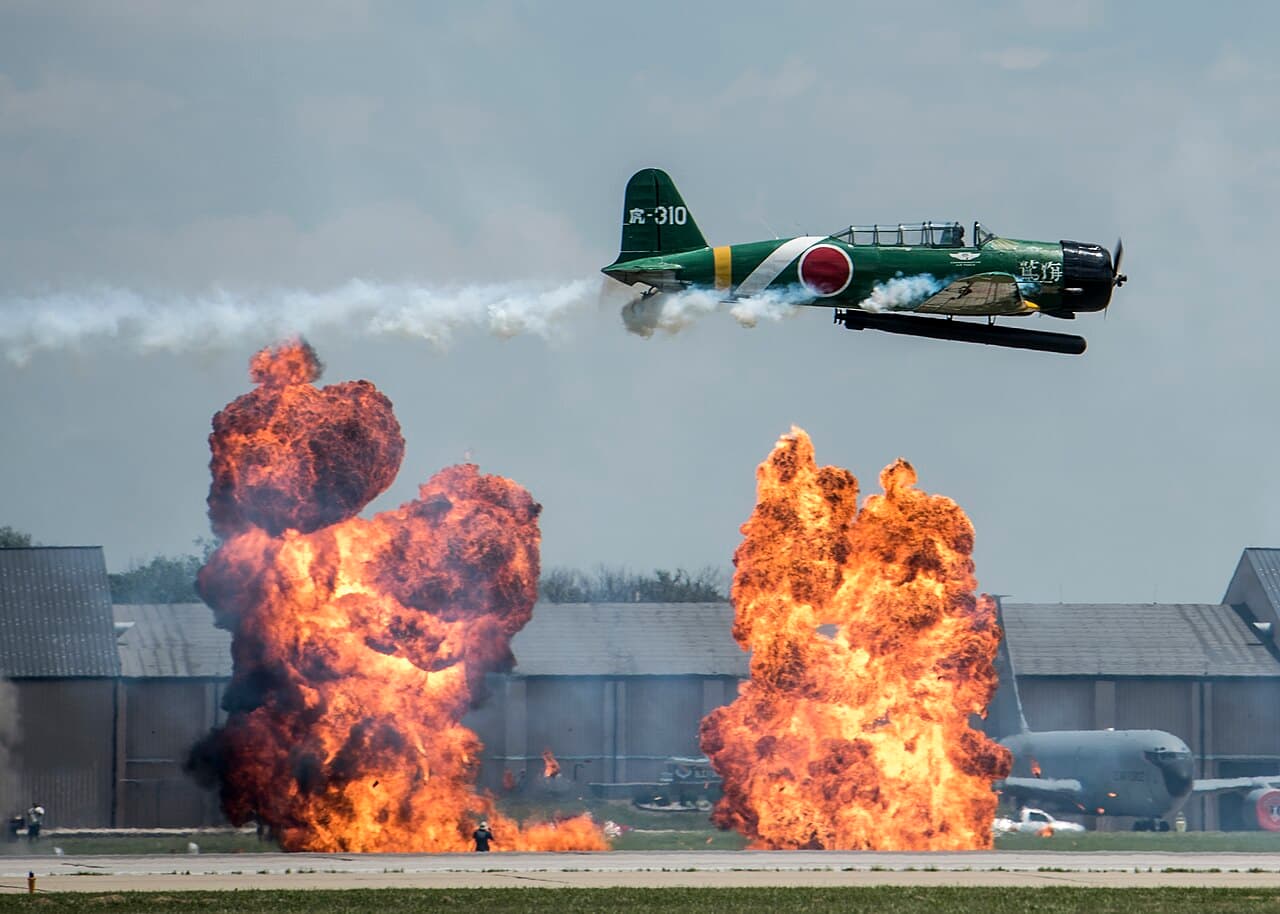
Nakajima B5N2 Type 97 Carrier Attack Bomber
Nakajima · Allied code name: “Kate”
How does the B5N2 stack up?
CompareOverview
The Nakajima B5N was the Imperial Japanese Navy's primary carrier-based torpedo bomber during the critical first years of the Pacific War, and it inflicted more damage on the United States Navy than any other single aircraft type. On the morning of December 7, 1941, B5N2s were responsible for the devastating torpedo and high-level bombing attacks that crippled the Pacific Fleet at Pearl Harbor. Six months later, B5N2s sank three American carriers, Lexington, Yorktown, and Hornet, fundamentally shaping the course of the Pacific campaign.
Known to the Allies as "Kate," the B5N2 was a remarkably advanced design when it entered service in 1937, featuring an enclosed cockpit, retractable landing gear, Fowler flaps, and a variable-pitch propeller, innovations that many Western torpedo bombers lacked. Its clean aerodynamic design gave it a significant speed advantage over its Allied counterpart, the Douglas TBD Devastator, and its crew of three worked with practiced precision in coordinated torpedo attacks.
The Kate's effectiveness depended heavily on two factors: the superb Type 91 aerial torpedo, which was far more reliable than any Allied equivalent in the early war, and the extraordinary skill of the IJN's prewar-trained aircrew. As those elite pilots were killed and not adequately replaced, and as Allied fighters and anti-aircraft defenses improved, the Kate became increasingly vulnerable. By 1944 it was obsolete, replaced by the B6N Tenzan, but its place in history was already secured by the devastation it had wrought.
Performance Profile
Max Speed
235 mph
at 11,810 ft
Range
1,237 miles
normal
Service Ceiling
27,100 ft
Rate of Climb
1,280 ft/min
Armament
1 guns
1x 7.7mm
Crew
3
Engine
Nakajima NK1B Sakae 11
1000 hp radial
Development History
Nakajima designed the B5N to a 1935 Japanese Navy specification for a carrier-based attack bomber to replace the biplane B4Y. Chief designer Katsuji Nakamura created a clean, low-wing monoplane with several advanced features that were ahead of their time. The hydraulically operated Fowler flaps, which extended rearward and downward to significantly increase wing area and lift at low speeds, allowed the relatively fast aircraft to operate safely from carrier decks.
The B5N1, powered by the Hikari 3 engine producing 770 hp, first flew in January 1937 and quickly proved superior to its Mitsubishi competitor. It entered service as the Navy Type 97 Carrier Attack Bomber in November 1937 and saw limited action in the Second Sino-Japanese War, where its performance validated the design concept.
The B5N2 variant, which became the definitive wartime model, appeared in late 1939. It replaced the Hikari engine with the more powerful Nakajima Sakae 11, producing 1,000 hp, which significantly improved performance. The B5N2 also featured a redesigned, more streamlined engine cowling. Internal fuel capacity provided operational range exceeding 1,200 miles, essential for the long-range strike missions the IJN envisioned.
However, the B5N2 retained the original's fundamental weakness: minimal defensive armament of a single rearward-firing 7.7mm machine gun. Lacking armor and self-sealing fuel tanks, it depended entirely on fighter escort and the element of surprise for survival. This was considered an acceptable trade-off by prewar Japanese doctrine, which emphasized offensive striking power over defensive protection, a philosophy that would exact a mounting toll as the war progressed.
Combat History
The B5N2's combat debut at Pearl Harbor on December 7, 1941, was the most devastating aircraft attack in naval history. Flying from six carriers of the Kido Butai, 144 B5N2s participated in both waves of the attack. In the first wave, 40 Kates armed with modified Type 91 torpedoes attacked Battleship Row at wave-top height. Their torpedoes, fitted with wooden fins to operate in Pearl Harbor's shallow waters, struck the battleships Oklahoma, West Virginia, California, Nevada, and Arizona with devastating precision. Simultaneously, 49 Kates carrying 1,764-pound armor-piercing bombs (converted 16-inch battleship shells) attacked from high altitude, scoring the fatal hit that detonated Arizona's forward magazine.
In the months following Pearl Harbor, B5N2s ranged across the Pacific and Indian Ocean, delivering devastating strikes against Darwin, Australia; Colombo and Trincomalee, Ceylon; and numerous Allied warships. At the Battle of the Coral Sea in May 1942, Kate torpedo planes fatally damaged USS Lexington. At Midway in June 1942, though the Japanese carriers were destroyed, B5N2s still managed to contribute torpedoes to the sinking of USS Yorktown. At the Battle of the Santa Cruz Islands in October 1942, Kates delivered the torpedo hits that sank USS Hornet.
As the war progressed, the Kate became increasingly vulnerable. Its low speed and single defensive gun made it easy prey for the new generation of American fighters. At the Battle of the Philippine Sea in June 1944, the few remaining B5N2s sent into action were virtually annihilated. By this time, the B6N Tenzan "Jill" was replacing the Kate aboard carriers, though production of the newer type was slow. Some surviving B5N2s were relegated to anti-submarine patrol, maritime reconnaissance, and training duties, while others were used in kamikaze attacks in the war's final months.
Variants
| Designation | Key Differences | Produced |
|---|---|---|
| B5N1 | Initial production with Nakajima Hikari 3 engine (770 hp); used primarily as a trainer by 1941. Three-blade fixed-pitch propeller. | 669 |
| B5N2 | Sakae 11 engine (1,000 hp), redesigned cowling, variable-pitch propeller; the Pearl Harbor attack variant. | 480 |
| B5N2 (reconnaissance) | Field conversion with additional fuel tank in bomb bay; used for long-range maritime reconnaissance. | - |
Strengths & Weaknesses
+Strengths
- Advanced aerodynamic design with Fowler flaps allowed high-speed cruise with safe low-speed carrier operations
- Excellent range of over 1,200 miles enabled long-distance strike missions far from the carrier force
- Combined with the superb Type 91 torpedo, the B5N2/torpedo team was the most lethal anti-ship weapon system of the early Pacific War
- Skilled three-man crew coordination enabled highly accurate torpedo drops and high-level bombing
-Weaknesses
- Pathetically weak defensive armament of a single 7.7mm rear gun left it nearly defenseless against fighter attack
- Complete lack of armor and self-sealing fuel tanks made it extremely vulnerable when enemy fighters were present
- Low maximum speed of 235 mph made it unable to outrun even the slowest Allied fighters by 1942
- Effectiveness declined catastrophically as Japan's elite torpedo crews were killed and replaced by poorly trained novices
Pilot Voices
“When I released my torpedo and saw it streaking toward the battleship, I pulled up and could see the ships of the American fleet spread out before me. It was a sight I will never forget.”
“The Kate was a beautiful airplane to fly, steady, reliable, and honest. But it had no way to defend itself. When the American fighters found us, all we could do was die bravely.”
Did You Know?
The torpedoes used by B5N2s at Pearl Harbor were modified with wooden stabilization fins to prevent them from hitting the harbor bottom in the shallow 40-foot water. This innovation was crucial to the attack's success.
B5N2 torpedo planes sank or helped sink more Allied warship tonnage than any other single aircraft type in the Pacific War, including three fleet carriers and multiple battleships.
Lieutenant Commander Mitsuo Fuchida, who led the Pearl Harbor attack in a B5N2 and transmitted the famous "Tora! Tora! Tora!" signal, later converted to Christianity and became a peace activist who toured the United States.
The B5N was more aerodynamically advanced than its American counterpart, the TBD Devastator, yet it entered service in the same year (1937). The TBD was already obsolete by Pearl Harbor while the B5N remained effective through 1943.


