
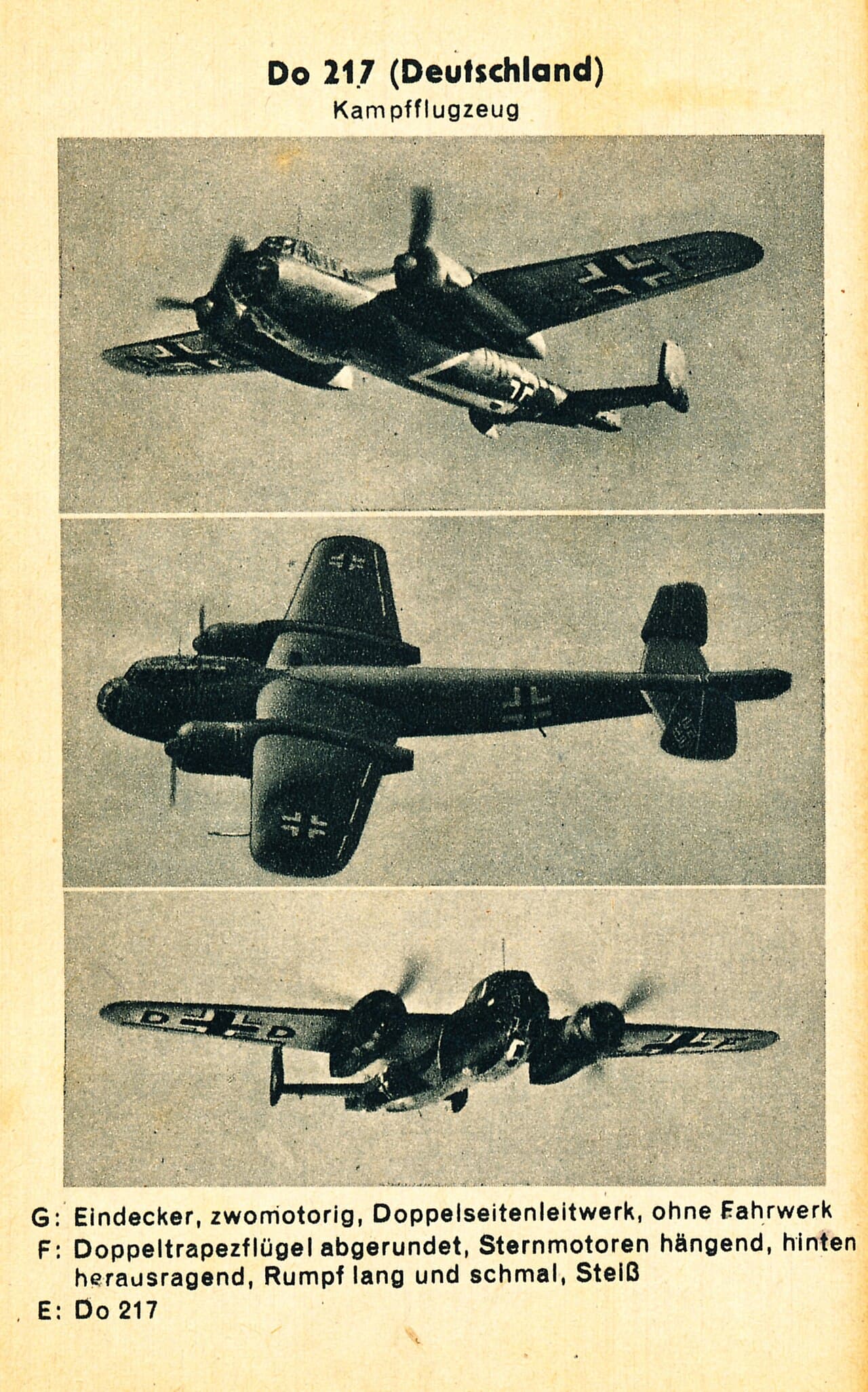
Dornier Do 217E
Dornier
How does the Do 217E stack up?
CompareOverview
The Dornier Do 217E was a large, powerful medium bomber designed to replace the aging Do 17 "Flying Pencil" in Luftwaffe service. Substantially bigger and heavier than its predecessor, the Do 217E packed an impressive bomb load of up to 8,818 pounds, more than any other standard German medium bomber, and featured a distinctive deep fuselage that housed a capacious internal bomb bay.
While the Do 217E was a competent conventional bomber, its most significant contribution to military history came as the world's first aircraft to employ precision guided munitions in combat. Equipped to carry the Fritz X radio-guided bomb and the Henschel Hs 293 anti-ship missile, Do 217E units achieved spectacular results against Allied naval targets, most notably sinking the Italian battleship Roma with Fritz X guided bombs on September 9, 1943, the first capital ship ever sunk by a guided weapon.
The Do 217 family never achieved the production numbers or the universal recognition of the Ju 88 or He 111, partly because Dornier diverted development resources into too many variants and sub-types. Nevertheless, the Do 217E was a genuinely capable aircraft that deserves recognition for pioneering an entirely new form of warfare, precision guided munitions, that would come to dominate aerial combat in the decades that followed.
Performance Profile
Max Speed
320 mph
at 16,730 ft
Range
1,430 miles
normal
Service Ceiling
24,610 ft
Rate of Climb
689 ft/min
Armament
5 guns
1x 20mm MG 151/20, 1x 13mm MG 131, 3x 7.92mm MG 81Z
Crew
4
Engine
BMW 801ML
1580 hp radial
Development History
The Do 217 was developed in the late 1930s as a larger, more capable successor to the Do 17, incorporating lessons from the earlier aircraft's service in the Spanish Civil War and the opening campaigns of WW2. Claudius Dornier's team enlarged the fuselage substantially, added more powerful engines, and introduced a pressurized crew compartment in some variants, an advanced feature for a mid-war bomber.
The first prototype flew in October 1938 with DB 601 inline engines, but the production Do 217E adopted the BMW 801 radial for its greater power and reliability. The transition to the radial engine required significant nose redesign, and the resulting aircraft bore little resemblance to the slim Do 17 it was meant to replace. The deep, slab-sided fuselage earned the aircraft no beauty prizes, but it provided generous internal volume for bombs and fuel.
The Do 217E-2 introduced the ability to carry and deploy the Fritz X (SD 1400) radio-guided bomb, a weapon that represented a quantum leap in precision bombing technology. The Fritz X was a 1,400 kg armor-piercing bomb fitted with radio command guidance and cruciform tail control surfaces. The bombardier guided it to the target using a joystick controller and a flare on the bomb's tail as a visual reference, a crude but effective system that achieved remarkable accuracy against moving ships.
The Do 217E-5 variant was adapted to carry the Henschel Hs 293 anti-ship guided missile, essentially a rocket-boosted glide bomb with radio command guidance. The Hs 293 was lighter than the Fritz X and designed for use against unarmored or lightly armored ships, while the Fritz X was intended for heavily armored warships. Together, these weapons gave the Do 217E a capability that no other aircraft in the world possessed.
Combat History
The Do 217E entered service in late 1941 and initially flew conventional bombing missions over England, including raids against industrial targets and ports. Its large bomb load and reasonable range made it a useful addition to the bomber force, but losses to RAF night fighters and anti-aircraft fire were significant. Like all Luftwaffe medium bombers, the Do 217E was poorly suited to penetrating heavily defended airspace without fighter escort.
The Do 217E's moment of historical significance came on August 25, 1943, when KG 100 aircraft armed with Hs 293 guided missiles attacked Royal Navy warships in the Bay of Biscay, sinking the sloop HMS Egret and damaging the destroyer HMCS Athabaskan, the first confirmed warship sinkings by guided missiles in history. This was a mere preview of what was to come.
On September 9, 1943, the Italian fleet was steaming south to surrender to the Allies when Do 217K-2 aircraft of III./KG 100, armed with Fritz X guided bombs, attacked the formation. The battleship Roma was hit by two Fritz X bombs: the first caused severe damage, and the second detonated a forward magazine, breaking the ship in half and killing 1,253 crew members. The Italia was also badly damaged. This was the first time a guided weapon had sunk a battleship, and it sent shockwaves through Allied naval planning.
Following these spectacular successes, KG 100 continued guided weapon attacks against Allied shipping during the Salerno landings, damaging the cruiser USS Savannah and the battleship HMS Warspite with Fritz X bombs. The Allies responded with electronic jamming equipment and intensive fighter patrols over the missile launch zones, progressively reducing the effectiveness of the guided weapons. By mid-1944, the Do 217E was being withdrawn from frontline service as attrition and the growing dominance of Allied air power made its operations increasingly untenable.
Variants
| Designation | Key Differences | Produced |
|---|---|---|
| Do 217E-2 | Standard medium bomber variant with BMW 801ML engines, dorsal turret, and internal bomb bay for up to 4,000 kg. Also wired for Fritz X guided bomb deployment. | 690 |
| Do 217E-5 | Anti-shipping variant equipped to carry 2x Hs 293 radio-guided anti-ship missiles on underwing racks. Featured FuG 203 Kehl radio command guidance transmitter for controlling missiles in flight. | - |
| Do 217K-2 | Redesigned variant with stepped windscreen replacing glazed nose. Primary Fritz X carrier aircraft. Used by III./KG 100 for the sinking of Roma. | 230 |
| Do 217M-1 | DB 603A inline engine variant developed to reduce dependency on BMW 801 radials (needed for Fw 190 production). Slightly different performance characteristics but similar capability. | - |
| Do 217N-2 | Night fighter variant with solid nose housing 4x MG 151/20 cannon and 4x MG 17 machine guns, plus Schrage Musik installation. FuG 212 radar. Used by NJG units. | - |
Strengths & Weaknesses
+Strengths
- Largest bomb load of any standard German medium bomber at up to 8,818 lbs, nearly double the He 111
- First aircraft to deploy precision guided weapons in combat, pioneering a revolution in aerial warfare
- Spacious internal bomb bay reduced drag penalty compared to externally-carried weapons
- Good range and endurance for maritime patrol and anti-shipping missions
-Weaknesses
- Large, heavy, and not particularly fast, vulnerable to fighters without escort
- Handling characteristics were poor, particularly at low speeds and high weights
- Complex airframe with many sub-variants created logistical headaches for maintenance units
- Fritz X and Hs 293 guidance required the launch aircraft to fly straight and level during the weapon's flight time, making it vulnerable to fighters and anti-aircraft fire
Pilot Voices
“We watched the Fritz X fall toward the battleship through binoculars. It corrected its course as the bombardier guided it. Then a flash, a column of water, and the great ship simply broke apart. We knew we were witnessing something that would change warfare forever.”
Did You Know?
The Do 217E-equipped KG 100 sank the Italian battleship Roma with Fritz X guided bombs on September 9, 1943, the first time a guided weapon sank a capital ship. This event is considered the birth of precision guided munitions in warfare.
The Fritz X bomb that sank Roma penetrated the ship's armored deck and detonated a magazine, causing the battleship to break in half and sink in minutes. Over 1,253 sailors were killed, more than died on any single Allied vessel at Pearl Harbor.
Allied scientists captured Hs 293 guided missiles and reverse-engineered them, contributing to the development of postwar American guided weapons programs. The radio guidance frequency was also jammed by Allied ships using modified television transmitters.


