
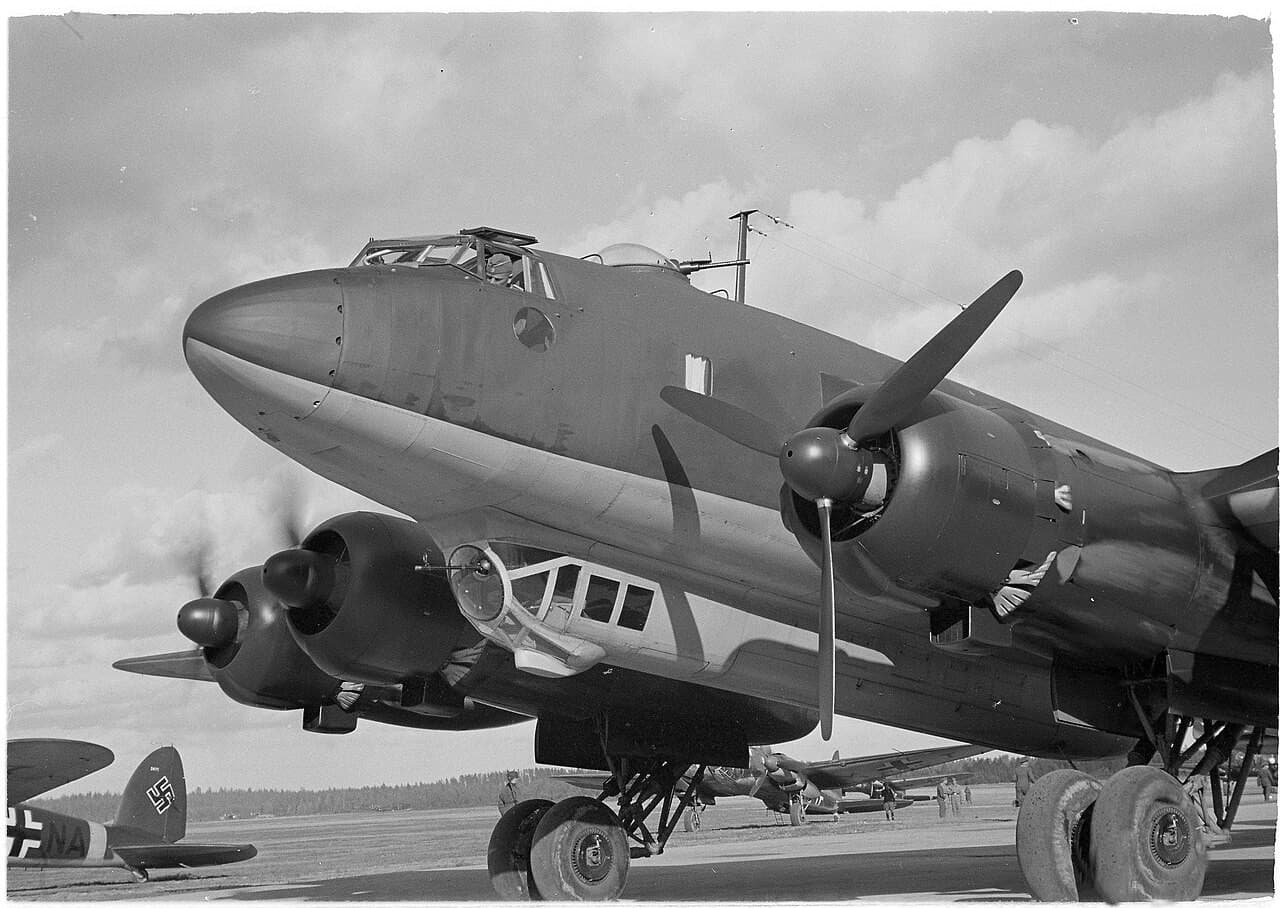
Focke-Wulf Fw 200C Condor
Focke-Wulf
How does the Fw 200C stack up?
CompareOverview
The Focke-Wulf Fw 200 Condor began life as an elegant four-engined airliner and ended it as the "Scourge of the Atlantic", Winston Churchill's grudging title for the aircraft that terrorized Allied convoys during the Battle of the Atlantic's darkest period. From mid-1940 through 1941, before effective countermeasures were deployed, Fw 200 Condors operating from bases in France and Norway ranged far out over the Atlantic, sinking merchant ships with bombs and gunfire, and shadowing convoys to guide U-boat wolfpacks to their targets.
The Fw 200C military variant was adapted from Kurt Tank's 1937 airliner design with minimal structural reinforcement, a compromise that would haunt the aircraft throughout its career. The graceful airframe, designed for the gentle loads of passenger service, was simply too fragile for the rigors of low-level anti-shipping attacks. Condors frequently suffered structural failures during combat maneuvers, and the fuselage had a distressing tendency to break in half during hard landings.
Despite its fragility, the Fw 200C was a genuine menace in the maritime patrol role. Its enormous range, over 2,000 miles, allowed it to patrol areas of the Atlantic beyond the reach of Allied land-based fighters, creating a gap in air cover that convoys had to cross unprotected. The combination of Condor reconnaissance and U-boat attacks was devastatingly effective, and it was only the introduction of escort carriers, long-range Liberators, and improved shipboard anti-aircraft defenses that finally neutralized the Condor threat.
Performance Profile
Max Speed
224 mph
at 15,750 ft
Range
2,206 miles
normal
Service Ceiling
19,030 ft
Rate of Climb
656 ft/min
Armament
5 guns
1x 20mm MG 151/20, 1x 13mm MG 131, 3x 7.92mm MG 15
Crew
5
Engine
Bramo 323R-2 Fafnir
1200 hp radial
Development History
The Fw 200 was originally designed in 1936-37 as a long-range airliner for Lufthansa's transatlantic routes. Kurt Tank's team produced an elegant, low-wing monoplane with four BMW 132H radial engines that could carry 26 passengers over distances that few contemporary aircraft could match. The prototype made a sensation-causing non-stop flight from Berlin to New York on August 10, 1938, covering 4,075 miles in 24 hours and 56 minutes. A reciprocal flight followed, and the Fw 200 seemed destined for a stellar commercial career.
The war intervened. The Luftwaffe, recognizing the Fw 200's exceptional range, ordered a military conversion for maritime patrol and anti-shipping duties. The resulting Fw 200C received structural reinforcement (though never enough), a ventral gondola housing a bomb aimer's position and defensive gun, external bomb racks, and maritime search equipment. The conversion was hasty and imperfect, the airframe had been designed for a maximum normal load of about 34,000 lbs, but the military version routinely operated at nearly 50,000 lbs.
The structural weakness was a constant problem. The fuselage joint at the wing root was particularly vulnerable, and several Condors broke their backs during hard landings or rough-field operations. Kits were developed to reinforce the critical areas, but the fundamental problem, an airliner airframe doing bomber work, was never fully resolved. Later C-variants (C-3, C-4, C-8) received progressively more reinforcement, but at the cost of added weight that reduced range and performance.
The Fw 200C-6 and C-8 variants were adapted to carry Hs 293 guided anti-ship missiles, giving the Condor a standoff attack capability that reduced its exposure to increasingly dangerous shipboard anti-aircraft fire. This development was promising but came too late and in too few numbers to restore the Condor's former effectiveness. By 1944, most surviving Condors had been relegated to the transport role, their anti-shipping days over.
Combat History
The Fw 200C's combat career began in earnest in August 1940 when KG 40, based at Bordeaux-Merignac in occupied France, began anti-shipping patrols over the Atlantic approaches to Britain. The results were immediately dramatic: in the period from August 1940 to February 1941, Condors sank over 85 ships totaling approximately 363,000 tons. Churchill's characterization of the Fw 200 as "the scourge of the Atlantic" was not hyperbole, the aircraft was devastating to unprotected merchant shipping.
The Condor's most effective tactic combined independent ship-hunting with U-boat cooperation. A Condor would locate a convoy, shadow it while transmitting position reports to U-boat headquarters (BdU), and then attack isolated stragglers or escorts with bombs. The U-boats would then close on the convoy guided by the Condor's reports. This air-submarine cooperation was one of the most dangerous threats the Allies faced in the Battle of the Atlantic.
Allied countermeasures gradually neutralized the Condor. The introduction of CAM ships (Catapult Aircraft Merchantmen) carrying expendable Hurricane fighters provided a desperate short-term solution, the fighter could be launched to chase off the Condor but had to ditch afterward. More effective were the escort carriers that began appearing in 1942-43, providing continuous air cover for convoys. Consolidated Liberators modified for very long-range (VLR) patrol also closed the "Atlantic Gap" where Condors had operated with impunity.
By 1943, the Fw 200's anti-shipping career was essentially over. Allied radar-equipped aircraft and escort fighters made the skies over the Atlantic too dangerous for the slow, poorly armed Condor. KG 40 continued to operate the type, but primarily in the transport role, flying supplies and personnel between German-held territories. Some Condors served as personal transports for senior Nazi officials, Hitler's personal Fw 200 "Immelmann III" was among the most famous individual aircraft of the war.
Variants
| Designation | Key Differences | Produced |
|---|---|---|
| Fw 200C-1 | Initial military production variant with ventral gondola, 4x bomb racks for SC 250 bombs, and FuG 200 Hohentwiel search radar. Structural reinforcements added over original airliner design. | 36 |
| Fw 200C-3 | Improved variant with Bramo 323R-2 engines (1,200 hp), upgraded armament including 20mm MG 151 in forward ventral gondola, additional structural reinforcement. | 76 |
| Fw 200C-4 | Upgraded maritime patrol variant with FuG 200 Hohentwiel search radar as standard, improved navigation equipment, and provisions for torpedo carriage. | - |
| Fw 200C-6 | Guided missile carrier variant with FuG 203 Kehl transmitter for controlling Hs 293 anti-ship missiles. Two Hs 293 missiles carried on outboard underwing racks. | - |
| Fw 200C-8 | Final production variant with maximum structural reinforcement, FuG 200 radar, and full Hs 293 capability. Some fitted with additional armor protection for low-level attacks. | - |
Strengths & Weaknesses
+Strengths
- Exceptional range of over 2,200 miles allowed patrol of mid-Atlantic areas beyond the reach of Allied land-based fighters
- Large airframe could carry substantial bomb load and maritime search equipment simultaneously
- Effective as both an independent ship-hunter and a cooperative reconnaissance platform guiding U-boats to convoys
- Versatile platform adaptable to bombing, reconnaissance, missile-launching, and transport roles
-Weaknesses
- Structurally fragile, airliner airframe was never adequately reinforced for military operations, with fuselage breaks during hard landings
- Slow and poorly armed, making it extremely vulnerable to any fighter opposition
- Low service ceiling meant it could not evade fighters by climbing above their operational altitude
- Chronic shortage of aircraft, KG 40 rarely had more than 6-8 serviceable Condors at any time
Pilot Voices
“We would fly for eight, ten, twelve hours over the empty ocean, searching for convoys. When we found one, the excitement was intense, but so was the knowledge that our aircraft was not built for combat. One determined fighter could finish us.”
Did You Know?
Churchill personally called the Fw 200 "the scourge of the Atlantic", one of the few individual aircraft types to receive such a specific designation from the British Prime Minister.
The Fw 200 prototype made a non-stop Berlin-to-New York flight on August 10, 1938, covering 4,075 miles in under 25 hours. The Japanese Navy was so impressed that they ordered five Condors for their own maritime patrol use, only two were delivered before the war made further deliveries impossible.
Hitler's personal transport aircraft was an Fw 200 V3 named "Immelmann III," fitted with a luxurious interior including an armored seat, personal escape hatch, and a parachute attached to the chair.


