
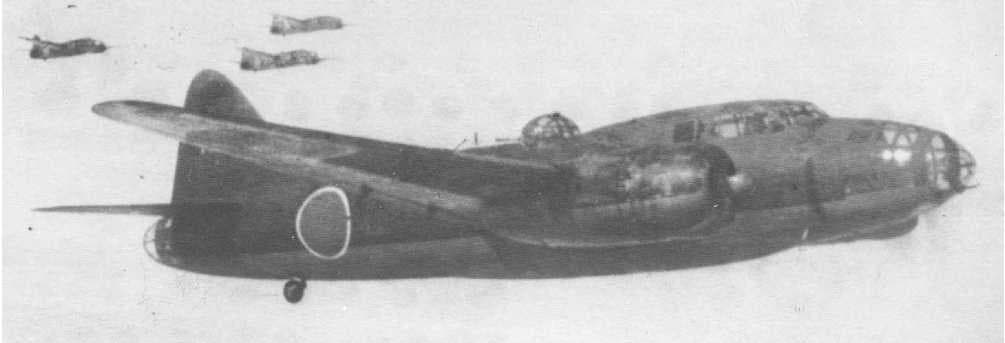
Mitsubishi G4M1 Type 1 Attack Bomber
Mitsubishi · Allied code name: “Betty”
How does the G4M1 stack up?
CompareOverview
The Mitsubishi G4M was the Imperial Japanese Navy's principal land-based medium bomber of World War II, an aircraft whose extraordinary range came at a terrible price. Designed to strike targets across the vast Pacific without fighter escort, the G4M carried its fuel in unprotected integral wing tanks that turned it into a flying tinderbox. Allied fighter pilots quickly learned that a single incendiary round into the wing would cause the G4M to erupt in flames, earning it the grim nickname "the one-shot lighter" among American pilots and "hamaki" (cigar) among its own crews.
Despite this lethal vulnerability, the G4M served throughout the entire Pacific War because Japan had no adequate replacement. Its range of over 2,200 miles was unmatched by any Allied medium bomber and was essential for operations across the vast distances of the Pacific theater. G4M bombers sank the British battleship Prince of Wales and battlecruiser Repulse on December 10, 1941, one of the most significant naval actions of the war, proving that land-based aircraft could destroy capital ships at sea.
The Betty served from the first day of the war to the last. On August 19, 1945, two white-painted G4M1s carried the Japanese surrender delegation to Ie Shima, where they transferred to an American C-54 transport for the flight to Manila. It was a fitting final mission for an aircraft that had been present at every stage of Japan's war.
Performance Profile
Max Speed
266 mph
at 13,780 ft
Range
2,262 miles
normal
Service Ceiling
28,870 ft
Rate of Climb
1,800 ft/min
Armament
5 guns
1x 20mm, 4x 7.7mm
Crew
7
Engine
Mitsubishi MK4A Kasei 11
1530 hp radial
Development History
The G4M originated from a 1937 Imperial Japanese Navy specification calling for a land-based attack bomber capable of carrying a torpedo or bombs to targets 2,000 nautical miles from base. This extraordinary range requirement, driven by the Navy's strategy of using land-based air power to whittle down an advancing enemy fleet across the Pacific, defined, and ultimately damned, the aircraft.
Mitsubishi's chief designer, Kiro Honjo, realized that meeting the range requirement with 1930s engine technology demanded an exceptionally clean aerodynamic design with maximum internal fuel capacity. He achieved this by using the wing structure itself as integral fuel tanks, carrying nearly 1,000 gallons of fuel in unprotected tanks within the wing. Armor protection was deemed impossible given the weight constraints, and self-sealing tanks were rejected because the self-sealing material would reduce fuel capacity by approximately 30%, making the range requirement unachievable.
Admiral Isoroku Yamamoto personally reviewed the design and expressed concern about the lack of protection, but the Navy's insistence on extreme range overrode his objections. The G4M1 first flew on October 23, 1939, and its performance validated the design concept, on paper. The aircraft was fast for a bomber, handled well, and could fly enormous distances. What remained untested was whether unprotected fuel tanks could survive contact with enemy fighters.
The G4M2, which entered service in 1943, attempted to address survivability with the more powerful Kasei 21 engine, a laminar-flow wing, and limited self-sealing capability for some fuel tanks. However, the fundamental vulnerability remained. The G4M3, a late-war variant with full self-sealing tanks and better armor, traded range for survivability but was produced in only small numbers before the war ended.
Combat History
The G4M's combat debut was devastating, for both sides. On December 10, 1941, G4M1 and G3M bombers of the Mihoro and Genzan Air Groups attacked Force Z, the Royal Navy task force centered on the battleship HMS Prince of Wales and the battlecruiser HMS Repulse, off the coast of Malaya. In a coordinated torpedo and high-level bombing attack, both capital ships were sunk, the first time in history that aircraft alone had destroyed battleships operating in the open sea. The engagement sent shockwaves through every navy in the world.
Through 1942, G4M units ranged across the Pacific, bombing targets from Darwin, Australia to Henderson Field on Guadalcanal. Over Guadalcanal, the Betty's vulnerability became brutally apparent. Flying unescorted over "The Slot" between the Solomon Islands, G4M formations were savaged by Marine F4F Wildcats and Army P-39 Airacobras. A single burst of .50-caliber fire into the wing tanks would cause the bomber to explode, and losses were staggering. On one raid against Guadalcanal, 17 out of 27 attacking G4Ms were shot down.
The most historically significant Betty loss came on April 18, 1943, when P-38 Lightnings from Henderson Field intercepted two G4M1 transports carrying Admiral Isoroku Yamamoto and his staff over Bougainville. Both bombers were shot down, killing Yamamoto, Japan's most brilliant naval strategist. The G4M's vulnerability made such a precise interception possible; a more survivable aircraft might have given Yamamoto's pilot a chance to escape.
In the war's final phase, the G4M served as the launch platform for the MXY-7 Ohka ("Cherry Blossom") rocket-powered kamikaze flying bomb. Each G4M2e "Betty" carried one Ohka under its belly, releasing it within range of American ships. However, the heavily laden Betty was even more vulnerable than usual, and American fighters often shot down the mother aircraft before it could release its deadly payload.
Variants
| Designation | Key Differences | Produced |
|---|---|---|
| G4M1 Model 11 | Initial production with Kasei 11 engines (1,530 hp each); no armor, no self-sealing tanks. Maximum range variant. | 1,200 |
| G4M2 Model 22 | Kasei 21 engines (1,850 hp), laminar-flow wing, powered dorsal turret, limited fuel tank protection. | 1,154 |
| G4M2e Model 24 | Modified to carry MXY-7 Ohka suicide bomb; bomb bay doors removed, additional fuel for the Ohka. | - |
| G4M3 Model 34 | Full self-sealing fuel tanks, improved armor, Kasei 25 engines; significantly reduced range. Only a handful completed. | 60 |
Strengths & Weaknesses
+Strengths
- Extraordinary operational range of over 2,200 miles, the longest of any medium bomber in any air force during the war
- Good speed for a twin-engine bomber, capable of outrunning some early-war fighters at altitude
- Clean aerodynamic design provided excellent fuel efficiency and handling qualities
- Capable torpedo bomber that proved it could sink capital warships, a revolutionary demonstration in 1941
-Weaknesses
- Unprotected integral wing fuel tanks made it catastrophically vulnerable to enemy fire; a single incendiary round could cause the aircraft to explode
- Virtually no armor protection for the crew, resulting in horrific casualty rates
- Defensive armament of one 20mm cannon and four 7.7mm guns was inadequate against determined fighter attack
- The extreme range that justified the design was less relevant as Japan was pushed onto the defensive and needed survivability more than reach
Pilot Voices
“We knew that every mission might be our last. The Betty had no armor, no protection. You flew, you dropped your torpedo, and you prayed the fighters did not catch you.”
“The Betty burned like no other aircraft I have ever seen. One short burst from the .50 calibers and the whole wing was a sheet of flame. The crews never had a chance.”
Did You Know?
American fighter pilots nicknamed the G4M the "one-shot lighter" or "flying Zippo" because of how easily it caught fire when hit. Japanese crews ruefully called it "hamaki" (cigar) or "the Type 1 lighter."
The G4M that carried Admiral Yamamoto to his death on April 18, 1943, was recovered in the jungle of Bougainville after the war. Parts of the wreckage are now displayed at museums in Japan and the United States.
Two white-painted G4M1s, marked with green crosses, carried the Japanese surrender delegation from Japan to Ie Shima on August 19, 1945, making the Betty the last Japanese military aircraft to fly an operational mission in World War II.
The sinking of HMS Prince of Wales and HMS Repulse by G4M and G3M bombers on December 10, 1941, was the single most impactful demonstration of air power over naval forces in the war, convincing every major navy that the age of the battleship was over.


