
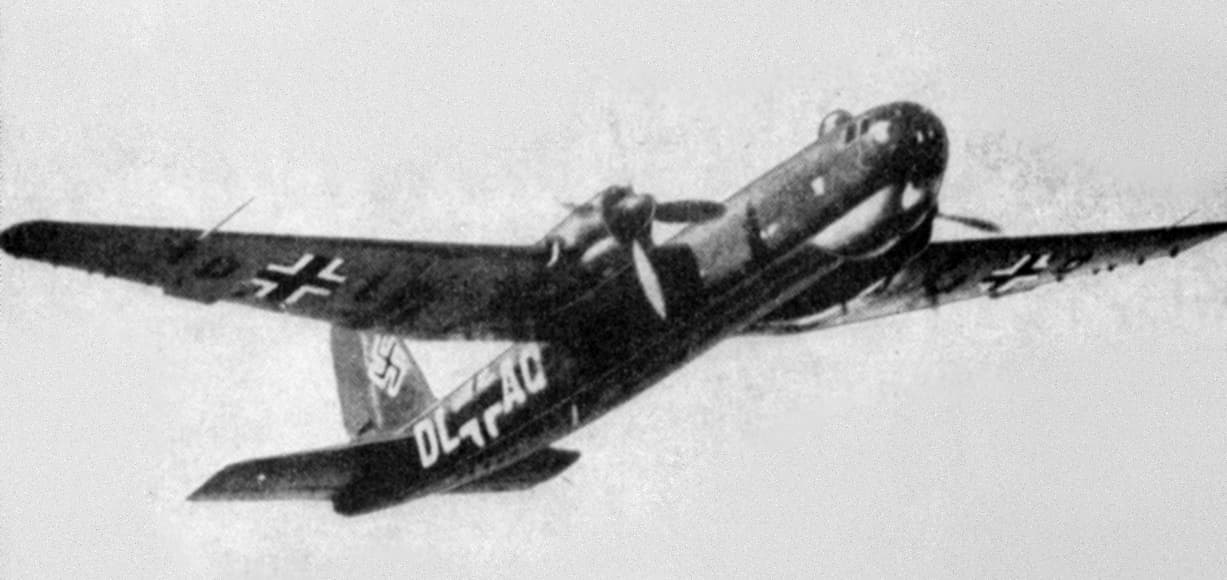
Heinkel He 177A Greif
Heinkel
How does the He 177A stack up?
CompareOverview
The Heinkel He 177A Greif (Griffin) was Germany's only operational heavy bomber of World War II, and one of the most troubled aircraft programs in aviation history. On paper, it was an impressive machine: a large, long-range bomber capable of carrying over 13,000 pounds of ordnance, including Fritz X guided bombs and Hs 293 anti-ship missiles. In practice, its revolutionary coupled-engine powerplant was so unreliable that crews called it the "Luftwaffenfeuerzeug", the Luftwaffe's cigarette lighter, for its terrifying tendency to catch fire in flight.
The He 177's problems stemmed from a fundamental design compromise. The Air Ministry demanded that this four-engined heavy bomber be capable of dive-bombing, a near-impossible requirement for an aircraft of its size. To reduce drag and structural loads in a dive, Heinkel paired two DB 605 engines on each wing into a single nacelle, driving a single propeller through a complex gearbox. These DB 610 "power systems" were a mechanical nightmare, generating catastrophic heat and suffering constant oil leaks, bearing failures, and engine fires.
Despite its problems, the He 177A did see operational service. Approximately 1,169 were built, and those that worked flew strategic bombing missions against England, anti-shipping strikes in the Atlantic, and support operations on the Eastern Front. The aircraft's potential was genuine, when functioning properly, it was fast, had excellent range, and could carry a devastating bomb load. But the coupled engines made every flight a gamble, and the He 177 never fulfilled the strategic bombing role that Germany so desperately needed.
Performance Profile
Max Speed
303 mph
at 19,685 ft
Range
3,417 miles
normal
Service Ceiling
25,920 ft
Rate of Climb
656 ft/min
Armament
6 guns
2x 20mm MG 151/20, 3x 13mm MG 131, 1x 7.92mm MG 81
Crew
6
Engine
Daimler-Benz DB 610 (coupled DB 605)
2950 hp inline
Development History
The He 177 program began in 1936 with a requirement for a long-range heavy bomber capable of carrying 2,000 kg of bombs over 1,600 km at 310 mph. The specification also included the ability to perform medium-angle dive-bombing, an extraordinary demand for what would become a 30-ton aircraft. Ernst Heinkel's design team, led by Siegfried Gunter, produced an elegant solution on paper: four engines paired into two nacelles, giving the clean aerodynamics of a twin-engined design with the power of four engines.
The coupled DB 606 engine installations (later upgraded to DB 610) were the source of almost all the He 177's problems. Two complete DB 601 (later DB 605) engines were bolted together, driving a single propeller shaft through a combining gearbox. The arrangement generated enormous heat in the confined nacelles, and the exhaust system, which ran directly past oil lines and hydraulic pipes, regularly ignited leaked fluids. Over 50 prototype and pre-production aircraft were lost to engine fires before the type even reached operational units.
Attempts to solve the engine problems consumed years of development time. Revised nacelle cooling ducts, redesigned exhaust manifolds, and improved oil sealing were progressively introduced, but the fundamental problem, too much heat in too small a space, was never fully overcome. Ernst Heinkel repeatedly proposed a straightforward four-engined version (the He 177B/He 277) with separate nacelles, which would have eliminated the fire problem entirely. The RLM resisted this change until late 1943, and by then it was too late for a new variant to enter production in meaningful numbers.
The He 177A-5, the most-produced sub-variant, incorporated the most mature engine installation and achieved somewhat better reliability. It could carry Fritz X and Hs 293 guided weapons, giving it a standoff anti-shipping capability. But even the A-5 was never fully trusted by its crews, and the aircraft's operational career was characterized by high loss rates from mechanical failure as much as from enemy action.
Combat History
The He 177A first saw limited operational service in early 1942 with KG 40 on anti-shipping patrols over the Atlantic. Results were poor, mechanical failures and engine fires caused more losses than enemy action, and the type was temporarily withdrawn for modifications. The aircraft returned to operations in late 1942, but its reliability remained questionable.
The He 177A's most concentrated bombing campaign was Operation Steinbock, the "Baby Blitz" of January-May 1944, when the Luftwaffe launched a retaliatory bombing offensive against London and southern England. He 177A-5 aircraft of KG 40 and KG 100 flew night bombing missions from bases in France, carrying up to 6,000 kg of bombs on each sortie. The raids caused moderate damage and civilian casualties, but losses were severe, both to RAF night fighters and to the aircraft's own engine problems, and the offensive was abandoned after a few months.
On the Eastern Front, He 177s were pressed into service for supply-dropping missions to encircled German forces, particularly at Stalingrad. The aircraft's long range and heavy payload capacity should have made it ideal for this role, but engine fires and mechanical failures continued to plague operations. Several He 177s were lost to engine fires while fully loaded with supplies, never reaching the intended recipients.
KG 100 also used He 177A-5 aircraft as launch platforms for Fritz X and Hs 293 guided weapons against Allied shipping in the Atlantic and Mediterranean. In this role, the He 177's long range was a genuine asset, allowing it to patrol far out over the ocean beyond the range of land-based fighter cover. However, the growing effectiveness of carrier-based fighters and ship-borne jamming equipment progressively neutralized the guided weapon threat by mid-1944.
Variants
| Designation | Key Differences | Produced |
|---|---|---|
| He 177A-1 | Initial production variant with DB 606 coupled engines (2,700 hp each). Plagued by engine fires and extremely poor reliability. Most lost to mechanical failure rather than combat. | 130 |
| He 177A-3 | Improved version with revised engine installation and lengthened fuselage. DB 610 coupled engines (2,950 hp each). Still suffered engine reliability issues but somewhat improved over A-1. | 170 |
| He 177A-5 | Most-produced variant with further engine reliability improvements, shortened tailplane, reinforced wing for external stores. Could carry Fritz X and Hs 293 guided weapons. Used in Operation Steinbock. | 826 |
| He 177A-5/R2 | Guided weapon carrier variant with FuG 203 Kehl transmitter for controlling Hs 293 missiles. Used by KG 40 and KG 100 for anti-shipping missions in the Atlantic and Mediterranean. | - |
| He 277 (proposed) | Redesign with four separate engines in individual nacelles, eliminating the coupled-engine fire problem. Prototypes flown in 1944 but production cancelled as the war situation made new bomber programs impossible. | - |
Strengths & Weaknesses
+Strengths
- Enormous bomb load capacity of over 13,000 lbs, the heaviest of any operational Luftwaffe aircraft
- Excellent range of over 3,400 miles made it suitable for Atlantic anti-shipping patrols
- Could carry guided weapons (Fritz X and Hs 293) for precision anti-shipping strikes at standoff range
- When engines functioned properly, the aircraft had respectable speed and handling for its size
-Weaknesses
- Coupled DB 610 engines were catastrophically unreliable, with chronic overheating and engine fires that killed more crews than the enemy
- Extremely complex powerplant required exceptional maintenance skills and generous spare parts, both increasingly scarce
- Dive-bombing requirement compromised the entire design, adding structural weight and leading to the coupled-engine configuration
- Never available in sufficient numbers with adequate serviceability to mount a sustained strategic bombing campaign
Pilot Voices
“Every takeoff in the He 177 was an adventure. You never knew if you would complete the mission or end up in a fireball. We used to say that you needed more courage to fly the 177 than to face the enemy.”
Did You Know?
The He 177 was nicknamed "Luftwaffenfeuerzeug" (Luftwaffe lighter) by its crews due to the alarming frequency of in-flight engine fires. Over 50 prototypes and pre-production aircraft were lost to fires before the type even reached combat units.
The coupled DB 610 "power system" was actually two complete DB 605 engines bolted together, driving a single propeller through a gearbox. The configuration generated so much heat that exhaust manifolds regularly set fire to nearby oil and hydraulic lines.
Germany's failure to develop a reliable heavy bomber is considered one of the Luftwaffe's most consequential strategic errors. While the Allies maintained fleets of thousands of heavy bombers, Germany never had a true strategic bombing capability.


