
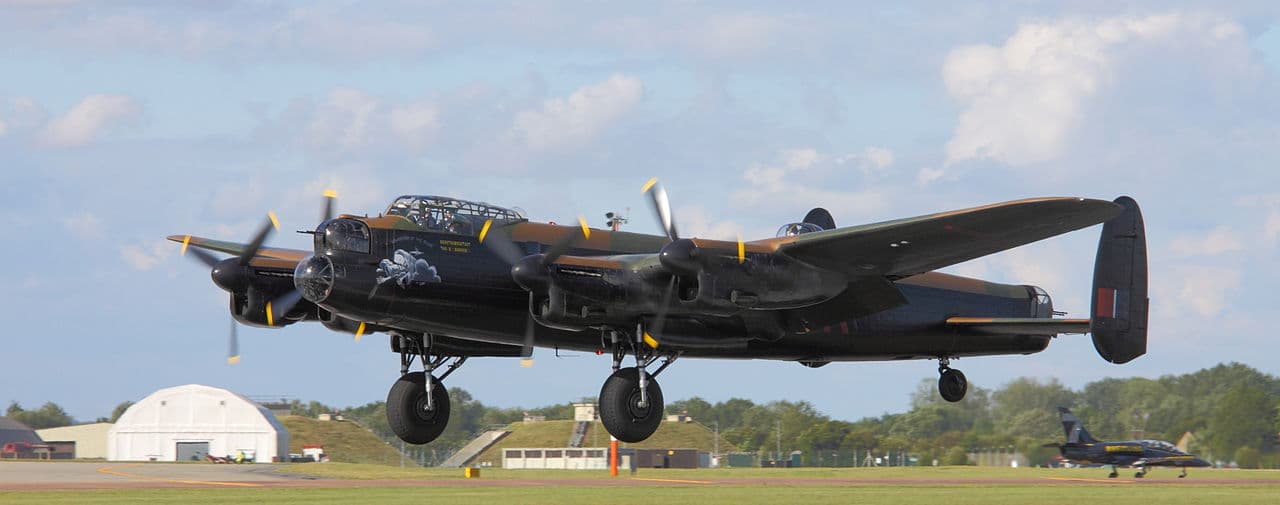
Avro Lancaster B Mk I
A.V. Roe & Company (Avro)
How does the Lancaster B Mk I stack up?
CompareOverview
The Avro Lancaster was the supreme heavy bomber of the European air war, carrying a greater bomb load farther than any other aircraft in RAF Bomber Command. Its cavernous, unobstructed 33-foot bomb bay could accommodate weapons that no other Allied bomber could carry, from the 12,000 lb Tallboy earthquake bomb to Barnes Wallis's legendary bouncing bomb used in the Dams Raid.
The Lancaster bore the brunt of the RAF's strategic night bombing campaign against Germany from 1942 to 1945, dropping 608,612 long tons of bombs in 156,000 sorties. It was the workhorse around which Air Chief Marshal Arthur "Bomber" Harris built his campaign to destroy German industrial capacity, and it performed this task with a reliability and capacity that made it irreplaceable.
Despite its iconic status, the Lancaster was a deadly aircraft to crew. Its loss rate was harrowing, of the 7,377 Lancasters built, 3,249 were lost on operations, and only 15% of Bomber Command aircrew survived a full tour of 30 missions. The Lancaster represents both the pinnacle of British heavy bomber design and the terrible human cost of the strategic bombing campaign.
Performance Profile
Max Speed
282 mph
at 11,500 ft
Range
2,530 miles
normal
Service Ceiling
24,500 ft
Rate of Climb
720 ft/min
Armament
8 guns
8x .303 Browning
Crew
7
Engine
Rolls-Royce Merlin XX
1280 hp inline
Development History
The Lancaster arose from the failure of its predecessor, the Avro Manchester. The Manchester, powered by two troublesome Rolls-Royce Vulture engines, was plagued by catastrophic engine failures that made it one of the most dangerous aircraft in Bomber Command, dangerous to its own crews. Chief designer Roy Chadwick's solution was brilliantly simple: replace the two unreliable Vultures with four proven Rolls-Royce Merlins.
The resulting aircraft, initially designated Manchester III, first flew on January 9, 1941. The transformation was remarkable. Where the Manchester had been unreliable and underpowered, the four-Merlin Lancaster was dependable and could carry an extraordinary bomb load. The Air Ministry immediately recognized its potential and ordered it into mass production.
The B Mk I entered service with No. 44 Squadron in February 1942 and quickly proved its superiority over the existing Halifax and Stirling heavy bombers. Its bomb bay, 33 feet long and unobstructed by internal dividers, could accommodate combinations of weapons that no other bomber could carry. This feature became crucial when Barnes Wallis developed his specialized weapons.
Production expanded rapidly across multiple factories, with A.V. Roe's works at Chadderton and Yeadon supplemented by Armstrong Whitworth, Austin Motors, Metropolitan-Vickers, and Vickers-Armstrongs. The Canadian-built Mk X, produced by Victory Aircraft at Malton, Ontario, added substantially to the total. By mid-1943, the Lancaster was the dominant type in Bomber Command and would remain so until the end of the war.
Combat History
The Lancaster's most famous operation was the Dams Raid of May 16-17, 1943, when 19 aircraft of No. 617 Squadron attacked the Mohne, Eder, and Sorpe dams using Barnes Wallis's "Upkeep" bouncing bomb. The raid breached the Mohne and Eder dams, flooding the Ruhr valley and demonstrating the Lancaster's ability to deliver precision weapons. The mission cost eight aircraft and 53 aircrew killed.
Throughout 1943-1944, Lancasters formed the backbone of Bomber Command's area bombing campaign against German cities. The Battle of the Ruhr, the Battle of Hamburg (where firestorm attacks killed an estimated 37,000 people), and the protracted Battle of Berlin all relied primarily on Lancaster formations. These campaigns inflicted immense damage on German industry but at a terrible cost, the Berlin campaign alone cost Bomber Command over 1,000 aircraft.
No. 617 Squadron's Lancasters continued to pioneer precision bombing with specialized weapons. Using the 12,000 lb Tallboy earthquake bomb, they sank the battleship Tirpitz on November 12, 1944, and destroyed the Bielefeld Viaduct, V-weapon sites, submarine pens, and hardened fortifications. The 22,000 lb Grand Slam, the largest bomb used in the war, was carried exclusively by specially modified Lancasters.
In the final year of the war, Lancasters increasingly flew daylight missions as Allied air superiority reduced the fighter threat. They supported the D-Day landings by bombing coastal batteries, dropped supplies to the French Resistance, and during Operation Manna in April-May 1945, dropped food to starving Dutch civilians. The Lancaster flew its last bombing mission on April 25, 1945, against Hitler's Eagle's Nest at Berchtesgaden.
Variants
| Designation | Key Differences | Produced |
|---|---|---|
| B Mk I | Standard production variant with four Merlin XX, 22, or 24 engines; 33-foot unobstructed bomb bay; eight .303 Browning guns in three turrets. | 3,425 |
| B Mk I (Special) | Modified for Upkeep bouncing bomb (Dams Raid), Tallboy, or Grand Slam; bomb doors removed, mid-upper turret deleted for weight savings. | - |
| B Mk III | Virtually identical to Mk I but powered by Packard-built Merlin 28 or 38 engines (American-made under license). | 3,039 |
| B Mk X | Canadian-built by Victory Aircraft at Malton, Ontario; Packard Merlin 224 engines; minor equipment differences. | 430 |
| B Mk VI | High-altitude variant with Merlin 85/87 engines and increased fuel capacity; used by Pathfinder Force. | 43 |
Strengths & Weaknesses
+Strengths
- Largest unobstructed bomb bay of any WWII bomber, enabling carriage of Grand Slam and Tallboy earthquake bombs
- Outstanding bomb load capacity of up to 22,000 lbs, far exceeding any Allied or Axis contemporary
- Reliable Merlin engine installation with four-engine redundancy and proven logistics chain
- Excellent handling characteristics for a heavy bomber, responsive and popular with crews
-Weaknesses
- Inadequate defensive armament of eight .303 machine guns was ineffective against armored German night fighters
- Extremely low crew survival rate, only 15% survived a full 30-mission tour
- Vulnerable belly with no ventral turret, exploited by German fighters using upward-firing Schrage Musik cannon
- Limited service ceiling of 24,500 feet made it vulnerable to radar-directed flak
Pilot Voices
“The Lancaster was the finest bomber of the war. She could carry a heavier load farther and handle better than anything else we had. She was a real lady.”
“You climbed into the Lancaster knowing the odds were against you. But she was a beautiful aircraft to fly, and if you brought her back, you loved her like nothing else.”
Did You Know?
Of the 7,377 Lancasters built, 3,249 were lost on operations, a 44% attrition rate. Over 21,000 Bomber Command aircrew were killed flying Lancasters.
The Lancaster could carry the 22,000 lb Grand Slam bomb, the largest conventional weapon used in World War II. No other Allied bomber could carry it.
During Operation Manna in April-May 1945, Lancasters dropped 6,680 tons of food to starving Dutch civilians in German-occupied Netherlands, flying at just 400 feet.

