
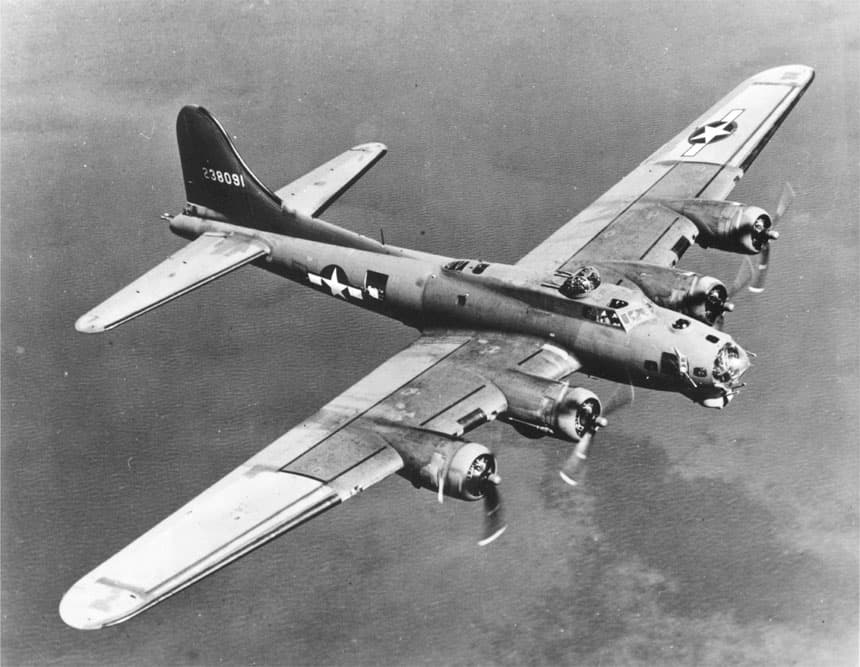
Boeing B-17G Flying Fortress
Boeing
How does the B-17G stack up?
CompareOverview
The Boeing B-17 Flying Fortress is the most iconic American bomber of World War II and one of the most recognized military aircraft in history. The four-engine heavy bomber became the symbol of American strategic air power in Europe, carrying the daylight precision bombing campaign against Nazi Germany from bases in England and Italy. Its legendary toughness, the ability to sustain horrific battle damage and still bring its crew home, made it beloved by the men who flew it.
The B-17G, the definitive variant, bristled with thirteen .50-caliber machine guns positioned to cover every approach angle, the most heavily armed bomber of the war. Its chin turret, added after savage frontal attacks by Luftwaffe fighters, gave the B-17G the aggressive profile that defines the aircraft in popular memory. Flying in tight "combat box" formations, B-17 groups put up a withering crossfire that made attacking fighters pay a steep price.
The Eighth Air Force in England and the Fifteenth Air Force in Italy dispatched thousands of B-17s on missions against German industry, transportation, oil production, and military targets. The human cost was staggering: over 4,750 B-17s were lost in combat, and the Eighth Air Force suffered more casualties than the entire US Marine Corps in the Pacific. But the strategic bombing campaign, carried largely on the wings of the B-17, was instrumental in destroying Germany's ability to wage war.
Performance Profile
Max Speed
287 mph
at 25,000 ft
Range
2,000 miles
normal
Service Ceiling
35,600 ft
Rate of Climb
900 ft/min
Armament
13 guns
13x .50 BMG
Crew
10
Engine
Wright R-1820-97 Cyclone
1200 hp radial
Development History
The B-17 originated from a 1934 Army Air Corps competition for a multi-engine bomber. Boeing's entry, the Model 299, was privately funded and daringly unconventional: a four-engine design when the competition only required "multi-engine" (which most manufacturers interpreted as two). A Seattle Times reporter dubbed it the "Flying Fortress" upon seeing it bristling with machine gun positions, and Boeing quickly trademarked the name.
The Model 299 prototype first flew on July 28, 1935, and outperformed all competitors. Tragically, it crashed on October 30, 1935, when the crew forgot to unlock the elevator gust lock before takeoff. Despite this setback, the Army ordered a small batch of Y1B-17 service test aircraft. These early models proved the concept but lacked turbochargers, adequate armament, and self-sealing fuel tanks.
The B-17E, entering service in late 1941, was the first true combat model. It added a tail gunner position, larger vertical stabilizer, powered dorsal and ventral turrets, and a completely redesigned tail section. The B-17F improved performance with more powerful engines and the Norden bombsight as standard. But it was the B-17G, entering production in September 1943, that became the definitive variant. The addition of the Bendix chin turret with twin .50-caliber guns addressed the critical vulnerability to head-on attacks that had cost so many crews in 1943.
Boeing, Douglas, and Vega (a Lockheed subsidiary) all produced B-17Gs in a remarkable example of wartime industrial collaboration. Peak production reached sixteen aircraft per day. In total, 8,680 B-17Gs were built, accounting for more than two-thirds of all B-17 production.
Combat History
The B-17 first saw combat with the RAF in 1941, when early B-17C models (Fortress I) flew high-altitude raids over Europe with disappointing results. The USAAF's B-17E entered combat in the Pacific after Pearl Harbor, flying missions from Java, Australia, and later the Southwest Pacific, though the heavy bomber was poorly suited to the naval war. It was in Europe that the B-17 found its purpose.
The Eighth Air Force flew its first B-17 mission from England on August 17, 1942, when twelve B-17Es bombed the rail marshaling yard at Rouen, France. From this modest beginning, the daylight bombing campaign grew into the largest aerial offensive in history. Through 1943, B-17 groups suffered devastating losses as they pushed deeper into Germany without fighter escort: the Schweinfurt-Regensburg raids of August and October 1943 cost 120 B-17s, demonstrating that unescorted daylight bombing was untenable.
The arrival of the P-51 Mustang escort fighter in early 1944 transformed the campaign. With fighters protecting them to and from the target, B-17 formations could concentrate on accuracy. "Big Week" in February 1944 saw over 1,000 B-17s and B-24s strike the German aircraft industry in a week of concentrated raids that began the systematic destruction of the Luftwaffe. On D-Day, over 1,300 B-17s bombed coastal defenses along the Normandy beaches.
By war's end, the Eighth Air Force alone had dropped 640,036 tons of bombs, the majority from B-17s. The cost was enormous: 26,000 airmen killed and nearly 5,000 B-17s lost. But the strategic bombing campaign destroyed Germany's oil production, shattered its transportation network, and forced the diversion of millions of soldiers and thousands of guns to air defense, resources desperately needed on the Eastern Front.
Variants
| Designation | Key Differences | Produced |
|---|---|---|
| B-17C/D | Early models, self-sealing tanks, flush gun positions, first combat with RAF | 112 |
| B-17E | Complete redesign: enlarged tail, dorsal/ventral turrets, tail gunner, first major combat variant | 512 |
| B-17F | Frameless Plexiglas nose, improved engines, Tokyo tanks, increased bomb load | 3,405 |
| B-17G | Chin turret, staggered waist gun windows, improved turbochargers, definitive variant | 8,680 |
| F-9/FB-17 | Photo-reconnaissance variant with cameras replacing bomb load | 61 |
Strengths & Weaknesses
+Strengths
- Legendary structural toughness; could sustain massive battle damage and remain airborne
- Thirteen .50-caliber guns provided comprehensive defensive coverage from all angles
- Excellent high-altitude capability with turbocharged engines, maintaining speed and altitude above 25,000 feet
- Precise Norden bombsight enabled accurate daylight precision bombing
- Tight combat box formations created overlapping fields of fire that deterred fighter attacks
-Weaknesses
- Relatively small bomb bay limited payload to 4,000-6,000 lbs on deep penetration missions, less than the B-24 or Lancaster
- Suffered devastating losses without fighter escort; unescorted raids deep into Germany were unsustainable
- Slow speed and predictable formation flying made it vulnerable to both fighters and flak
- Thin fuselage skin offered little protection against 20mm cannon shells and heavy flak
Pilot Voices
“The B-17 could take a beating that no other airplane in the world could take and still bring you home.”
“If you were going to war in a heavy bomber, the B-17 was the one you wanted. It would get you there and bring you back when nothing else could.”
Did You Know?
The B-17 "Memphis Belle" and its crew became the first Eighth Air Force bomber to complete 25 combat missions, a feat celebrated in two major films.
B-17 waist gunners wore electrically heated flight suits at altitude because temperatures in the unpressurized fuselage could reach -60 degrees Fahrenheit.
On February 1, 1943, the B-17 "All American" had its tail nearly severed by a mid-air collision with an attacking Bf 109 but flew over 90 minutes back to base and landed safely.
The Eighth Air Force suffered a higher casualty rate than any other major American combat unit, with a crewman having roughly a 26% chance of completing his 25-mission tour.


