
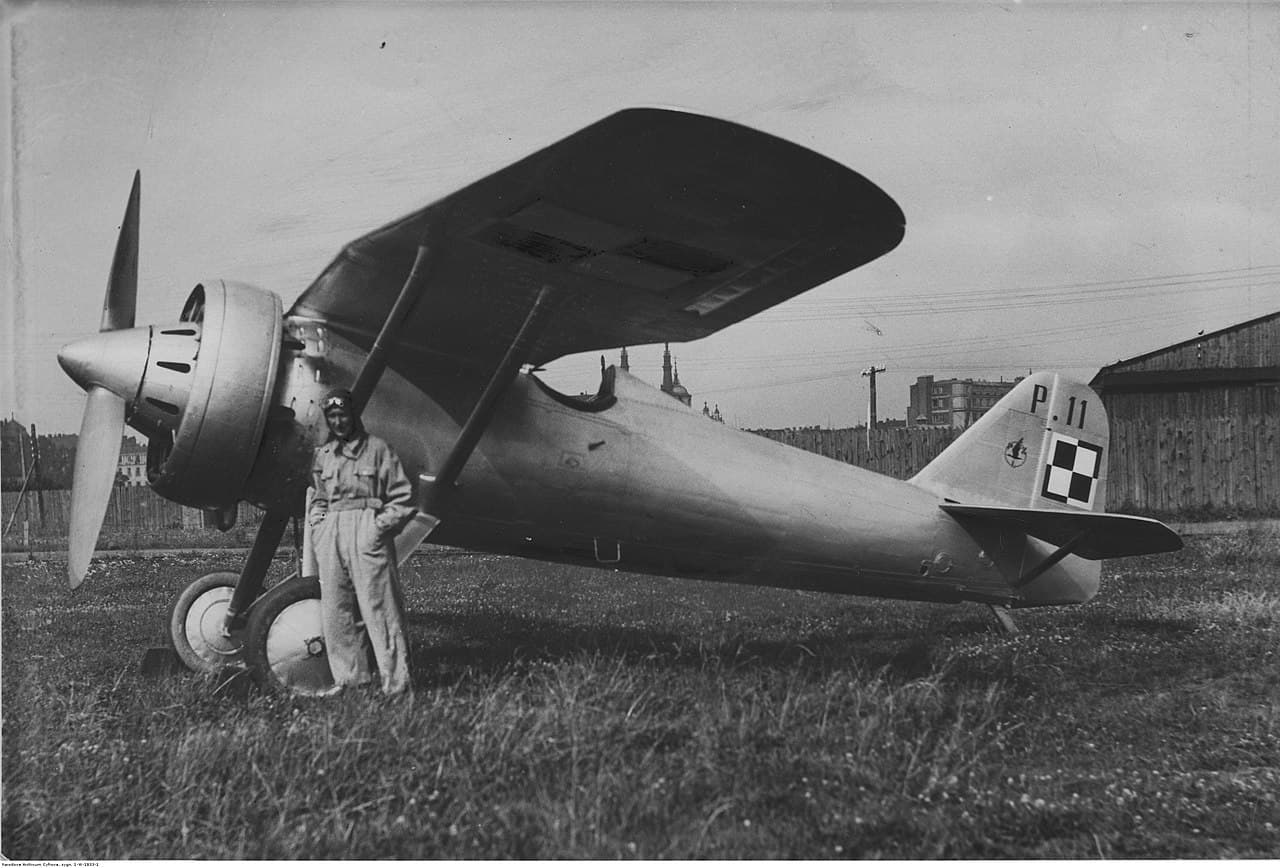
PZL P.11c
PZL
How does the P.11c stack up?
CompareOverview
The PZL P.11 was the primary fighter of the Polish Air Force when Germany invaded on September 1, 1939, and it became the first fighter aircraft to engage the Luftwaffe in the opening hours of World War II. A gull-winged monoplane designed by the brilliant Zygmunt Pulawski, the P.11 had been one of the most advanced fighters in the world when it entered service in 1934, but by 1939 it was hopelessly obsolete, outperformed by the Messerschmitt Bf 109 by margins of 100 mph in speed and thousands of feet in service ceiling.
Despite its obsolescence, the P.11 and its pilots fought with extraordinary tenacity during the September Campaign. Armed with only two rifle-caliber machine guns and facing an enemy with overwhelming numerical and qualitative superiority, Polish fighter pilots claimed approximately 126 confirmed aerial victories in the first two weeks of the war, a remarkable achievement for an aircraft that had no business engaging modern monoplane fighters and twin-engine bombers in combat.
The P.11's story is inseparable from the tragedy of Poland in September 1939. It represented the best Poland could field, and its pilots, many of whom later escaped to fly Hurricanes and Spitfires with the RAF, demonstrated a courage and skill that far exceeded the capabilities of their machines.
Performance Profile
Max Speed
242 mph
at 18,045 ft
Range
435 miles
normal
Service Ceiling
36,090 ft
Rate of Climb
2,440 ft/min
Armament
2 guns
2x 7.92mm KM Wz.33
Crew
1
Engine
PZL Bristol Mercury VI S2
645 hp radial
Development History
The PZL P.11 was the culmination of a series of innovative gull-winged fighters designed by Zygmunt Pulawski at the Panstwowe Zaklady Lotnicze (State Aviation Works) in Warsaw. Pulawski's distinctive high-mounted gull wing, which provided excellent pilot visibility and avoided the need for a parasol or strut-braced arrangement, was first seen in the P.1 prototype of 1929 and refined through the P.6 and P.7 series before reaching its definitive form in the P.11.
The P.11 prototype first flew in August 1931, and the type entered service with the Polish Air Force in 1934. At that time, it was genuinely one of the best fighters in the world, faster than the Boeing P-26 Peashooter, more maneuverable than most contemporaries, and featuring an all-metal stressed-skin construction that was advanced for its era. The distinctive inverted gull wing gave the pilot outstanding visibility downward and forward, crucial for a combat fighter, and the robust Bristol Mercury radial engine was reliable in the harsh Polish climate.
Production was divided between the P.11a with the Mercury IVS2 engine (645 hp) and the definitive P.11c with the Mercury VI S2, which featured a lowered engine thrust line for improved forward visibility. The P.11c also introduced an enclosed cockpit option, though many Polish pilots preferred to fly with the canopy open or removed. Total production reached 325 aircraft, including export variants for Romania and Greece.
By 1935-36, however, the P.11 was already showing its age. Its fixed landing gear, open cockpit, and limited armament of two machine guns were increasingly outdated as the first generation of modern enclosed-cockpit monoplanes, the Bf 109, Spitfire, and Hurricane, began to appear. Poland ordered the PZL P.50 Jastrzab as a replacement, but this modern fighter was still in prototype testing when war broke out, leaving the P.11 to face the Luftwaffe alone.
Combat History
At dawn on September 1, 1939, the Polish Air Force was caught in the process of dispersing to hidden field airstrips, a precaution that saved the majority of its aircraft from destruction on the ground, contrary to the enduring myth that the Polish Air Force was annihilated in the first hours. P.11 fighters were airborne and engaging Luftwaffe formations within minutes of the first attacks, and the air battles that followed over the next two weeks were far more intense and costly for the Germans than most accounts acknowledge.
Polish P.11 pilots faced a nightmarish tactical situation. The Bf 109E was over 100 mph faster, could climb away at will, and carried far heavier armament. The only advantages the P.11 possessed were its extremely tight turning radius and its ability to operate from rough, unprepared fields close to the front lines. Polish pilots developed tactics to exploit these slim advantages: diving attacks from above using what altitude advantage they could gain, sharp turning engagements that prevented the faster Bf 109s from using their speed, and ambushes of German bomber formations before escorts could intervene.
The results, given the circumstances, were remarkable. Polish fighter pilots claimed approximately 126 aerial victories during the September Campaign, the majority scored by P.11 pilots. On September 1 alone, pilots of the Pursuit Brigade (Brygada Poscigowa) defending Warsaw claimed several Dornier Do 17 and Heinkel He 111 bombers destroyed. Throughout the campaign, Polish fighters repeatedly disrupted German bomber formations and forced the Luftwaffe to provide heavier fighter escort than planned, diverting resources from other missions.
The P.11's combat career effectively ended with the Polish defeat in early October 1939, though a handful of aircraft escaped to Romania. The Romanian Air Force had operated its own P.11 variants since 1936, and Greek P.11s flew against Italian invaders in 1940-41. But the P.11's enduring significance lies in those desperate September days, when outmatched Polish pilots proved that courage and skill could partly compensate for technological obsolescence, and that the myth of Poland's passive aerial defeat was exactly that: a myth.
Variants
| Designation | Key Differences | Produced |
|---|---|---|
| P.11a | Initial production variant with Bristol Mercury IVS2 engine (517 hp) and higher engine thrust line. Less refined forward visibility. Served from 1934. | 50 |
| P.11c | Definitive Polish Air Force variant with Mercury VI S2 engine (645 hp), lowered engine line for improved visibility, provision for enclosed cockpit. Main combat variant of September 1939. | 175 |
| P.11b (Romanian) | Export variant for Romania with IAR-built Gnome-Rhone 9Krse engine (580 hp). Romania purchased 50 and built an additional 95 under license. | 50 |
| P.11f (Greek) | Export variant for Greece with Mercury VI S2 engine. 36 delivered to the Greek Air Force for use against Italian invasion in 1940-41. | 36 |
| P.11g Kobuz | Proposed upgraded variant with Mercury VIII engine (840 hp), enclosed cockpit, four machine guns, and retractable landing gear. Development overtaken by the war. | 1 |
Strengths & Weaknesses
+Strengths
- Exceptional maneuverability with a very tight turning radius, one of the few advantages Polish pilots could exploit against the Bf 109
- Excellent pilot visibility from the gull wing arrangement, critical for spotting enemy aircraft in combat
- Rugged construction and reliable Bristol Mercury engine could operate from rough, unprepared field strips
- Light weight and responsive controls made it a forgiving aircraft for pilots of varying skill levels
-Weaknesses
- Hopelessly outclassed by the Bf 109E in speed (100+ mph deficit), climb rate, and dive speed
- Armament of only two 7.92mm machine guns was wholly inadequate, insufficient to reliably bring down bombers
- Fixed landing gear created substantial drag, contributing to the low top speed of 242 mph
- Open cockpit and lack of armor or self-sealing tanks made the pilot extremely vulnerable to enemy fire
Pilot Voices
“We knew our aircraft were obsolete. We knew we could not match the Messerschmitt. But we were Polish, and we fought.”
“In a turning fight the P.11 could hold its own against anything, but the German simply would not turn with us. He would dive in, fire, and zoom away, and there was nothing we could do about it.”
Did You Know?
The P.11 was designed by Zygmunt Pulawski, whose gull-wing design was so innovative that similar configurations were known internationally as "Pulawski wings", but Pulawski was killed in a flying accident in 1931 before the P.11 entered service.
Contrary to the widespread myth that the Polish Air Force was destroyed on the ground on September 1, most Polish aircraft, including the majority of P.11 fighters, had been dispersed to concealed satellite fields before the attack.
Polish P.11 pilot Stanislaw Skalski, who scored 4 victories during the September Campaign, later escaped to Britain and became one of the top-scoring Polish aces of the war flying Spitfires with the RAF.
The P.11 was considered the best fighter in the world in 1934, but Poland's inability to fund and develop a modern replacement left its air force fighting WW2 with what was essentially a pre-1935 design.


