
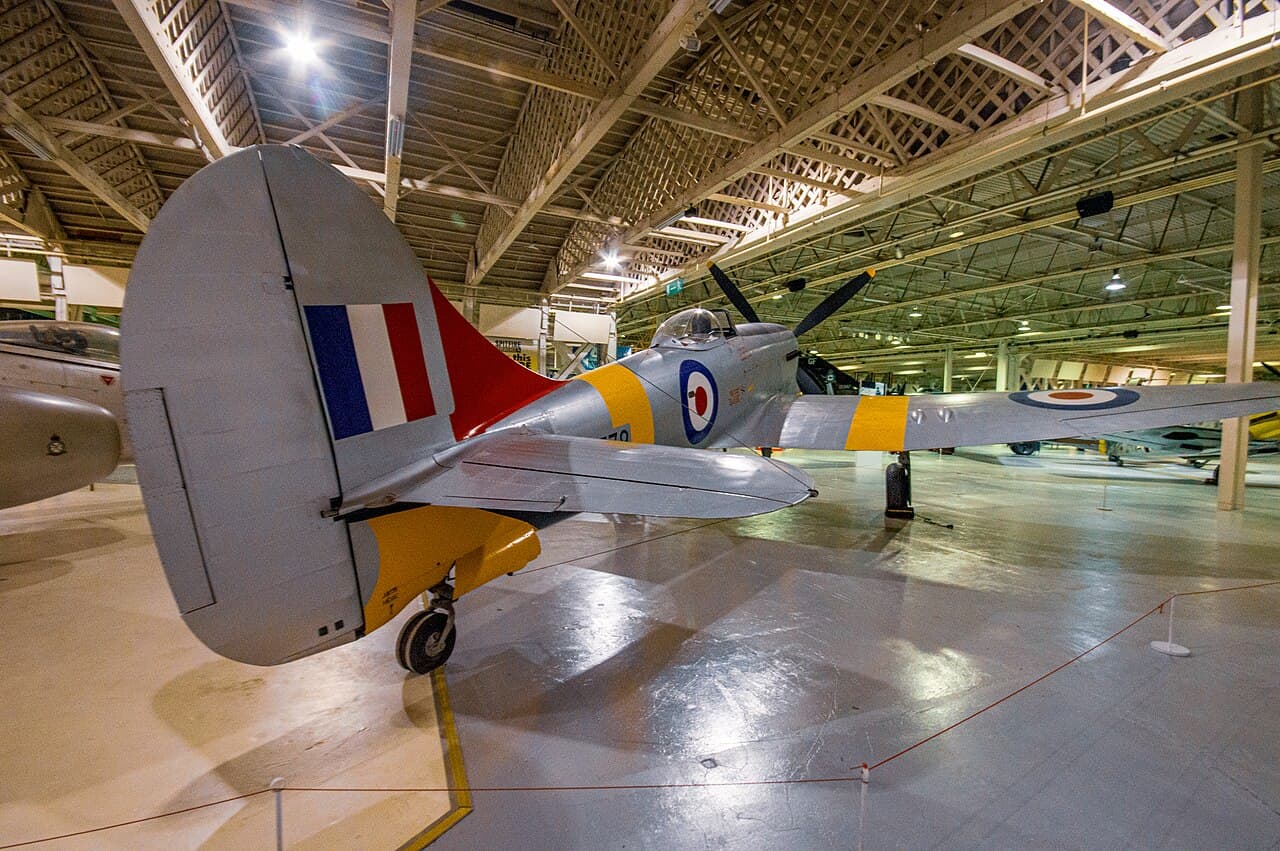
Hawker Tempest Mk V
Hawker Aircraft
How does the Tempest Mk V stack up?
CompareOverview
The Hawker Tempest Mk V was the fastest and most powerful piston-engine fighter in RAF service during the final year of the war, and arguably the finest low-to-medium altitude fighter produced by any nation. Developed as a thoroughbred refinement of the Typhoon, it corrected virtually every flaw of its predecessor while adding a new thin-section laminar flow wing that transformed its performance.
The Tempest arrived in service just in time for two critical missions: intercepting V-1 flying bombs over southern England and fighting the Luftwaffe's best in the skies over northwest Europe. It excelled at both. Against the V-1, the Tempest's searing low-altitude speed made it the most successful interceptor, accounting for 638 of the pilotless bombs.
In air combat over the continent, the Tempest proved capable of meeting and defeating the Fw 190D-9, the Bf 109K, and even the Me 262 jet, making it the premier RAF air superiority fighter during the final campaigns of the European war.
Performance Profile
Max Speed
435 mph
at 17,000 ft
Range
740 miles
normal
Service Ceiling
36,500 ft
Rate of Climb
4,700 ft/min
Armament
4 guns
4x 20mm Hispano Mk V
Crew
1
Engine
Napier Sabre IIB
2180 hp inline
Development History
The Tempest originated as the Typhoon II, a redesign intended to address the Typhoon's fundamental aerodynamic limitations. Sydney Camm and his team at Hawker recognized that the Typhoon's thick wing was the primary obstacle to higher performance. The solution was a completely new semi-elliptical wing with a laminar flow profile, significantly thinner than the Typhoon's wing.
The new wing was so different that the Air Ministry agreed to give the aircraft a new name: Tempest. The redesign also introduced a longer fuselage for better stability, relocated the radiator from the chin to a wing leading-edge installation, and increased fuel capacity. The result was an aircraft that looked superficially similar to the Typhoon but was aerodynamically far superior.
Six prototype Tempests were built with different engine configurations. The Mk V, powered by the Napier Sabre IIB, was the first to reach production because the Sabre was already in service with the Typhoon and required no new supply chain. The first production Mk V flew in June 1943, but service entry was delayed until April 1944 as Hawker prioritized fixing remaining issues.
The initial Series 1 Tempest Vs featured long-barrel Hispano Mk II cannon with protruding barrels, while the definitive Series 2 used short-barrel Hispano Mk V cannon housed entirely within the wing, giving a cleaner aerodynamic profile. Only 805 Mk Vs were built during the war, but their quality made up for their limited numbers.
Combat History
The Tempest V entered operational service with No. 3 Squadron and No. 486 (RNZAF) Squadron at Newchurch in April 1944, initially tasked with pre-invasion fighter sweeps over France. When the V-1 flying bomb campaign began on June 13, 1944, the Tempest's superb low-altitude speed made it the ideal interceptor. No. 150 Wing's Tempests destroyed 638 V-1s, more than any other aircraft type, with individual pilots like Squadron Leader Joseph Berry claiming 60 V-1 kills.
After the V-1 threat diminished, Tempest units moved to the continent to provide air superiority for the advancing Allied armies. In the skies over the Low Countries and Germany, Tempests fought an increasingly desperate Luftwaffe. On January 1, 1945, during Operation Bodenplatte, Tempests of No. 122 Wing helped defeat the massive Luftwaffe surprise attack on Allied airfields, destroying numerous Fw 190s and Bf 109s.
The Tempest became the most effective Allied fighter against the Me 262 jet, claiming 20 confirmed kills against the revolutionary German jet. Tempest pilots developed tactics of patrolling at low altitude near known Me 262 bases, catching the jets during their vulnerable takeoff and landing phases when their speed advantage was negated.
By VE Day, Tempest units had claimed over 1,000 enemy aircraft destroyed in aerial combat and on the ground. The aircraft had proven itself the equal or superior of every Luftwaffe fighter it encountered, including the Fw 190D "Dora" and Bf 109K, cementing its reputation as the finest piston-engine fighter in the RAF's arsenal.
Variants
| Designation | Key Differences | Produced |
|---|---|---|
| Tempest V Series 1 | Initial production with long-barrel Hispano Mk II cannon protruding from the wing leading edge. | 100 |
| Tempest V Series 2 | Definitive variant with short-barrel Hispano Mk V cannon housed entirely within the wing for cleaner aerodynamics. | 705 |
| Tempest II | Radial-engine variant powered by the Bristol Centaurus V; entered service too late for the European war but served in the Far East and postwar. | 452 |
| Tempest VI | Napier Sabre V engine with 2,340 hp; tropicalized for Middle East service; postwar only. | 142 |
Strengths & Weaknesses
+Strengths
- Fastest piston-engine RAF fighter at low and medium altitudes, reaching 435 mph
- New laminar-flow wing provided superior roll rate and dive acceleration compared to contemporaries
- Excellent forward visibility with bubble canopy, ideal for both air combat and ground attack
- Heavy four-cannon armament with 150 rpg gave outstanding destructive power
-Weaknesses
- Complex Napier Sabre engine required skilled maintenance and high-quality fuel
- Limited production numbers meant it could not fully replace the Typhoon
- Performance dropped off above 25,000 feet compared to high-altitude optimized fighters
- Late arrival in April 1944 meant it missed the critical early air superiority battles
Pilot Voices
“The Tempest was the finest propeller-driven fighter I ever flew. It had the speed of a Mustang, the firepower of a Typhoon, and handling that was in a class of its own.”
“When you opened that Sabre engine to full power, the acceleration was breathtaking. Nothing in the Luftwaffe could stay with you below twenty thousand feet.”
Did You Know?
The Tempest destroyed more V-1 flying bombs than any other aircraft type, accounting for 638 of the nearly 4,000 V-1s shot down by fighters.
Tempest pilot Pierre Clostermann, who later wrote the classic memoir "The Big Show," considered the Tempest V the finest fighter he flew during the entire war, superior even to the Spitfire.
The Tempest was one of the few Allied piston fighters that could catch and destroy Me 262 jets in level flight at low altitude, claiming 20 confirmed jet kills.


