James Holloway writes about military readiness, logistics, and the practical limits of modern forces. His work focuses on how training, sustainment, and organizational decisions shape what militaries can actually do -- not just what they are designed to do on paper.
The Most Capable Submarine Britain Has Ever Built
The Astute class is the Royal Navy's newest and most advanced class of nuclear-powered attack submarines. Designed to replace the aging Trafalgar class that had served since the 1980s, the Astute boats represent a generational leap in capability: larger, quieter, better armed, and equipped with sensor systems that set new standards for the Royal Navy.
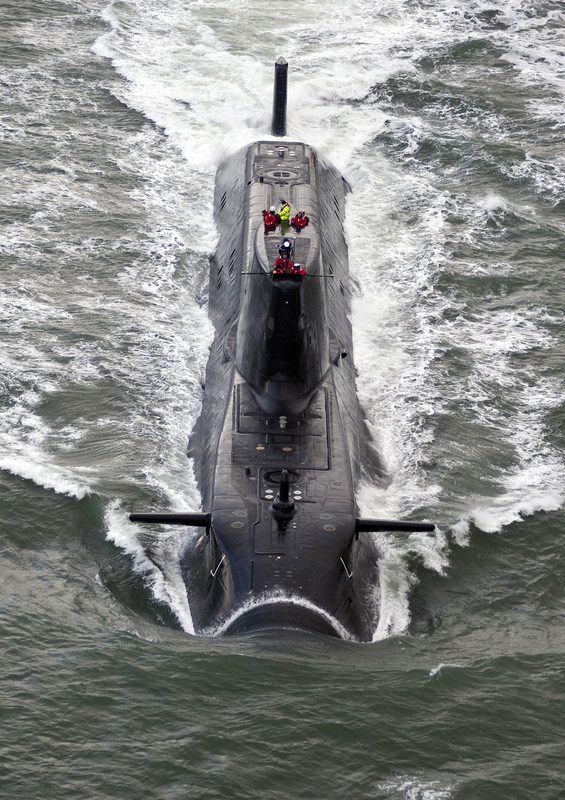
HMS Astute on the surface with crew on the casing. The Astute class is the most advanced attack submarine Britain has ever built. Royal Navy photo via Wikimedia Commons.
Seven boats are planned for the class. HMS Astute was commissioned in 2010, followed by HMS Ambush in 2013, HMS Artful in 2016, HMS Audacious in 2020, and HMS Anson in 2024. HMS Agamemnon and HMS Agincourt are still under construction at BAE Systems' shipyard in Barrow-in-Furness, Cumbria. The program has been plagued by delays and cost overruns that have stretched across more than two decades.
But the submarines themselves are formidable. Each Astute-class boat displaces approximately 7,400 tonnes submerged, making them significantly larger than the Trafalgar class they replace. At 97 meters long and with a crew of around 98, they are closer in size to a ballistic missile submarine than a traditional hunter-killer.
Nuclear Power: A Reactor That Lasts Forever
The Astute class is powered by a Rolls-Royce PWR2 nuclear reactor, the same type used in the Royal Navy's Vanguard-class ballistic missile submarines. The PWR2 produces enough energy to power a city the size of Southampton. More importantly, it generates enough steam to drive the submarine at speeds exceeding 30 knots while submerged.
The reactor's most significant feature is its fuel life. The PWR2 core is designed to last the entire operational life of the submarine, approximately 25 years, without ever needing to be refueled. This is a massive improvement over the previous Trafalgar class, whose PWR1 reactors required refueling approximately every eight to ten years. Refueling a nuclear submarine means cutting open the hull, removing the old reactor core, installing a new one, and welding the hull back together, a process that takes years and costs hundreds of millions of pounds.
By eliminating the need for refueling, the Astute class gains years of additional operational availability. The boats spend more time at sea and less time in drydock. For a navy with a limited number of submarines, this increase in availability is as strategically important as any weapons upgrade.
The reactor also provides unlimited range. Like all nuclear submarines, the Astute class can circumnavigate the globe without surfacing. The only constraints on patrol duration are food supplies and crew endurance, typically limiting deployments to around 90 days, though the boats can remain submerged much longer if necessary.
Sonar: Hearing Everything
The Astute class carries the Thales Sonar 2076 integrated sonar suite, which the Royal Navy has described as the most advanced sonar system fitted to any submarine in the world. The system combines bow-mounted sonar, flank arrays running along the length of the hull, a towed array that trails behind the submarine, and intercept sonar capable of detecting and classifying active sonar transmissions from other vessels.
The Sonar 2076 processes acoustic data using advanced computing that can distinguish between thousands of individual sound signatures, identifying not just the type of vessel but potentially the individual ship based on its unique acoustic fingerprint. The system's sensitivity is reportedly capable of detecting low-frequency sounds across thousands of miles of ocean under favorable conditions.
The sonar suite represents a philosophy that has defined submarine warfare since the Cold War: the submarine that detects the enemy first almost always wins. In underwater combat, detection means targeting, and targeting means destruction. The Astute class is designed to hear everything in the ocean around it while remaining completely silent itself.
Weapons: Torpedoes and Cruise Missiles
The Astute class carries a mixed weapons load of Spearfish heavyweight torpedoes and Tomahawk Block IV cruise missiles, launched from six 533mm torpedo tubes in the bow. The boat can carry up to 38 weapons in any combination of torpedoes and missiles.
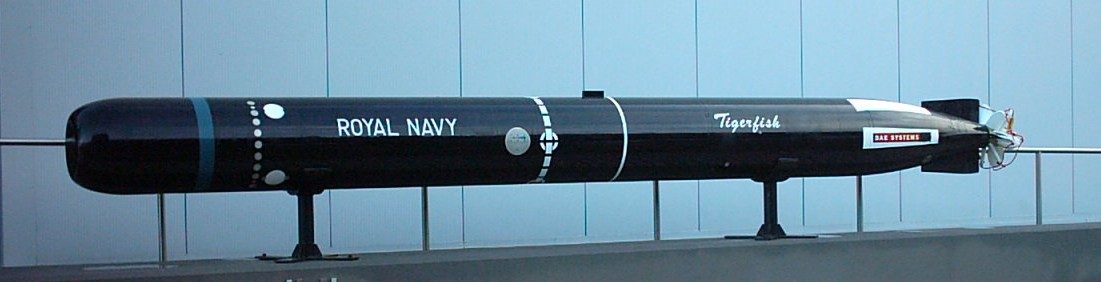
A Royal Navy Spearfish heavyweight torpedo on display. Capable of speeds exceeding 60 knots, the Spearfish can chase down any submarine or surface vessel. Photo via Wikimedia Commons.
The Spearfish torpedo is one of the most capable heavyweight torpedoes in service anywhere. Powered by a gas turbine engine, it can reach speeds exceeding 60 knots, fast enough to chase down any submarine or surface vessel. The torpedo uses a combination of wire guidance (the torpedo trails a thin wire back to the submarine for mid-course corrections) and autonomous active/passive sonar for terminal homing. Its warhead is large enough to cripple or sink any warship afloat.
The Tomahawk cruise missile gives the Astute class a land-attack capability that extends the submarine's reach far beyond the ocean. Launched from the torpedo tubes while submerged, the Tomahawk can strike targets more than 1,000 miles inland with GPS-guided precision. British submarines have used Tomahawk missiles in combat during operations in Afghanistan, Libya, and Syria.
This dual capability, anti-submarine warfare and land attack, makes the Astute class one of the most versatile military platforms in the Royal Navy. A single submarine can hunt enemy submarines in the deep ocean one week and strike targets hundreds of miles inland the next.
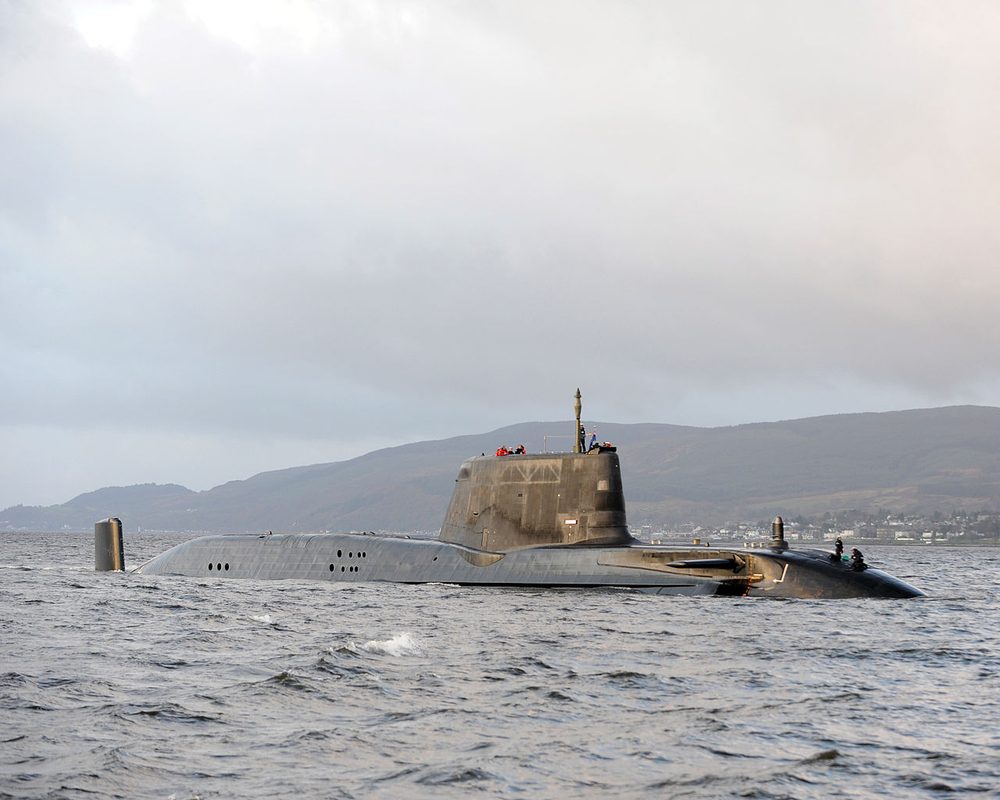
HMS Astute at sea, showing the streamlined hull and conning tower. The pump-jet propulsor and anechoic coating make the Astute class among the quietest submarines in any navy. Royal Navy photo.
Stealth: The Pump-Jet Advantage
The Astute class uses a pump-jet propulsor rather than a traditional propeller. The pump-jet is essentially a ducted propulsion system that accelerates water through an internal channel, producing thrust without the cavitation noise that makes conventional propellers detectable at speed.
Cavitation occurs when a spinning propeller creates areas of low pressure that cause dissolved gases in seawater to form bubbles. These bubbles collapse with a characteristic crackling sound that sonar systems can detect from considerable distances. At higher speeds, cavitation becomes increasingly severe, creating a noise signature that can reveal a submarine's position.
The pump-jet largely eliminates this problem. By enclosing the propulsion mechanism in a duct, water pressure is maintained at levels that prevent cavitation across a much wider range of speeds. The result is a submarine that can move faster while remaining quieter than its predecessors.
Additional noise reduction measures include rafted machinery, where critical equipment is mounted on isolation platforms that absorb vibration before it can reach the hull, and an anechoic coating on the outer hull that absorbs incoming sonar pulses rather than reflecting them back. The combination of these technologies makes the Astute class significantly quieter than the Trafalgar class and among the quietest submarines in any navy.
A Troubled Birth
The Astute class's capabilities are impressive, but the program's history is a cautionary tale in defense procurement. When the contract was awarded to GEC-Marconi (later BAE Systems) in 1997, the first boat was expected to cost around £2 billion and enter service in 2005. HMS Astute was not actually commissioned until 2010, five years late, and the program's total cost had ballooned dramatically.
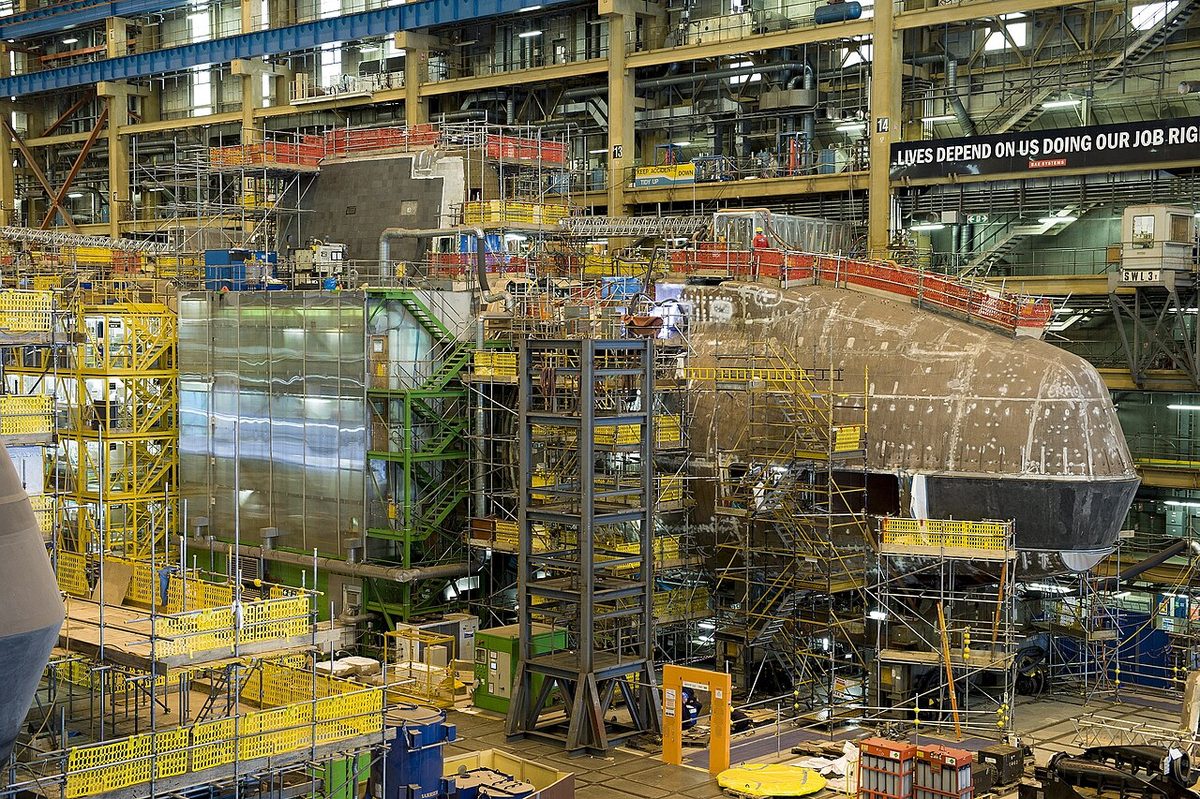
An Astute-class submarine under construction at BAE Systems' Devonshire Dock Hall in Barrow-in-Furness. The program required rebuilding institutional submarine-building knowledge that had atrophied during the 1990s. Photo via BAE Systems.
Several factors contributed to the delays. The gap between the Trafalgar class and Astute class meant that critical submarine design and construction skills had atrophied in the British shipbuilding workforce. BAE Systems had to rebuild institutional knowledge that had been lost during the procurement holiday of the 1990s. The company eventually brought in engineers from General Dynamics Electric Boat, the American company that builds Virginia-class submarines, to help get the program back on track.
HMS Astute's early career added to the program's troubles. In October 2010, just months after commissioning, the submarine ran aground on a shingle bank off the Isle of Skye during sea trials. The grounding caused minor damage to the hull but significant embarrassment to the Royal Navy. The incident was attributed to navigational error.
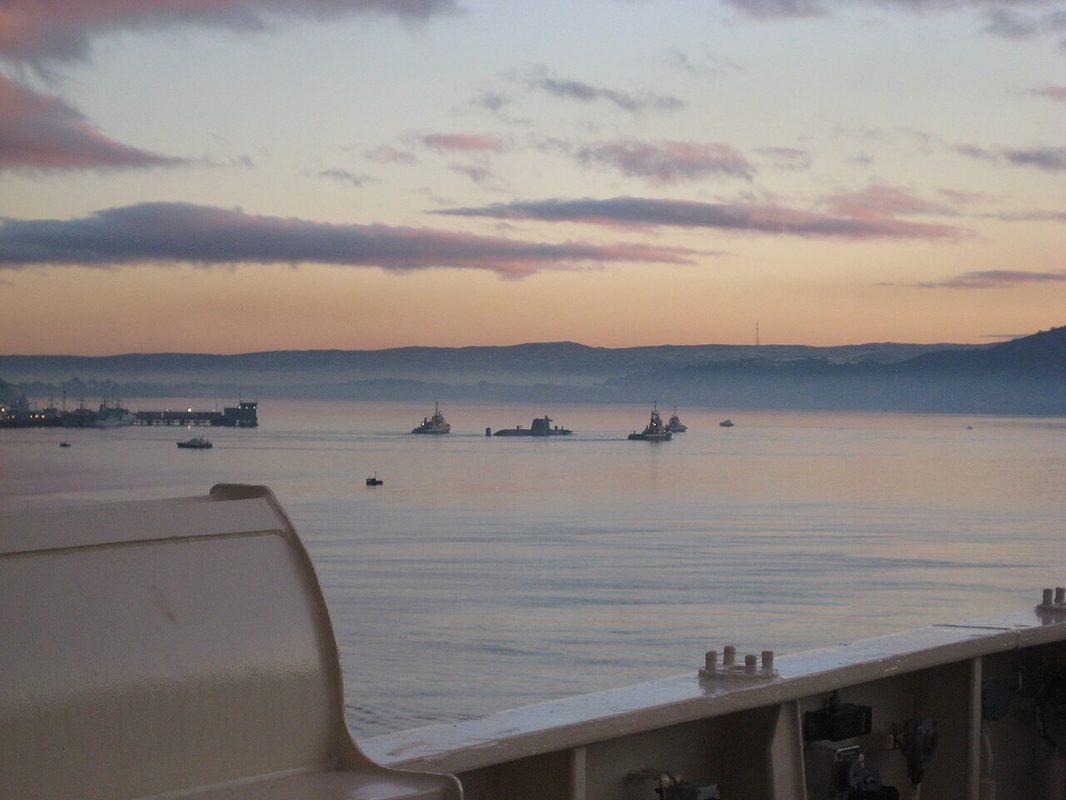
Naval vessels near the submarine facilities on the Clyde. The Astute program has been one of the most challenging procurement efforts in British defense history. Photo via Wikimedia Commons.
Despite these difficulties, each successive boat has been delivered more efficiently than the last. The lessons learned during Astute's construction have been applied to her sisters, and the program has stabilized. The later boats, Audacious and Anson, were delivered closer to schedule and with fewer technical issues.
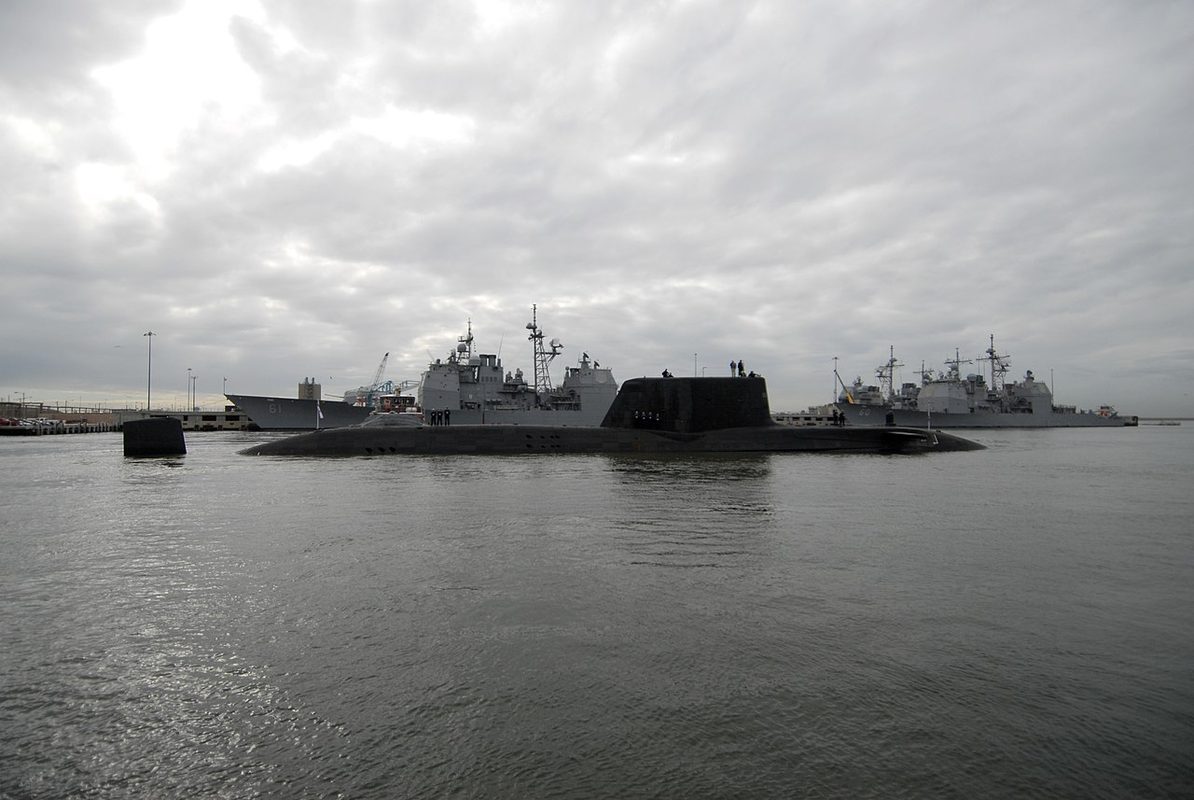
HMS Astute alongside at Naval Station Norfolk. The Astute class regularly operates alongside U.S. Navy forces on both sides of the Atlantic. Royal Navy photo.
The Astute class is frequently compared to the United States Navy's Virginia-class submarines, the world's other premier Western attack submarine. The two classes share many design philosophies, including nuclear propulsion, advanced sonar, mixed torpedo and missile armament, and extreme acoustic stealth, but they differ in important ways.
The Virginia class is slightly larger and carries the AN/BQQ-10 sonar suite, which is continuously upgraded with new processing capabilities. The American boats also feature the Virginia Payload Module on later blocks, adding four large-diameter launch tubes that can carry up to 28 additional Tomahawk missiles, giving later Virginia-class boats a total missile capacity that far exceeds the Astute class.
The Astute class's Sonar 2076, however, is widely regarded as at least comparable to the American system, and some assessments rate it as superior in certain acoustic environments. The Royal Navy has historically excelled in sonar technology, and the Astute class continues that tradition.
In terms of overall capability, both classes represent the state of the art in submarine design. The Virginia class benefits from larger production numbers, since the US Navy plans to build at least 30, while the Astute class's seven boats give the Royal Navy a smaller but highly capable submarine force.
Strategic Role
The Astute class serves multiple strategic roles for the United Kingdom. Its primary mission is anti-submarine warfare: hunting and, if necessary, destroying enemy submarines. In a conflict scenario, Astute-class boats would be tasked with protecting the Royal Navy's Vanguard-class ballistic missile submarines, which carry Britain's nuclear deterrent.
The boats also provide intelligence gathering, surveillance, and reconnaissance capabilities. A nuclear submarine can loiter undetected near areas of interest for weeks, monitoring communications, tracking ship movements, and building a detailed picture of adversary activities.
The land-attack mission adds a power projection capability that has proven valuable in recent conflicts. The ability to position a submarine undetected off a hostile coast and strike targets deep inland provides political and military leaders with options that no other platform can match.
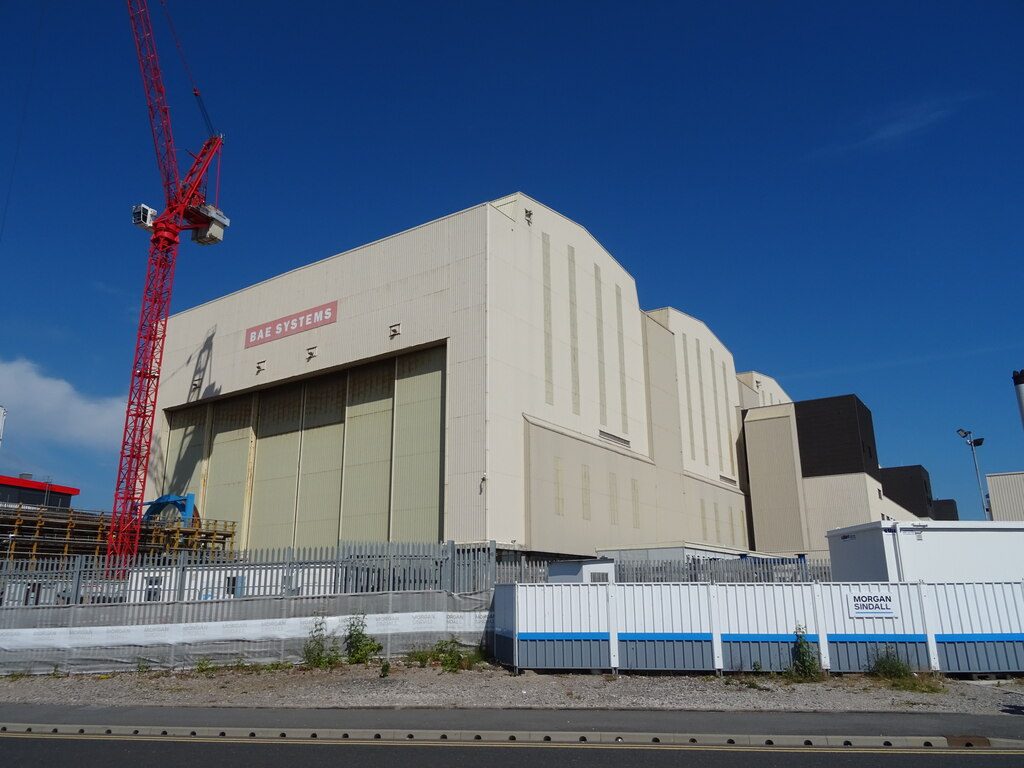
BAE Systems' shipyard at Barrow-in-Furness, where all seven Astute-class submarines are being built. The facility is the UK's sole nuclear submarine construction site. Photo via Wikimedia Commons.
Seven Astute-class boats will form the backbone of the Royal Navy's submarine force for decades to come. They may have been expensive and difficult to build, but the result is a class of submarines that can hold its own against any adversary beneath the waves.