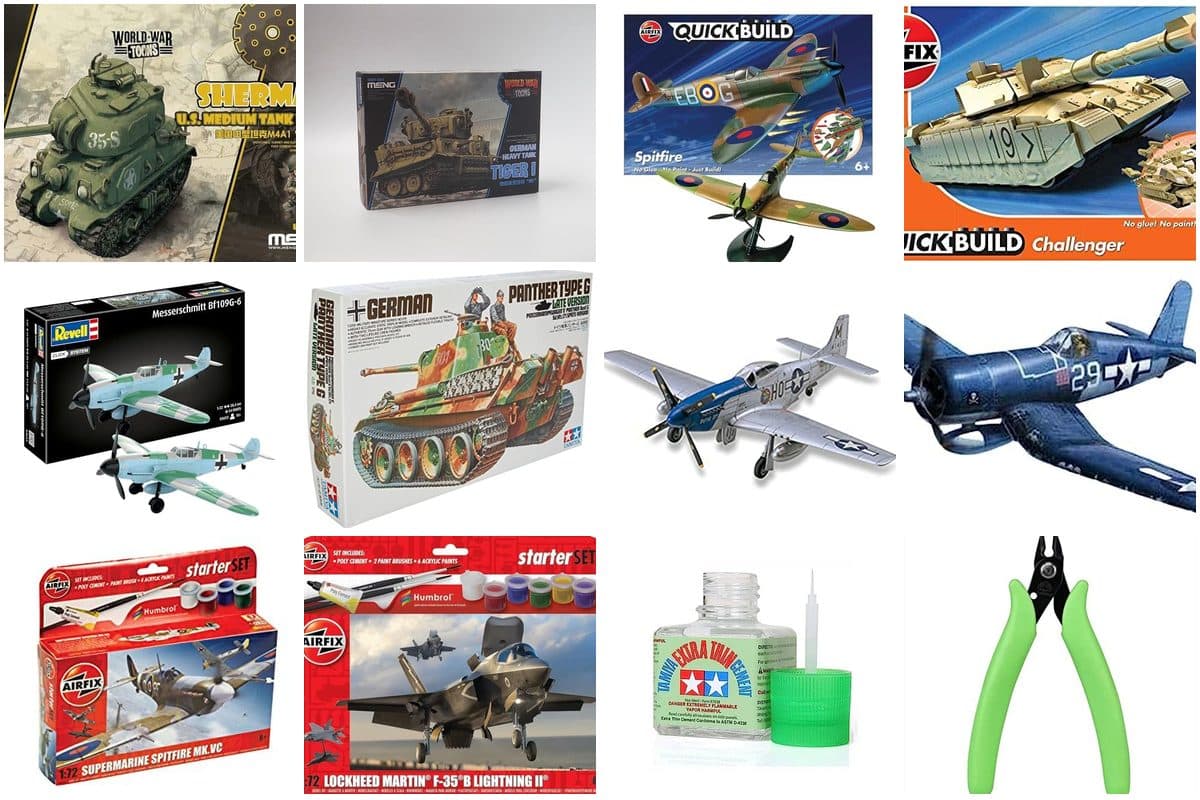

Scale modeling is one of those hobbies that looks intimidating from the outside. Walk past a competition display and you will see weathered Tiger tanks with chipped paint, P-51 Mustangs with hand-painted invasion stripes, and aircraft carriers with individually rigged antenna wire. It is easy to assume you need years of experience and a room full of specialized tools to get started.
You do not. The modern model kit industry has spent the last decade building on-ramps for beginners. Snap-fit kits that require zero glue. Starter sets that come with paint, brushes, and cement in the box. Tamiya kits with part counts low enough to finish in a single afternoon. If you can follow a set of illustrated instructions and hold a pair of nippers, you can build a model that looks good on a shelf.
This guide covers 20 kits and essential tools, organized by difficulty level. Every product is something you can order today, and every recommendation includes an honest assessment of what it does well and where it falls short. No filler picks.
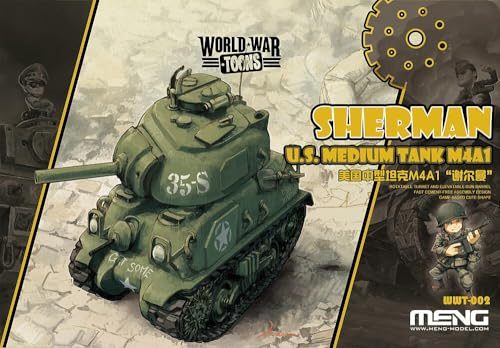
Meng WWT Sherman
~$18


Tamiya 1/48 P-51D Mustang
$28 on Amazon
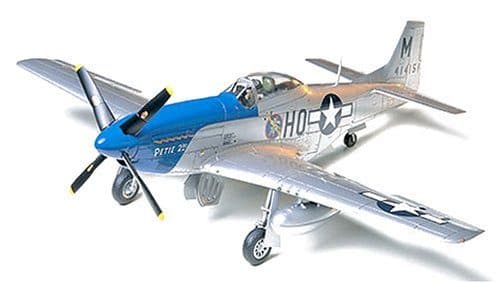
Tamiya's 1/48 Mustang offers a larger, more detailed version of America's most famous WW2 fighter. Excellent fit, a well-detailed cockpit, and the option for drop tanks or a clean configuration. A classic that has earned its reputation.
Snap-Fit Kits: No Glue Needed ($10 - $25)
If you have never built a scale model before, start here. Snap-fit kits use alignment pins and friction to hold parts together, so you skip glue, paint, and the entire learning curve around adhesives. The finished models will not win any awards at IPMS competitions, but they will give you a feel for the hobby with almost zero frustration.
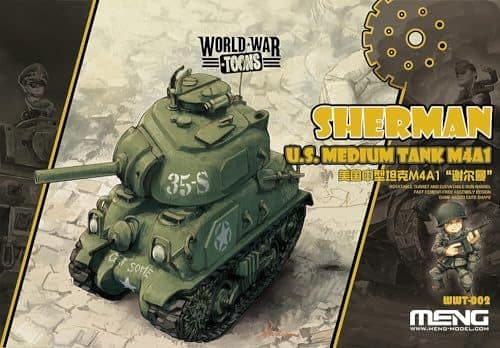
1. Meng WWT-002 Sherman (World War Toons)
~$18 on Amazon
Meng's "World War Toons" line turns WW2 tanks into charming, cartoon-proportioned snap-fit kits. Around 40 parts click together in under an hour without glue or paint. Pre-colored plastic means you get a display-ready model straight from the box.
Best for: Absolute beginners, kids 10+, or experienced builders who want a stress-free palette cleanser
The WWT Sherman squashes the M4's proportions into something that looks like it rolled out of an animated movie. The charm factor is undeniable, and the engineering behind the snap-fit system is surprisingly good. Parts are designed with alignment pins that lock together without cement, producing a solid little model in about 45 minutes. It also takes paint well if you want to practice basic brush techniques later.
The WWT line has developed a following among experienced builders who use them as quick weekend projects. They also work as gifts for kids who want their own tank but are not ready for hundreds of tiny parts and toxic cement. The trade-off is obvious: you are building a caricature, not a scale replica. There is no interior detail, no individual track links, and the proportions are deliberately exaggerated. But as a gateway into the hobby, nothing else matches the WWT's combination of accessibility and satisfaction.
2. Meng WWT-001 Tiger I (World War Toons)
~$18 on Amazon
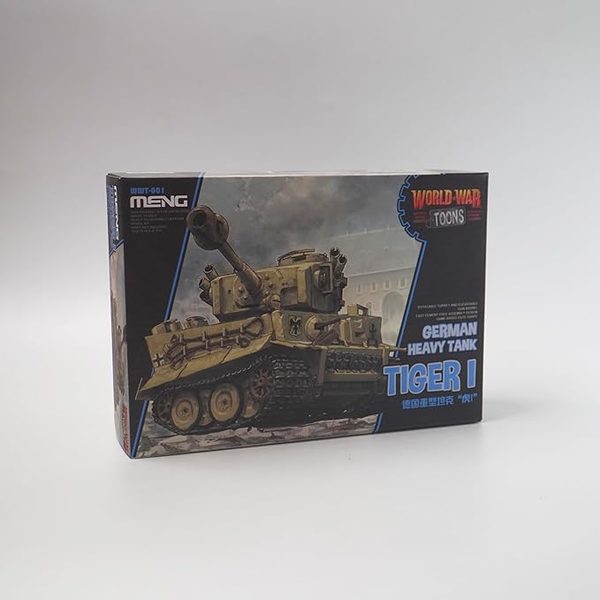
Same snap-fit engineering as the WWT Sherman applied to Germany's most famous heavy tank. The Tiger I's boxy hull and flat turret face translate well into the cartoon style, and assembly is equally fast.
Best for: Beginners who want a German armor subject, or anyone pairing it with the Sherman for an Allied vs. Axis shelf display
Meng's WWT Tiger I captures the boxy silhouette that made the original tank so recognizable on the battlefields of North Africa and the Eastern Front. Like every kit in the World War Toons line, the parts come pre-colored and snap together without any adhesive. You can have it built and sitting on your desk during a lunch break.
Grab this alongside the WWT Sherman and you have a two-tank display for under $40. The limitations mirror those of every snap-fit: simplified detail, no weathering potential without a coat of primer first, and proportions that prioritize personality over accuracy. If historical fidelity matters to you, these cartoon kits will feel like toys. That is sort of the point. They exist to make you comfortable handling sprues, reading instruction sheets, and working through a parts sequence before you graduate to something more involved.
3. Airfix Quick Build Spitfire (J6000)
~$15 on Amazon
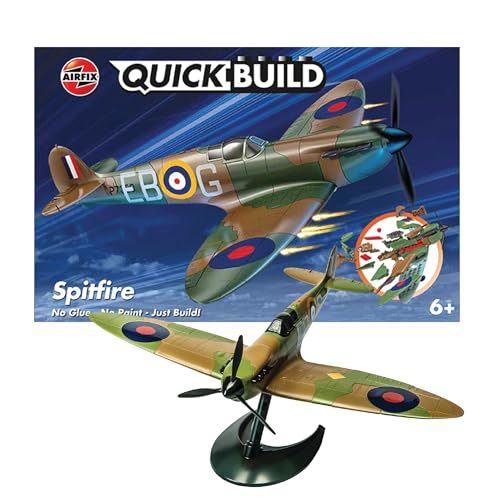
Airfix's Quick Build line uses a Lego-like snap system with pre-colored plastic and sticker decals. The Spitfire is the most popular kit in the range. No glue, no paint, and a display stand is included in the box.
Best for: First-time aircraft builders, ages 5+, or anyone who wants a completed Spitfire on their desk in under an hour
Airfix has been making model kits since 1952, and their Quick Build range is engineered specifically for people who have never touched a sprue. The parts push together with a satisfying click, and self-adhesive stickers handle the markings. The Spitfire version captures the elliptical wing shape and general profile of the Mk.I in a chunky, simplified style that sits comfortably between "toy" and "model."
The included display stand is a nice touch that most snap-fit competitors skip. On the downside, Quick Build kits are not to any recognized scale, so you cannot display them alongside conventional 1/72 or 1/48 models without the size difference being jarring. The sticker decals also tend to peel over time, especially at curved surfaces. Still, for under $15, this is the fastest path from "I have never built a model" to "there is a Spitfire on my shelf."
4. Airfix Quick Build Challenger Tank (J6010)
~$18 on Amazon
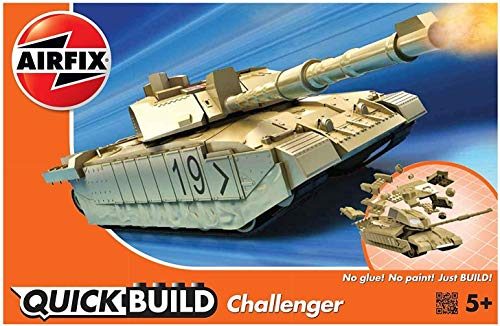
The Challenger 2 in Quick Build form gives you a modern British main battle tank that snaps together without glue. Pre-colored green plastic and sticker markings mean you can build and display it in about 45 minutes.
Best for: Anyone who prefers modern armor over WW2 subjects, or kids who want a tank that looks like it could still be in service
The Challenger 2 is Britain's current main battle tank, and Airfix's Quick Build version captures the distinctive angular turret and Chobham composite armor profile in a simplified snap-together format. Like the Spitfire above, parts are pre-colored and use sticker decals. The turret rotates on the finished model, which is a small detail that adds play value for younger builders.
The weakness here is the same as all Quick Build kits: the proportions are slightly exaggerated, and the stickers do not hold up as well as proper waterslide decals. The green plastic color is also a generic shade that does not closely match real British military vehicles. If you plan to paint it later, you will need to prime the entire model first since the waxy snap-fit plastic does not accept paint well without surface preparation. For a pure out-of-box experience, though, this delivers.
5. Revell Easy-Click Bf109G-6 (1:32)
~$22 on Amazon
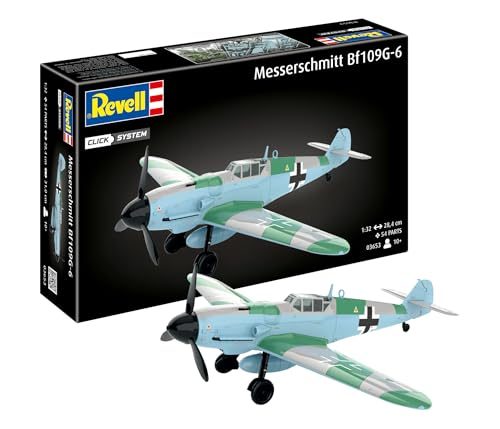
Revell's Easy-Click system offers snap-fit assembly at a larger 1:32 scale with only 42 parts. The bigger size means more visible detail on the finished model, and the plug-and-clamp system holds parts firmly without cement.
Best for: Beginners who want a bigger finished model, or anyone who finds 1/72 parts too small to handle comfortably
Revell's Easy-Click line occupies a middle ground between the toy-like Quick Build kits and traditional cement-assembly models. The Bf109G-6 comes at 1:32 scale, which means the finished model is roughly 11 inches long. At that size, cockpit details, panel lines, and surface features are all visible without squinting. The 42-part count keeps things manageable while delivering a result that looks closer to a "real" model kit than any of the cartoon-style snap-fits above.
The catch is that Revell's snap-fit tolerances are not as tight as Airfix or Meng. Some builders report minor gaps at fuselage seams that would need filler putty to eliminate completely. The included decals are waterslide rather than stickers, which is an upgrade, but waterslide decals require a bowl of water and some patience if you have never applied them before. At the price point, this is a solid stepping stone between pure snap-fit and glue-assembly kits.
6. Revell SnapTite A-10 Warthog
~$15 on Amazon
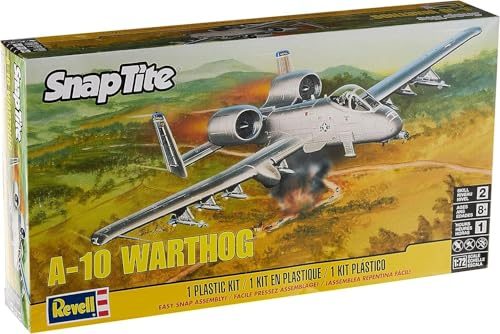
The A-10 Thunderbolt II in Revell's classic SnapTite format. Pre-decorated parts snap together to produce a recognizable Warthog without any glue or paint. A fan-favorite subject in one of the lowest-effort formats available.
Best for: A-10 fans who want a display piece with zero setup, or as a gift for someone who might be interested in the hobby
The A-10 Warthog is one of those aircraft that sells itself. Between the twin engines mounted high on the fuselage and the massive GAU-8 Avenger cannon that the airframe was literally built around, it is visually distinct in a way that makes even a simplified model immediately recognizable. Revell's SnapTite version strips the build down to roughly 25 parts that click together in about 30 minutes.
This kit has been in production for years, and the tooling shows its age. Surface detail is soft compared to modern releases, and the proportions are not quite right if you compare it side-by-side with reference photos. Fit can be loose at certain joints, especially where the wings meet the fuselage. For a quick display piece or a test of whether someone might enjoy the hobby, it works fine. Just do not expect the kind of detail that Tamiya or modern Airfix delivers in their conventional kits.
Easy Build with Glue ($15 - $35)
Once you are comfortable handling parts and following instruction sheets, it is time to pick up a bottle of plastic cement. These kits use traditional assembly but keep part counts manageable and rely on manufacturers known for excellent fit. A tube of Tamiya Extra Thin Cement, a pair of nippers, and one of these kits is all you need to build your first "real" scale model.
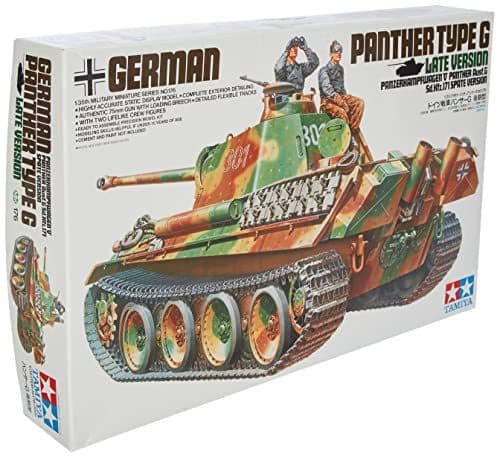
7. Tamiya 1/35 Panther Ausf.G Late Version
~$22 on Amazon
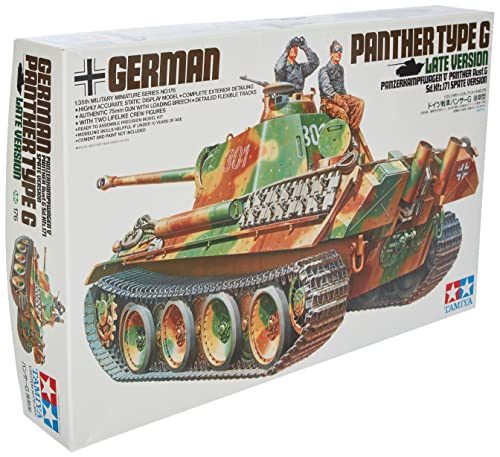
Tamiya's Panther G is the single most recommended first "real" armor kit in the hobby. Low part count, near-perfect fit, and a price under $25 make it the obvious first step up from snap-fit builds.
Best for: Anyone ready to use cement for the first time, or returning builders who have not touched a kit in 20 years
There is a reason this kit shows up in every "first model kit" recommendation thread on Reddit, Scalemates, and armor modeling forums. Tamiya engineered the Panther G with tolerances so tight that parts practically fall into place. The instruction sheet is clear and logical. The part count sits at around 150, which is enough to produce a detailed model without overwhelming a first-time builder. And at roughly $22, the financial risk is minimal.
The Panther itself was Germany's response to the T-34 on the Eastern Front, and its sloped armor and long 75mm gun make for a visually striking model even without paint. The kit includes vinyl tracks (not individual links), which simplifies one of the trickiest parts of armor modeling. The downside is that this is an older Tamiya tooling, so detail is good but not up to the standard of modern releases from Meng or Rye Field Model. The turret schurzen (side skirts) can also be fiddly to align. None of that matters for a first build. This kit teaches you fundamentals without punishing mistakes. For a deeper look at armor modeling options, check out our guide to the best tank model kits.
8. Tamiya 1/72 P-51D Mustang
~$12 on Amazon
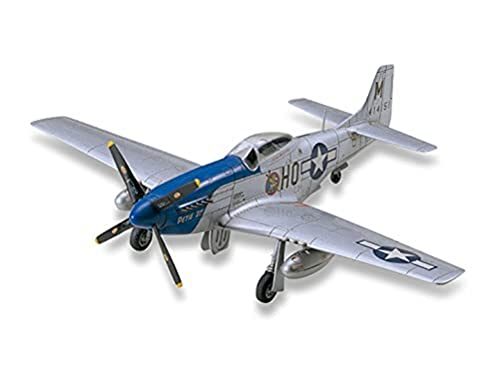
Tamiya's 1/72 Mustang is a compact, affordable first aircraft kit. Around 50 parts, excellent fit, and the smaller scale means less surface area to paint if you choose to finish it.
Best for: First-time aircraft builders who want a proper scale model, or anyone building a WW2 fighter collection on a budget
At 1/72 scale, the finished Mustang fits in the palm of your hand. That small size is actually an advantage for beginners because there is less surface area to worry about when painting, and the low part count means fewer opportunities for mistakes. Tamiya's engineering shines here. Panel lines are crisply recessed, the cockpit has enough detail to look good through the clear canopy, and the two-piece fuselage halves align without fighting you.
The main drawback of 1/72 scale is that small parts can be extremely tiny. The landing gear struts, pitot tube, and canopy frame require steady hands and good lighting. If you have large fingers or limited dexterity, consider stepping up to 1/48 scale instead. The included decals offer markings for famous 8th Air Force Mustangs, which adds some historical interest. At around $12, this is the cheapest "real" model kit in this guide, and the quality-to-price ratio is hard to beat.
9. Tamiya 1/72 Bf109 G-6
~$14 on Amazon
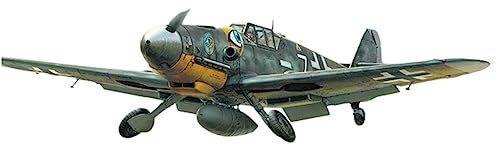
The natural companion to the P-51D above. Tamiya's 1/72 Bf109 G-6 has similar part count and build complexity, giving you the Luftwaffe's most produced fighter variant in a beginner-friendly package.
Best for: Building alongside the P-51D for an Allied vs. Axis display, or anyone drawn to German WW2 aviation
The Bf109 was the backbone of the Luftwaffe throughout WW2, and the G-6 "Gustav" variant was built in larger numbers than any other. Tamiya's 1/72 rendition captures the type's narrow-track landing gear, angular nose profile, and distinctive bulges over the synchronized machine guns. Build difficulty is comparable to the P-51D, with the same kind of forgiving fit and clear instructions.
One area where the Bf109 is slightly harder than the Mustang is the landing gear. The real aircraft had notoriously narrow gear that made ground handling tricky, and the model reflects this with thin struts that can be fragile during assembly. Take your time gluing those parts and let the cement fully set before handling the model. The included decals offer Luftwaffe marking options. Pair this with the Mustang at #8 for a matched set that totals under $30.
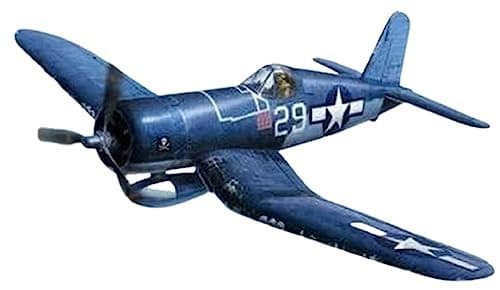
10. Tamiya 1/72 F4U-1A Corsair
~$14 on Amazon
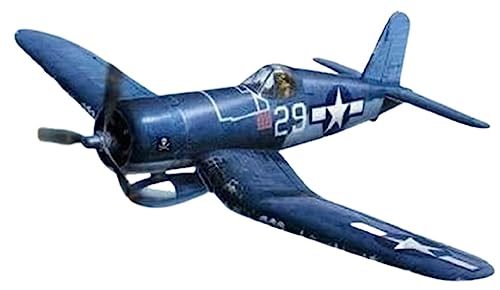
The Corsair's inverted gull wing makes it one of the most visually distinctive WW2 fighters. Tamiya's 1/72 version keeps the part count low while capturing that unique wing shape in a beginner-appropriate build.
Best for: Pacific Theater enthusiasts, or anyone who wants a fighter that looks different from every other WW2 aircraft on the shelf
The Vought F4U Corsair earned an 11:1 kill ratio in the Pacific and served with both the US Navy and Marines. That distinctive cranked wing was not an aesthetic choice. It was an engineering solution to clear the massive Hamilton Standard propeller without making the landing gear impractically long. Tamiya's 1/72 kit captures the wing shape accurately, and the overall build experience is on par with their P-51D and Bf109.
The gull wing does introduce one challenge that straight-wing fighters avoid: getting both wing halves to align symmetrically requires careful dry-fitting before you commit to cement. If one side sits slightly higher than the other, the asymmetry will be visible from across the room. Go slow during that step. The cockpit detail is adequate for the scale, and the frame-style canopy is provided as a single clear piece that avoids the headache of masking individual panes. A strong choice for anyone building a WW2 Pacific shelf.
11. Tamiya 1/48 Spitfire Mk.I
~$30 on Amazon
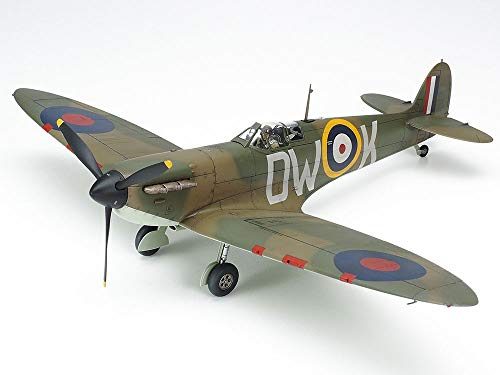
Tamiya's 1/48 Spitfire is the gold standard for a first larger-scale aircraft kit. More detail than 1/72, bigger parts that are easier to handle, and Tamiya's characteristically precise fit make this an excellent second or third build.
Best for: Builders who have finished a 1/72 kit and want to step up in scale and detail
At 1/48 scale, the Spitfire Mk.I measures about 8 inches in wingspan, which is large enough to show off panel line detail, cockpit instruments, and exhaust staining without needing a magnifying glass. Tamiya's engineering is at its best here. The fuselage halves click together with no gap-filling required. The clear canopy parts are thin and distortion-free. Landing gear is sturdy enough to support the finished model without sagging.
The step up from 1/72 is noticeable in build time and painting commitment. At 1/48, any paint mistakes, brush marks, or visible glue spots are more obvious. You will want to thin your paints properly and invest in some masking tape for the canopy. The kit does not include paint or tools, so factor those into the total cost. Marking options cover Battle of Britain-era machines, which means the classic brown and green camouflage scheme that looks fantastic even with basic brush painting. This is a natural follow-up if you enjoyed any of the 1/72 Tamiya kits above.
12. Tamiya 1/48 P-51D Mustang
~$28 on Amazon
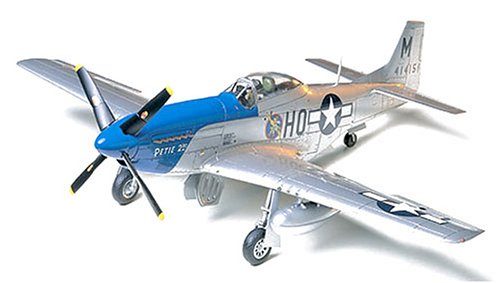
Tamiya's 1/48 Mustang offers a larger, more detailed version of America's most famous WW2 fighter. Excellent fit, a well-detailed cockpit, and the option for drop tanks or a clean configuration. A classic that has earned its reputation.
Best for: Beginners who prefer 1/48 scale from the start, or as a second aircraft build after a 1/72 warm-up
The P-51D Mustang is probably the most modeled aircraft in the hobby, and Tamiya's 1/48 version has been a staple recommendation for over 15 years. The kit captures the "D" variant's bubble canopy, the four-blade propeller, and the laminar flow wing that gave the Mustang its long-range capability. Build quality is predictably excellent. Parts fit with minimal seam work, and the cockpit detail will look good through the clear canopy without any aftermarket upgrades.
This is a slightly older tooling, which means detail is clean but not as refined as recent releases from Eduard or Tamiya's own newer kits. The biggest weakness is the propeller: the blades are molded at a uniform pitch that does not quite match reference photos. Most beginners will never notice. For the price and the build experience, this remains one of the safest recommendations in 1/48 aircraft modeling. Natural bare metal finish (NMF) Mustangs are notoriously hard to paint convincingly, so consider choosing the olive drab marking option for your first attempt.
Starter Sets with Paint and Tools ($20 - $50)
Starter sets solve the biggest problem new builders face: figuring out what else you need to buy. These kits come with paint, a brush, cement, and sometimes basic tools. The included supplies are not professional-grade, but they are good enough to finish the model in the box and help you figure out which tools you actually want to upgrade later.
13. Airfix Starter Set: Spitfire Mk.Vc (A55001)
~$25 on Amazon
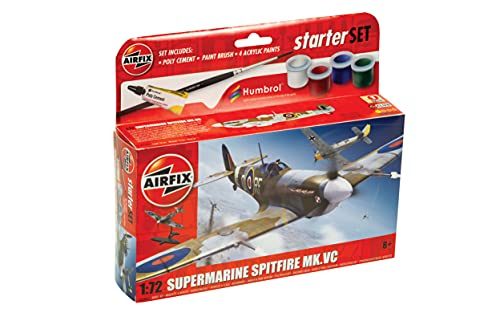
Airfix's Spitfire Mk.Vc starter set includes a 1/72 kit, four Humbrol acrylic paints, a brush, poly cement, and decals. Everything you need to go from sealed box to painted, finished model in one purchase.
Best for: True beginners who do not want to research what supplies to buy separately
This is the single best "buy one thing and start building" option on this list. Airfix has refined their starter sets over decades, and the current version includes solid, usable paints and a cement tube that will last well beyond this one kit. The Spitfire Mk.Vc itself is a modern Airfix tooling with crisp panel lines and good detail for 1/72 scale. Four Humbrol acrylic paints cover the basic camouflage colors, and the included brush is adequate for a first build.
The limitation is the paint selection. Four colors will get you through the basic scheme, but you will want additional shades for details like cockpit interiors, exhaust stains, and tire rubber. The single brush is also a "one size fits none" compromise. It works for broad fuselage panels but is too large for fine detail work. Plan on buying at least one fine-tipped brush and a few extra paint pots once you finish this kit. Despite those gaps, the value proposition is strong. Buying the kit, paints, cement, and brush separately would cost roughly 40% more.
14. Airfix Starter Set: F-35B Lightning II (A55010)
~$28 on Amazon
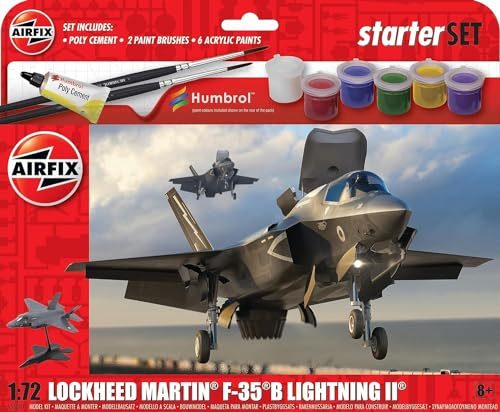
Same starter set format as the Spitfire above, but with a modern stealth fighter. Includes six Humbrol paints, two brushes, poly cement, and decals. The F-35B's simple color scheme (mostly gray) makes painting less intimidating than multi-color WW2 camouflage.
Best for: Beginners who prefer modern military aircraft over WW2 subjects
Modern jets have a painting advantage for beginners: most of them are various shades of gray. No complex camouflage patterns, no sharp color boundaries to mask, and no fading or chipping to replicate. The F-35B's two-tone gray scheme can be convincingly brush-painted by a first-timer, especially with the six Humbrol paints included in this set (two more than the Spitfire starter gets).
The F-35 kit itself is a Skill Level 1 Airfix release with manageable part count and straightforward assembly. Weapon bay doors can be posed open or closed, which is a nice option. The downside is that stealth aircraft have smooth, featureless surfaces with minimal panel line detail, which means the finished model can look a bit plain without careful paint work. There is less visual "interest" than a WW2 fighter covered in rivets, access panels, and exhaust staining. If that sounds boring to you, pick the Spitfire set above instead. If you love the look of fifth-generation fighters, this set delivers.
15. Airfix Starter Set: Curtiss Tomahawk IIB (A55101A)
~$23 on Amazon
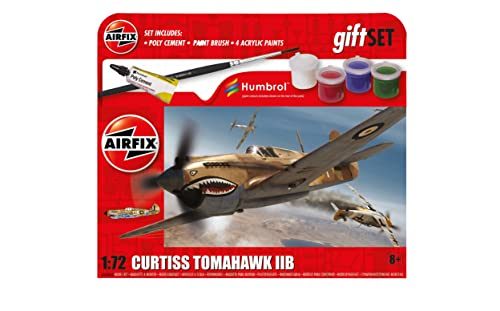
The famous shark-mouth P-40 in Airfix starter set format. Includes paint, brush, and cement. The Tomahawk's desert camouflage and nose art make it one of the most visually rewarding WW2 aircraft to paint at any skill level.
Best for: Beginners who want a visually striking finished model, especially fans of the North Africa campaign
The P-40 Warhawk with its famous shark mouth livery is one of the most recognizable aircraft silhouettes of WW2. This Airfix starter set depicts the Tomahawk IIB variant that flew with the RAF's No. 112 Squadron in the Western Desert, and the shark mouth is included as a decal rather than requiring freehand painting. That matters for beginners because the nose art is the entire visual appeal of the model, and getting it right with a decal is far easier than attempting it with a brush.
The desert camouflage scheme (dark earth over mid stone) requires only two main colors, which the included paint set covers. The kit itself is an older Airfix tooling that does not match the crispness of their newest releases. Some builders report minor fit issues around the cowling and wing root that need a thin bead of filler putty. These are fixable problems for a patient first-timer, not dealbreakers. The shark mouth alone makes this one of the most display-worthy beginner builds in the Airfix range.
16. Revell Model Set: Bf109G-10 & Spitfire Mk.V Combat Set
~$35 on Amazon
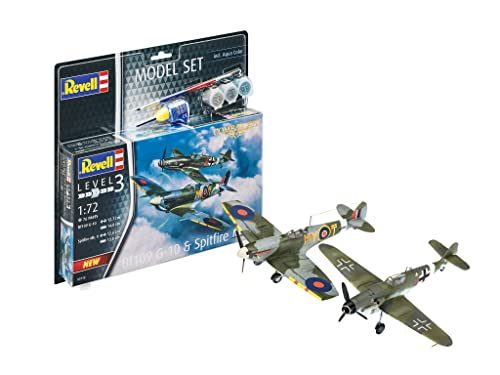
Two aircraft in one box: a Bf109G-10 and a Spitfire Mk.V at 1/72 scale, plus Revell Aqua Color paints, a brush, and Contacta glue. The natural rival pairing gives you an Allied and Axis fighter to build side-by-side.
Best for: Buyers who want two kits in one purchase, or anyone drawn to the Battle of Britain matchup
Getting two kits for the price of one starter set is a strong value proposition, especially when the subjects are natural rivals. The Spitfire Mk.V and Bf109G-10 were adversaries over the English Channel and northern France, and displaying them together tells a story that a single aircraft cannot.
The significant downside is the paint selection. Revell includes a few Aqua Color pots, but the set does not provide enough colors to fully finish both models according to the painting guide. You will likely need to buy additional paint pots to complete the camouflage patterns on both aircraft. The kits themselves are standard Revell 1/72 tooling, which means acceptable but not Tamiya-level fit. Expect some seam work on the fuselage halves. The Contacta Professional glue is actually quite good for the price, and the bottle will last through both builds. Just budget for extra paint and you will be satisfied with this set.
Essential Beginner Tools ($5 - $30)
Snap-fit kits need nothing beyond your hands. Once you move to cement-assembly kits, you need a few basic tools. The four items below will cover every kit in this guide and most kits you build for the next several years. Buy quality once rather than replacing cheap tools repeatedly.
17. Tamiya Extra Thin Cement (87038)
~$8 on Amazon
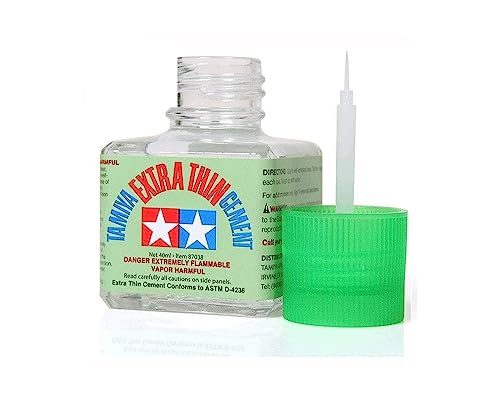
The hobby's gold standard plastic cement. The built-in brush applicator wicks liquid cement into joints by capillary action, creating clean bonds without excess glue squeezing out. One 40ml bottle will last through 10+ kits.
Best for: Every builder using cement-assembly kits. This should be your first supply purchase
Tamiya Extra Thin Cement is not glue in the traditional sense. It is a solvent that melts the surface of styrene plastic, fusing the two parts together at a molecular level. The result is a bond stronger than the surrounding plastic. The fine brush applicator lets you hold two parts together, touch the brush to the seam, and watch the liquid wick into the joint automatically. This capillary action technique is cleaner and more precise than squeezing tube cement onto a surface.
The weakness is the learning curve. Extra Thin is potent, and applying too much will melt surface detail around the joint. First-timers should practice on spare sprues before committing to visible parts. The fumes are also notable. Work in a ventilated area or near an open window. A 40ml bottle costs around $8 and will last through many builds, making it one of the best value purchases in the hobby. If you only buy one cement, buy this one.
18. Tamiya Basic Tool Set (74016)
~$28 on Amazon
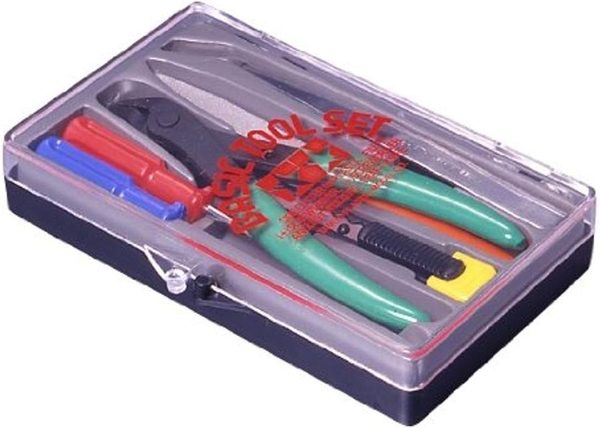
An all-in-one starter tool set from Tamiya containing sprue nippers, a hobby knife, flat and round files, tweezers, and a drill bit. Everything a beginner needs in a single purchase at a fair price.
Best for: First-time builders who need every tool at once, or as a gift for someone entering the hobby
Buying tools individually can add up fast, and beginners often do not know which specific tools they actually need. Tamiya's Basic Tool Set solves this by bundling the essentials: side-cutting nippers for removing parts from sprues, a hobby knife for cleaning up nub marks, flat and round needle files for smoothing seams, pointed tweezers for placing small parts, and a pin vise drill bit for detail work. The quality is solidly mid-range across the board.
The nippers included are the weakest link. They cut cleanly enough for a beginner, but experienced builders will notice they leave larger nub marks than dedicated single-blade nippers from brands like GodHand or Tamiya's own upgraded cutters. The hobby knife blade is functional but dulls faster than premium replacements. Think of this set as training wheels. Every tool inside will get the job done for your first 5-10 kits, and by then you will know exactly which individual tools you want to upgrade. If you are buying a gift for a new modeler, this set plus a bottle of Extra Thin Cement covers everything they need.
19. GodHand Keroro Nipper (PN-125)
~$25 on Amazon
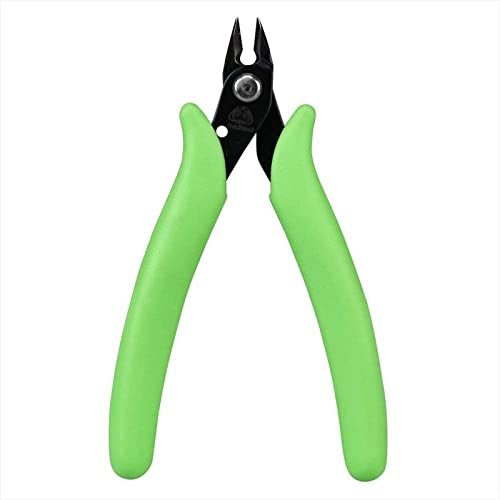
GodHand's entry-level nipper with sharp dual blades designed for clean sprue cuts. A significant upgrade over the nippers included in tool sets, without the $50+ price tag of GodHand's professional models.
Best for: Builders ready to upgrade from basic nippers, or anyone who wants cleaner cuts from day one
The single tool upgrade that makes the biggest difference in build quality is better nippers. Clean cuts at the sprue gate mean less cleanup work with a knife and file, and fewer chances of accidentally gouging the part surface. GodHand's Keroro Nipper sits at the entry point of their lineup and delivers noticeably cleaner cuts than the nippers bundled with tool sets from Tamiya or Revell.
The Keroro uses a double-edged blade design that slices through standard 3mm sprues with minimal force. The ergonomic grip is comfortable for extended building sessions. The trade-off versus GodHand's professional SPN-120 model is blade longevity. The Keroro's blades are not as hard as the higher-end steel, so they will dull faster if you are cutting thick gates or clear parts. For a beginner working through their first 5-10 kits, the Keroro will stay sharp enough. It is a meaningful quality-of-life improvement over bundled nippers at a price that will not make you wince if you damage them while learning.
20. Tamiya Surface Primer L (Gray, 180ml Spray)
~$12 on Amazon
A rattle-can primer that gives paint something to grip. Gray is the most versatile color for military subjects, and the 180ml can will prime 8-10 models in 1/72 or 3-4 in 1/48 scale.
Best for: Any builder who plans to paint their model, especially after completing a starter set kit
Primer does two things that matter for beginners. First, it gives paint a uniform surface to grip, which means fewer coats needed and better adhesion that does not chip off when you handle the model. Second, and perhaps more useful, a coat of gray primer reveals every surface flaw on the model. Seam lines you thought you sanded smooth, glue spots you missed, and sink marks from the molding process all become visible under primer. Fix those issues now, reprime the affected area, and your paint job will look dramatically better.
Tamiya's spray primer goes on thin and even without requiring an airbrush. Hold the can about 8-10 inches from the model and use short, sweeping passes. Multiple light coats are better than one heavy coat. The gray shade works under most military colors. The can has limited paint volume compared to automotive primers, so do not waste it on broad sweeps from too far away. In cold weather, warm the can in your hands for a minute before spraying to improve atomization. This is the kind of supply that separates a model that "looks painted" from one that looks finished.
What You Need Before Your First Build
If you picked a snap-fit kit from the first section, you need nothing else. Open the box and start building.
For cement-assembly kits, here is the minimum shopping list:
- Sprue nippers (included in the Tamiya Basic Tool Set, or buy the GodHand Keroro standalone)
- Plastic cement (Tamiya Extra Thin Cement is the standard)
- A hobby knife (X-Acto #1 or equivalent, for cleaning nub marks)
- Sanding sticks or fine sandpaper (400-600 grit, for smoothing seams)
If you plan to paint:
- Primer (Tamiya Gray Spray Primer)
- Acrylic paints (Tamiya, Vallejo, or Humbrol all work well for brush painting)
- At least two brushes (one flat for large areas, one fine round for detail)
- A cup of water (for rinsing brushes between colors)
Total starter investment for a painted cement-assembly build: roughly $50-70, including the kit itself. Starter sets like the Airfix Spitfire set at #13 bring that down to around $25 by bundling paint, brush, and cement with the kit.
Choosing the Right Scale
Scale determines how big the finished model will be and how detailed the parts are. Here is a quick reference for beginners:
| Scale | Aircraft Wingspan | Tank Length | Part Count | Best For |
|---|---|---|---|---|
| 1/72 | 4-6 inches | 3-4 inches | 40-80 | Collections, small shelf space, budget builds |
| 1/48 | 7-10 inches | 5-6 inches | 80-150 | Good detail vs. build time balance |
| 1/35 | N/A (armor scale) | 6-10 inches | 100-400 | Most popular for tanks and vehicles |
| 1/32 | 10-14 inches | N/A | 150-300 | Large display models, high detail |
For first-time aircraft builders: Start at 1/72 scale. The kits are cheap, builds are fast, and mistakes cost you $12, not $60. Move to 1/48 once you are comfortable with cement, painting, and decal application.
For first-time armor builders: 1/35 is the industry standard scale for tanks. Most beginner armor kits are designed at this scale, and the parts are large enough to handle comfortably. The Meng WWT snap-fit tanks at the top of this guide are not to any specific scale but serve as an on-ramp before you tackle 1/35.
Avoid 1/32 aircraft and 1/16 armor for your first build. The larger scale means higher part counts, longer build times, and more expensive mistakes. Save those for when you have a few completed kits under your belt.
Frequently Asked Questions
What is the best first model kit for a complete beginner?
For zero experience, start with the Meng WWT Sherman (snap-fit, no glue needed) or the Airfix Quick Build Spitfire. Both build in under an hour with no tools required. When you are ready for cement assembly, the Tamiya 1/35 Panther G is the most recommended first "real" kit in the hobby.
Do I need to paint a model kit?
No. Snap-fit kits like the Meng World War Toons and Airfix Quick Build lines come in pre-colored plastic and look fine unpainted. Even standard cement-assembly kits can be displayed unpainted if you are just practicing assembly techniques. Paint is optional until you decide you want a more realistic finished product.
What is the difference between plastic cement and super glue for model kits?
Plastic cement (like Tamiya Extra Thin) is a solvent that melts styrene plastic and fuses parts together permanently. The bond is stronger than the surrounding plastic. Super glue (cyanoacrylate) creates a surface bond without melting the material. Use plastic cement for styrene-to-styrene joints and super glue for attaching clear parts, photoetch metal, or resin accessories.
What scale should I start with for aircraft models?
1/72 scale is the best starting point. Kits are affordable ($10-15 from Tamiya), builds are fast, and the smaller size means less surface area to paint. Once you are comfortable with assembly and painting techniques, move to 1/48 for more detail and larger parts that are easier to handle.
Are Airfix starter sets worth it?
Yes, for first-time builders. The included paints, brush, and cement would cost roughly 40% more if purchased separately. The paint selection is limited (you will want extra colors for detail work), and the brushes are basic, but they are good enough to finish the kit in the box. The Spitfire Mk.Vc starter set is the best value in the current range.
How long does it take to build a beginner model kit?
Snap-fit kits (Meng WWT, Airfix Quick Build) take 30-60 minutes. A simple 1/72 aircraft with cement assembly takes 2-4 hours over one or two sessions. Add another 2-3 hours if you are painting and applying decals. A 1/35 tank like the Tamiya Panther G might take 6-10 hours total for a first-timer, spread across multiple sessions.
Can kids build scale model kits?
Snap-fit kits like the Airfix Quick Build range are designed for ages 5 and up. Cement-assembly kits are generally recommended for ages 10 and above, with adult supervision for the first few builds due to the solvent-based cement and sharp hobby knives. The Meng World War Toons kits are particularly popular with kids because of their cartoon-style proportions and simple assembly.
What should I build after my first kit?
If you started with a snap-fit, move to a cement-assembly kit like the Tamiya Panther G or a Tamiya 1/72 aircraft. If you finished a 1/72 aircraft, try a 1/48 kit like the Tamiya 1/48 Spitfire. For tank builders, see our full tank model kit guide for intermediate recommendations. If you are looking for gift ideas that include model kits, check out our military enthusiast gift guide.
Ready to Build
Every experienced modeler started exactly where you are now: staring at a box, wondering if the finished product would look anything like the picture on the front. It probably will not match the box art (those are painted by professionals), but it will be something you built with your own hands. That first completed model, sitting on a shelf with visible glue marks and slightly crooked decals, is the one most builders remember most fondly.
Start with whatever subject interests you most. A Spitfire, a Sherman, an A-10. The specific kit matters less than the act of starting. Pick one from this list, clear a table, and begin. You can always upgrade your tools, skills, and kit selection later.
For more specific armor recommendations, check our complete guide to the best tank model kits. WW2 aircraft fans should also see our best WW2 model kits roundup. If you are shopping for someone else, our Father's Day military gift guide and military history buff gift guide include model kits alongside other gear.