Skip to content
April 19:Battles of Lexington and Concord251yr ago

The Type 99 Tank Was Built to Beat the Abrams. China Thinks It Succeeded.

Marcus Webb · · 11 min read
Save
Share:
Chinese ZTZ-99A main battle tank on parade showing its angular turret and ERA armor
Marcus Webb
Marcus Webb

Military Vehicles & Ground Systems Contributor

Marcus Webb writes about military ground vehicles, armored platforms, and the logistics of land warfare. His work covers everything from MRAPs and infantry carriers to the training pipelines that keep ground forces operational in contested environments.

China built the Type 99 to beat the Abrams. On paper, they might have. The ZTZ-99A — the latest production variant of China's most advanced main battle tank — matches or exceeds the M1A2 SEPv3 Abrams in nearly every measurable specification: firepower, protection, mobility, and crew technology. Chinese state media has said as much, repeatedly. But paper and a battlefield are very different things, and the Type 99 has a problem that no specification sheet can solve: it has never fired a shot in anger.

The Abrams has been to war. Multiple wars. It has been hit by RPGs, IEDs, anti-tank missiles, and even other tanks. Its crews have decades of institutional combat knowledge baked into their doctrine, training, and maintenance practices. The Type 99 has been to parades, training exercises, and arms exhibitions. That gap between combat-tested and combat-theoretical is the single largest variable in any comparison between these two machines — and it is the one variable that cannot be measured.

Design Philosophy: Different Answers to the Same Question

Both tanks were designed to dominate the modern combined-arms battlefield, but they approach the problem from different doctrinal traditions. The Abrams descends from a Western design philosophy that prioritizes crew survivability above all else. The Type 99 descends from a Soviet-influenced tradition that prioritizes compactness, mechanical reliability, and firepower density.

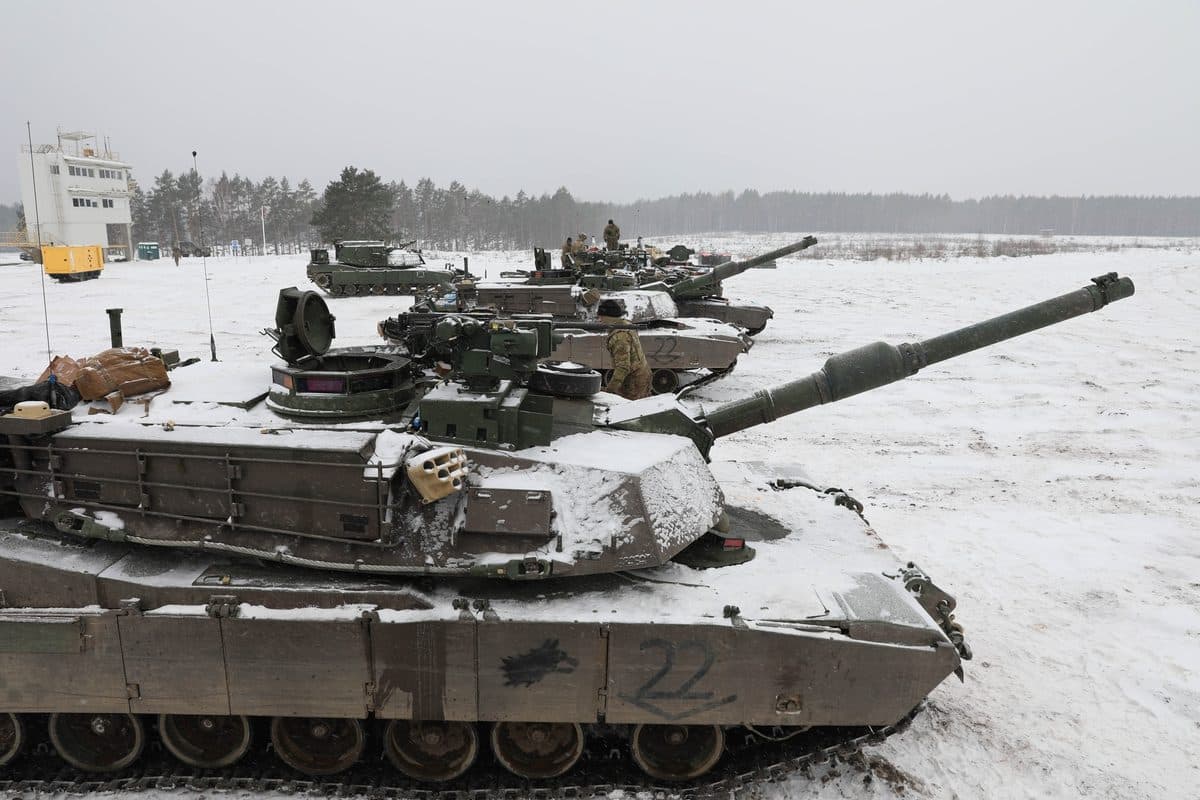
The M1A2 SEPv3 Abrams weighs approximately 73 tons. It has a four-person crew: commander, gunner, loader, and driver. The human loader is a deliberate design choice — it provides redundancy (the loader can perform multiple roles if another crew member is incapacitated) and allows the turret bustle to be used for ammunition storage with blow-out panels that vent an explosion away from the crew if the ammo is hit. The Abrams' Honeywell AGT-1500 gas turbine engine produces 1,500 horsepower, giving the tank a power-to-weight ratio of roughly 20.5 hp/ton.

M1A2 Abrams tank during a combined arms training exercise with dust clouds rising
An M1A2 Abrams during a training exercise. The Abrams' combat record across multiple conflicts gives it a level of operational validation that the Type 99 has never faced (U.S. Army photo).

The ZTZ-99A weighs approximately 55-58 tons — significantly lighter. It has a three-person crew: commander, gunner, and driver. An autoloader feeds the 125mm smoothbore gun, eliminating the need for a human loader. This reduces the turret volume and overall weight but introduces a mechanical single point of failure: if the autoloader jams, the crew cannot manually load rounds the way an Abrams loader can. The Type 99A's diesel engine reportedly produces 1,500 horsepower, giving the lighter tank a superior power-to-weight ratio of approximately 26-27 hp/ton.

Firepower: 120mm vs. 125mm

The Abrams carries the M256 120mm smoothbore gun, a licensed version of the Rheinmetall L/44 that has been the NATO standard tank gun for decades. It fires a range of ammunition including the M829A4 armor-piercing fin-stabilized discarding sabot (APFSDS) round, which uses a depleted uranium penetrator capable of defeating any known armor at combat ranges. The M829 series has been continuously improved, and the A4 variant is specifically designed to defeat tanks equipped with explosive reactive armor (ERA) and active protection systems.

The Type 99A carries a ZPT-98 125mm smoothbore gun derived from the Soviet 2A46 design but significantly modified. The 125mm bore gives a marginal caliber advantage, and the gun is reportedly capable of firing a range of APFSDS, HEAT, and HE-FRAG rounds. Perhaps most notably, the ZPT-98 can also fire gun-launched anti-tank guided missiles (ATGMs) through the barrel — a capability the Abrams lacks. These laser-beam-riding missiles can reportedly engage targets at ranges exceeding 5 kilometers, well beyond the effective range of conventional tank ammunition.

The autoloader on the Type 99A can cycle rounds at approximately 7-8 rounds per minute. A trained Abrams loader can sustain 10-15 rounds per minute under combat conditions, with burst rates even higher. The human loader is faster than the machine — but only when that human is not fatigued, injured, or incapacitated. Over a prolonged engagement, the autoloader's consistency may offset its slower peak rate.

Type 99A tanks in formation during a military exercise demonstrating China's armored capabilities
Type 99A tanks during a Chinese military exercise. The three-man crew and autoloader allow a smaller, lighter turret — but introduce a mechanical dependency that a human loader would not (photo via military exercise documentation).

Protection: Armor, ERA, and Active Defense

The Abrams uses composite armor incorporating depleted uranium mesh layers in the turret front and hull front — the exact composition is classified, but its resistance to penetration has been demonstrated in combat. During the 2003 Iraq War, Abrams tanks withstood direct hits from RPG-7s, RPG-29s, and even other tank rounds without crew fatalities in most cases. The tank's blow-out panels on the turret bustle ammunition storage are a critical survivability feature: if the ammunition is hit, the blast vents upward and away from the crew compartment rather than detonating inside the turret.

The Type 99A uses composite armor of unknown composition, supplemented by modular explosive reactive armor (ERA) blocks on the turret front and hull glacis. Chinese sources claim the combined protection is equivalent to 1,000-1,200mm of rolled homogeneous armor (RHA) against APFSDS and higher against HEAT rounds. These claims have not been independently verified. ERA is effective against shaped-charge warheads (RPGs, HEAT rounds) but provides less protection against kinetic energy penetrators like the M829 APFSDS series.

Where the Type 99A may have an edge is active protection. The tank reportedly features the GL-5 active protection system, a hard-kill system designed to detect and intercept incoming anti-tank missiles and RPGs before they reach the hull. The Abrams' Trophy APS integration is ongoing but was not standard equipment on most production vehicles until recent SEPv3/v4 upgrades. The Type 99A also reportedly carries the JD-3 laser dazzler — an electro-optical countermeasure designed to blind the guidance systems of incoming laser-guided missiles and damage the optics of enemy gunners. This is a capability the Abrams does not have.

Specifications Comparison

Specification Type 99A (ZTZ-99A) M1A2 SEPv3 Abrams
CountryChinaUnited States
Crew3 (autoloader)4 (manual loader)
Weight~55-58 tons~73 tons
Main GunZPT-98 125mm smoothboreM256 120mm smoothbore
Rate of Fire7-8 rpm (autoloader)10-15 rpm (human loader)
Gun-Launched ATGMYes (5+ km range)No
Engine1,500 hp diesel1,500 hp gas turbine
Power-to-Weight~26-27 hp/ton~20.5 hp/ton
Max Speed~80 km/h (road)~67 km/h (road)
Operational Range~450-600 km~425 km
Armor TypeComposite + ERAComposite w/ DU mesh
Active ProtectionGL-5 (reported)Trophy (on latest variants)
Laser DazzlerJD-3 (reported)No
Production~1,000-1,200 (estimated)~10,000+ (all variants)
Combat ExperienceNoneExtensive (1991, 2003, ongoing)
Unit Cost~$2.5-3M (estimated)~$10-12M

Note: Many Type 99A specifications are estimates based on open-source analysis. Chinese official figures are limited and sometimes contradicted by independent assessments.

The Combat Experience Gap

This is the elephant in the comparison. The M1 Abrams has fought in Desert Storm (1991), the Iraq War (2003-2011), and has been used by Saudi Arabia, Iraq, and other operators in various conflicts since. Its combat performance has been extensively documented, its vulnerabilities identified and addressed, and its tactics refined through real engagement data. When an Abrams crew trains, they train on techniques that were developed from actual combat after-action reports.

The Type 99 has participated in Chinese military exercises, international arms exhibitions, and the military competitions that China hosts. It has never been exported. It has never been fired at by an enemy. No one — not the PLA, not Western intelligence — knows how the Type 99's armor performs against a real APFSDS round rather than a test slab. No one knows how the autoloader behaves after the hull has been hit by a mine blast. No one knows how the GL-5 active protection system performs in the dust, smoke, and electromagnetic chaos of an actual battlefield.

M1A2 Abrams tank in a desert environment during combat operations
The Abrams has been to war and come back with lessons that shaped every subsequent upgrade. The Type 99's specifications are theoretical until tested under fire (U.S. Army photo).

History is full of weapons that looked formidable on paper and failed in combat. The Iraqi T-72 — a tank the Type 99's ancestor was derived from — was systematically destroyed by Abrams tanks in 1991 and 2003. The T-72's export variants were admittedly degraded compared to the Soviet originals, but the engagements demonstrated that specifications alone do not determine outcomes. Crew training, doctrine, combined-arms integration, logistics, and maintenance culture matter at least as much as the hardware.

Doctrine: How They Would Actually Fight

The United States employs tanks as part of integrated combined-arms teams. An Abrams platoon operates with infantry fighting vehicles, artillery, close air support, drones, and a logistics tail that can sustain operations for extended periods. American tank doctrine emphasizes maneuver, firepower, and the ability to fight at night — the Abrams' thermal sights give it a significant advantage in low-visibility conditions.

Chinese tank doctrine is evolving rapidly but retains elements of its Soviet heritage. The PLA emphasizes mass, speed, and concentrated armored thrusts supported by artillery and air defense. The Type 99's lighter weight and diesel engine give it a logistical advantage in China's potential theaters of operation — particularly in the rough terrain along the Indian border or the dense infrastructure of Taiwan, where a 73-ton Abrams would face bridge weight restrictions that a 55-ton Type 99 would not.

The doctrinal difference matters because a tank does not fight alone. An Abrams supported by an Apache helicopter, a fire support team calling in precision artillery, and a logistics chain that keeps the tanks fueled and armed is a profoundly different threat than the same Abrams fighting unsupported. Whether the PLA can provide equivalent combined-arms support to its Type 99 formations in combat — not just in exercises — is unknown.

The Numbers Question

China has produced an estimated 1,000-1,200 Type 99 and Type 99A tanks. This is not a large number by Chinese standards — the PLA also fields thousands of older Type 96 tanks, which are cheaper and less capable. The Type 99 is reserved for elite units, not mass deployment.

The United States has produced over 10,000 Abrams tanks in all variants since 1980. The active Army operates roughly 2,500 Abrams, with thousands more in storage and hundreds in allied inventories worldwide. But numbers alone are misleading — in a Western Pacific scenario, the relevant question is not how many tanks each side has globally, but how many can reach the point of contact. Geography favors China in most scenarios along its borders.

Frequently Asked Questions

Could a Type 99A destroy an M1A2 Abrams?

Almost certainly yes, under the right circumstances. The 125mm APFSDS rounds fired by the ZPT-98 gun have sufficient energy to penetrate the Abrams' side and rear armor, and possibly the frontal armor at close range depending on the ammunition type. Conversely, the Abrams' M829A4 round would likely penetrate the Type 99A. In tank-on-tank combat, the outcome depends on who detects and fires first, not just on armor and gun specifications.

Has the Type 99 ever been in combat?

No. The Type 99 has never been exported and has never been used in combat. It has participated in Chinese military exercises and international competitions but has no verified combat record. This is its most significant limitation compared to the battle-tested Abrams.

Why is the Type 99 so much lighter than the Abrams?

The three-man crew and autoloader eliminate the need for a larger turret, and Chinese composite armor is less dense than the Abrams' depleted uranium armor package. The lighter weight gives the Type 99A a higher power-to-weight ratio and allows it to cross bridges and terrain that cannot support a 73-ton Abrams.

Continue Reading

Share this article

Share:

Recommended

Ace of The Skies: Can You Identify These Military Aircraft Throughout The Years?
Test Yourself

Ace of The Skies: Can You Identify These Military Aircraft Throughout The Years?

Can you identify these aircraft?

Take the Quiz

On This Day in Military History

April 19

Battles of Lexington and Concord (1775)

British regulars and colonial militia exchanged fire at Lexington Green and the North Bridge in Concord, Massachusetts, in the opening battles of the American Revolutionary War. The "shot heard round the world" launched a conflict that would create the United States of America.

1943Warsaw Ghetto Uprising Begins

1995Oklahoma City Bombing

See all 4 events on April 19

Get Military News & History in Your Inbox

Join thousands of readers receiving our weekly digest of military technology, history, and analysis.

Test Your Knowledge