Skip to content
April 25:The Gallipoli Landings, ANZAC Day111yr ago

The Ghost Shark: Australia's Autonomous Underwater Drone

Alex Carter · · 11 min read
Save
Share:
Ghost Shark extra-large autonomous underwater vehicle prototype showing its streamlined hull design
Alex Carter
Alex Carter

Modern Warfare & Defense Technology Contributor

Alex Carter writes about modern warfare, emerging military technology, and how doctrine adapts to new tools. His work focuses on what changes in practice -- command, control, targeting, and risk -- when systems like drones and autonomous platforms become routine.

Beneath the surface of Australia's defense transformation lies a machine that most people will never see. The Ghost Shark is an extra-large autonomous underwater vehicle, an XL-AUV, built by Anduril Australia to operate in the deep ocean for days at a time without any human aboard or any physical connection to the surface. It can dive to 6,000 meters, carry modular mission payloads, and execute complex underwater operations using artificial intelligence. While Australia's AUKUS nuclear submarine program captures headlines, the Ghost Shark may be the undersea platform that reaches operational capability first, and it is being built in quantities that no submarine program can match.

Why Australia Needs Autonomous Underwater Systems

Australia's strategic geography creates an enormous underwater challenge. The nation sits at the junction of the Indian and Pacific Oceans, with maritime approaches that span thousands of kilometers of deep water. The Royal Australian Navy (RAN) currently operates six Collins-class diesel-electric submarines, capable boats, but aging and insufficient in number to cover Australia's vast maritime domain.

The AUKUS agreement with the United States and United Kingdom will eventually deliver nuclear-powered attack submarines, but the first Australian-built AUKUS submarines are not expected until the mid-2030s. In the meantime, Australia needs to expand its undersea presence. Autonomous underwater vehicles can fill that gap, not as replacements for crewed submarines, but as force multipliers that extend the navy's reach into areas where sending a manned submarine would be too risky, too slow, or too expensive.

An XL-AUV can be deployed ahead of a naval task force to survey the underwater environment. It can linger in a chokepoint for days, monitoring submarine traffic. It can map the seabed for mines, relay intelligence back to surface ships, or position itself as an underwater sensor node in a distributed surveillance network. Each of these missions currently requires either a manned submarine or a surface vessel towing sonar equipment, assets that are expensive, scarce, and vulnerable. The Ghost Shark can do the same work at a fraction of the cost and risk.

Design and Capabilities

The Ghost Shark is significantly larger than typical underwater drones. While precise dimensions remain partially classified, the vehicle exceeds 5.8 meters in length and over 2 meters in height, large enough to carry substantial mission payloads while maintaining the endurance needed for extended autonomous operations. It is electrically powered with propeller-driven propulsion, giving it a quiet acoustic signature that is difficult to detect.

The vehicle's most remarkable specification is its depth capability: 6,000 meters (nearly 20,000 feet). That is deeper than the average depth of the ocean and well beyond the operating envelope of any crewed military submarine. At these depths, the Ghost Shark can access environments that are effectively unreachable by conventional naval forces, positioning sensors, laying payloads, or conducting surveys in water so deep that the pressure would crush a standard submarine hull.

Endurance is equally impressive. The Ghost Shark can operate for up to 10 days without surfacing or requiring human intervention. This allows it to deploy to a distant operating area, conduct its mission, and return, all autonomously. The vehicle uses Anduril's Lattice artificial intelligence platform to manage navigation, propulsion, obstacle avoidance, and mission execution without real-time human control.

The hull uses a "flooded" design architecture, where seawater enters the outer structure and waterproof compartments protect critical systems like propulsion, navigation, and computing. This approach reduces the engineering challenge of resisting water pressure across the entire hull and allows the vehicle to operate at extreme depths more efficiently than a traditional pressure-hull design.

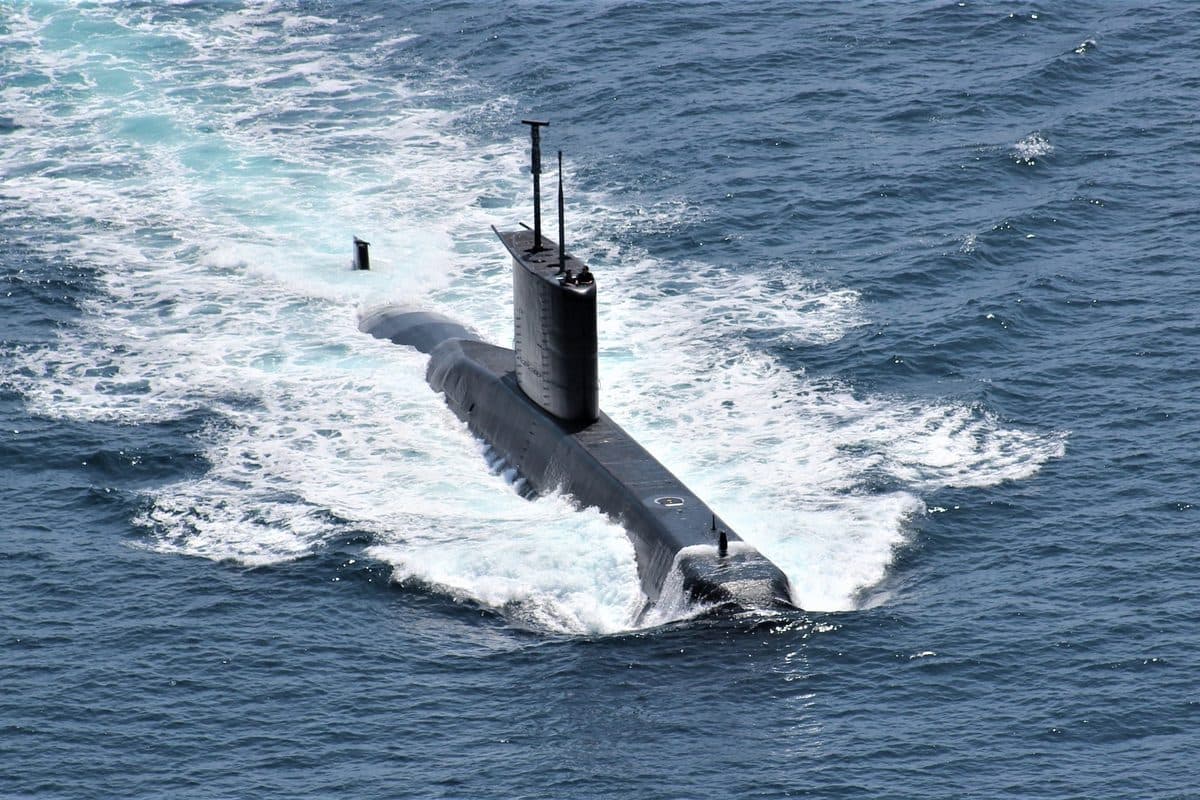
Ghost Shark XL-AUV autonomous underwater vehicle during water testing showing its dark hull partially submerged
The Ghost Shark XL-AUV during testing. Its flooded hull design and extreme depth capability allow it to operate in ocean environments that are inaccessible to crewed submarines. (Anduril Australia)

Modular Mission Payloads

Like many modern autonomous systems, the Ghost Shark is designed around modularity. The vehicle can accept different mission-specific payload modules, allowing the same platform to perform radically different roles depending on what is installed. One configuration might carry a sonar array for anti-submarine warfare, listening for enemy submarines and reporting their positions. Another might carry mine countermeasure equipment, scanning the seabed for mines and marking or neutralizing them.

Other potential payloads include electronic intelligence gathering equipment, underwater communications relays, environmental monitoring sensors, and seabed mapping systems. The modular approach means the RAN does not need a different vehicle for each mission type, it needs one versatile platform and a library of payload modules.

This flexibility is particularly valuable in the Indo-Pacific context, where missions can range from monitoring submarine activity in deep ocean transit routes to surveying shallow coastal waters for mines before an amphibious operation. The Ghost Shark can adapt to both scenarios through payload swaps rather than platform changes.

Lattice AI and Autonomous Operations

The Ghost Shark runs on Anduril's Lattice operating system, the same AI-driven software platform that powers the company's autonomous air vehicles, ground sensors, and command-and-control systems. Lattice provides the Ghost Shark with the ability to make real-time decisions about navigation, threat avoidance, and mission execution without waiting for instructions from a human operator.

Underwater operations present unique challenges for autonomous systems. Radio waves do not propagate through seawater, so the vehicle cannot maintain a continuous data link with its operators the way an aerial drone can. Once the Ghost Shark submerges, it is on its own, relying entirely on its onboard AI to navigate, avoid obstacles, manage its power budget, and execute the mission plan.

This is why the quality of the autonomy software matters more for underwater vehicles than perhaps any other domain. An aerial drone that loses its data link can often climb to altitude and reestablish contact. An underwater vehicle operating at 4,000 meters depth has no such option. It must be capable of completing its mission and returning safely using only its own intelligence. Lattice is designed to provide that level of autonomous decision-making.

Production and the Australian Supply Chain

Anduril has invested approximately $60 million in a dedicated, highly automated manufacturing facility in Australia specifically for Ghost Shark production. More than 40 Australian companies are part of the supply chain, making the program a significant contributor to Australia's growing defense industrial base.

In September 2025, Australia's Minister for Defence Richard Marles announced a A$1.7 billion (approximately US$1.1 billion) investment to acquire a fleet of "dozens" of Ghost Shark XL-AUVs. The first vehicle was delivered to the Royal Australian Navy in January 2026 for sea acceptance testing, with full-scale production expected to ramp up through 2026 and fleet delivery continuing over the following five years.

The scale of the order is notable. "Dozens" of autonomous underwater vehicles represents a fundamentally different force structure than a navy built around a handful of exquisite crewed submarines. Each Ghost Shark costs a fraction of what a crewed submarine costs to build and operate. A fleet of dozens can be deployed across multiple operating areas simultaneously, something that is impossible with six submarines that must also rotate through maintenance and training cycles.

International Interest

The Ghost Shark has already crossed the Pacific. Anduril announced that a Ghost Shark XL-AUV arrived in the United States for demonstrations and evaluation, signaling potential interest from the U.S. Navy. The American military has its own XL-AUV programs, most notably Boeing's Orca, but the Ghost Shark's advanced autonomy, extreme depth capability, and modular design may offer capabilities that existing American programs have not yet demonstrated.

The AUKUS framework provides a natural pathway for technology sharing between Australia, the United States, and the United Kingdom. A Ghost Shark variant adopted by allied navies would create interoperability advantages and economies of scale that benefit all three nations. The underwater domain is increasingly central to great power competition, and autonomous systems that can operate independently for days at extreme depths are exactly the kind of capability that AUKUS was designed to develop.

The Bigger Picture

The Ghost Shark represents a broader shift in undersea warfare. For more than a century, navies have relied on crewed submarines as their primary undersea platforms, expensive, scarce, and crewed by highly trained sailors. Autonomous underwater vehicles do not replace submarines, but they change the economics of undersea presence. A navy with six crewed submarines and fifty autonomous underwater vehicles has a very different capability than a navy with six submarines alone.

The Ghost Shark can go places crewed submarines cannot, deeper, longer, and into environments where the risk to human life is unacceptable. It can perform the tedious, dangerous work of mine detection, seabed surveillance, and persistent monitoring that currently consumes submarine time better spent on higher-value missions. And it can do so in numbers that fundamentally change how an adversary must think about the undersea domain.

Australia is betting heavily on this approach. The combination of AUKUS nuclear submarines for high-end undersea warfare and Ghost Shark autonomous vehicles for distributed undersea presence creates a layered capability that is greater than either system alone. The nuclear submarines bring speed, endurance, and heavy weapons. The Ghost Sharks bring numbers, persistence, and the ability to be everywhere at once. Together, they represent Australia's vision for undersea warfare in the decades ahead, and the Ghost Shark is arriving first.

Share this article

Share:

Recommended

Ace of The Skies: Can You Identify These Military Aircraft Throughout The Years?
Test Yourself

Ace of The Skies: Can You Identify These Military Aircraft Throughout The Years?

Can you identify these aircraft?

Take the Quiz

On This Day in Military History

March 15

Germany Occupies Czechoslovakia: The End of Appeasement (1939)

German troops marched into Prague and occupied the remainder of Czechoslovakia, violating the Munich Agreement signed just six months earlier. Hitler declared a "Protectorate of Bohemia and Moravia." This was the moment that finally convinced Britain and France that appeasement had failed, two weeks later, they guaranteed Poland's independence, setting the stage for World War II.

1781, Battle of Guilford Courthouse: A Pyrrhic British Victory

1917, Tsar Nicholas II Abdicates: The Russian Revolution Begins

1943, Germans Recapture Kharkov After Days of Savage Street Fighting

See all 10 events on March 15

Get Military News & History in Your Inbox

Join thousands of readers receiving our weekly digest of military technology, history, and analysis.

Test Your Knowledge