Skip to content
April 29:Liberation of Dachau Concentration Camp81yr ago

K2 Black Panther vs M1 Abrams: The Korean Tank That Outscores America's Best on Paper

Marcus Webb · · 10 min read
Save
Share:
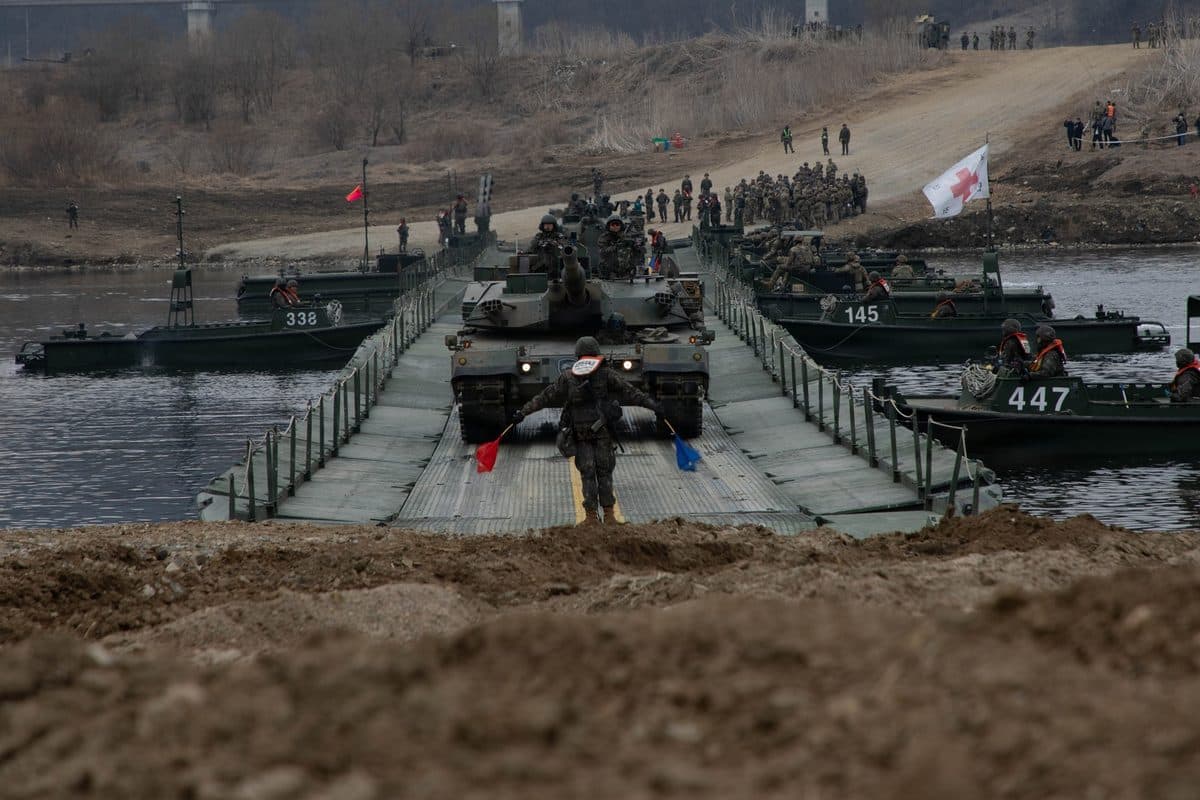
South Korean K2 Black Panther main battle tank crossing a river during Freedom Shield exercises
Marcus Webb
Marcus Webb

Military Vehicles & Ground Systems Contributor

Marcus Webb writes about military ground vehicles, armored platforms, and the logistics of land warfare. His work covers everything from MRAPs and infantry carriers to the training pipelines that keep ground forces operational in contested environments.

On paper, South Korea's K2 Black Panther beats the M1 Abrams in almost every measurable category. It weighs nearly 19 tons less. It carries a longer gun with an autoloader that eliminates the need for a fourth crew member. Its hydropneumatic suspension can lower the hull behind cover or tilt the entire tank to improve gun depression -- a capability no Western tank matches. Its diesel engine delivers the same 1,500 horsepower as the Abrams' gas turbine while burning roughly half the fuel. And Poland has already ordered over 1,000 of them, making the K2 one of the most successful tank exports of the 21st century.

But paper and combat are not the same thing. The M1 Abrams has fought in two Gulf Wars, survived thousands of enemy engagements, and built a combat record that no other modern tank can match. The K2 has never been fired at in anger. That distinction matters more than any specification sheet -- and it is the central tension in any honest comparison between these two machines.

The Numbers at a Glance

K2 Black Panther vs M1A2 SEPv3 Abrams

Specification K2 Black Panther M1A2 SEPv3 Abrams
Combat Weight 55 tonnes 73.6 tonnes
Crew 3 (commander, gunner, driver) 4 (+ loader)
Main Armament CN08 120mm L/55 (autoloader) M256A1 120mm L/44 (manual)
Engine MTU MB 883 V-12 diesel, 1,500 hp Honeywell AGT1500 gas turbine, 1,500 hp
Power-to-Weight 27.3 hp/tonne 20.4 hp/tonne
Top Speed (Road) 70 km/h 67 km/h
Range 450 km 426 km
Suspension In-arm hydropneumatic (ISU) Torsion bar
Active Protection Soft-kill KAPS + hard-kill capable Trophy APS (on select variants)
Unit Cost (approx.) $8.5 million $10.5 million (SEPv3)

Where the K2 Wins on Paper

The Weight Advantage

The K2's 55-tonne combat weight versus the Abrams' 73.6 tonnes is not just a number. It is a strategic capability difference. At 55 tonnes, the K2 can cross bridges that would collapse under an Abrams. It can be transported by standard military cargo aircraft without special accommodations. It can operate on roads and terrain that would be marginal for a 74-tonne vehicle. In the Korean Peninsula's mountainous terrain, with its narrow roads and aging bridge infrastructure, this weight advantage is not academic -- it is operationally decisive.

The weight savings come from several design decisions. The autoloader eliminates the fourth crew member and the space required for a manual loading station. The diesel engine is more compact than the Abrams' gas turbine. And the K2's composite armor, while classified in detail, appears to use a more weight-efficient configuration than the Abrams' depleted uranium armor package -- though whether it provides equivalent protection is unknown.

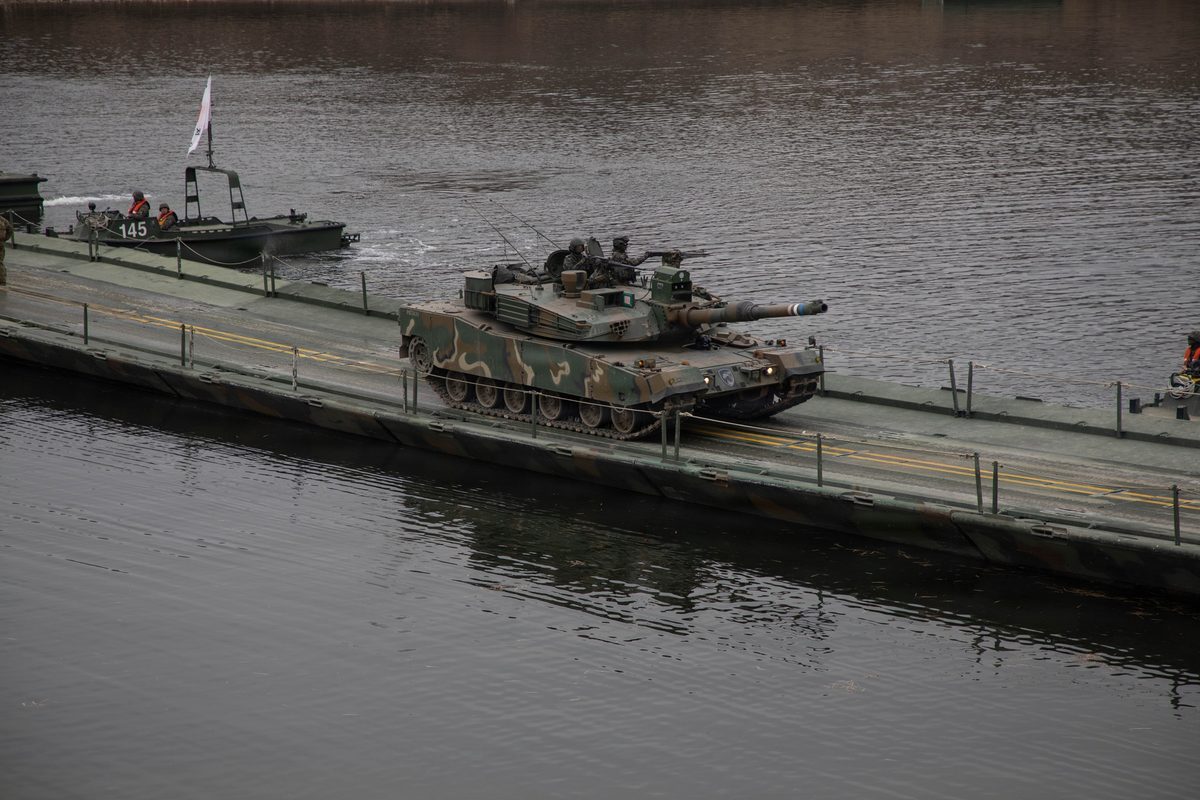
K2 Black Panther tank crossing a military pontoon bridge during combined exercises in South Korea
A K2 Black Panther crosses an Improved Ribbon Bridge during Freedom Shield exercises in South Korea. The K2's 55-tonne weight allows it to cross infrastructure that heavier Western tanks cannot. (U.S. Army photo)

The Gun and Autoloader

The K2's CN08 120mm gun uses an L/55 barrel -- 55 calibers long, compared to the Abrams' L/44. The longer barrel generates higher muzzle velocity, which translates directly to greater armor penetration at range. The difference is roughly equivalent to one generation of ammunition improvement: the K2 firing standard ammunition achieves penetration comparable to the Abrams firing its most advanced rounds.

The autoloader allows the K2 to sustain a rate of fire of 10 rounds per minute for the first several rounds -- faster than even the best human loaders, who typically manage 6 to 8 rounds per minute. The autoloader also maintains consistent performance regardless of crew fatigue, terrain, or the chaos of combat, conditions that degrade human loading speed significantly.

The Suspension No One Else Has

The K2's most distinctive feature is its In-arm Suspension Unit (ISU), a hydropneumatic system that allows the tank to adjust the height and angle of its hull independently at each road wheel. The practical effect is remarkable: the K2 can lower its profile behind a berm, raise itself to clear obstacles, or tilt its hull forward to increase gun depression beyond what the turret's mechanical limits would normally allow.

In a hull-down position -- the defensive posture where a tank exposes only its turret above cover -- the K2 can "kneel" to present the smallest possible target. It can also lean its hull sideways to fire from positions that would be impossible for a conventional tank. This capability is particularly valuable in Korea's mountainous terrain, where fighting positions on ridgelines and hillsides demand maximum gun depression. The Abrams, with its conventional torsion bar suspension, cannot match this flexibility.

Fuel Economy

The Abrams' Honeywell AGT1500 gas turbine is a logistical burden that the US Army has lived with for forty years. The engine burns approximately 300 gallons of fuel per 8 hours of operation, and its consumption barely decreases at idle. The K2's MTU diesel engine uses roughly half the fuel for equivalent operations. In a sustained conflict, this difference compounds: an armored brigade of K2s requires significantly fewer fuel trucks, fewer supply convoys, and less logistical infrastructure than an equivalent Abrams formation. On the Korean Peninsula, where supply lines could be disrupted early in a conflict, fuel efficiency is not a luxury.

M1 Abrams main battle tank firing its 120mm main gun during live fire exercise
An M1 Abrams fires its 120mm main gun during a gunnery exercise. Despite the K2's advantages on paper, the Abrams has proven its lethality and survivability in thousands of real-world engagements. (U.S. Army photo)

Where the Abrams Wins in Reality

Combat-Proven Armor

The M1 Abrams has been hit by rocket-propelled grenades, anti-tank guided missiles, improvised explosive devices, and even other tanks' main guns. In the vast majority of engagements, the crew survived. During the 1991 Gulf War, Abrams tanks destroyed over 2,000 Iraqi armored vehicles while suffering virtually no losses to enemy fire. In the 2003 invasion of Iraq, Abrams tanks took multiple hits from RPGs and ATGMs in urban combat and continued fighting. The Abrams' combination of composite armor, depleted uranium inserts, and a blow-out ammunition compartment that directs explosion energy away from the crew has been validated in ways that no amount of testing can replicate.

The K2's armor has never been tested in combat. Its composite armor package is classified, and South Korea has not disclosed whether it includes depleted uranium or equivalent high-density materials. The K2 incorporates a Korean Active Protection System (KAPS) designed to intercept incoming anti-tank missiles, but this system has not been validated against the full spectrum of modern threats the way the Abrams' Trophy APS has in Israeli service.

The Human Loader Debate

The K2's autoloader eliminates the loader's position, reducing the crew to three. This saves weight and reduces the interior volume that must be armored. But it also removes a fourth pair of eyes, a fourth set of hands for maintenance, and a fourth crew member who can take over another's role if someone is wounded. In the Abrams, the loader also serves as the tank commander's primary security during non-combat operations, mans a machine gun for close defense, and assists with track maintenance -- the brutal physical work of repairing 63-tonne vehicles in the field.

The US Army has studied autoloaders extensively and consistently chosen to retain the human loader. The reasoning is not sentimental. Four-person crews are more resilient, more flexible, and more capable of sustained operations than three-person crews. During multi-day operations, a four-person crew can rotate rest periods more effectively. In an era of increasingly complex battlefield environments, that fourth crew member provides capability that an autoloader cannot.

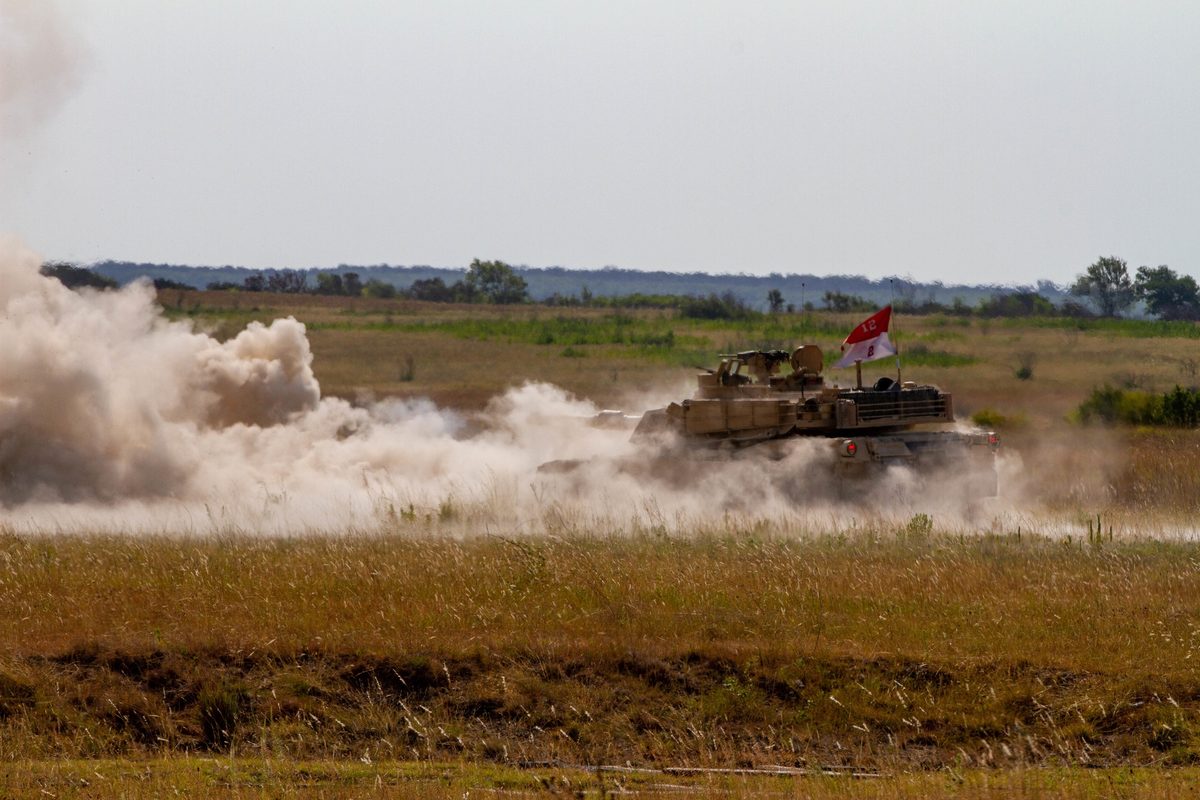
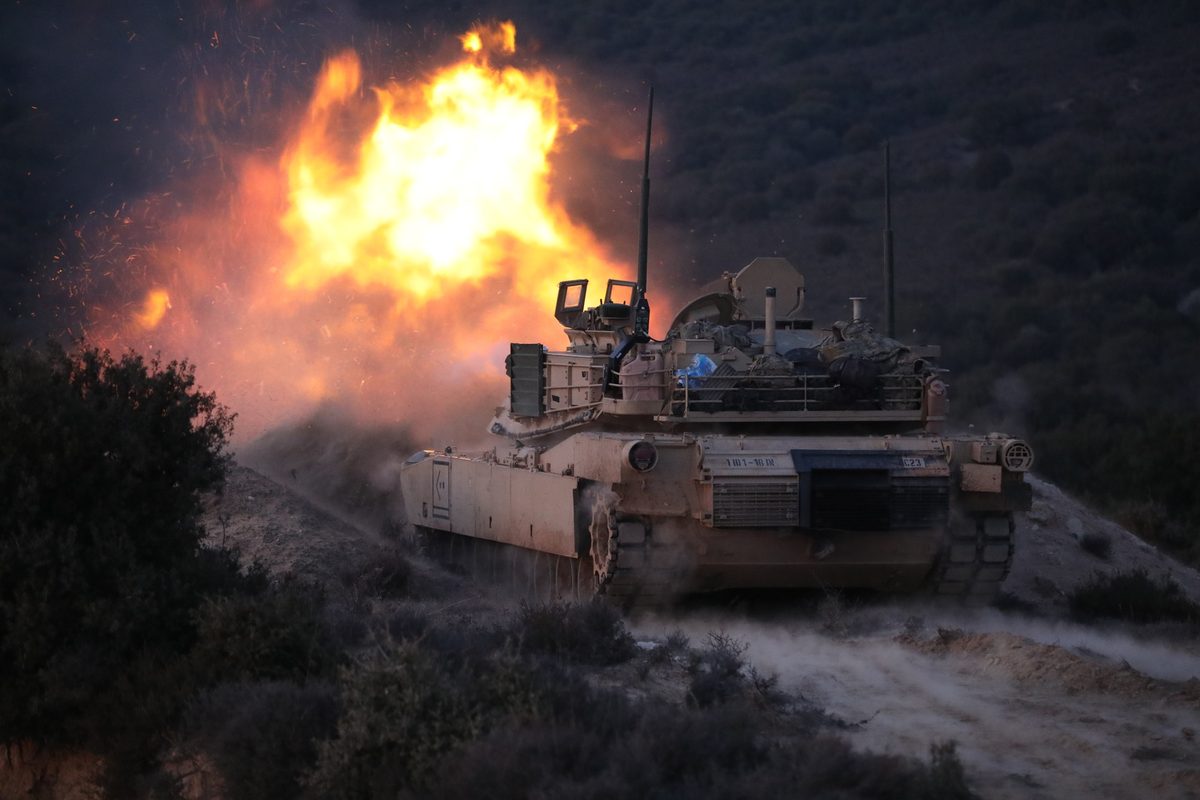
M1 Abrams tank firing at a target during live fire exercise in Greece with dust and muzzle blast visible
An M1 Abrams from the 1st Infantry Division fires during a live fire exercise at Petrochori Training Area, Greece. The Abrams' combat deployments across multiple theaters have generated institutional knowledge that no amount of peacetime testing can substitute. (U.S. Army photo)

Institutional Knowledge and Combat Doctrine

The US Army has operated the Abrams since 1980. Forty-five years of training, doctrine development, maintenance procedures, and lessons learned from multiple wars have produced an institutional depth that new tank programs cannot replicate quickly. American tankers know the Abrams' strengths and weaknesses intimately. They know how the tank behaves when hit, how it performs in sand versus mud versus urban terrain, and how to keep it running with improvised repairs thousands of miles from a depot.

The K2 entered South Korean service in 2014. It is an excellent machine, but the South Korean Army has had barely a decade to develop the kind of deep operational knowledge that comes from decades of use across diverse environments and against real enemies.

The Export Question

The K2's most compelling real-world validation comes not from combat but from the export market. Poland signed a framework agreement in 2022 to acquire up to 1,000 K2 tanks, the largest tank order in NATO since the Cold War. The first batch of 180 K2s has already been delivered, with Polish industry producing subsequent batches under license as the K2PL variant. The deal was driven by Poland's urgent need to replace Soviet-era T-72s donated to Ukraine, but the choice of the K2 over alternatives -- including the Abrams, which Poland also operates -- reflects a judgment that the K2 offers more capability per dollar.

Norway, Romania, and several Middle Eastern nations have also evaluated the K2 or entered preliminary discussions. South Korea has aggressively marketed the K2 as a cost-effective alternative to Western tanks, emphasizing its lower weight, diesel efficiency, and technology transfer packages that allow buyer nations to build the tank domestically.

The Abrams, by contrast, has seen declining export interest. Its 74-tonne weight, enormous fuel consumption, and higher operating costs make it expensive to own and difficult to deploy on infrastructure not built for American-weight vehicles. Saudi Arabia, Egypt, Iraq, and Australia operate Abrams variants, but new orders have slowed as customers look at lighter, more economical alternatives.

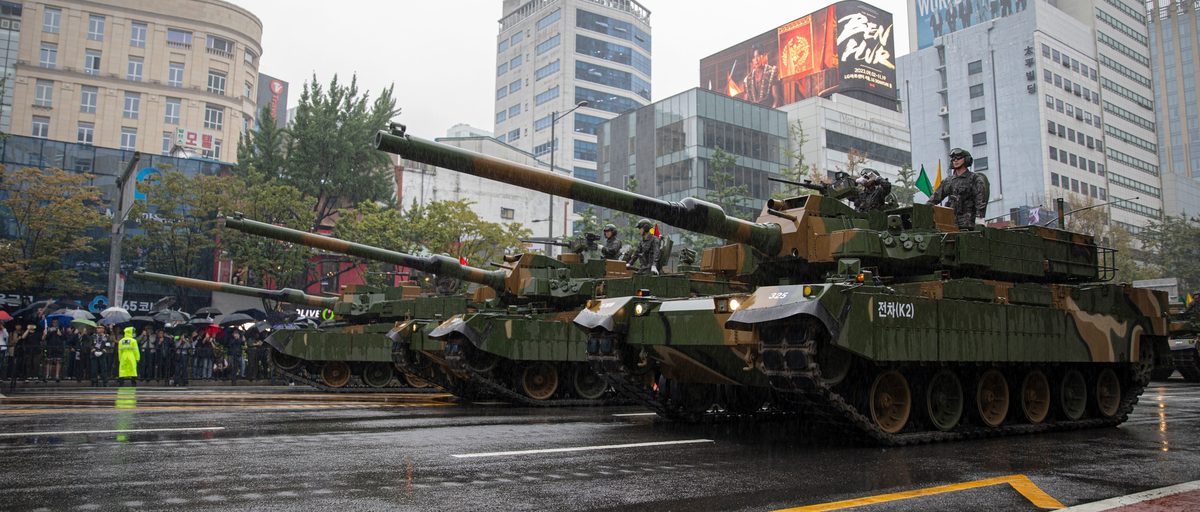
K2 Black Panther tanks on display during the 75th Republic of Korea Armed Forces Day parade in Seoul
K2 Black Panther tanks on display during the 75th Republic of Korea Armed Forces Day parade in Seoul, September 2023. South Korea's defense industry has transformed the K2 into one of the most successful tank exports of the 21st century. (U.S. Army photo)

The Verdict: Different Tanks for Different Wars

The K2 Black Panther and the M1 Abrams are not competing for the same role in the same army. The K2 was designed for a specific operational environment -- the Korean Peninsula, with its mountains, narrow valleys, and the need to stop a massive North Korean armored assault. Its lighter weight, advanced suspension, and fuel efficiency are optimized for that theater. The Abrams was designed for a different fight -- stopping Soviet tank armies on the plains of Central Europe -- and then proved its value in the deserts of the Middle East.

On a specification sheet, the K2 wins in weight, power-to-weight ratio, fuel economy, rate of fire, suspension flexibility, and arguably firepower. The Abrams wins in armor protection (proven, not theoretical), crew survivability (validated in combat), institutional support, and the irreplaceable advantage of having fought real wars against real enemies.

The honest answer to "which is better?" depends entirely on what you mean by better. If you are building an armored force from scratch in 2026 and have never fought a tank war, the K2 is probably the smarter purchase. If you need a tank that you know will keep your crew alive when the shooting starts, the Abrams has a forty-year record that no specification sheet can match. The K2 outscores the Abrams on paper. But the Abrams has proven something the K2 has not: that its paper performance translates to the only test that matters.

Share this article

Share:

Recommended

Ace of The Skies: Can You Identify These Military Aircraft Throughout The Years?
Test Yourself

Ace of The Skies: Can You Identify These Military Aircraft Throughout The Years?

Can you identify these aircraft?

Take the Quiz

Get Military News & History in Your Inbox

Join thousands of readers receiving our weekly digest of military technology, history, and analysis.

Test Your Knowledge