Skip to content
April 28:Execution of Benito Mussolini81yr ago

The Me 262: The World's First Operational Jet Fighter

Daniel Mercer · · 13 min read
Save
Share:
Messerschmitt Me 262 jet fighter on the ground showing its twin Jumo 004 jet engines and swept wings
Daniel Mercer
Daniel Mercer

Military History Editor

Daniel Mercer writes about military history with a focus on the 20th century, including World War II, the Cold War, and Vietnam. His work looks at how decisions made decades ago still influence doctrine, planning, and assumptions today.

On July 18, 1942, test pilot Fritz Wendel opened the throttles of the Messerschmitt Me 262 V3 prototype and took off from Leipheim airfield on the power of jet engines alone. The aircraft accelerated past 500 mph, faster than any propeller-driven fighter in the world could hope to reach. In that moment, a new era of aerial warfare began. The Me 262 was not merely an incremental improvement over existing fighters. It was a technological leap that made every piston-engine aircraft in the sky obsolete. But technological revolutions do not win wars by themselves, and the story of the Me 262 is as much about what went wrong as what went right.

A Jet Fighter Before Its Time

The Me 262 program began in 1938, when the German Air Ministry issued a requirement for a jet-powered fighter. Messerschmitt's design team, led by Willy Messerschmitt and project engineer Woldemar Voigt, produced an airframe that was remarkably advanced: a low-wing monoplane with two jet engines mounted in nacelles under the wings, a tricycle landing gear (uncommon for German aircraft), and all armament concentrated in the nose. The wings incorporated a slight sweep, not for aerodynamic reasons related to high-speed flight (that science was still being developed), but to adjust the center of gravity after the engines proved heavier than expected and had to be moved forward.

The airframe was ready before the engines. BMW's 003 turbojet, intended as the primary powerplant, suffered chronic development problems. The first jet-powered Me 262 test flight actually used a piston engine in the nose as backup, which proved fortunate when both BMW jets failed during the flight. Junkers' Jumo 004 axial-flow turbojet eventually became the production engine, and while it was more reliable than the BMW 003, "reliable" was a relative term. The Jumo 004's turbine blades, made from inferior alloys due to Germany's shortage of nickel and chromium, had a service life of just 10 to 25 hours before requiring replacement.

Despite these engine problems, the Me 262's performance was staggering. The production Me 262A-1a could reach approximately 540 mph at altitude, more than 100 mph faster than the P-51D Mustang, the best Allied piston fighter. At those speeds, the Me 262 could dictate the terms of any engagement. It could attack Allied bomber formations, slash through the escort fighters, and disengage before the defenders could react. No Allied fighter could catch it in level flight.

The Hitler Controversy

The most debated aspect of the Me 262's history is Adolf Hitler's intervention in the program. In late 1943, Hitler saw the Me 262 demonstrated and reportedly demanded that it be used as a fast bomber, a "Blitz bomber," rather than as a fighter. He wanted an aircraft that could strike the Allied invasion beaches with impunity, not one that would defend German cities from bombing.

The impact of this decision has been fiercely debated by historians for decades. The bomber variant, designated Me 262A-2a Sturmvogel ("Storm Bird"), could carry two 250-kilogram bombs, but its usefulness as a bomber was limited. It had no bombsight, its speed advantage was reduced by the drag of external bombs, and the small bomb load meant it had minimal impact on ground targets. Diverting production and training resources to the bomber role almost certainly delayed the availability of the far more effective fighter variant.

However, many historians argue that Hitler's interference has been exaggerated as an explanation for the Me 262's limited impact. The real problems were more fundamental: engine unreliability, fuel shortages, lack of trained jet pilots, and the overwhelming numerical superiority of Allied air power. Even without Hitler's bomber directive, it is unlikely that the Me 262 could have been fielded in sufficient numbers early enough to change the outcome of the air war.

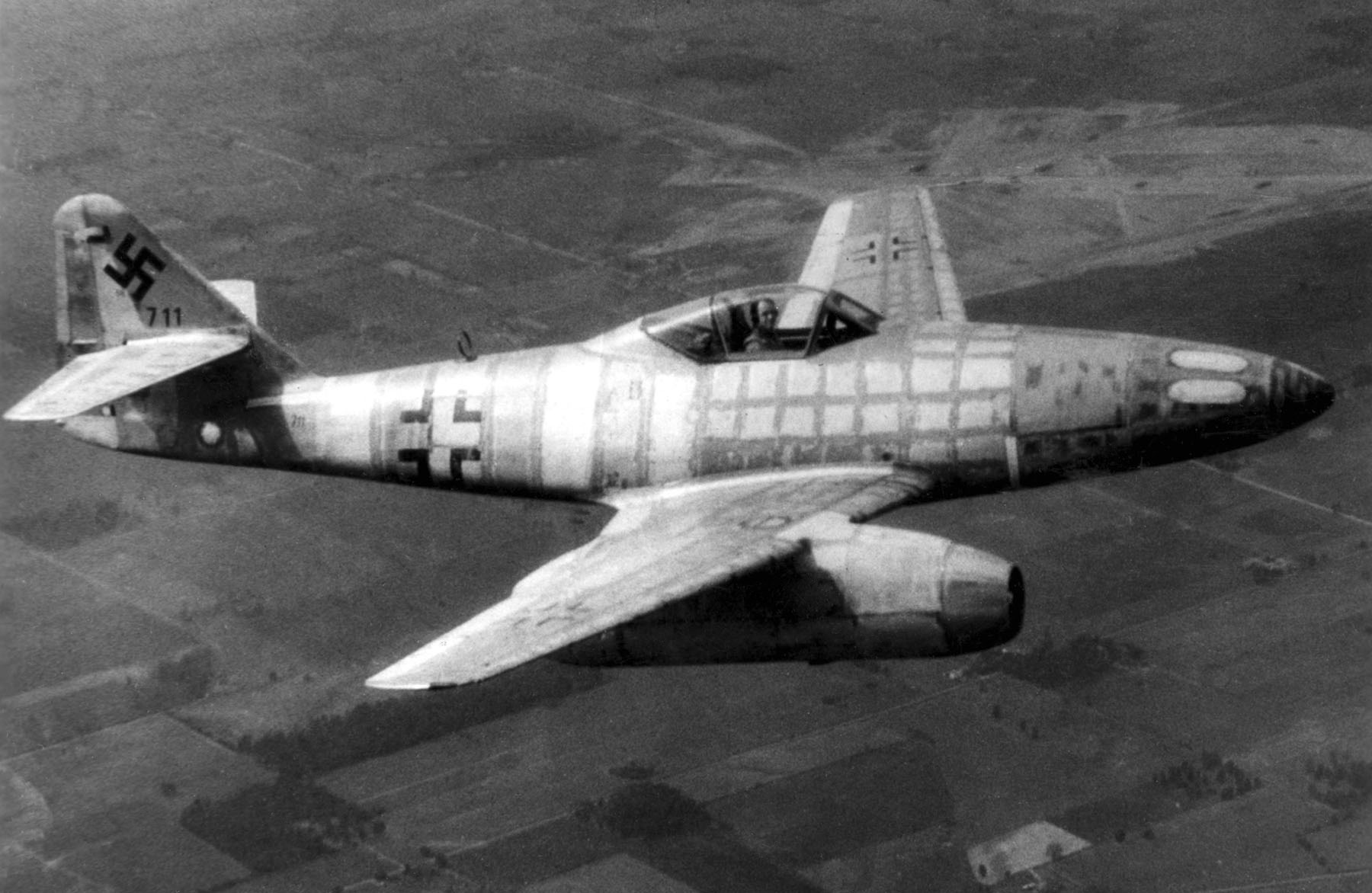
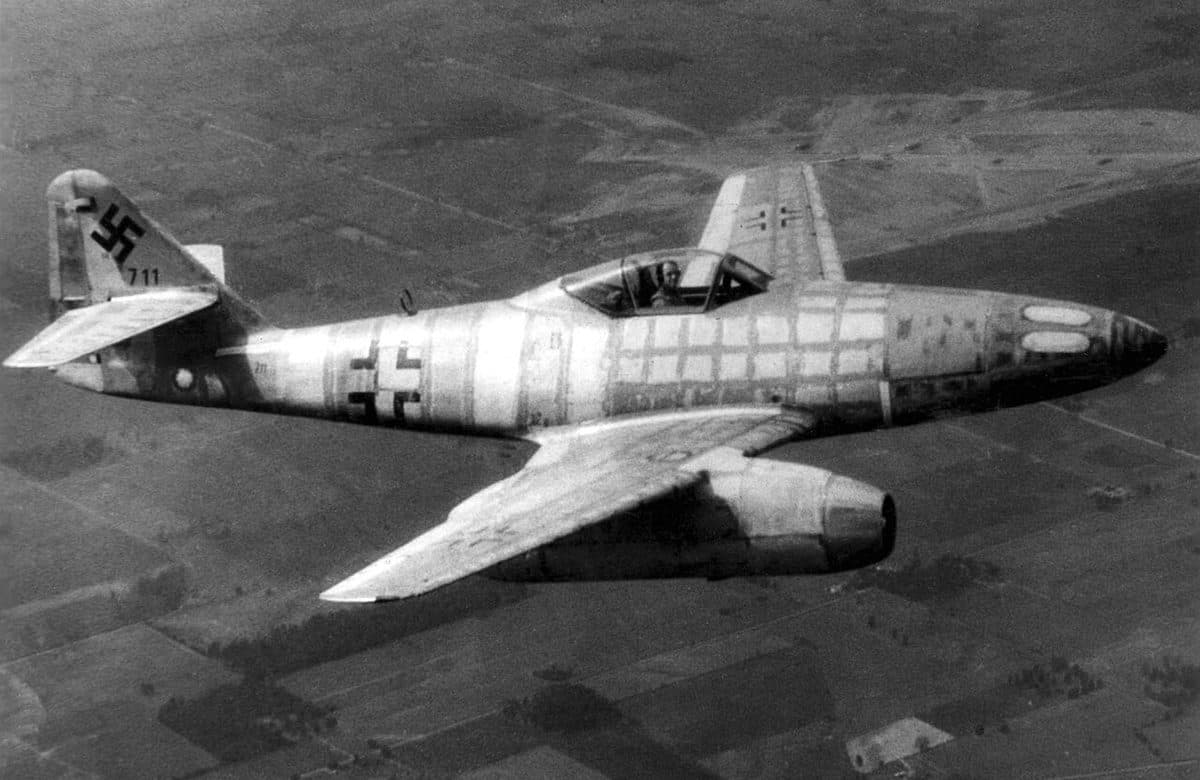
Messerschmitt Me 262 in flight showing its revolutionary twin-jet configuration that made it 100 mph faster than any Allied fighter
The Me 262 in flight. Its twin Junkers Jumo 004 engines gave it a speed advantage over every Allied fighter, but their short service life and Germany's material shortages severely limited the aircraft's operational effectiveness. (Bundesarchiv)

Armament: The Bomber Killer

The Me 262A-1a carried four Rheinmetall-Borsig MK 108 30mm cannon in the nose. The MK 108 was a devastating weapon. Each high-explosive mine shell (Minengeschoß) weighed 330 grams and could destroy a heavy bomber with as few as three hits. A single burst from four MK 108s hitting a B-17 Flying Fortress would tear the aircraft apart.

The drawback was the MK 108's low muzzle velocity. The shells traveled relatively slowly, making accurate deflection shooting at crossing targets difficult. The limited ammunition capacity (100 rounds per upper gun and 80 rounds per lower gun) meant that pilots had to make every burst count. Experienced Me 262 pilots learned to close to very short range before firing, maximizing the probability of hits.

Late in the war, the Me 262 received an even more fearsome weapon: the R4M unguided air-to-air rocket. Twenty-four R4M rockets were carried on underwing racks, and a salvo fired into a bomber formation could be devastating. The rockets spread into a pattern that increased the probability of hits, and each warhead was powerful enough to destroy a heavy bomber. JG 7's attacks on American bomber formations using R4M rockets produced some of the most lopsided kills-to-losses ratios of the air war.

Operational History

The first operational Me 262 unit was Erprobungskommando 262, followed by Kommando Nowotny, named after Walter Nowotny, an Austrian ace with 258 victories who was killed in combat in November 1944 while flying an Me 262. The difficulties of the early operational period were severe: engine failures, accidents during takeoff and landing, and the challenge of transitioning pilots from propeller-driven aircraft to jets.

Jagdgeschwader 7 (JG 7), activated in late 1944, became the first full jet fighter wing in history. Based in central Germany, JG 7 flew intercept missions against American bomber formations and achieved considerable success. On March 18, 1945, JG 7 launched a major attack against a force of over 1,200 American bombers and their escorts, claiming 12 bombers and one fighter destroyed, though the unit also lost several Me 262s.

Perhaps the most famous Me 262 unit was Jagdverband 44 (JV 44), led by Adolf Galland, the former General of Fighters who had been removed from his administrative post by Göring. Galland assembled a unit of experienced aces, many with Knight's Crosses, and operated from Munich-Riem airfield in the final weeks of the war. JV 44 demonstrated what the Me 262 could achieve in the hands of expert pilots, but by April 1945, fuel shortages and Allied ground advances made sustained operations impossible.

Vulnerabilities

For all its speed advantage in the air, the Me 262 was most vulnerable when it was slowest: during takeoff and landing. The Jumo 004 engines accelerated slowly and were prone to flameouts if the throttle was advanced too quickly. A fully loaded Me 262 needed a long takeoff run, during which it was an easy target for Allied fighters.

Allied commanders quickly recognized this vulnerability. P-51 Mustang units were assigned to patrol known Me 262 airfields, waiting to catch the jets at their most vulnerable moments. Some Allied fighters would orbit above a jet base for hours, picking off Me 262s as they took off or landed. The Luftwaffe responded by positioning flak batteries around jet airfields and having conventional piston-engine fighters fly cover during takeoff and landing, an ironic arrangement where slower fighters protected faster ones.

The engines themselves remained the Me 262's Achilles heel throughout its service. The Jumo 004's 10-to-25-hour service life meant that engines needed constant replacement. Germany's collapsing industrial base could not maintain a steady supply of replacement engines, spare parts, or the specialized fuels that the jets required. Many Me 262s sat on airfields unable to fly, not because they were damaged, but because they lacked serviceable engines or fuel.

Production and Numbers

Approximately 1,430 Me 262s were produced before the war ended. Of those, only around 300 ever saw combat. The remainder were destroyed on the ground, lacked engines or fuel, or were still in assembly when their factories were overrun. The gap between production numbers and combat-ready aircraft tells the real story of the Me 262. Germany could build the airframes, but it could not field a sustainable jet fighter force in the face of material shortages, Allied bombing of factories and airfields, and the fundamental unreliability of the Jumo 004 engine.

Legacy

The Me 262 did not save the Third Reich, and it was never going to. But it fundamentally changed the trajectory of military aviation. Every major power studied captured Me 262s after the war. The Americans, British, and Soviets all flew and tested them, incorporating lessons into their own jet fighter programs. The axial-flow turbojet concept pioneered by the Jumo 004, as opposed to the centrifugal-flow design used by Britain's Gloster Meteor, became the standard for all subsequent jet engines.

The Me 262's swept wings, nose-mounted armament, and twin-engine jet configuration established a template that would be echoed in postwar designs from the P-38's successor generation through the F-86 Sabre and MiG-15 that would fight over Korea just five years later. The jet age had arrived on the back of the Me 262, and despite its troubled operational history, the aircraft proved beyond doubt that the future of air combat belonged to jet power.

The question that haunts the Me 262's story, could it have changed the war, almost certainly has a single answer: no. Even with perfect leadership decisions, unlimited fuel, and reliable engines, the Me 262 could not have reversed the strategic situation that Germany faced by 1944. The Allies had too many aircraft, too many pilots, too much industrial capacity, and too many fronts for a single weapons system to overcome. But the Me 262 demonstrated what was possible, and in doing so, it made every piston-engine fighter in the world obsolete overnight. That is legacy enough for any machine.

Share this article

Share:

Recommended

Ace of The Skies: Can You Identify These Military Aircraft Throughout The Years?
Test Yourself

Ace of The Skies: Can You Identify These Military Aircraft Throughout The Years?

Can you identify these aircraft?

Take the Quiz

On This Day in Military History

March 19

The Bombing of USS Franklin (CV-13) (1945)

Operating 70 miles off the coast of Shikoku, Japan, the Essex-class aircraft carrier USS Franklin was struck by two 550-pound bombs from a lone Japanese dive bomber. The bombs detonated among 31 fully armed and fueled aircraft, igniting aviation fuel and ordnance in a catastrophic chain of secondary explosions. Between 724 and 807 crew members were killed, the single deadliest attack on a U.S. Navy ship that survived the war. The crew's extraordinary damage control effort saved the ship, which steamed 12,000 miles home under her own power.

1865, Battle of Bentonville: Last Major Battle of the Civil War

1945, Hitler Issues the Nero Decree

1944, Operation Margarethe: Germany Occupies Hungary

See all 10 events on March 19

Get Military News & History in Your Inbox

Join thousands of readers receiving our weekly digest of military technology, history, and analysis.

Test Your Knowledge