Skip to content
April 25:The Gallipoli Landings, ANZAC Day111yr ago

The Ohio-Class Submarine Carries 24 Nuclear Missiles and Can End Civilization. Here's How It Works.

Nathan Cole · · 14 min read
Save
Share:
Ohio-class ballistic missile submarine surfaced at sea
Nathan Cole
Nathan Cole

Naval Warfare & Maritime Systems Analyst

Nathan Cole covers naval warfare, maritime strategy, and the ships and submarines that project power across the world's oceans. His work focuses on fleet architecture, carrier operations, and how navies adapt to threats from missiles, drones, and undersea warfare.

Start with the math. A single Ohio-class ballistic missile submarine carries 20 Trident II D5 missiles. Each missile can carry up to 8 independently targetable nuclear warheads. That is 160 warheads aboard one vessel. Each W88 warhead has a yield of 475 kilotons, roughly 30 times the power of the bomb that destroyed Hiroshima. One submarine, operating alone and undetected, carries enough destructive force to end a civilization. The United States keeps four to five of them at sea at all times. This is not a theoretical capability. It is the operational reality of nuclear deterrence, and it has been for over 40 years.

What the Ohio Class Is

The Ohio class is a fleet of 18 submarines: 14 SSBNs (Ship, Submersible, Ballistic, Nuclear) that carry nuclear missiles, and 4 SSGNs (guided-missile submarines) that were converted from the ballistic missile role in the early 2000s. The SSBNs are the sea-based leg of the United States nuclear triad, alongside land-based ICBMs and strategic bombers. Of the three legs, the submarine force is considered the most survivable, and therefore the most stabilizing. A nation that knows its adversary's submarines cannot be found and destroyed has no rational incentive to launch a first strike.

The numbers define the platform. An Ohio-class SSBN displaces 18,750 tons submerged, making it one of the largest submarines ever built. It stretches 560 feet, nearly two football fields, with a 42-foot beam. The hull is powered by a General Electric S8G pressurized-water nuclear reactor that drives a single shaft, producing enough energy to sustain speeds exceeding 20 knots submerged. The reactor does not need refueling for the operational life of the submarine. A crew of 155 operates the vessel in two rotating crews, Blue and Gold, that alternate between patrols and shore-based training.
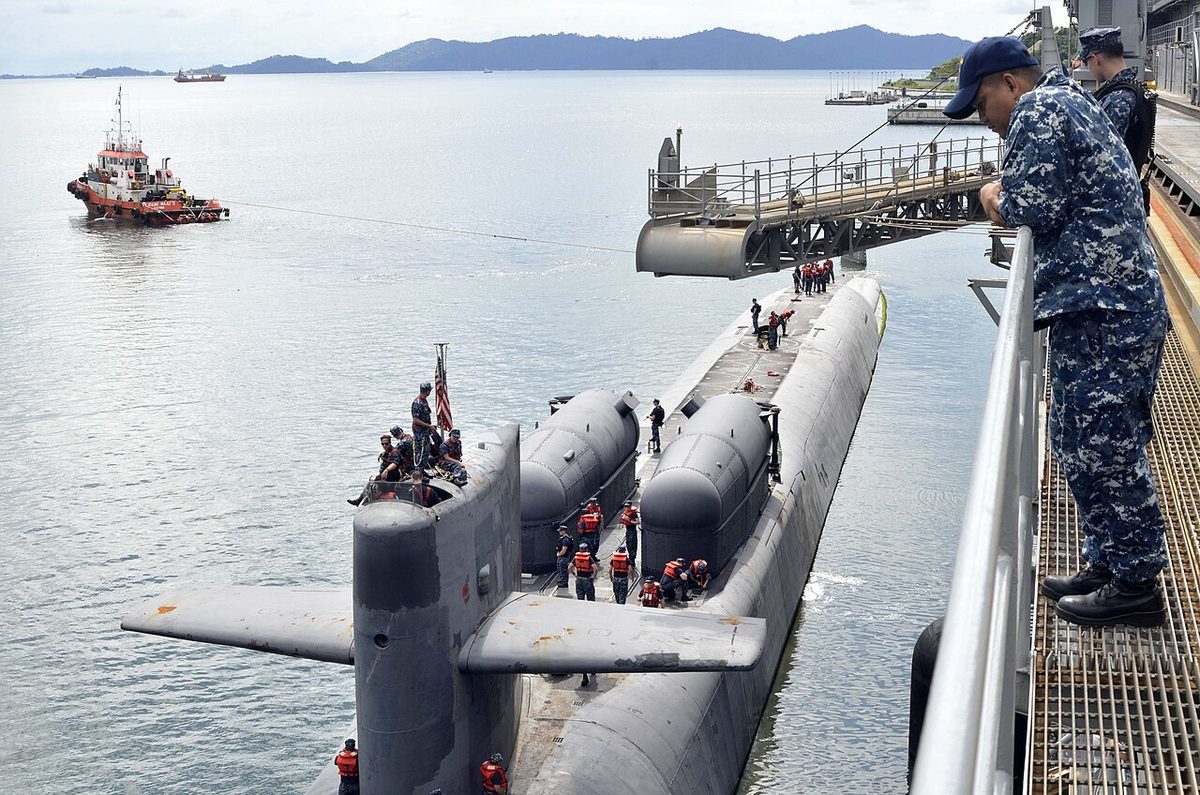
Ohio-class ballistic missile submarine underway at sea
An Ohio-class SSBN underway. At 560 feet long and nearly 19,000 tons submerged, these are among the largest submarines ever constructed.

The first Ohio-class submarine, USS Ohio (SSBN-726), was commissioned in 1981. The class was designed during the Cold War specifically to survive a Soviet first strike and deliver a retaliatory response so devastating that no rational adversary would risk initiating nuclear war. That logic, mutually assured destruction, remains the foundation of strategic deterrence today.

The Trident II D5: The Weapon

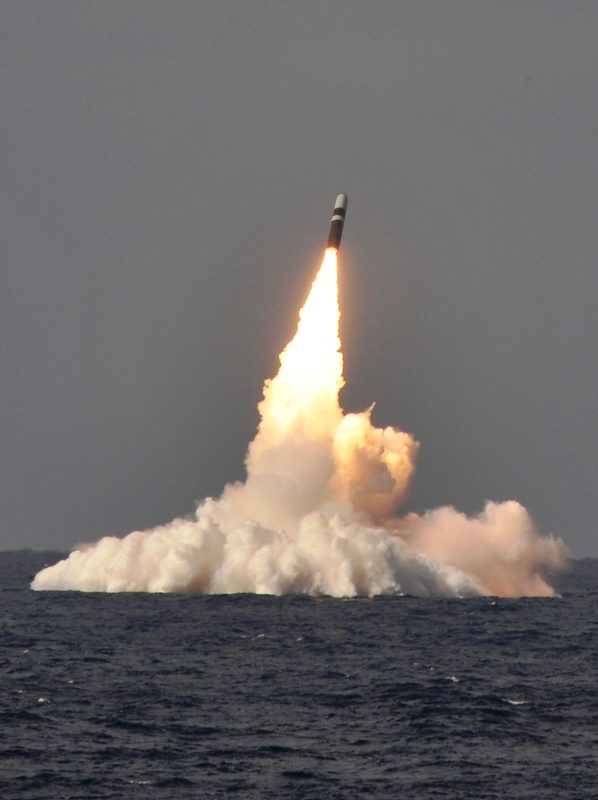
The Trident II D5 is the most capable submarine-launched ballistic missile ever deployed. Built by Lockheed Martin, it is a three-stage, solid-fuel missile with a range exceeding 7,000 miles, meaning an Ohio-class submarine operating in the mid-Atlantic can strike targets deep inside any continent on Earth. The missile is 44 feet long, weighs 130,000 pounds at launch, and accelerates through the atmosphere before releasing its warheads on independent ballistic trajectories during the terminal phase of flight.

Trident II D5 ballistic missile launching from a submarine at sea
A Trident II D5 missile launches from an Ohio-class submarine. The missile can deliver multiple independently targetable warheads to ranges exceeding 7,000 miles.

Each Trident II can carry up to 8 multiple independently targetable reentry vehicles (MIRVs). The warhead options are the W88, with a yield of 475 kilotons, and the W76-1/W76-2, with yields of 100 kilotons and approximately 5-7 kilotons respectively. The W76-2 low-yield variant was introduced to provide a more "proportional" response option, though the strategic implications of using any nuclear weapon, regardless of yield, remain catastrophic. The missile's circular error probable (CEP) is approximately 90 meters, meaning half of all warheads will land within 90 meters of their programmed target from thousands of miles away. That accuracy, combined with the W88's yield, gives the Trident II a hard-target kill capability against even the most hardened underground facilities.

The reliability record is near-perfect. Since entering service in 1990, the Trident II D5 has completed over 180 consecutive successful test flights. No other ballistic missile, land-based or sea-based, comes close to that record.

The Patrol Cycle: 70 to 90 Days Underwater

An Ohio-class deterrent patrol typically lasts 70 to 90 days. During that time, the submarine operates submerged, maintaining strict emissions control. That means no active sonar, no radio transmissions, no communication with the outside world except through receipt of one-way very-low-frequency (VLF) messages. The submarine receives coded messages; it does not reply. To transmit would be to reveal its position, and position is the one thing an SSBN must never compromise.

The Blue and Gold crew rotation system is what makes sustained deterrent patrols possible. While one crew is at sea for 70-90 days, the other crew is ashore, training, taking leave, and maintaining qualifications. When the submarine returns to port, the crews swap. The turnover period lasts approximately 35 days, during which the boat undergoes maintenance and resupply while the incoming crew conducts refresher training. Then the submarine goes back to sea. This cycle continues without interruption. The submarine is always either on patrol, preparing for patrol, or in a maintenance period that has been scheduled years in advance.

Interior view of Ohio-class submarine missile tubes in the missile compartment
The missile compartment of an Ohio-class submarine houses 24 launch tubes, though current arms agreements limit loadout to 20 Trident II missiles.

What does 70-90 days underwater actually mean for the crew? It means no sunlight, no fresh air, no phone calls home, no news except what the Navy chooses to relay in short "familygrams." The crew operates on an 18-hour watch cycle, six hours on watch and twelve hours off, which does not correspond to any natural day-night rhythm. Meals are the primary social event. Space is constrained: junior enlisted sailors "hot-rack," sharing bunks in shifts. The atmosphere is recycled and manufactured by electrolysis machines that split seawater into breathable oxygen. Fresh water is produced by desalination. The food is good. Submarine galleys are considered the best in the Navy, because when every other comfort has been stripped away, meals become the one thing that maintains morale.

The longest recorded Ohio-class patrol belongs to USS Pennsylvania (SSBN-735), which spent 140 days submerged, double the standard patrol length. In February 2025, the Ohio-class fleet completed its 1,000th strategic deterrent patrol, a milestone that represents over four decades of continuous, unbroken nuclear deterrence at sea.

Why They Cannot Be Found

The Ohio class was designed around a single operational imperative: remain undetected. Everything about the submarine, from its reactor and propulsion to its hull design and operating procedures, serves that imperative. In 1982, during initial sea trials, the USS Ohio demonstrated acoustic stealth that the Navy described as virtually undetectable by contemporary anti-submarine warfare systems. That was over 40 years ago. The submarines have been quieted further since.

The S8G reactor uses natural circulation at low speeds, meaning the coolant flows through the reactor without mechanical pumps. Pumps create noise. At patrol speed, the Ohio class operates without them. Every piece of machinery aboard is mounted on sound-isolation rafts that decouple vibrations from the hull. The propeller is designed to minimize cavitation, the formation of air bubbles that collapse and create detectable noise. The hull itself is coated in anechoic tiles that absorb active sonar pulses rather than reflecting them.

The ocean is vast, covering 139 million square miles of surface area with an average depth of over 12,000 feet. An Ohio-class submarine operating at patrol depth in the open ocean is, for all practical purposes of current detection technology, invisible. Anti-submarine warfare remains one of the most difficult military problems in existence. Despite billions of dollars invested in satellite surveillance, underwater sensor networks, and AI-driven detection algorithms, no nation has demonstrated a reliable capability to track a modern SSBN on deterrent patrol. This is not an intelligence gap. It is a physics problem. Sound propagation in seawater is affected by temperature, salinity, pressure, and ocean currents in ways that make consistent long-range detection effectively impossible in the deep ocean.

The Logic of Deterrence

Nuclear deterrence is built on a simple and terrible premise: if you strike first, you will be destroyed in the response. The Ohio-class SSBN exists to guarantee that response. Land-based ICBMs have known locations, so their silos can be targeted. Strategic bombers must take off from airfields that can be hit before the aircraft are airborne. But a submarine at sea, at an unknown location in millions of square miles of ocean, cannot be preemptively destroyed. It will survive. And it will launch.

The current force posture keeps 4 to 5 SSBNs on deterrent patrol at any time, distributed across the Atlantic and Pacific. That means between 640 and 800 nuclear warheads are at sea, ready to launch within minutes of receiving a valid launch order. The launch order follows a rigid chain of command: the President authorizes, the order is transmitted through the National Command Authority, and the submarine's commanding officer and executive officer authenticate the message using sealed codes. There is no veto, no delay mechanism, no second vote. The system is designed so that a retaliatory strike can be executed even if the entire civilian and military command structure on land has been destroyed.

This is the paradox of the Ohio class. Its purpose is to never be used. Its value lies entirely in the certainty that it would be used if necessary. The weapon system works only as long as every potential adversary believes, without any doubt, that launching a nuclear first strike against the United States would result in their own annihilation, delivered from submarines they cannot find, carrying missiles they cannot intercept, with warheads they cannot survive.

The Columbia Class: What Comes Next

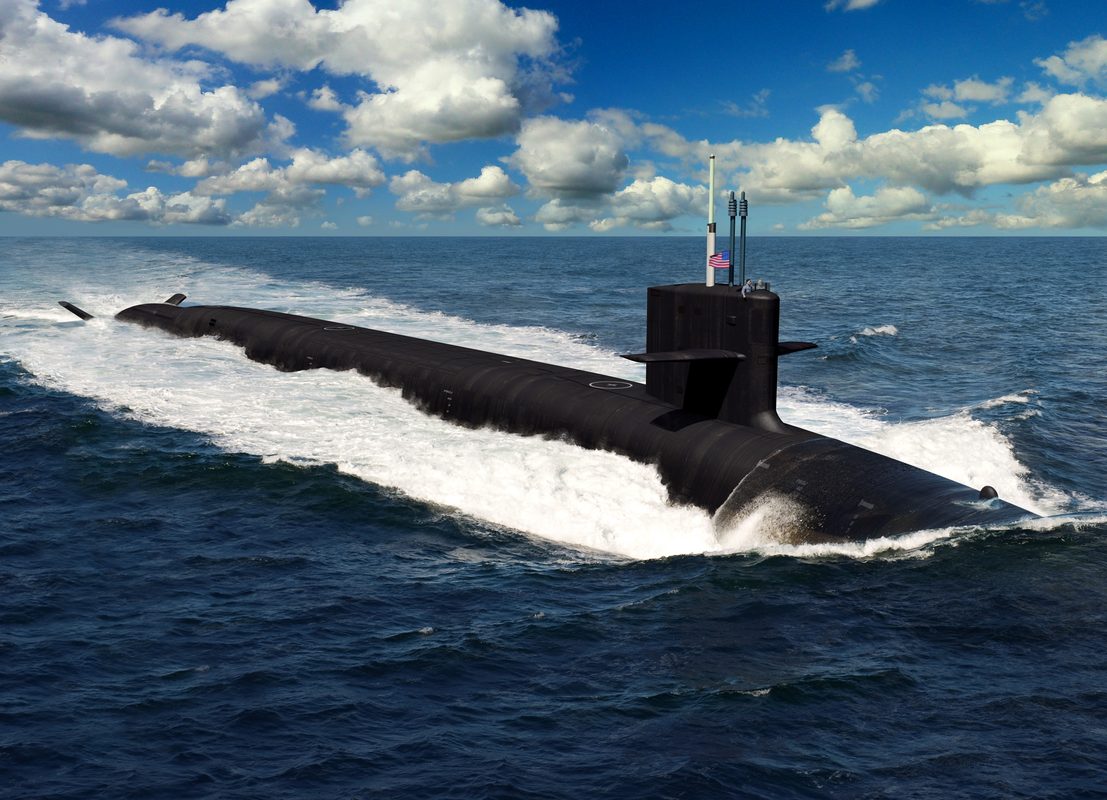
Columbia-class ballistic missile submarine rendering showing the next-generation SSBN design
The Columbia class will replace the Ohio-class SSBNs beginning in the early 2030s, carrying 16 Trident II missiles with a life-of-ship reactor that never needs refueling.

The Ohio class cannot serve forever. The oldest boats are approaching the end of their extended service lives, and the Navy is building the Columbia class to replace them. Twelve Columbia-class submarines will replace 14 Ohio-class SSBNs, fewer boats but with higher availability rates due to a life-of-ship reactor that eliminates the need for a mid-life refueling overhaul that takes an Ohio-class submarine out of service for years.

Each Columbia-class boat will carry 16 Trident II D5LE missiles, four fewer tubes than the Ohio class, a reduction negotiated under arms control agreements. The Columbia is designed with an electric-drive propulsion system that replaces the Ohio's mechanical reduction gears, making it even quieter than its predecessor. The first boat, USS District of Columbia (SSBN-826), is approximately 65% complete but running 16 to 17 months behind schedule. The program carries a total estimated cost of $348 billion across all 12 boats. First deterrent patrol is currently projected for approximately 2031.

The schedule pressure is real. The Navy must begin retiring Ohio-class submarines before the Columbia class is fully operational, which means the transition period will see a temporary reduction in the number of available SSBNs. This is the single most consequential shipbuilding program in the Department of Defense, not because of its cost, but because a gap in submarine-based deterrence cannot be filled by any other system. There is no substitute for an undetectable, survivable, second-strike nuclear platform. If the Columbia class is late, the deterrent weakens. It is that simple.

The SSGN Conversion: A Second Life

Four Ohio-class boats, USS Ohio, Michigan, Florida, and Georgia, were converted from ballistic missile submarines to guided-missile submarines (SSGNs) between 2002 and 2008. Their 24 missile tubes were modified so that 22 tubes now carry up to 7 Tomahawk cruise missiles each, for a total of 154 conventionally armed cruise missiles per submarine. The remaining 2 tubes were converted into lockout chambers for special operations forces. These SSGNs have deployed extensively in support of conventional operations, including strikes against targets in Libya in 2011.

The SSGN conversion gave the Navy a massive conventional strike platform on a hull that was already paid for and still had decades of service life remaining. But the four SSGNs are aging, and there is currently no planned replacement. When they retire in the late 2020s and early 2030s, the Navy will lose 616 Tomahawk launch tubes, a significant reduction in undersea conventional strike capacity.

Forty Years of Nuclear Peace

Since USS Ohio departed on its first deterrent patrol in 1982, no nuclear weapon has been used in conflict. Correlation is not causation, and deterrence theory has no shortage of critics who argue that the system is inherently unstable, that accidents are inevitable, and that the logic of mutually assured destruction is a form of collective insanity. Those criticisms have merit. But the empirical record is what it is: for over four decades, the Ohio class has patrolled the world's oceans carrying enough destructive power to end human civilization, and that power has never been used. The system has worked, not because it is moral, or rational in any human sense, but because it has made the alternative unthinkable.

The Ohio-class submarine is not a weapon that inspires admiration in the way a fighter jet or a tank might. It is a weapon that inspires a particular kind of awe, the recognition that 155 people, operating a 560-foot machine in the darkness of the deep ocean, hold a capability that no individual, no city, and no nation could survive. That is the purpose it was built for. And for 40 years, it has served that purpose by never once needing to fulfill it.

Share this article

Share:

Recommended

Ace of The Skies: Can You Identify These Military Aircraft Throughout The Years?
Test Yourself

Ace of The Skies: Can You Identify These Military Aircraft Throughout The Years?

Can you identify these aircraft?

Take the Quiz

Get Military News & History in Your Inbox

Join thousands of readers receiving our weekly digest of military technology, history, and analysis.

Test Your Knowledge