Skip to content
April 27:The Sinking of the SS Sultana161yr ago

The Stryker Has 10 Variants on One Chassis. Here's How the Army Turns One Vehicle Into an Entire Brigade.

Marcus Webb · · 10 min read
Save
Share:
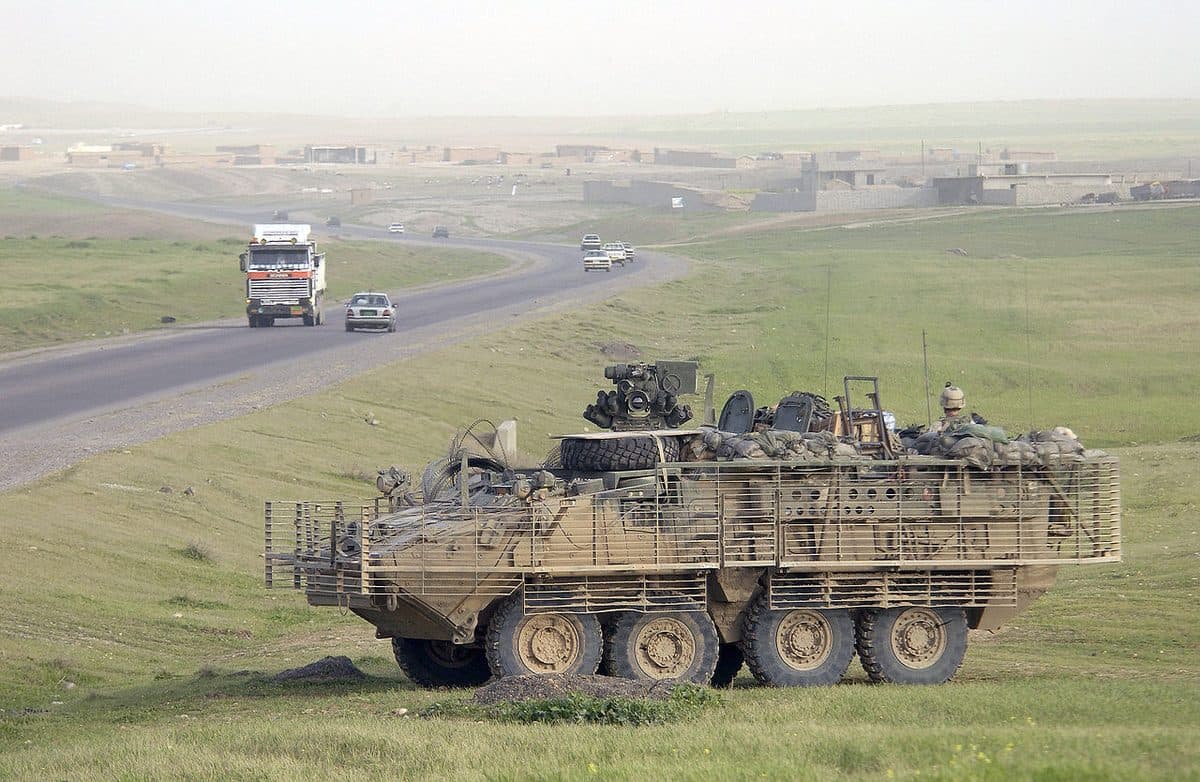
U.S. Army Stryker infantry carrier vehicles on patrol in Iraq with slat armor cages
Marcus Webb
Marcus Webb

Military Vehicles & Ground Systems Contributor

Marcus Webb writes about military ground vehicles, armored platforms, and the logistics of land warfare. His work covers everything from MRAPs and infantry carriers to the training pipelines that keep ground forces operational in contested environments.

Ten completely different military vehicles. One chassis. One engine. One set of spare parts. The Stryker family of vehicles represents one of the most successful modular vehicle programs in modern military history, not because any single variant is the best at what it does, but because the entire family shares a common platform that dramatically simplifies the logistics of keeping a brigade combat team operational in the field.

The concept sounds obvious in retrospect: build one eight-wheeled armored vehicle and adapt it for every role a brigade needs. Infantry carrier. Mobile gun system. Reconnaissance vehicle. Anti-tank platform. Mortar carrier. Medical evacuation. Command post. Engineer squad vehicle. Chemical reconnaissance. Air defense. Ten missions, one chassis, one supply chain.

But the Stryker's path to becoming the backbone of the Army's medium-weight force was anything but straightforward. Critics called it too heavy for rapid deployment and too light for serious combat. Soldiers in Iraq discovered it couldn't survive RPG attacks without improvised armor. The Mobile Gun System variant, which mounted a 105mm cannon on the wheeled chassis, was eventually retired because the recoil was tearing the vehicle apart. The Stryker's story is one of engineering pragmatism, accepting tradeoffs to achieve something more valuable than perfection in any single role.

The Gap Between Light and Heavy

The Stryker exists because the Army had a hole in its force structure. On one end were light infantry divisions, soldiers who could deploy anywhere in the world within 96 hours but who arrived with little more than what they could carry. On the other end were heavy armored divisions, M1 Abrams tanks and Bradley fighting vehicles that could destroy anything on the battlefield but required weeks of sealift and hundreds of support vehicles to deploy.

Between these two extremes was nothing. The Army had no medium-weight force that could deploy faster than heavy armor but arrive with more firepower and protection than light infantry. This gap had been painfully apparent in the 1990s. In Somalia, light infantry was pinned down without armored support. In Kosovo, it took weeks to deploy heavy forces to a crisis that demanded an immediate response.

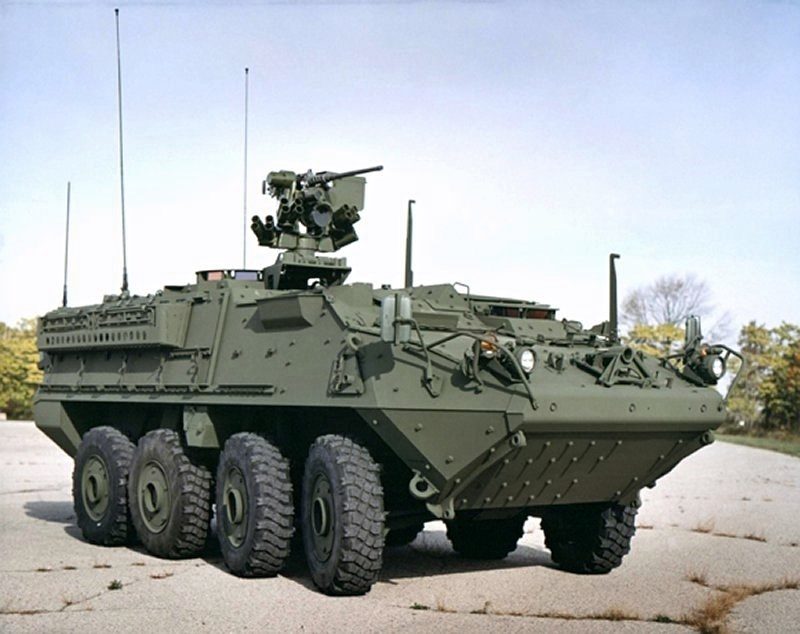
Stryker ICV infantry carrier vehicle front view showing the 8x8 wheeled configuration
The M1126 Stryker Infantry Carrier Vehicle, the baseline variant of the family. The 8x8 wheeled platform provides the common chassis shared across all ten variants.

In 1999, Army Chief of Staff General Eric Shinseki announced the creation of Interim Brigade Combat Teams, later renamed Stryker Brigade Combat Teams, built around a new family of wheeled armored vehicles. The vehicle chosen was based on the Canadian LAV III, an 8x8 platform manufactured by General Dynamics Land Systems. The program was named "Stryker" in honor of two Medal of Honor recipients: Private First Class Stuart Stryker (World War II) and Specialist Four Robert Stryker (Vietnam).

The Ten Variants

Every variant of the Stryker shares the same basic platform: a 20-ton, eight-wheel-drive armored hull powered by a Caterpillar C7 350-horsepower diesel engine. This commonality means that a mechanic trained on one variant can work on any of them. Spare parts are interchangeable. The same tires, the same engine components, the same drivetrain, regardless of what mission module is mounted on top.

The M1126 Infantry Carrier Vehicle (ICV) is the most numerous variant, carrying a nine-soldier infantry squad plus a crew of two. It's the vehicle that defines the Stryker Brigade's core capability: delivering infantry to the fight with enough armor to survive small arms and artillery fragments.

The M1128 Mobile Gun System (MGS) mounted a 105mm cannon in an automated turret, giving Stryker brigades direct-fire support without requiring a tank. The concept was sound, a wheeled vehicle with the firepower of a light tank. In practice, the recoil forces of the 105mm gun stressed the chassis beyond its design limits, and the autoloader was mechanically unreliable. The Army began retiring the MGS in 2022, acknowledging that putting a tank gun on a 20-ton wheeled vehicle had reached the limits of engineering compromise.

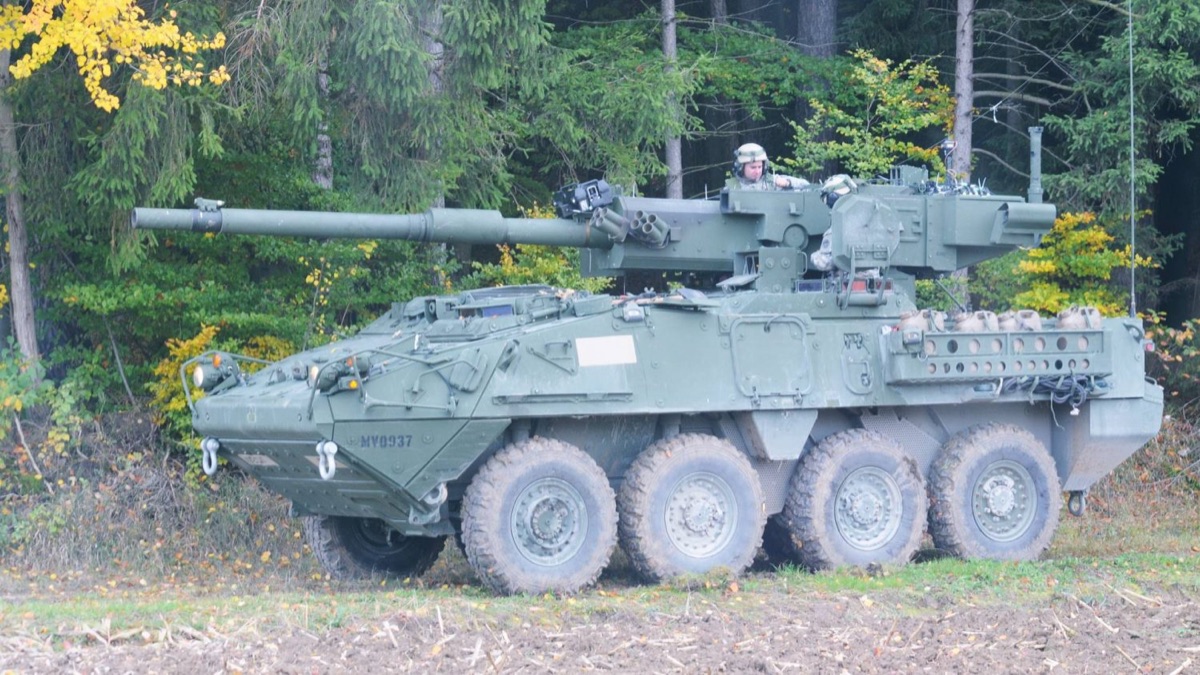
Stryker Mobile Gun System showing the 105mm autoloader mechanism
The M1128 Mobile Gun System's autoloader mechanism. The 105mm cannon provided significant firepower, but the recoil forces pushed the wheeled chassis beyond its design limits, leading to the variant's retirement.

The M1127 Reconnaissance Vehicle (RV) carries a Long-Range Advanced Scout Surveillance System, giving brigade commanders eyes forward of the main body. The M1134 Anti-Tank Guided Missile Vehicle (ATGM) carries a dual TOW missile launcher, providing long-range anti-armor capability. The M1129 Mortar Carrier (MC) carries a 120mm mortar system for indirect fire support.

The M1133 Medical Evacuation Vehicle (MEV) is configured as a mobile treatment platform, capable of carrying four litter patients. The M1130 Commander's Vehicle (CV) serves as a mobile command post with enhanced communications equipment. The M1132 Engineer Squad Vehicle (ESV) carries combat engineers and their equipment, including a mine plow.

The M1135 Nuclear, Biological, Chemical Reconnaissance Vehicle (NBCRV) carries sensors for detecting chemical, biological, radiological, and nuclear contamination, a niche but critical capability in an era of WMD threats.

The SHORAD Revolution

The newest and arguably most important variant is the M-SHORAD (Maneuver Short-Range Air Defense). This variant mounts Stinger missiles, Hellfire missiles, and a 30mm cannon on the Stryker chassis, giving ground units their own air defense capability for the first time in decades.

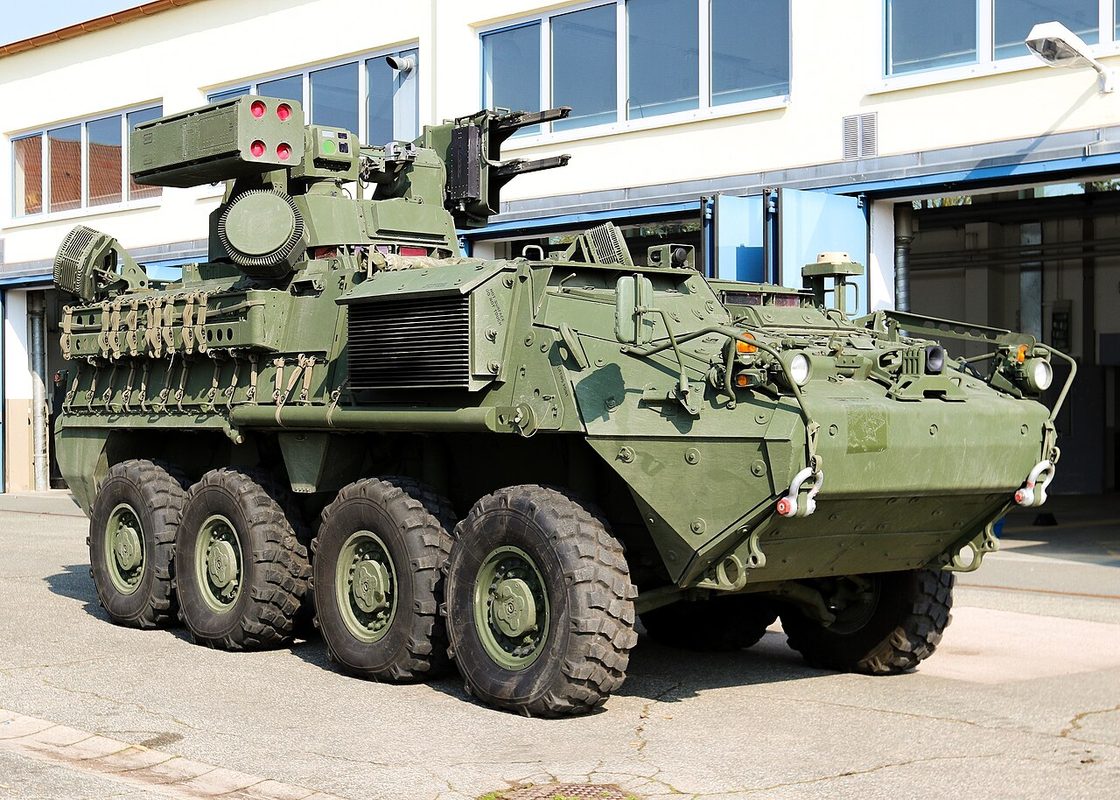
M-SHORAD Stryker air defense variant with Stinger and Hellfire missiles at a training range
The M-SHORAD variant at a training range in Germany, 2023. Equipped with Stinger missiles, Hellfire missiles, and a 30mm autocannon, it restores short-range air defense capability that the Army largely abandoned after the Cold War.

The Army had largely dismantled its short-range air defense capability after the Cold War, operating under the assumption that American air superiority would prevent enemy aircraft from threatening ground forces. The proliferation of combat drones, particularly the devastating effectiveness of Turkish Bayraktar TB2 drones in the 2020 Nagorno-Karabakh war and the widespread use of small drones in Ukraine, forced a rapid reassessment. The M-SHORAD program was accelerated, and the first units were deployed to Europe in 2021.

A directed-energy variant, the DE M-SHORAD, adds a 50-kilowatt laser weapon capable of engaging drones at a fraction of the cost of a missile. Where a Stinger costs roughly $120,000 per shot, the laser costs about $1 per shot in electricity. Against the swarms of cheap drones that have come to dominate modern battlefields, this economics equation changes the calculus of air defense entirely.

Iraq: The Trial by Fire

The Stryker's combat debut came in October 2003, when the 3rd Brigade, 2nd Infantry Division deployed to Mosul, Iraq. The deployment immediately validated the Stryker's core concept, and exposed its most significant vulnerability.

In urban combat, the Stryker proved highly effective. Its wheeled design was faster and quieter than tracked vehicles, allowing units to respond to incidents across the city more rapidly than Bradley-equipped units. The vehicle's relatively low profile and moderate noise signature made it less intimidating in counterinsurgency operations where alienating the civilian population was counterproductive. Soldiers could dismount quickly from the rear ramp, and the vehicle's communications suite allowed platoon leaders to maintain situational awareness across a wide area.

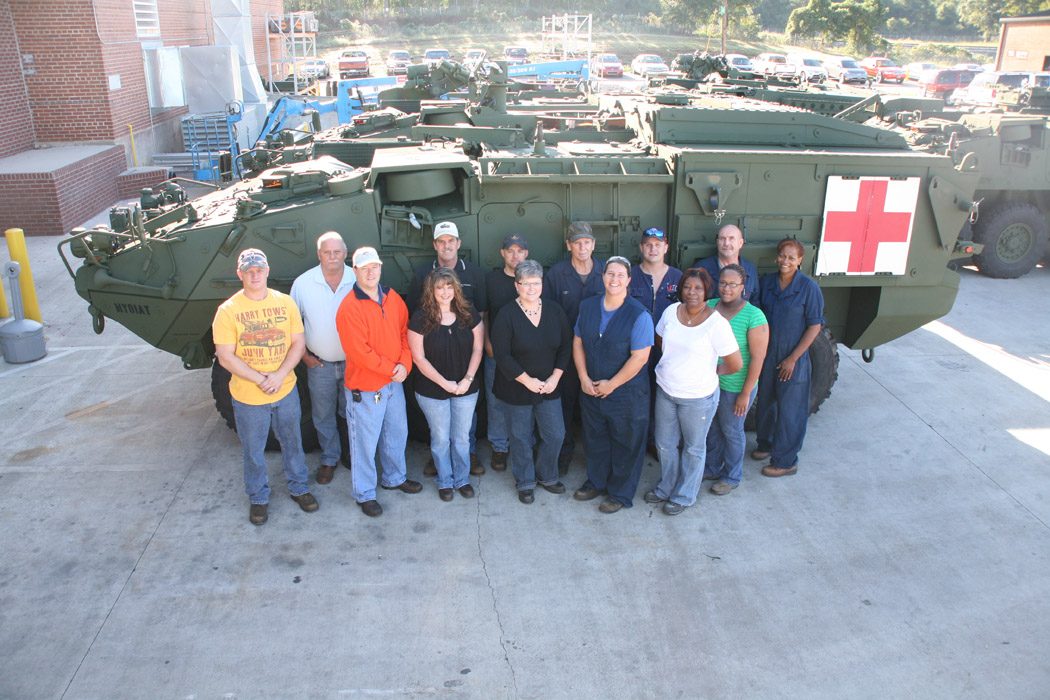
Stryker MEV Medical Evacuation Vehicle variant
The Stryker Medical Evacuation Vehicle (MEV) shares the same chassis as every other variant, meaning mechanics, spare parts, and logistic chains are identical across the entire brigade.

But the Stryker's base armor could not defeat the RPG-7, the ubiquitous anti-armor weapon of Iraqi insurgents. The solution was "slat armor", a cage of steel bars mounted around the vehicle's exterior that detonated RPG warheads before they reached the hull. The slat armor worked, but it added weight, reduced mobility, and looked like a cage on wheels. It was a field modification that became standard, a reminder that no vehicle enters combat exactly as its designers intended.

Over the course of multiple deployments, Stryker brigades compiled a strong combat record. The vehicle's speed, deployability, and versatility proved more valuable in practice than the heavier armor and firepower that critics had demanded. The Stryker was not the best infantry carrier. It was not the best reconnaissance vehicle. It was not the best anything. But it was good enough at everything, and the logistics advantage of a common chassis across the entire brigade proved decisive.

The Logistics Argument That Won

The Stryker's most compelling advantage has nothing to do with combat performance. It's about supply chains.

A conventional brigade combat team might operate M1 Abrams tanks, M2 Bradley fighting vehicles, M109 Paladin howitzers, M113 armored personnel carriers, and various other tracked and wheeled platforms. Each of these vehicles has its own engine, its own transmission, its own track system, its own set of unique parts. A brigade maintenance section has to stock components for half a dozen different vehicle families. Mechanics must be trained on multiple platforms.

A Stryker Brigade Combat Team operates one vehicle family. One engine type. One transmission. One set of tires. One drivetrain. A mechanic who can fix the ICV can fix the ATGM, the mortar carrier, and the command vehicle. The supply chain that delivers parts for one variant delivers parts for all of them. This doesn't just simplify logistics, it transforms them. A Stryker brigade can sustain itself with a smaller logistics footprint than a comparable heavy brigade, which means it can deploy faster and operate further from its supply bases.

More than 4,900 Strykers have been built in all variants. The vehicle is C-130 transportable, a critical requirement for rapid deployment, though in practice, the weight of combat-loaded Strykers with slat armor pushes the limits of what a C-130 can carry. The Army currently operates seven Stryker Brigade Combat Teams, making the Stryker the backbone of its medium-weight force.

The Stryker family is not the most advanced armored vehicle program in the world. Individual variants are outperformed by purpose-built platforms in their respective roles. But the Stryker was never designed to be the best at anything. It was designed to be good enough at everything while being maintainable, deployable, and sustainable with a single supply chain. In a military where logistics determines what's possible, that's an innovation worth more than any single weapon system.

Share this article

Share:

Recommended

Ace of The Skies: Can You Identify These Military Aircraft Throughout The Years?
Test Yourself

Ace of The Skies: Can You Identify These Military Aircraft Throughout The Years?

Can you identify these aircraft?

Take the Quiz

Get Military News & History in Your Inbox

Join thousands of readers receiving our weekly digest of military technology, history, and analysis.

Test Your Knowledge