Charles Bash covers military culture, global defense forces, and the human side of armed services around the world. His work explores how militaries shape the lives of the men and women who serve in them.
In July 2019, the United States formally expelled Turkey from the F-35 Joint Strike Fighter program. The reason was blunt: Turkey had accepted delivery of Russian S-400 air defense missiles, and Washington would not allow its most advanced stealth fighter to operate alongside a system designed to track and kill it. The expulsion cost Turkey access to the most capable fighter jet in NATO's arsenal. But Turkey's response was not to beg for readmission. It was to build its own.
The TAI KAAN (formerly known as the TF-X or MMU) made its maiden flight on February 21, 2024, lifting off from Murted Airfield near Ankara for a thirteen-minute sortie that reached 8,000 feet and 230 knots. That flight was the product of years of ambition, billions of dollars, and a fundamental question that Turkey's defense establishment had been wrestling with since the S-400 crisis: can a NATO ally with no prior experience building stealth aircraft develop a fifth-generation fighter from scratch?
The answer, so far, is a qualified yes, with enormous caveats about engines, timelines, and whether the finished product will match the jet it was designed to replace.
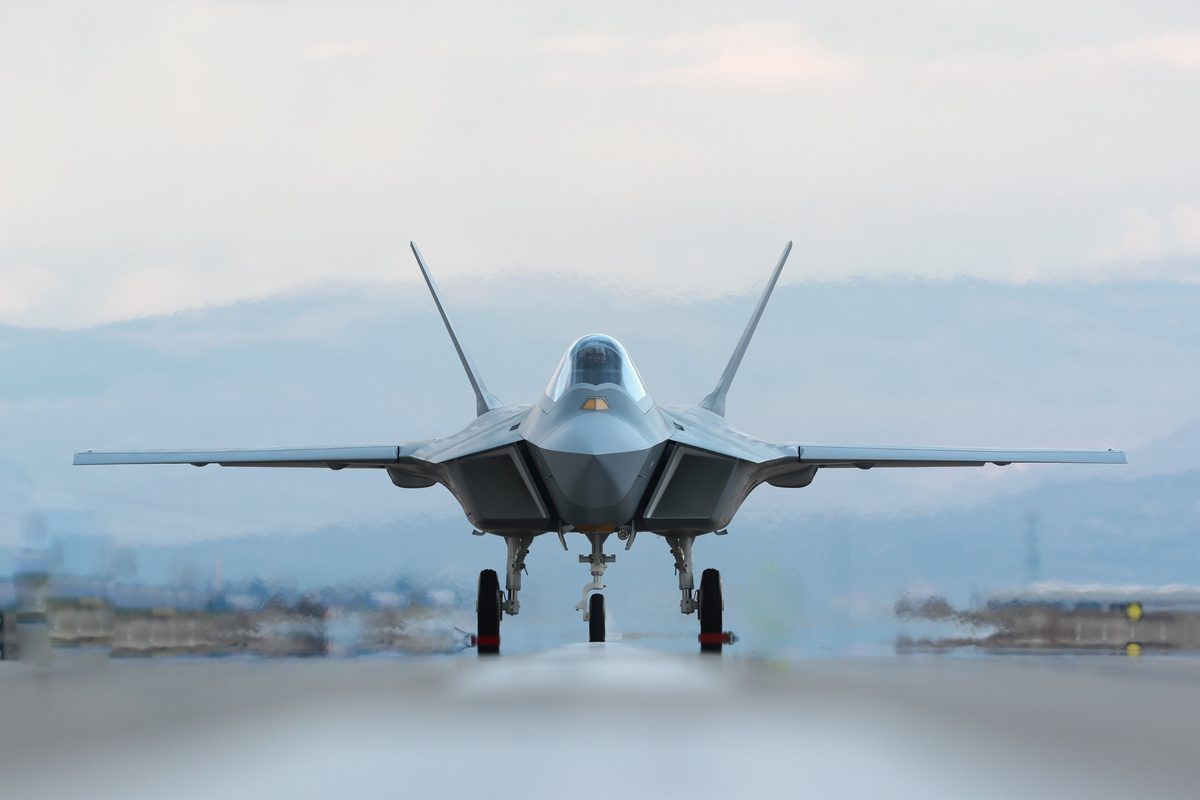
The KAAN prototype during ground testing at TAI's facility near Ankara. The aircraft's twin-engine configuration is immediately apparent, distinguishing it from the single-engine F-35 (TAI photo).
The S-400 Decision That Changed Everything
To understand the KAAN, you have to understand why Turkey bought the S-400 in the first place, a decision that looks increasingly like the most consequential defense procurement choice any NATO ally has made in the 21st century.
Turkey had been seeking a long-range air defense system for over a decade. It evaluated the American Patriot, the European SAMP/T, and the Chinese HQ-9 before settling on Russia's S-400 Triumf. The Russian system offered several advantages: it was cheaper than the Patriot, it came with a technology transfer package that Washington refused to offer, and Moscow was willing to let Turkey operate the system independently rather than linking it into NATO's integrated air defense network.
For Ankara, that last point mattered enormously. Turkey wanted strategic autonomy, the ability to defend its airspace without depending on allied systems controlled from NATO headquarters. The S-400 offered that independence. What it cost was something Turkey's leaders either underestimated or accepted as a calculated trade: access to the F-35.
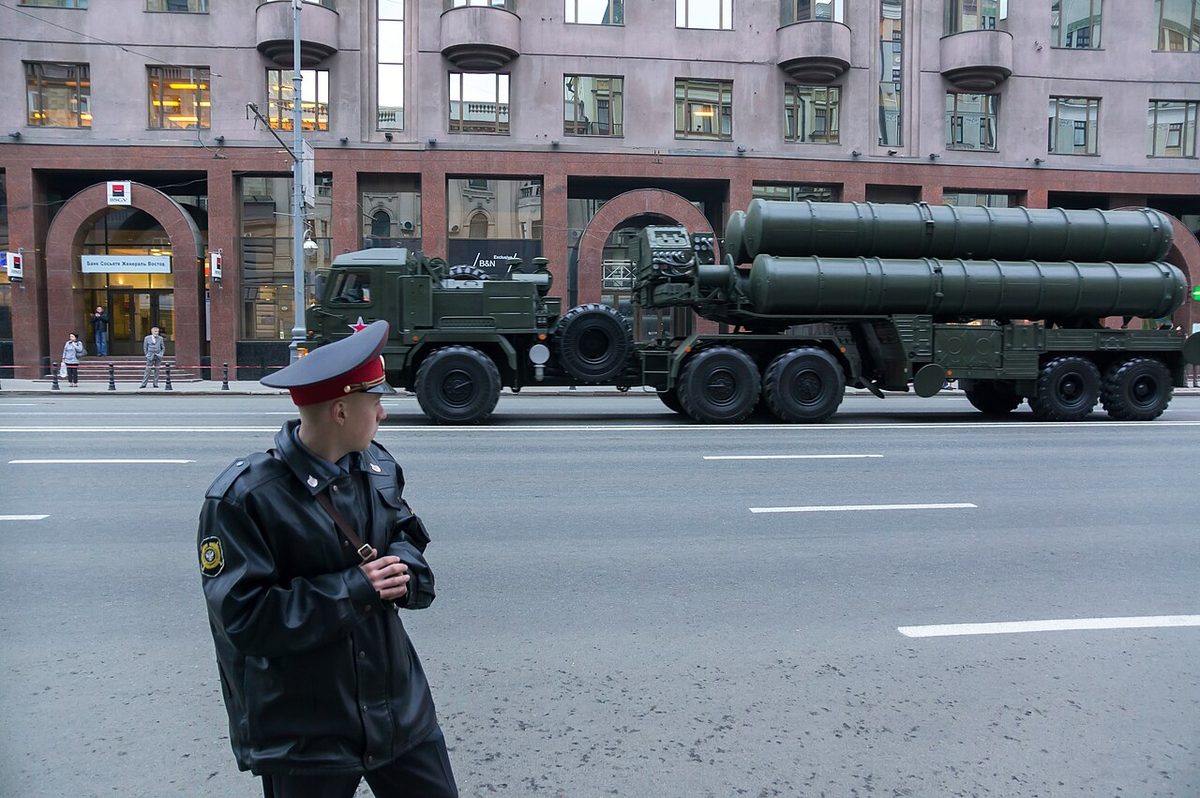
The S-400 Triumf air defense system, the weapon system Turkey chose over the F-35. Its acquisition triggered Turkey's expulsion from the Joint Strike Fighter program (Russian MoD photo).
The American position was unambiguous. The Pentagon argued that the S-400's radar systems could collect data on the F-35's stealth characteristics (its radar cross-section, electronic emissions, and flight profiles) and that this data could be transmitted to Moscow, effectively giving Russia a blueprint for defeating the West's most advanced fighter. Turkey countered that it would operate the S-400 independently and not integrate it with NATO systems. Washington was unconvinced.
The consequences cascaded. Turkey had been a production partner on the F-35, manufacturing around 900 components including center fuselage sections and cockpit displays. Those contracts were terminated. Turkish pilots training on the F-35 at Luke Air Force Base in Arizona were sent home. Turkey's six F-35s, aircraft it had paid for but not yet received, were retained by the United States. CAATSA sanctions followed, targeting Turkey's defense procurement agency.
In a single decision, Turkey lost its seat at the most important military aviation table in the Western alliance. The KAAN is its answer.
What Turkey Is Actually Building
The KAAN is a twin-engine, single-seat stealth fighter designed by Turkish Aerospace Industries (TAI), Turkey's state-owned aerospace manufacturer. In its final operational configuration, the aircraft is expected to reach Mach 1.8, handle +9/-3.5 g maneuvers, and carry a maximum takeoff weight of approximately 35,000 kilograms, making it substantially larger and heavier than the F-35A's 29,000 kilograms.
The twin-engine layout is a deliberate departure from the F-35's single-engine philosophy. Turkey wants a fighter with the raw performance of aircraft like the F-22 Raptor and the Su-57, air superiority platforms that prioritize speed, climb rate, and maneuverability alongside stealth. The F-35 sacrificed some of those attributes for multirole versatility and lower operating costs. Turkey is betting that the next generation of aerial combat will reward performance over economy.
Internal weapons bays are a core design feature. Like all fifth-generation fighters, the KAAN is designed to carry its primary armament internally to preserve its stealth profile. Turkey is developing indigenous weapons specifically for the aircraft, including beyond-visual-range air-to-air missiles and the SOM cruise missile, a standoff weapon Turkey already produces for its F-16 fleet.
The aircraft's sensor suite will center on an AESA (Active Electronically Scanned Array) radar being developed domestically by Aselsan, Turkey's largest defense electronics company. AESA radars are standard equipment on fifth-generation fighters; their electronically steered beams offer better detection range, resistance to jamming, and the ability to track multiple targets simultaneously compared to older mechanically scanned radars.
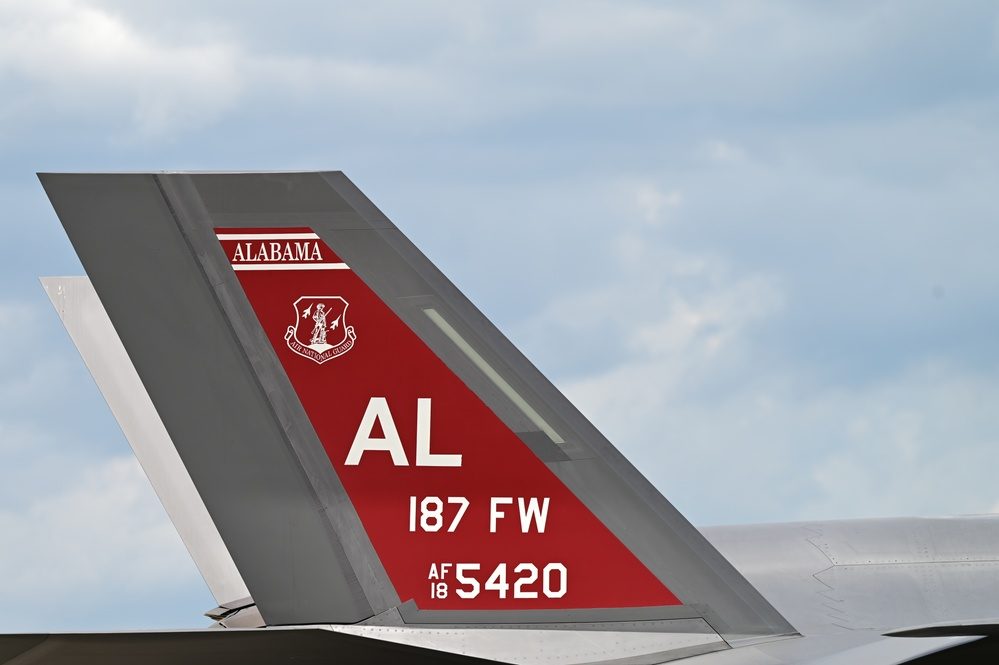
The F-35A Lightning II, the aircraft Turkey was expelled from purchasing. Turkey had planned to buy over 100 F-35s before the S-400 crisis ended its participation in the program (U.S. Air Force photo).
The Engine Problem
Every honest assessment of the KAAN program must address the elephant in the hangar: engines. Turkey does not yet have a domestic engine capable of powering the KAAN to its full operational specifications.
The initial prototypes and early production aircraft will fly with General Electric F110 turbofan engines, the same powerplant used in Turkey's existing F-16 fleet. The F110 is a proven, reliable engine, but it was designed for a fourth-generation fighter. It does not produce the thrust needed for supercruise (sustained supersonic flight without afterburners), a capability that most fifth-generation fighters are expected to achieve.
Turkey's solution is the TEI TF-10000, a turbofan engine being developed by TEI (Tusas Engine Industries) with the eventual goal of powering the KAAN's full-rate production aircraft. Turkish officials have stated that the indigenous engine should be ready after 2030, allowing the KAAN to achieve its full performance envelope.
The timeline is ambitious. Developing a modern turbofan engine from scratch is arguably harder than designing the airframe it powers. Only a handful of countries (the United States, Russia, Britain, France, and China) have successfully developed engines for fifth-generation fighters. Even China, with vastly greater resources, struggled for years with the WS-15 engine for its J-20 stealth fighter.
Turkey's reliance on the American-made F110 also creates an uncomfortable dependency. The very program designed to assert Turkish defense independence relies, at least initially, on an American engine. If Washington decided to restrict F110 exports to Turkey, a scenario that is not impossible given the ongoing tensions over the S-400, the KAAN program could face a crisis.
KAAN vs. F-35: An Honest Comparison
The inevitable comparison is to the F-35, the jet Turkey was supposed to buy. But comparing the KAAN to the F-35 is complicated, because the two aircraft are designed around fundamentally different philosophies.
The F-35 is a sensor platform first, a fighter second. Its greatest advantage is not raw performance but its ability to fuse information from multiple sensors and data links into a unified picture of the battlespace, then share that picture with every friendly platform in the network. The F-35's sensor fusion and networking capabilities are the product of decades of American investment in software, data architecture, and coalition interoperability.
Hobby shops have been handing this kit to first-time aircraft builders for over a decade. Around 90 parts, Tamiya's trademark tight fit, and 308 verified reviews at 4.6 stars.
The KAAN, at least in its initial configuration, will not match the F-35's sensor fusion. Turkey does not have decades of experience integrating complex sensor suites, and the software development required to match Lockheed Martin's capabilities is arguably as challenging as the hardware. What the KAAN may offer is better kinematic performance, including more speed, more thrust, and potentially better air-to-air maneuvering, thanks to its twin-engine layout and larger size.
Stealth is another question mark. The KAAN's external shaping follows fifth-generation design principles: canted vertical stabilizers, blended wing-body design, internal weapons carriage, and radar-absorbent materials. But the degree of radar cross-section reduction depends heavily on manufacturing precision, materials science, and edge treatments, areas where Turkey has no prior production experience. The F-35's stealth was refined over decades of American low-observable technology development stretching back to the F-117 Nighthawk in the 1970s.
The most realistic assessment is that the KAAN will be a capable aircraft, better than any fourth-generation fighter in Turkey's inventory, but unlikely to match the F-35 in the areas that matter most: sensor integration, stealth maturity, and network-centric warfare capabilities. Turkey is building a very good jet. Whether it is building a great one remains to be seen.
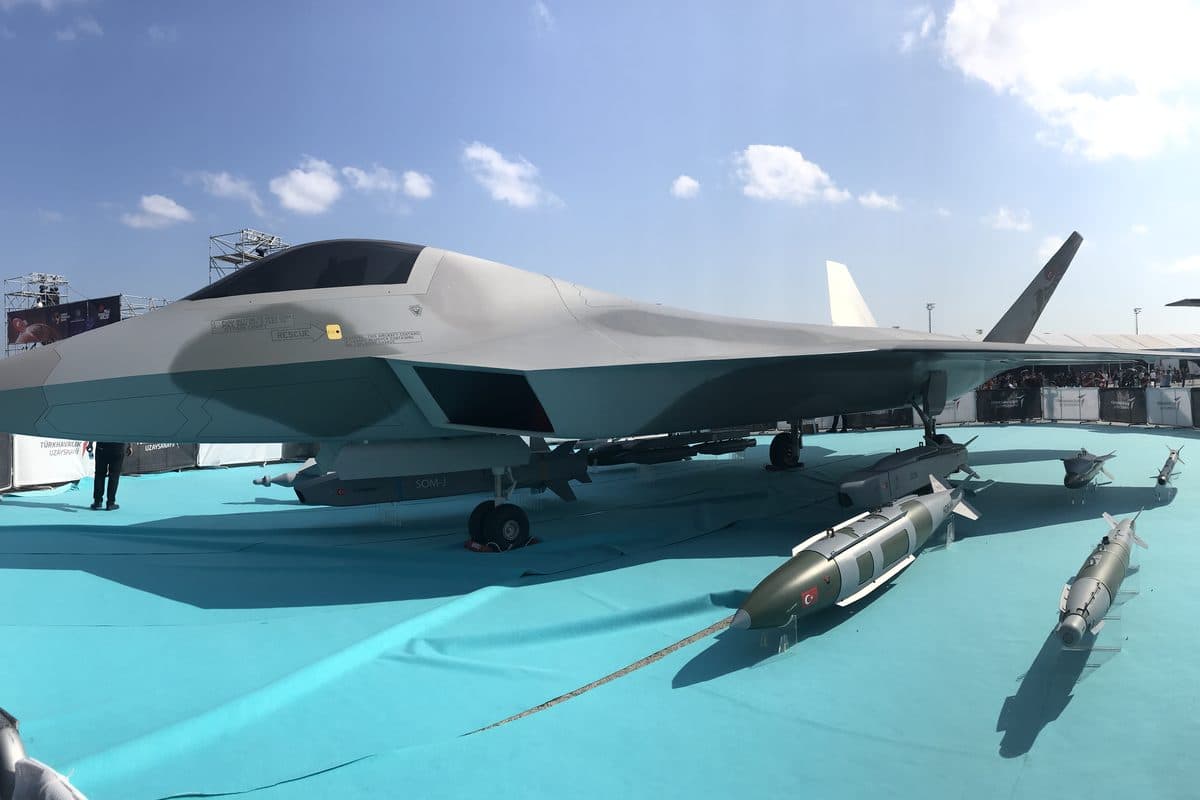
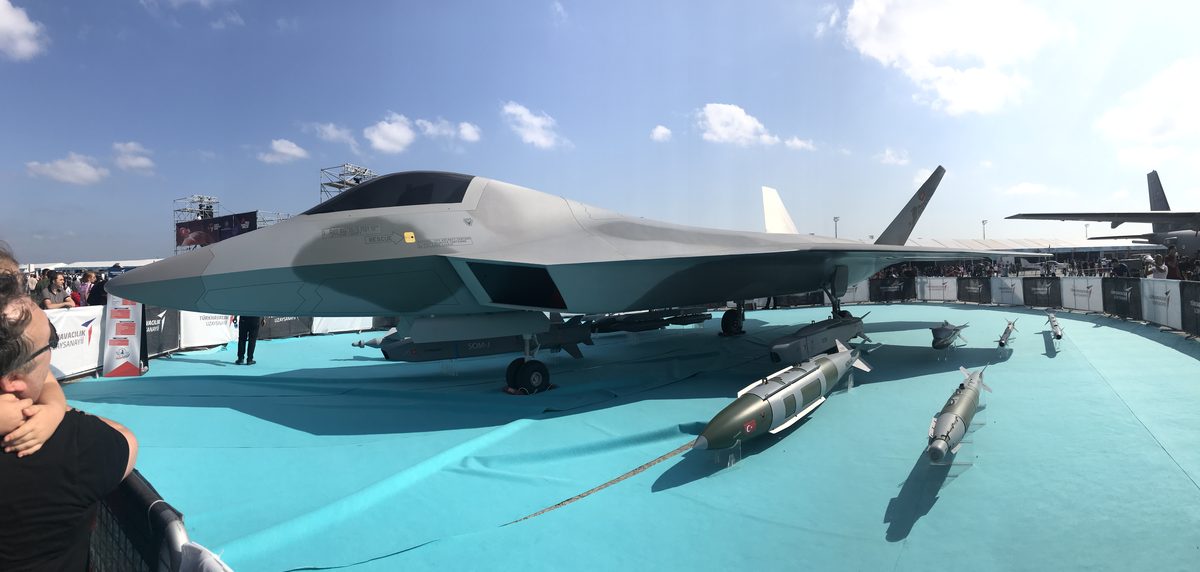
A full-scale KAAN mockup at Turkey's Teknofest technology festival. The aircraft's angular design and canted stabilizers reflect fifth-generation stealth principles (TAI photo).
Export Ambitions and the $10 Billion Indonesia Deal
Turkey is not building the KAAN solely for its own air force. From the program's inception, export sales have been a central part of the business case. A fighter that only Turkey buys will be prohibitively expensive per unit. A fighter that also sells to Pakistan, Indonesia, Malaysia, and Gulf states can spread development costs across a much larger production run.
The most significant export development to date is the reported $10 billion deal with Indonesia for 48 KAAN aircraft. If finalized, this would represent Indonesia's largest defense procurement in history and would establish the KAAN as a viable competitor in the international fighter market.
Pakistan is another key potential customer. Representatives from Turkish and Pakistani defense industries finalized partnership plans at the 2025 Pak-Turkish Industrial Expo, and Pakistan, which has historically been blocked from acquiring American fighters due to geopolitical tensions, represents a natural market for a non-American stealth fighter.
The export market for the KAAN is essentially nations that want fifth-generation capability but cannot buy American. That market is larger than Washington might prefer. Countries subject to U.S. arms export restrictions, or those unwilling to accept the political conditions attached to American weapons sales, represent a substantial customer base. Turkey is positioning the KAAN as the stealth fighter for nations that want independence from American defense dependency, a message that resonates in capitals from Jakarta to Islamabad to Riyadh.
The Bigger Picture: Turkey's Defense Independence Push
The KAAN is the most visible element of a broader transformation in Turkey's defense industry. Over the past decade, Turkey has systematically reduced its dependence on foreign weapons systems, building an indigenous defense sector that now exports everything from armed drones to armored vehicles to naval platforms.
The Bayraktar TB2 drone became Turkey's most famous defense export, proving its effectiveness in Libya, Syria, Nagorno-Karabakh, and Ukraine. Turkish warships built by local shipyards are competing for contracts from Pakistan to Malaysia. Aselsan's electronic systems equip platforms across multiple continents.
This defense industrial push is driven by practical experience. Turkey has been burned repeatedly by arms embargoes: from the United States after its 1974 intervention in Cyprus, from Germany over operations in Syria, and from Canada over drone exports to conflict zones. Each embargo reinforced the same lesson: a country that depends on foreign suppliers for critical weapons systems can be disarmed by the stroke of a foreign politician's pen.
The KAAN represents the apex of this philosophy. If Turkey can build its own stealth fighter, it will never again face the humiliation of being expelled from a program like the F-35. Whether the finished aircraft matches the performance of American or Chinese fifth-generation fighters is almost secondary to the strategic statement it makes: Turkey does not need anyone's permission to arm itself.
The timeline remains aggressive. TAI has completed the assembly of a third prototype as of early 2026, with first deliveries to the Turkish Air Force targeted for late 2028. Whether Turkey meets that deadline will depend heavily on engine development, test flight progress, and the inevitable engineering challenges that every first-generation stealth program encounters. But the trajectory is clear. Turkey is building a stealth fighter. The only question is how good it will be when it arrives.