Skip to content
May 2:The Fall of Berlin: Soviet Forces Capture the Nazi Capital81yr ago

Type 055 vs Arleigh Burke: China Built a Destroyer That Outguns America's Most Proven Warship

Nathan Cole · · 13 min read
Save
Share:
Chinese Type 055 destroyer Nanchang sailing at sea
Nathan Cole
Nathan Cole

Naval Warfare & Maritime Systems Analyst

Nathan Cole covers naval warfare, maritime strategy, and the ships and submarines that project power across the world's oceans. His work focuses on fleet architecture, carrier operations, and how navies adapt to threats from missiles, drones, and undersea warfare.

For over three decades, the Arleigh Burke-class destroyer has been the backbone of American naval power. With more than seventy ships built and an Aegis combat system that has no true peer, the Burke has earned its reputation as the most capable and most combat-proven surface combatant in the world. Then China launched the Type 055.

Designated a "destroyer" by the People's Liberation Army Navy but reclassified as a "cruiser" by the Pentagon, because calling a 13,000-ton warship with 112 vertical launch cells a "destroyer" would mean admitting that China's destroyers are now bigger and more heavily armed than anything in the U.S. Navy's surface fleet. The Type 055 Renhai-class represents a new era in naval warfare, one where the United States no longer holds an automatic advantage in per-ship firepower.

The comparison between these two warships matters because it reveals where China has caught up, where America still leads, and where the balance of naval power in the Pacific is heading.
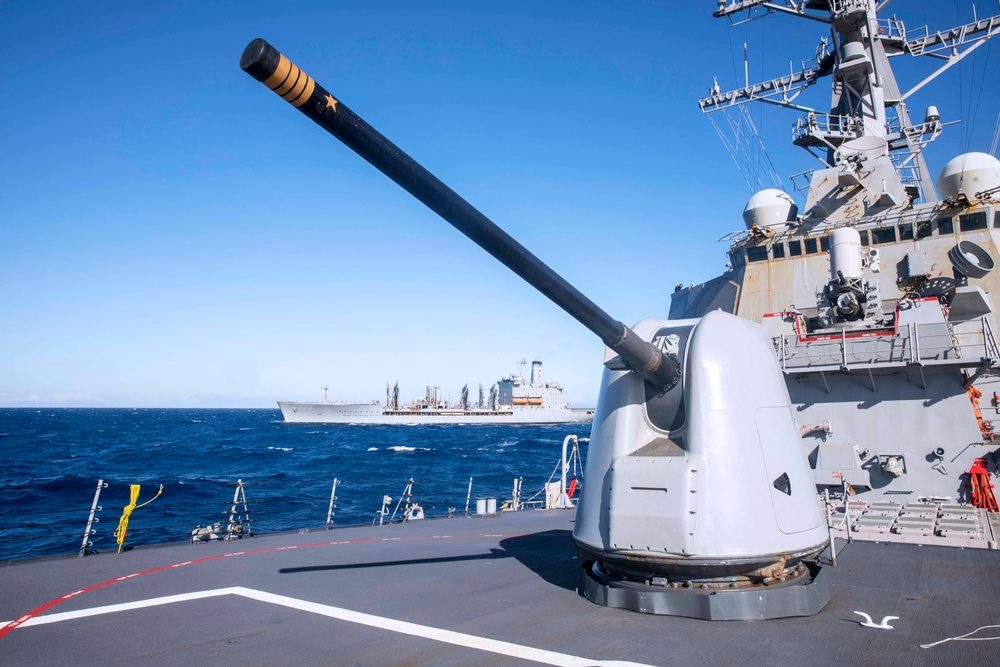
USS Arleigh Burke guided-missile destroyer underway in the Mediterranean Sea
USS Arleigh Burke (DDG-51) underway. More than seventy Burke-class destroyers have been built since 1991, making it the most numerous surface combatant class in any major navy (U.S. Navy photo).

The Numbers at a Glance

Specification Type 055 Renhai Arleigh Burke Flight III
Displacement ~13,000 tons (full load) ~9,800 tons (full load)
Length 180 m (590 ft) 154 m (505 ft)
VLS Cells 112 96
Primary Radar Dual-band (S-band + X-band) AN/SPY-6(V)1 AMDR (S-band)
Anti-Ship Missiles YJ-18, YJ-21 (hypersonic) SM-6 (dual-role), Tomahawk
SAMs HHQ-9B SM-2, SM-3, SM-6, ESSM
Speed 30+ knots 30+ knots
Ships Built/Planned 8 (9th fitting out) 70+ (production ongoing)
First Commissioned 2020 1991 (Flight III from 2023)
Primary Role Carrier escort, area defense Multirole, BMD, carrier escort

The VLS Gap: 112 vs. 96 and Why It Matters

The vertical launch system cell count is the most frequently cited number in this comparison, and for good reason. VLS cells are the measure of a modern warship's striking power. Each cell can hold a surface-to-air missile, a land-attack cruise missile, an anti-submarine rocket, or an anti-ship missile. More cells means more firepower, more flexibility, and more staying power in a sustained engagement.

The Type 055's 112 cells versus the Burke's 96 cells represents a 17 percent advantage in raw capacity. But the gap is potentially larger than the numbers suggest, because the Chinese VLS cells are physically bigger than the American Mk 41 launchers. The Type 055's universal VLS cells are deeper and wider, capable of accommodating larger missiles, including the YJ-21, a hypersonic anti-ship ballistic missile that cannot fit in a standard Mk 41 cell.

This size difference matters tactically. The Burke can quad-pack ESSM (Evolved SeaSparrow Missiles) into a single Mk 41 cell, effectively increasing its self-defense missile count. But it cannot carry the largest land-attack or anti-ship weapons without dedicated cells. The Type 055's larger cells give it more flexibility to mix heavy strike weapons with area defense missiles without the packaging compromises that constrain the Burke.

Missile operations aboard a U.S. Navy warship
Operations aboard a U.S. Navy warship. The Mk 41 Vertical Launch System has been the standard for American surface combatants since the 1980s, but its size limits the weapons it can carry (U.S. Navy photo via DVIDS).

Radar and Sensors: Different Philosophies

If VLS cells measure striking power, radar measures awareness, and this is where the comparison gets more nuanced than the firepower gap suggests.

The Type 055 employs a dual-band radar system with both S-band and X-band arrays integrated into its superstructure. Dual-band radar offers theoretical advantages: the S-band provides long-range volume search and tracking, while the X-band delivers precise fire control and target discrimination. By combining both, the Type 055 can detect targets at long range and guide weapons with high accuracy using a single integrated system.

The Arleigh Burke Flight III carries the AN/SPY-6(V)1 AMDR (Air and Missile Defense Radar), a next-generation S-band AESA radar that represents a generational leap over the SPY-1D that equipped earlier Burke flights. The SPY-6 offers dramatically improved sensitivity and discrimination (Raytheon claims it is 35 times more sensitive than SPY-1D), with the ability to simultaneously perform area air defense, ballistic missile defense, and horizon search functions.

The critical difference is maturity and integration. America's Aegis combat system, the software backbone that processes radar data and coordinates weapon engagements, has been continuously refined through four decades of operational service, dozens of live-fire exercises, and actual combat deployments in the Red Sea, the Persian Gulf, and the Pacific. China's equivalent combat management system, while technically sophisticated, has never been tested in combat.

Radar hardware can be evaluated on paper. Combat system performance can only be proven under fire. That distinction heavily favors the Burke.

Anti-Ship Capability: China's Decisive Advantage

If there is one area where the Type 055 holds an unambiguous advantage, it is anti-ship warfare. China has invested heavily in weapons designed to sink American warships, and the Type 055 carries the most capable ship-launched anti-ship missile suite in the world.

The YJ-18 is a subsonic cruise missile that accelerates to Mach 3 in its terminal phase, a flight profile designed to give defenders minimal reaction time. With an estimated range of 540 kilometers, it outranges most American ship-launched anti-ship weapons.

The YJ-21, reportedly deployed on Type 055 destroyers, is a hypersonic anti-ship ballistic missile, a weapon class the United States does not yet field on any surface combatant. Traveling at speeds exceeding Mach 5 in a maneuvering trajectory, the YJ-21 is designed to overwhelm shipboard defenses that were engineered to counter subsonic and supersonic threats, not hypersonic ones.

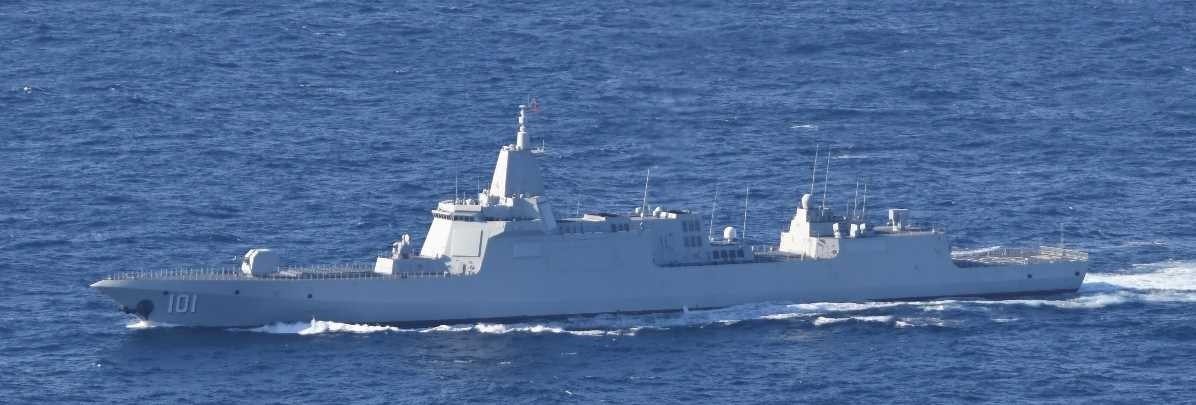
Type 055 Renhai-class destroyer at sea viewed from an elevated angle
A Type 055 destroyer at sea. The ship's clean, low-profile superstructure integrates its dual-band radar arrays for reduced radar cross-section (PLA Navy photo).

The Arleigh Burke's anti-ship options are less specialized. The SM-6 can function in an anti-ship role using its active radar seeker, but it was designed primarily as an air defense missile. The Harpoon, carried by some Burkes, is a subsonic missile designed in the 1970s that lacks the range and speed to challenge modern warship defenses. The Navy is integrating the Maritime Strike Tomahawk for long-range anti-ship capability, but the Tomahawk is subsonic and relies on mid-course targeting updates that may be difficult to sustain in a contested electromagnetic environment.

This gap reflects decades of strategic priorities. During the post-Cold War era, the U.S. Navy faced no credible surface threat and focused its weapons development on air defense, ballistic missile defense, and land-attack. China, facing the world's most powerful navy, focused relentlessly on anti-ship weapons. The Type 055 embodies that focus.

Where the Burke Still Leads

Raw firepower comparisons favor the Type 055, but warfare is not a spreadsheet exercise. The Arleigh Burke retains significant advantages that do not show up in specification tables.

Combat experience. Burke-class destroyers have conducted real-world air defense operations in the Red Sea against Houthi missiles and drones, launched Tomahawk strikes against targets in Syria and Iraq, and performed ballistic missile defense patrols in the Western Pacific. The Type 055 has conducted exercises but has never fired a weapon in anger. The difference between peacetime capability and wartime performance is not trivial.

The Aegis ecosystem. The Burke does not fight alone. It operates within an integrated network that links every Aegis-equipped ship, E-2D Hawkeye airborne early warning aircraft, F-35 fighters, and land-based sensors into a cooperative engagement capability (CEC) that allows any platform in the network to target and fire using any other platform's sensor data. This network effect multiplies the Burke's combat power in ways that are difficult to quantify but decisive in practice.

Ballistic missile defense. The Burke Flight III, equipped with SM-3 and SM-6 interceptors, provides the at-sea component of America's ballistic missile defense architecture. The Type 055's BMD capability, if it exists, remains undemonstrated.

Numbers. The U.S. Navy has over seventy Burkes with more under construction. China has eight Type 055s with a ninth fitting out. In any sustained conflict, quantity has a quality all its own. The Type 055 may be the better ship one-on-one, but the Burke fleet's mass represents a strategic advantage that no single-class comparison can capture.

Arleigh Burke-class destroyer viewed from above while underway
An Arleigh Burke-class destroyer underway. The class has been in continuous production for over three decades, a testament to its adaptability and the U.S. Navy's reliance on its capabilities (U.S. Navy photo).

What the Comparison Really Tells Us

The Type 055 vs. Arleigh Burke comparison is ultimately a proxy for a larger question: has the era of uncontested American naval supremacy ended?

The answer is yes, at least in terms of per-ship capability. China has demonstrated the industrial capacity and technical sophistication to build warships that match or exceed American surface combatants in specific dimensions. The Type 055 carries more missiles, in bigger cells, with hypersonic anti-ship weapons that the U.S. Navy cannot yet match afloat. That is a factual statement, not speculation.

But naval warfare has never been decided by comparing individual ships. It is decided by fleets, networks, logistics, training, leadership, and the willingness to absorb losses and continue fighting. In those dimensions, the United States retains advantages that decades of Chinese investment have not yet erased. The Aegis combat system and its cooperative engagement architecture represent forty years of integration, testing, and refinement. The U.S. Navy's global basing network enables sustained operations far from home waters. And the Burke fleet's sheer numbers provide a strategic depth that no single class of Chinese warships can match.

The Type 055 is a warning, not a verdict. It signals that China is building a navy designed to win fights, not just show the flag. The United States is responding with the DDG(X) next-generation destroyer program and the ongoing Flight III Burke production run. Whether these programs can maintain the qualitative edge that has defined American naval power since World War II depends not just on technology, but on shipbuilding capacity, industrial strategy, and strategic focus.

The 112-to-96 VLS gap is real. What matters is whether America's advantages in networks, experience, and mass remain enough to compensate for it.

There is also a production dimension that often gets overlooked. China's shipbuilding capacity now exceeds America's by a factor that the Pentagon finds alarming. Chinese shipyards can build surface combatants faster and cheaper than their American counterparts, which means the current Type 055 fleet of eight ships is not the final number. It is the beginning. If China can sustain its shipbuilding pace while the U.S. Navy struggles with industrial base constraints, the numerical advantage that currently favors the Burke fleet may narrow or disappear within a decade.

The Type 055 vs. Arleigh Burke comparison is not really about two ships. It is about two navies, two industrial bases, and two visions of how wars at sea will be fought in the 2030s. One side is betting on mass, modern weapons, and a defensive posture in its own waters. The other is betting on networks, experience, and the ability to project power across oceans. The answer to which approach prevails may define the strategic balance of the century.

For more on the platforms that define modern naval power, see our detailed profiles of the Arleigh Burke-class destroyer and the Type 055 Renhai-class. For how these ships fit into broader naval strategy, explore our analysis of the world's best attack submarines.

Share this article

Share:

Recommended

Ace of The Skies: Can You Identify These Military Aircraft Throughout The Years?
Test Yourself

Ace of The Skies: Can You Identify These Military Aircraft Throughout The Years?

Can you identify these aircraft?

Take the Quiz

Get Military News & History in Your Inbox

Join thousands of readers receiving our weekly digest of military technology, history, and analysis.

Test Your Knowledge