
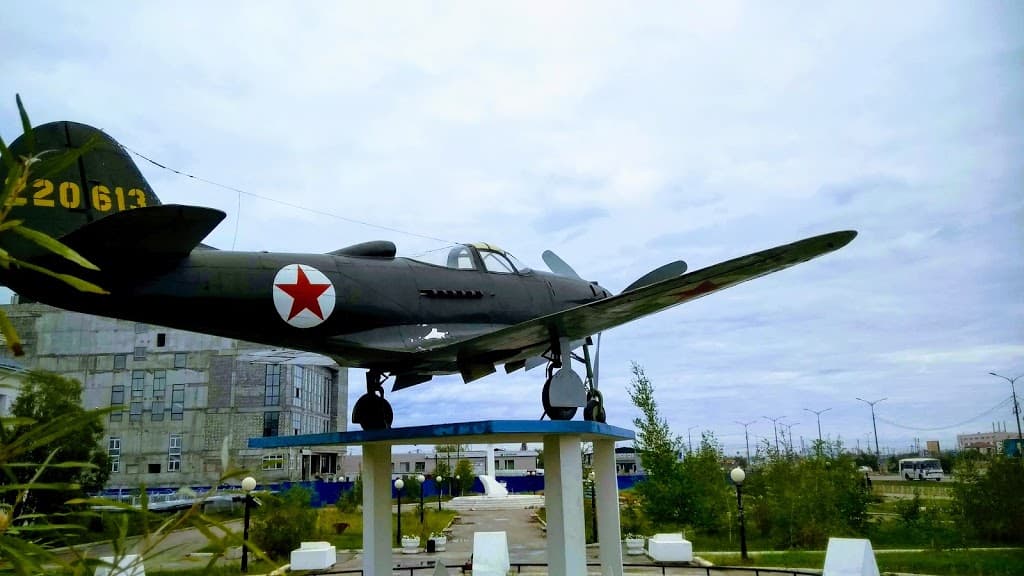
Bell P-39N Airacobra
Bell Aircraft
How does the P-39N stack up?
CompareOverview
The Bell P-39 Airacobra was one of the most unconventional fighters of World War II, featuring a mid-mounted engine behind the pilot, tricycle landing gear, and a 37mm cannon firing through the propeller hub. While the Airacobra was considered inadequate by the USAAF and RAF for high-altitude combat over Western Europe, it found its true calling on the Eastern Front, where Soviet pilots turned it into one of the most feared fighters of the war.
The P-39's unusual layout placed the Allison V-1710 engine behind the cockpit with a long driveshaft running beneath the pilot's feet to the propeller. This arrangement concentrated the aircraft's weight near the center of gravity, giving it excellent handling qualities and making it a superb gun platform. The 37mm nose cannon, while slow-firing, was devastating against both aircraft and ground targets. The tricycle landing gear provided much better ground handling than conventional tail-draggers.
Of the 9,588 Airacobras produced, nearly 5,000 were sent to the Soviet Union under Lend-Lease, where they became the mount of many of the USSR's greatest aces. Soviet pilots, who typically fought at low and medium altitudes on the Eastern Front, loved the P-39 for its maneuverability, its cannon armament, and the protection the rear engine provided against frontal attack.
Performance Profile
Max Speed
376 mph
at 9,500 ft
Range
750 miles
normal
Service Ceiling
35,000 ft
Rate of Climb
2,600 ft/min
Armament
7 guns
1x 37mm, 2x .50 BMG, 4x .30 cal
Crew
1
Engine
Allison V-1710-85
1200 hp inline
Development History
The XP-39 was designed by Bell Aircraft's Robert Woods and Harland Poyer to meet a 1937 Army Air Corps circular proposal for a high-altitude interceptor. The original prototype, which first flew on April 6, 1938, featured a turbocharger and demonstrated outstanding performance at altitude, reaching 390 mph at 20,000 feet. However, the NACA (predecessor to NASA) recommended removing the turbocharger and engine-driven supercharger in favor of a single-stage, single-speed supercharger to reduce weight and drag.
This fateful decision crippled the P-39's high-altitude performance. Without the turbocharger, the Allison engine lost power rapidly above 15,000 feet, making the aircraft uncompetitive at the altitudes where European air combat typically occurred. The RAF received 675 Airacobra Is but quickly rejected them after disappointing combat trials, diverting most to the Soviet Union.
Bell continued to improve the design through numerous variants. The P-39N, one of the most-produced models, featured the V-1710-85 engine with 1,200 hp, improved propeller, reduced weight through lighter armor and smaller fuel tanks, and better combat performance. The subsequent P-39Q added two underwing .50-caliber gun pods in place of the four .30-caliber wing guns, simplifying maintenance and improving firepower.
Despite its limitations in the high-altitude European air war, the P-39 was well-suited to the low-altitude combat that characterized the Eastern Front, the Mediterranean, and the Southwest Pacific. Bell produced over 9,500 Airacobras, making it one of the most-produced American fighters, even though its most effective service was with a foreign air force.
Combat History
The P-39 saw its first American combat in the Pacific, where the 8th, 35th, and 36th Fighter Groups flew Airacobras in the desperate early battles over New Guinea and Guadalcanal in 1942. The aircraft performed adequately at the low altitudes typical of Pacific combat but was gradually replaced by P-38s and P-47s as they became available. The 347th Fighter Group operated P-39s in the Solomons, where First Lieutenant Bill Fiedler scored the type's first aerial victory.
In North Africa, P-39s of the 81st and 350th Fighter Groups flew ground-attack and escort missions during the Tunisian campaign. The aircraft's 37mm cannon proved effective against ground targets, but the P-39 was clearly outperformed by the Bf 109F and G at medium and high altitudes. In the Mediterranean, Airacobras continued in the ground-attack role through the Italian campaign.
The P-39's greatest combat success came on the Eastern Front. Soviet pilots received nearly 5,000 Airacobras under Lend-Lease and used them to devastating effect. Aleksandr Pokryshkin, the second-highest-scoring Allied ace with 59 victories, scored 48 of his kills in P-39s. Grigory Rechkalov scored all 56 of his victories in the Airacobra. Soviet pilots valued the aircraft's maneuverability at low altitude, its heavy nose cannon for head-on attacks, and the engine placement that shielded the pilot from frontal fire. The P-39 equipped many elite Soviet Guards fighter regiments and was considered one of the most effective fighters on the Eastern Front.
The Airacobra's Soviet service revealed that an aircraft dismissed by one air force could become a prized weapon in different tactical circumstances. The low-altitude, close-quarters combat of the Eastern Front played perfectly to the P-39's strengths while minimizing its high-altitude weakness.
Variants
| Designation | Key Differences | Produced |
|---|---|---|
| P-39D | First major USAAF variant, self-sealing tanks, 37mm M4 cannon, four .30 cal wing guns | 923 |
| P-39N | V-1710-85, Aeroproducts propeller, reduced weight, most-produced single variant | 2,095 |
| P-39Q | Two underwing .50 cal pods replaced four .30 cal wing guns, final and most-produced overall variant | 4,905 |
| P-400 | Export model originally for RAF (20mm Hispano cannon), diverted to USAAF in Pacific | 675 |
| P-63 Kingcobra | Enlarged derivative with laminar-flow wing, 1,325 hp engine, mostly Lend-Lease to USSR | 3,303 |
Strengths & Weaknesses
+Strengths
- Devastating 37mm nose cannon effective against both aircraft and ground targets
- Mid-engine layout provided excellent handling and made it a stable gun platform
- Tricycle landing gear gave superior ground handling and forward visibility during taxi
- Concentrated nose armament eliminated convergence issues
- Engine behind pilot provided frontal protection and improved survivability in head-on attacks
-Weaknesses
- Severe performance degradation above 15,000 feet due to lack of turbocharger
- Dangerous flat spin tendency if the center of gravity shifted too far aft
- Limited ammunition supply for the 37mm cannon (only 30 rounds)
- Rejected by the RAF as unsuitable for European combat
- Overshadowed by P-38, P-47, and P-51 in American service
Pilot Voices
“I loved the Airacobra. It was fast, maneuverable, and that 37mm cannon was like hitting the enemy with a sledgehammer.”
“The P-39 was a good airplane down low. Above 15,000 feet, you were in trouble. But most of our fighting in the Pacific was on the deck anyway.”
Did You Know?
The original XP-39 prototype had a turbocharger that gave it outstanding high-altitude performance. Its removal on NACA's recommendation fundamentally changed the aircraft's capabilities and combat career.
Soviet ace Aleksandr Pokryshkin scored 48 of his 59 total victories while flying P-39 Airacobras, making him the most successful P-39 pilot of the war.
The P-39 was the first fighter with tricycle landing gear to enter large-scale service, a feature that would become standard on all postwar fighters.
The car-type door on the P-39's cockpit was unique among WW2 fighters and earned the aircraft the affectionate nickname "flying car" among some pilots.


