Skip to content
April 19:Battles of Lexington and Concord251yr ago

The AV-8B Harrier II: The Jump Jet That Gave Marines Their Own Air Power

Michael Trent · · 16 min read
Save
Share:
AV-8B Harrier II hovering near a Marine amphibious assault ship during flight operations
Michael Trent
Michael Trent

Defense Systems Analyst

Michael Trent covers military aircraft, weapons systems, and defense technology with an emphasis on cost, maintenance, and real-world performance. He focuses less on specifications and more on how systems hold up once they are deployed, maintained, and operated at scale.

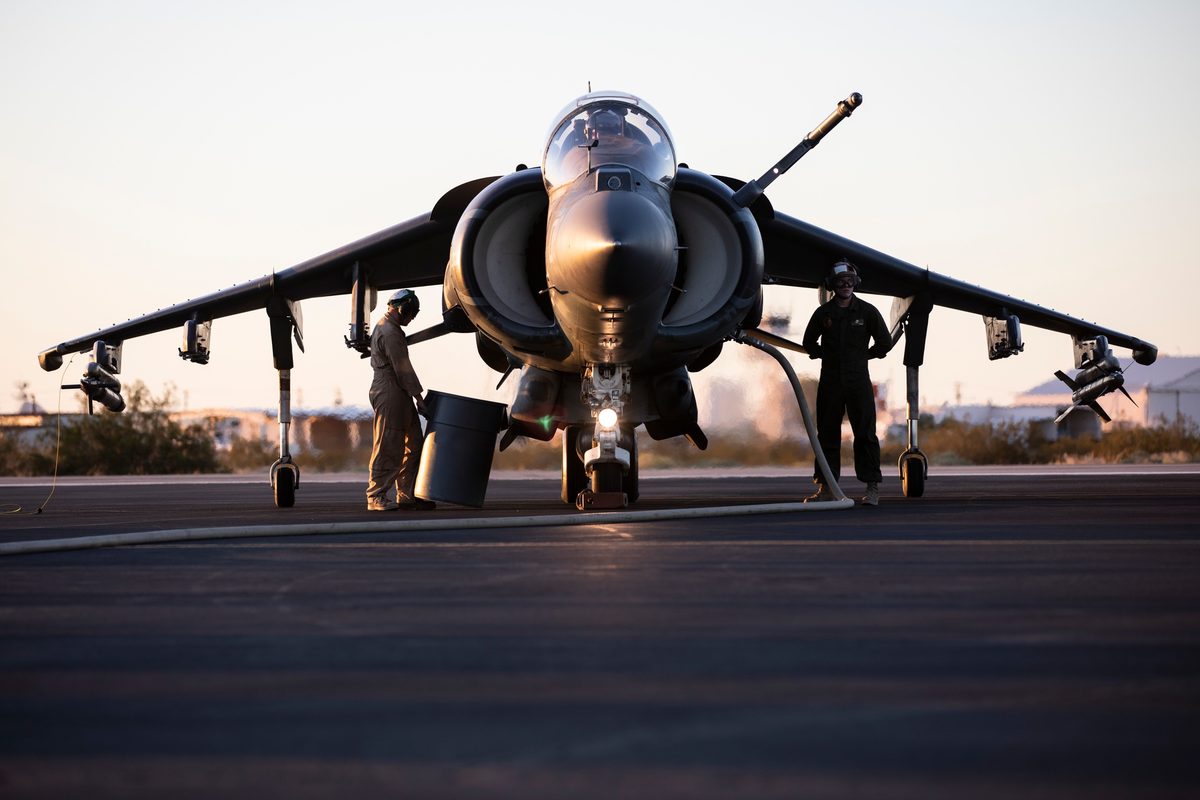
The AV-8B Harrier II is retiring in 2026 after 41 years of Marine Corps service. When VMA-223 conducts its final flight at MCAS Cherry Point on June 3, it will close the chapter on one of the most remarkable aircraft concepts ever to reach operational service — a tactical jet fighter that could take off from a parking lot, hover like a helicopter, land vertically on a ship, and deliver precision weapons in combat. No runway required.

The Harrier was never the fastest, never the stealthiest, and never carried the most weapons. It had three times the accident rate of the F/A-18 Hornet and earned the nickname "the Widow Maker." But it could do something no other Western tactical jet could do: deploy with Marines on amphibious assault ships, giving them organic fixed-wing air power independent of the Navy's carrier fleet. That single capability made the Harrier irreplaceable for four decades.

How a Jump Jet Works

Everything about the Harrier starts with the Rolls-Royce Pegasus engine — designated an International Historic Mechanical Engineering Landmark for good reason. The Pegasus is a single turbofan that splits its output through four rotating nozzles arranged in pairs on either side of the fuselage, near the aircraft's center of gravity. The front pair exhausts cold bypass fan air. The rear pair exhausts hot combustion gases. The thrust splits roughly 60/40 between front and rear.

All four nozzles are mechanically synchronized via chain linkages — they always point the same direction. A lever in the cockpit controls their angle through approximately 98.5 degrees of rotation: fully aft for forward flight, fully down for hover, and slightly forward of vertical for braking. The pilot manages nozzle angle, throttle, and flight controls simultaneously, which is why Harrier pilots describe the workload as "patting your head and rubbing your stomach while riding a unicycle."

Vertical Takeoff vs. Short Takeoff

In a vertical takeoff, the nozzles rotate straight down and the aircraft lifts off on a column of thrust. It works, but it comes at an enormous cost: maximum vertical takeoff weight is only 18,950 pounds compared to 31,000 pounds for a short takeoff. That difference means VTO cuts the Harrier's useful payload nearly in half.

This is why nearly all operational missions used short takeoff and vertical landing (STOVL). The aircraft accelerates on a takeoff roll, the pilot rotates the nozzles partially downward at around 65 knots, and the combination of wing lift and vectored thrust gets the aircraft airborne in a very short distance with far more fuel and weapons. Ski-jump ramps on ships further enhance this by angling the aircraft upward at the end of the deck run.

Hover Control

At low speed, conventional ailerons and rudder are useless — there is not enough airflow over them. The Harrier uses a Reaction Control System (RCS) that bleeds high-pressure air from the engine and ducts it to jet nozzles at the nose (pitch), tail (pitch and yaw), and wingtips (roll). The flight control system automatically blends between aerodynamic surfaces and RCS jets based on airspeed, so the pilot uses normal stick and pedal inputs regardless of speed.

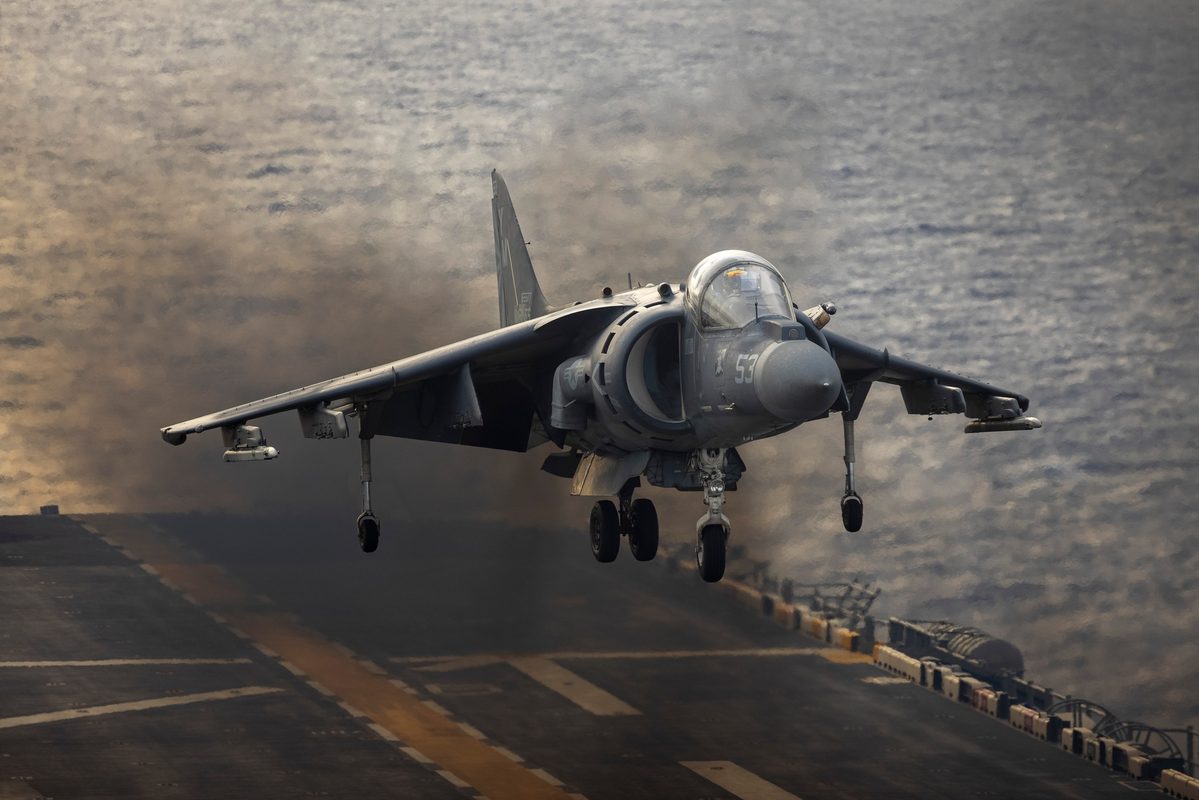
AV-8B Harrier II hovering with nozzles rotated downward during a vertical landing
The Harrier's four rotating nozzles visible during a hover. The front cold nozzles and rear hot nozzles are synchronized to always point in the same direction. (U.S. Marine Corps photo)

Design and Specifications

The AV-8B was a dramatic redesign of the original Harrier by McDonnell Douglas. The first-generation AV-8A had proven the VSTOL concept for the Marines in the 1970s but suffered from short range, low payload, and limited avionics. McDonnell Douglas redesigned nearly everything while keeping the Pegasus engine.

Specification AV-8B Harrier II+
Crew 1
Length 46 ft 4 in (14.1 m)
Wingspan 30 ft 4 in (9.25 m)
Engine Rolls-Royce Pegasus 11-61 (F402-RR-408), 23,800 lbf
Max Speed 662 mph (Mach 0.89) — subsonic
Service Ceiling 50,000 ft (15,240 m)
Combat Radius ~300 nmi (typical CAS mission)
Ferry Range 2,265 miles (3,640 km)
Weapons Capacity 9,200 lb (4,170 kg) across 7 hardpoints
Gun GAU-12/U 25mm Equalizer (300 rounds)

The AV-8B was the first combat aircraft to use composite materials extensively. Its graphite-epoxy composite wing — thicker, longer span, and higher aspect ratio than the original — was groundbreaking for the early 1980s and increased payload capacity dramatically. The cockpit was raised 12 inches with a one-piece wraparound canopy for vastly improved visibility. Under-fuselage Lift Improvement Devices — simple strakes that trap reflected exhaust gases during hover — added measurable extra lift with no moving parts. Two additional wing pylons brought the total to six, plus a centerline station.

Variants

The AV-8B evolved through three main variants. The Day Attack model (1985) carried the Angle Rate Bombing System with a TV/laser tracker but no radar — it could only operate in clear weather during daylight. The Night Attack variant (1989) added a forward-looking infrared sensor, night-vision-compatible cockpit, and the more powerful Pegasus F402-RR-408 engine.

The AV-8B+ (1993) was the definitive upgrade: an APG-65 pulse-Doppler radar — the same unit used in early F/A-18 Hornets — installed in an extended nose. This gave the Harrier beyond-visual-range combat capability with the AIM-120 AMRAAM, transforming it from a pure attack aircraft into a genuine multirole fighter. The Spanish and Italian navies also operated the AV-8B+ from their light carriers.

Why the Harrier Mattered: Organic Marine Air Power

The Harrier's most important feature was not its ability to hover. It was what that ability enabled: deployment on amphibious assault ships.

The Wasp-class and America-class amphibious assault ships are not aircraft carriers. They are 40,000-ton vessels designed to put Marines ashore. But in a "Harrier carrier" configuration, a single Wasp-class LHD could operate 20 or more AV-8Bs — giving the Marines their own mini aircraft carrier, independent of the Navy's supercarrier fleet.

This mattered enormously. Marines did not have to wait for or depend on a Navy carrier air wing for close air support. Their jets sailed with them, ready on the flight deck, launching and recovering on the same ship that carried their helicopters, landing craft, and ground forces. A Marine Expeditionary Unit with Harriers had organic air power — a self-contained combat force that could project power from the sea without needing a runway within a thousand miles.

Quick turnaround reinforced this advantage. A Harrier could land vertically, refuel, rearm, and launch again in under 23 minutes. During Desert Storm, AV-8Bs operating from a forward expeditionary strip just 35 nautical miles from the Kuwait border were relaunching faster than any other tactical jet in theater.

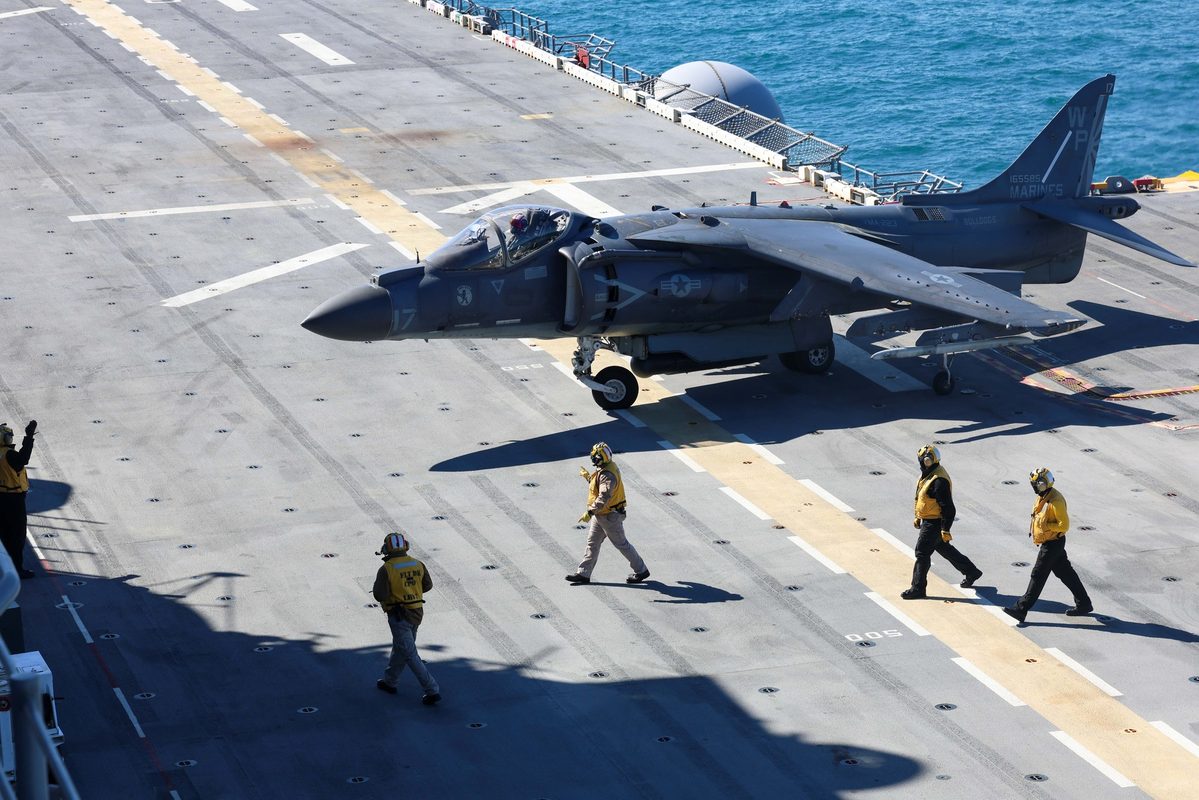
Multiple AV-8B Harrier II aircraft on the flight deck of a Marine amphibious assault ship
AV-8B Harriers on the deck of an amphibious assault ship. In "Harrier carrier" configuration, these ships could operate 20 or more jets, giving Marines organic fixed-wing air power. (U.S. Marine Corps photo)

No Runway Needed

The Harrier could operate from places no other tactical jet could reach. Amphibious assault ships. Rapidly constructed expeditionary airfields. Stretches of highway. Forest clearings. Damaged conventional airfields with cratered runways. During the Cold War, NATO doctrine envisioned Harriers operating from hidden forest bases in Germany to survive a Soviet first strike against NATO airfields. The RAF practiced deploying to roads and clearings throughout the era.

This operational flexibility was the Harrier's trump card. Conventional airfields are easy to find and easy to crater. An aircraft that does not need one is extraordinarily difficult to neutralize. The concept was vindicated dramatically in 1982 when 28 Sea Harriers — first-generation models, not AV-8Bs — operated from the small carriers HMS Hermes and HMS Invincible during the Falklands War, 8,000 miles from home. They shot down 20 Argentine aircraft with zero air-to-air losses. Without the Harrier's ability to operate from small carriers, the UK could not have projected air power to the South Atlantic at all.

Operational History

The AV-8B saw extensive service across four decades. During Desert Storm in 1991, 86 AV-8Bs flew 3,380 sorties with a mission availability rate exceeding 90 percent. General Norman Schwarzkopf named the AV-8B among the seven weapons that played a crucial role. In Afghanistan, Harriers provided continuous close air support from 2001 through 2014, operating from forward bases including Kandahar and Bagram. During the 2003 invasion of Iraq, 60 AV-8Bs deployed on amphibious ships flew over 1,000 sorties in direct support of Marine ground forces.

The aircraft also served in Bosnia, Kosovo, and countless Marine Expeditionary Unit deployments worldwide. Wherever Marines went by sea, Harriers went with them.

The Dangerous Aircraft Pilots Loved

The Harrier's accident record was sobering. A Class A accident rate of 11.44 per 100,000 flight hours — three times the F/A-18 Hornet, five times the A-10. Over 31 years of USMC service: 143 major accidents, one-third of the fleet destroyed, 45 Marines killed.

The reasons were inherent to the aircraft's nature. VSTOL operations place the aircraft in the most hazardous flight regime — low altitude, low airspeed, transitioning between wing-borne and jet-borne flight — far more often than a conventional jet. The single Pegasus engine provided no redundancy; engine failure in hover meant ejection. The vectored-thrust system, four rotating nozzles, reaction control system, and water injection added mechanical complexity that conventional fighters simply do not have. And pilots transitioning from conventional jets had to unlearn fundamental instincts — in a normal jet, pulling back on the stick always means climb; in a hovering Harrier, it means drifting backward.

Despite all this, Harrier pilots were fiercely loyal to the aircraft. The ability to hover, to take off from a ship, to operate from a road — these gave pilots a sense of flying something truly special. The small, tight-knit Harrier community within the Marine Corps fostered strong unit identity. It was a badge of honor.

Engineering Innovations

The AV-8B pioneered several technologies that became standard in modern military aviation. Its extensive use of graphite-epoxy composites in the wing, fuselage sections, and control surfaces was groundbreaking for a combat aircraft in the early 1980s — a technology path that led directly to modern fighters being built primarily from composites.

The under-fuselage Lift Improvement Devices were ingeniously simple: strakes that trap reflected exhaust gases during hover to create additional lift. No moving parts, no additional systems — just clever aerodynamic shaping that squeezed meaningful extra performance from the same engine. The HOTAS (Hands On Throttle And Stick) control layout, while not unique to the Harrier, was implemented early and influenced subsequent designs.

And the Pegasus engine itself remains an engineering landmark. Stanley Hooker's concept of splitting a turbofan's output into four vectorable nozzles — with cold fan exhaust going forward and hot core exhaust going aft, balanced around the center of gravity — was the elegant solution that made practical V/STOL possible. No one has improved on the fundamental concept in the six decades since.

AV-8B Harrier II taking off from a forward expeditionary airstrip in a desert environment
AV-8Bs operated from forward expeditionary strips during Desert Storm, positioned just 35 nautical miles from the Kuwait border — the most forward-deployed tactical strike platform in the theater. (U.S. Marine Corps photo)

The F-35B Carries the Legacy Forward

The F-35B Lightning II replacing the Harrier is a generational leap — supersonic, stealthy, with advanced sensor fusion and radar. Its lift fan plus vectoring rear nozzle uses different architecture than the Pegasus, but the entire concept of STOVL combat jets operating from amphibious ships exists because the Harrier proved it could work.

The United States, United Kingdom, Italy, Japan, and South Korea are all building or operating ships designed around STOVL jets — a lineage that traces straight back to the Harrier. The "Lightning carrier" concept for America-class LHAs, with F-35Bs operating as a mini carrier air wing, is the direct descendant of the Harrier carrier configuration that Marines pioneered decades ago.

When VMA-223 shuts down its last Pegasus engine in June 2026, four decades of Harrier flight will end. But the idea the Harrier proved — that a combat jet does not need a runway, that Marines can carry their own air power on their own ships — will fly on indefinitely.

Frequently Asked Questions

Can the Harrier really take off vertically?

Yes, but it rarely does in practice. Vertical takeoff cuts the aircraft's payload nearly in half compared to a short takeoff. Nearly all operational missions used short takeoff and vertical landing (STOVL) — a short runway roll for takeoff to maximize weapons and fuel, then a vertical landing on return.

How fast is the AV-8B Harrier?

The AV-8B has a maximum speed of 662 mph (Mach 0.89) at sea level — it is subsonic. This was a known tradeoff: the vectored-thrust engine design that enabled VSTOL operations was not compatible with supersonic flight.

When is the AV-8B being retired?

The final AV-8B flight is scheduled for June 3, 2026, at MCAS Cherry Point. VMA-223, the last operational Harrier squadron, will deactivate later in FY2026. The F-35B Lightning II is the replacement.

Why was the Harrier so dangerous to fly?

The Harrier spent more time in hazardous low-speed, low-altitude flight regimes than conventional jets. Its single engine provided no redundancy, the vectored-thrust system added mechanical complexity, and pilots had to manage nozzle angle, throttle, and reaction controls simultaneously. The transition between wing-borne and jet-borne flight was especially demanding.

What is VIFF?

VIFF stands for Vectoring In Forward Flight — rotating the engine nozzles during normal winged flight to produce sudden deceleration or tighter turns. While theoretically a powerful dogfighting tool, VIFF was considered a last-resort maneuver in practice because it bleeds enormous energy and leaves the aircraft vulnerable. Sea Harrier pilots in the Falklands did not use VIFF in combat.

Share this article

Share:

Recommended

Ace of The Skies: Can You Identify These Military Aircraft Throughout The Years?
Test Yourself

Ace of The Skies: Can You Identify These Military Aircraft Throughout The Years?

Can you identify these aircraft?

Take the Quiz

On This Day in Military History

March 10

Tokyo Firebombing: The Deadliest Air Raid in History (1945)

In the early morning hours of March 10, the firestorm from Operation Meetinghouse consumed 15.8 square miles of eastern Tokyo, killing more than 100,000 people — the deadliest single air raid in human history, surpassing both atomic bombings individually. Over one million residents were left homeless. The tactics proved so effective that General LeMay applied them to 66 more Japanese cities over the next five months.

1831French Foreign Legion Created

1975Battle of Ban Me Thuot: The Beginning of the End for South Vietnam

1848Treaty of Guadalupe Hidalgo Ratified

See all 10 events on March 10

Get Military News & History in Your Inbox

Join thousands of readers receiving our weekly digest of military technology, history, and analysis.

Test Your Knowledge