Marcus Webb writes about military ground vehicles, armored platforms, and the logistics of land warfare. His work covers everything from MRAPs and infantry carriers to the training pipelines that keep ground forces operational in contested environments.
The BMP-3 carries a 100mm cannon, a 30mm autocannon, and three machine guns on a vehicle that can swim across rivers. The Bradley carries one 25mm gun on a vehicle that weighs almost twice as much. Both designers think they made the right call. The BMP-3 was built for Soviet doctrine: mass, speed, and the ability to cross water obstacles without stopping. The Bradley was built for American doctrine: protection, firepower integration, and keeping soldiers alive long enough to fight again. Ukraine has put both philosophies under real combat stress, and the results challenge assumptions on both sides.
Two Philosophies, One Job
An infantry fighting vehicle has a fundamentally contradictory mission: it must be light enough to keep up with fast-moving operations, armored enough to protect the infantry squad inside, and armed enough to contribute to the fight after the squad dismounts. Every IFV design is a compromise between these demands, and the BMP-3 and Bradley represent the two most divergent solutions any major army has produced.
The Soviet philosophy, embodied in the BMP series since 1966, prioritized offensive tempo. The BMP was designed for a war in which the Red Army would drive west through Europe at maximum speed, crossing rivers on the move, overwhelming NATO defenders with mass, and treating individual vehicle losses as acceptable costs. This produced vehicles that were light, fast, amphibious, and heavily armed, but thinly armored.
The American philosophy, developed after observing Soviet IFVs in the 1970s, prioritized survivability and fire support. The Bradley was designed for a war in which outnumbered NATO forces would fight from prepared positions in the Fulda Gap, needing every soldier and vehicle to survive multiple engagements. This produced a heavier vehicle with better armor, a stabilized cannon with excellent fire control, and anti-tank missiles, but no amphibious capability and fewer dismounts.
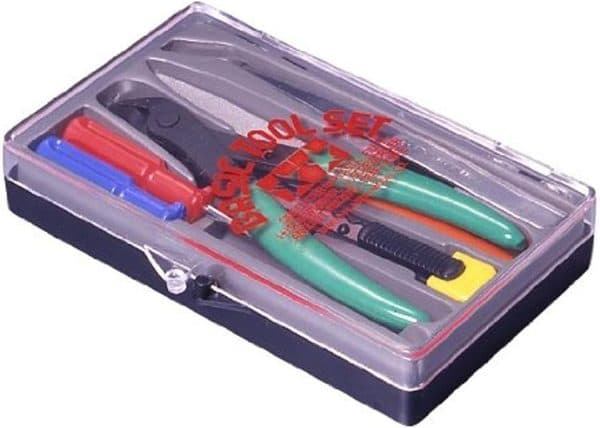
An all-in-one starter tool set from Tamiya containing sprue nippers, a hobby knife, flat and round files, tweezers, and a drill bit. Everything a beginner needs in a single purchase at a fair price.
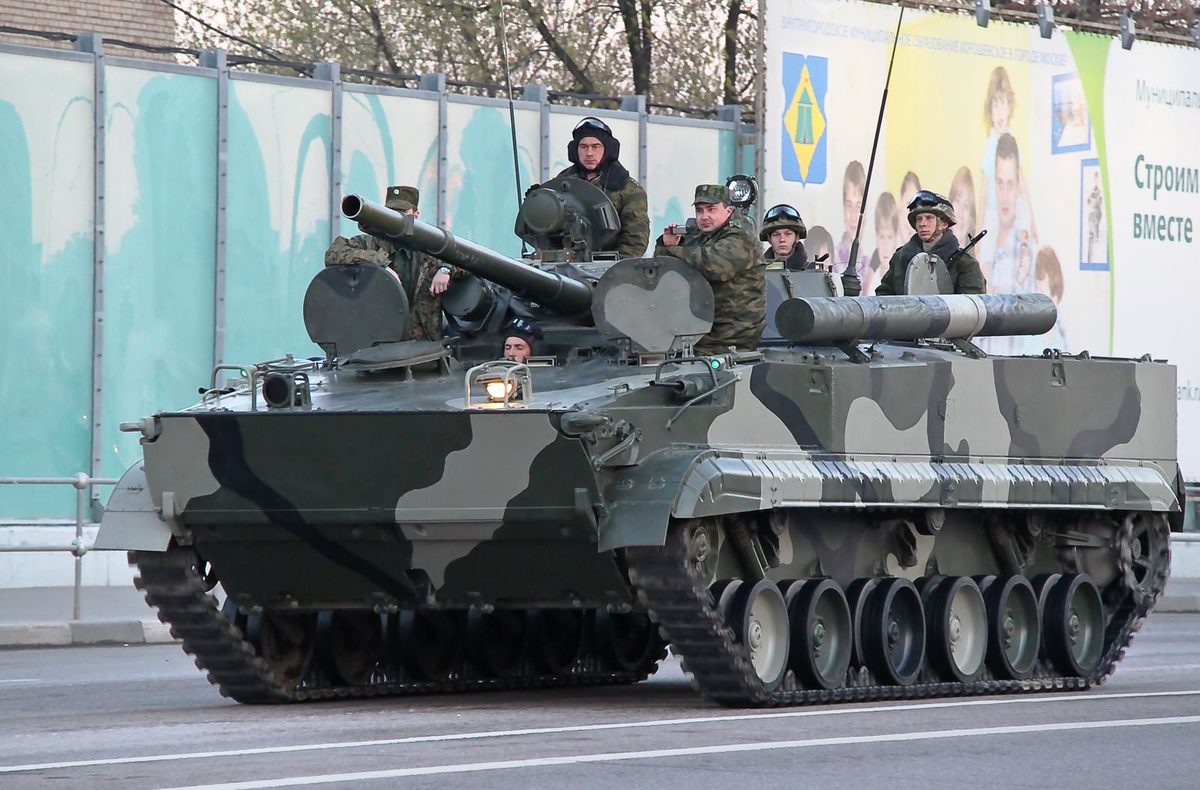
A BMP-3 fires its 100mm gun during live-fire exercises. The turret mounts both the 100mm weapon and a coaxial 30mm autocannon, which is unprecedented firepower for an IFV. (Photo via Russian Ministry of Defense)
The BMP-3: Firepower at Any Cost
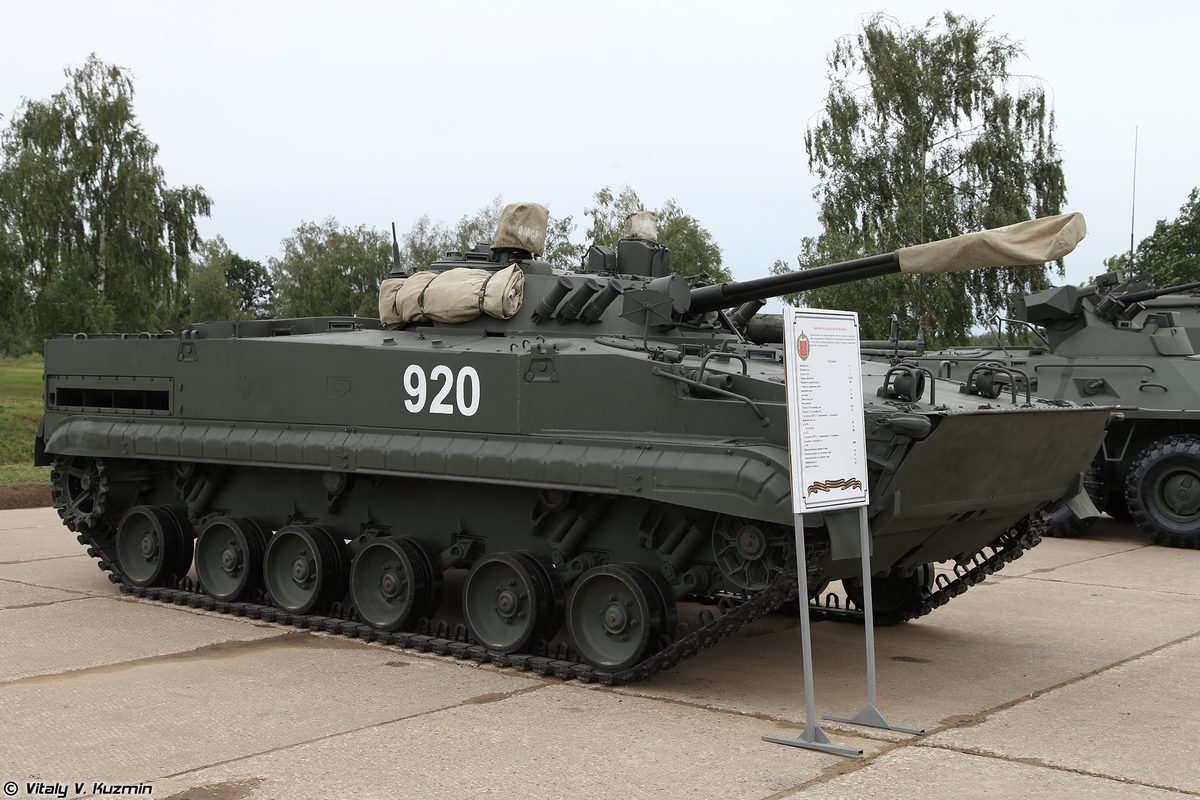
The BMP-3, entering service in 1987, was the most heavily armed infantry fighting vehicle ever built, and it still holds that distinction. Its 2A70 100mm rifled gun can fire conventional rounds and the 9M117 Bastion gun-launched anti-tank guided missile, giving it tank-killing capability at ranges up to 4,000 meters. Mounted coaxially is a 2A72 30mm autocannon for engaging lighter vehicles and infantry positions. Three 7.62mm PKT machine guns (one coaxial, two in the hull) provide close-in defense. That's five weapons systems on a single 18.7-ton platform.
The vehicle is powered by a UTD-29 500-horsepower diesel engine that gives it a road speed of 44 mph and, critically, amphibious capability. The BMP-3 can enter water without preparation and swim at 6 mph using water jets, a capability designed for crossing the rivers of Western Europe without waiting for engineers to build bridges. It carries seven dismounts in addition to a crew of three (commander, gunner, driver).
The design sacrifices are significant. Armor is aluminum alloy with a steel-laminate front, providing protection against 30mm rounds on the frontal arc but vulnerable to anything heavier, and to mines and IEDs from below. The aluminum hull, while lightweight, has a dangerous tendency to burn when penetrated by shaped-charge warheads, a vulnerability that has been documented extensively in combat.
The Bradley: Survivability First
A Bradley launches a TOW anti-tank missile. The dual-launcher system gives the Bradley tank-killing capability at ranges exceeding 3,750 meters. (U.S. Army photo)
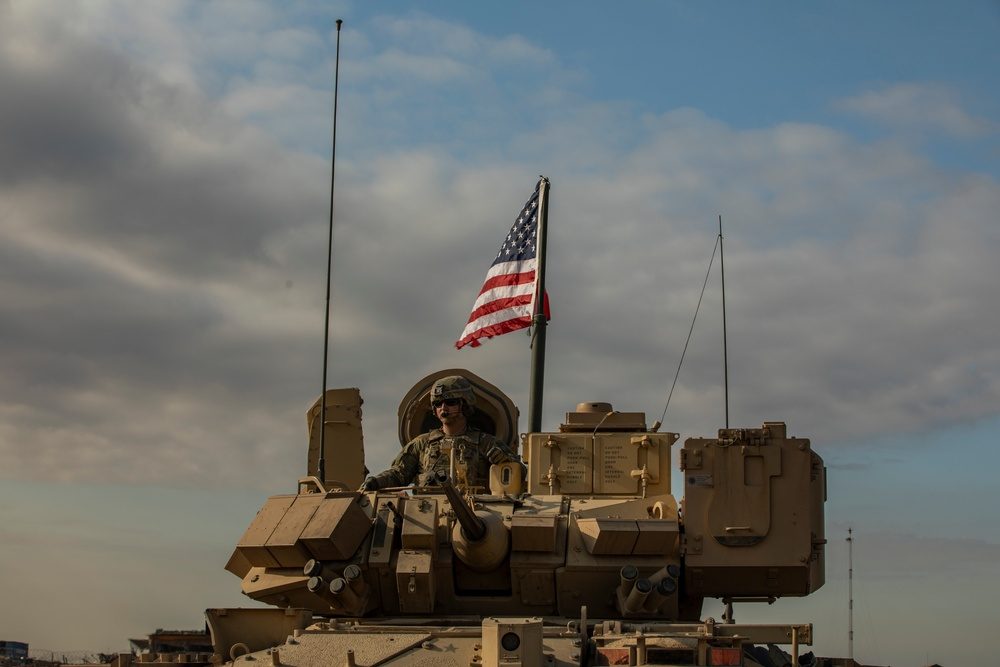
The M2 Bradley entered service in 1981 after one of the most contentious development programs in American military history, controversially depicted in the 1998 film The Pentagon Wars, which portrayed the vehicle as a design-by-committee disaster. The real Bradley has proven to be one of the most effective IFVs ever fielded. Its 25mm M242 Bushmaster chain gun is less powerful than the BMP-3's armament, but it's coupled with an advanced fire-control system that gives it exceptional first-round hit probability at combat ranges. The dual TOW anti-tank missile launcher provides genuine tank-killing capability at ranges up to 3,750 meters.
The M2A3 variant, currently in widespread service, weighs approximately 33 tons, nearly twice the BMP-3's weight. That mass is largely armor: reactive armor panels, spall liners to protect the crew from armor fragments, and an overall protection level that lets the Bradley survive hits that would destroy a BMP. The trade-off is that the Bradley is not amphibious (it can ford shallow water but cannot swim) and carries only six dismounts, one fewer squad member than the BMP-3.
The Bradley's 600-horsepower Cummins VTA-903T diesel gives it a road speed of 41 mph, comparable to the BMP-3. But it's the fire control that sets the Bradley apart: the Commander's Independent Viewer (CIV) with thermal imaging allows the commander to scan for targets independently of the gunner, and the Improved Bradley Acquisition System (IBAS) provides hunter-killer capability, letting the commander designate targets while the gunner engages them, dramatically increasing the rate of engagement.
Dry pigment palettes applied with the included sponge applicator. No thinners, no mixing, almost impossible to overdo. Set A covers sand and mud effects, which are the most commonly needed weathering effects for armor models.
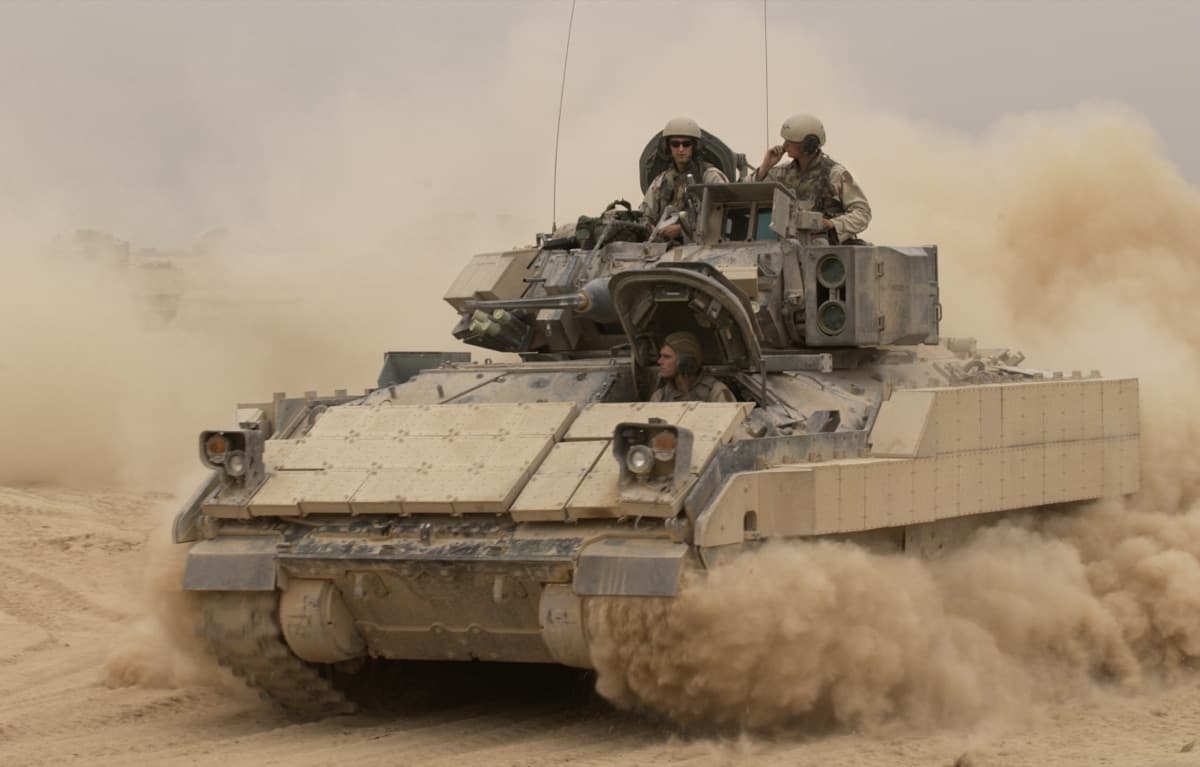
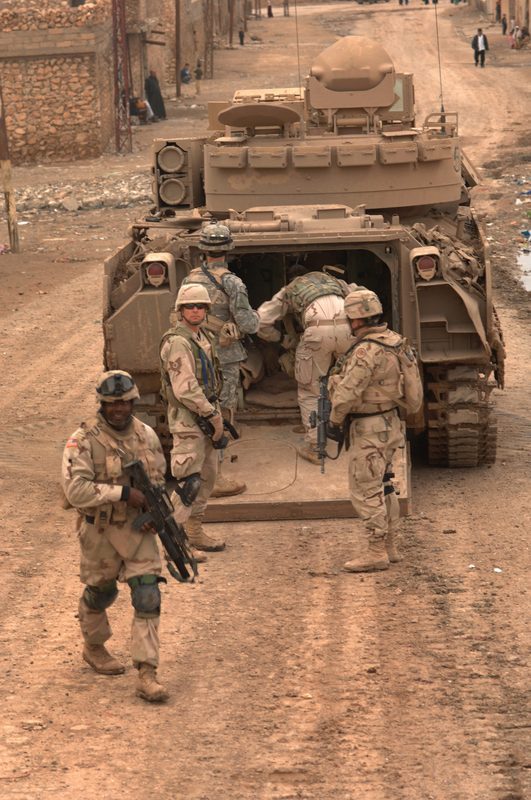
A Bradley in Ukrainian service during combat operations. Despite being an older ODS variant, the Bradley's survivability has impressed Ukrainian crews. (Photo via Ukrainian Armed Forces)
The war in Ukraine has provided the first large-scale combat test of both vehicles, and the results are illuminating, though not always in the way either side expected. Russia has lost hundreds of BMP-3s, with open-source intelligence tracking documenting the aluminum hull's vulnerability to anti-tank missiles, mines, and even heavy machine gun fire at close range. The ammunition storage layout, with 100mm rounds stored in an exposed autoloader, has led to catastrophic turret ejections, the same "jack-in-the-box" effect seen with Russian tanks.
The United States supplied M2A2 ODS (Operation Desert Storm) variants to Ukraine beginning in early 2023, not the latest M2A3 model but still highly capable. Ukrainian crews have reported high satisfaction with the Bradley's survivability. In multiple documented incidents, Bradleys have survived direct hits from anti-tank missiles and mines that would have destroyed BMP-3s, with crews walking away from impacts that crumpled armor panels but didn't penetrate the fighting compartment. The 25mm cannon, while less impressive on paper than the BMP-3's armament, has proven devastatingly effective against Russian IFVs and APCs at typical combat ranges.
The most famous Bradley engagement occurred during Ukraine's 2023 counteroffensive, when a group of Bradleys engaged Russian positions and one vehicle absorbed multiple hits while continuing to fight. The incident went viral and effectively ended the decades-long mockery of the Bradley as a design-by-committee failure. In combat, the vehicle designed to keep soldiers alive does exactly that.
The Philosophical Verdict
A BMP-3 demonstrates its amphibious capability during exercises. The ability to swim without preparation was central to Soviet offensive doctrine. (Photo via Russian Ministry of Defense)
The BMP-3 vs Bradley comparison isn't really about which vehicle is "better." It's about which war you're planning to fight. If your doctrine calls for rapid offensive operations across a continent, crossing rivers on the move and accepting attrition as a cost of tempo, the BMP-3's design makes sense: light, fast, heavily armed, and numerous. If your doctrine calls for fighting outnumbered against a peer adversary, where every trained soldier is irreplaceable and every vehicle must survive to fight multiple engagements, the Bradley's design makes sense: heavy, survivable, and equipped with the best sensors and fire control available.
Ukraine has stress-tested both doctrines simultaneously. The results suggest that in modern combat, where anti-tank missiles are ubiquitous, mines are everywhere, and drones provide constant surveillance, survivability matters more than offensive tempo. A destroyed IFV isn't just a lost vehicle; it's a lost crew, a lost squad, and a gap in the line that can't be filled quickly. The Bradley's designers bet that protection was worth the weight penalty. Thirty years of combat, from Desert Storm to Iraq to Ukraine, have proven them right.
Russia appears to agree. The next-generation Russian IFV program, variously linked to the T-15 Armata heavy IFV, prioritizes crew protection over amphibious capability, a fundamental reversal of the BMP philosophy. Whether Russia can actually produce the T-15 in meaningful numbers is another question entirely. But the fact that Moscow is designing a Bradley-weight IFV tells you everything about which philosophy won the argument.