Alex Carter writes about modern warfare, emerging military technology, and how doctrine adapts to new tools. His work focuses on what changes in practice -- command, control, targeting, and risk -- when systems like drones and autonomous platforms become routine.
For most of the post-Cold War era, the global aircraft carrier conversation was a one-country monologue. The United States operated more carriers than the rest of the world combined, all of them nuclear-powered supercarriers with no peer equivalent. That era is ending. China now operates three aircraft carriers -- the Liaoning (CV-16), the Shandong (CV-17), and the Fujian (CV-18) -- with a fourth reportedly under construction. The Fujian, launched in 2022 and undergoing sea trials in 2025-2026, features electromagnetic catapults, the same launch technology installed on the U.S. Navy's newest Ford-class carrier. China is the only nation besides the United States to field this system on a carrier. The gap is narrowing. The question is how fast, and where it still matters most.
This article compares China's three operational carriers against the U.S. Navy's carrier fleet, with particular focus on the Ford-class as America's latest and most advanced design. The comparison covers hardware, propulsion, launch systems, air wings, operational experience, and the strategic implications of China's carrier ambitions. The data draws from the U.S. Department of Defense's annual China Military Power Report, the International Institute for Strategic Studies (IISS) Military Balance, the Center for Strategic and International Studies (CSIS), and the Congressional Research Service (CRS). Where figures are estimated rather than confirmed, we say so.
China's Three Carriers at a Glance
China's carrier program has moved through three distinct generations in roughly a decade. Each ship represents a significant leap over its predecessor, and understanding where each one fits is essential to evaluating the overall trajectory.
Liaoning (CV-16): The Training Ship
The Liaoning began life as the Varyag, an incomplete Kuznetsov-class hull laid down in a Soviet shipyard in Mykolaiv, Ukraine, in 1988. Construction halted at roughly 68 percent completion when the Soviet Union collapsed. According to reporting by Jane's Defence, Ukraine sold the unfinished hull to a Chinese company in 1998 for $20 million, ostensibly to be converted into a floating casino in Macau. Instead, it was towed to Dalian Shipbuilding Industry Company, where it spent the next decade being rebuilt and completed as a functional aircraft carrier. The People's Liberation Army Navy (PLAN) commissioned the ship in September 2012.
The IISS Military Balance lists the Liaoning's displacement at approximately 60,000 tons at full load. It is conventionally powered by eight boilers driving four steam turbines, a propulsion system inherited from the original Soviet design. Its most visible feature is a 14-degree ski-jump ramp at the bow, which aircraft use to launch without the assistance of catapults. This Short Take-Off But Arrested Recovery (STOBAR) configuration limits the maximum takeoff weight of its aircraft, which constrains fuel and weapons loads. The ship carries J-15 "Flying Shark" fighters, a derivative of the Russian Su-33, along with Z-8 and Z-9 helicopters for search and rescue, anti-submarine warfare, and airborne early warning.
The PLAN has consistently described the Liaoning as a training and research platform, and its operational record supports that characterization. The carrier has conducted increasingly complex exercises in the Western Pacific and South China Sea, practicing carrier strike group operations with escort destroyers and frigates. It has never deployed on a sustained combat patrol comparable to a U.S. Navy carrier deployment. Its primary value to the PLAN has been institutional: teaching an entire navy how to operate fixed-wing aviation at sea, from deck handling procedures to pilot carrier qualification to multi-ship formation tactics. Every carrier navy in history had to start somewhere, and the Liaoning is where China started.
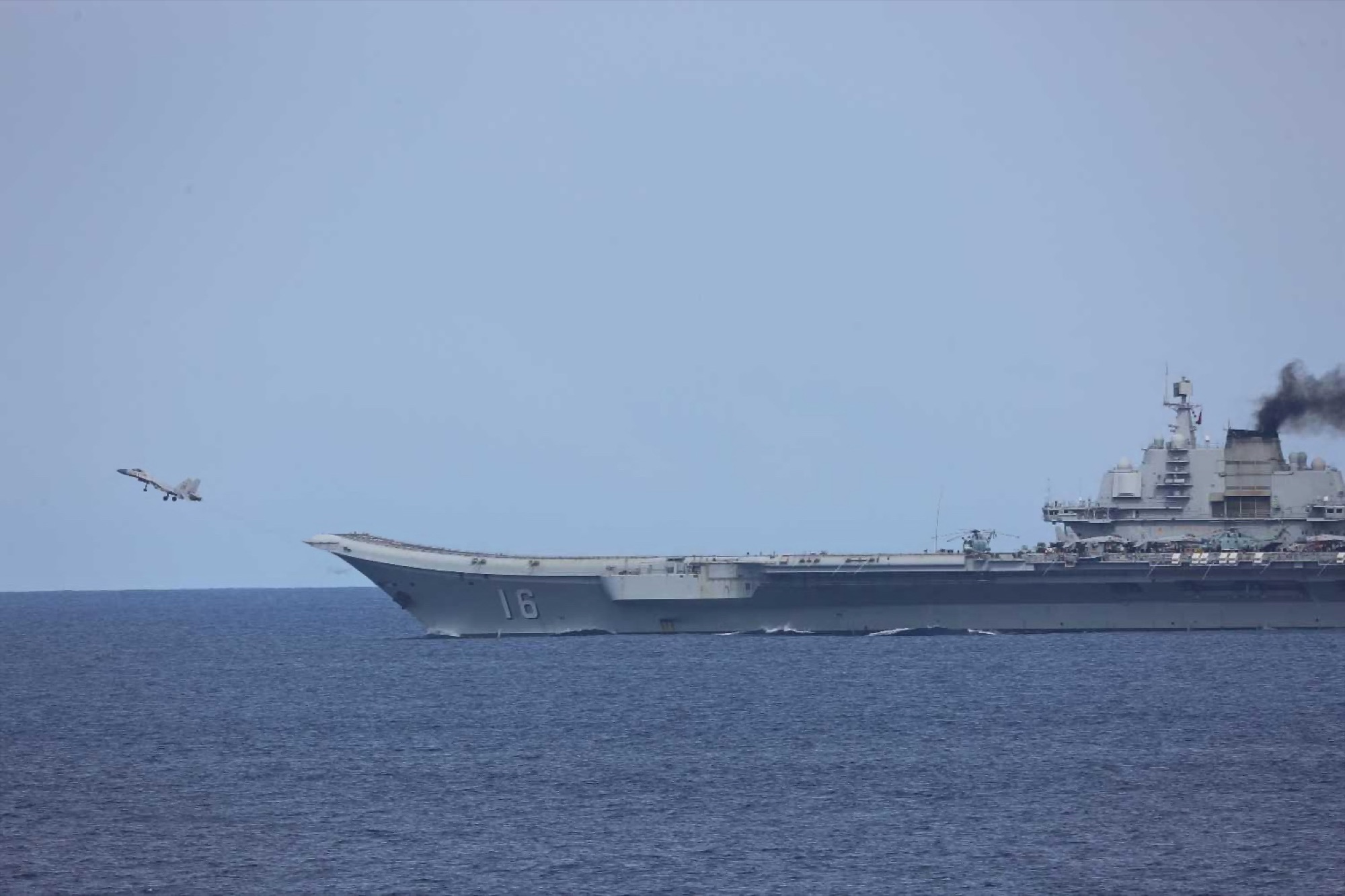
The Liaoning (CV-16) conducting flight operations. Originally a Soviet Kuznetsov-class hull, the Liaoning serves as China's carrier training platform and the foundation on which the PLAN built its carrier aviation program. (Photo via Chinese state media)
Shandong (CV-17): China's First Indigenous Carrier
The Shandong, commissioned in December 2019, is China's first domestically designed and built aircraft carrier. It is based on the Liaoning's general layout but incorporates significant improvements informed by years of operating the first ship. Per IISS estimates, the Shandong displaces approximately 66,000 tons at full load. Its island superstructure is smaller and repositioned to free up more flight deck area. The hangar is larger, and the Office of Naval Intelligence has assessed the ship carries a larger air wing than the Liaoning, approximately 36 fixed-wing aircraft and helicopters compared to roughly 24-30 on the older carrier.
Like the Liaoning, the Shandong uses a STOBAR configuration with a ski-jump ramp and conventional steam propulsion. It retains the same fundamental limitations: aircraft must take off under their own power up the ramp, which restricts maximum takeoff weight and therefore limits the weapons and fuel each sortie can carry. The J-15 remains the primary fighter. The Shandong's improvements in deck layout and aircraft handling equipment do allow faster sortie generation rates, however. Sortie generation rate, the speed at which a carrier can launch, recover, rearm, and relaunch aircraft, is one of the most important measures of a carrier's combat effectiveness, and the Shandong's incremental gains here reflect real engineering progress.
The Shandong is based at Yulin Naval Base on Hainan Island, positioning it for operations in the South China Sea. It has conducted increasingly frequent and complex training deployments, including transits through the Miyako Strait into the Western Pacific. As tracked by Japan's Ministry of Defense and reported widely in open-source defense media, the Liaoning and Shandong conducted simultaneous operations in April 2023 for the first time, demonstrating the PLAN's growing ability to coordinate multiple carrier groups. The Shandong represents the bridge between learning on a refurbished Soviet hull and building something genuinely new.
Fujian (CV-18): The Generational Leap
The Fujian, launched at Jiangnan Shipyard in Shanghai in June 2022, represents a fundamentally different class of warship from its predecessors. Satellite imagery analyzed by CSIS's ChinaPower project puts the Fujian at approximately 80,000 tons full displacement, making it the largest non-American aircraft carrier ever built and among the largest warships constructed by any nation outside the United States. It features a flat flight deck with no ski-jump ramp, three electromagnetic aircraft launch systems (EMALS), and an advanced arresting gear system. This Catapult Assisted Take-Off But Arrested Recovery (CATOBAR) configuration places the Fujian in a category previously occupied only by American and French carriers.
EMALS is the critical technology. Electromagnetic catapults use a linear induction motor to accelerate aircraft to flight speed, replacing the steam catapults that American carriers used for decades. The U.S. Navy's Gerald R. Ford (CVN-78) is the first operational carrier with EMALS. China's Fujian is the second. The advantage of EMALS over steam catapults is precise, adjustable launch energy: heavier aircraft get more power, lighter unmanned systems get less, reducing airframe stress and expanding the range of aircraft types a carrier can launch. Per the Congressional Research Service, EMALS also requires less maintenance, fewer crew, and less below-deck volume than steam catapult systems. It is the most significant advancement in carrier launch technology in 70 years, and China has built it.
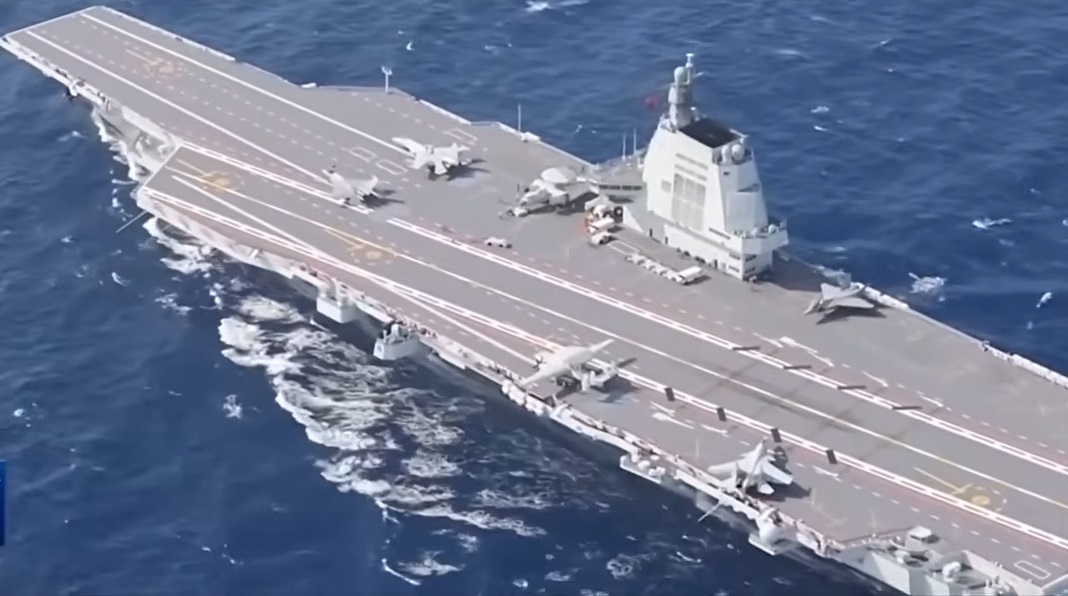
The Fujian (CV-18) at Jiangnan Shipyard in Shanghai. At 80,000 tons, it is the largest non-American aircraft carrier ever built. The flat flight deck and three electromagnetic catapult tracks are clearly visible, marking a generational leap from China's earlier ski-jump carriers. (Satellite imagery via CSIS)
The Fujian is conventionally powered, likely by an integrated electric propulsion system (IEPS) that generates the enormous electrical power EMALS requires without nuclear reactors. This is a notable engineering achievement. The Ford-class uses nuclear reactors to power its EMALS; China has apparently solved the power generation challenge with conventional propulsion, though the long-term implications for sustained high-tempo operations remain to be seen.
The Fujian's air wing is expected to include the J-35 (also referred to as the J-31 or FC-31 in earlier development stages), China's second stealth fighter design. If the J-35 deploys aboard the Fujian, China would become the second nation after the United States to operate stealth fighters from an aircraft carrier. The air wing is also expected to include the KJ-600, an airborne early warning aircraft analogous to the U.S. Navy's E-2D Hawkeye. The KJ-600's development has been closely watched because no ski-jump carrier can launch a turboprop AEW aircraft of this size. Catapults are required, and the Fujian's EMALS solves that problem. For additional context on how carrier-based stealth fighters are shaping naval aviation, see our analysis of the J-35 Falcon Hawk.
Chinese state media (Xinhua) reported that the Fujian began sea trials in 2024. The ship is expected to be commissioned into PLAN service in 2026 or 2027. Full operational capability, including a qualified air wing and integration with escort vessels, will likely take several additional years beyond commissioning.
The Comparison: China vs. the U.S. Navy
Comparing Chinese and American carriers requires looking beyond individual ship specifications to the systems, experience, and infrastructure that make a carrier force effective. The following table summarizes the key differences.
Aircraft Carrier Comparison: China vs. United States
Specification
Liaoning (CV-16)
Shandong (CV-17)
Fujian (CV-18)
USS Gerald R. Ford (CVN-78)
Displacement (full load)
~60,000 tons
~66,000 tons
~80,000 tons
~100,000 tons
Length
999 ft (305 m)
999 ft (305 m)
~1,036 ft (~316 m)
1,106 ft (337 m)
Propulsion
Conventional (steam turbines)
Conventional (steam turbines)
Conventional (IEPS, est.)
Nuclear (2x A1B reactors)
Launch system
Ski-jump (STOBAR)
Ski-jump (STOBAR)
3x EMALS (CATOBAR)
4x EMALS (CATOBAR)
Air wing (est.)
~24-30 aircraft
~36 aircraft
~40-50 aircraft
75+ aircraft
Primary fighter
J-15 Flying Shark
J-15 Flying Shark
J-35 (expected) + J-15T
F/A-18E/F Super Hornet, F-35C
AEW aircraft
Z-18J (helicopter)
Z-18J (helicopter)
KJ-600 (expected)
E-2D Advanced Hawkeye
Commissioned
2012
2019
~2026-2027 (est.)
2017
Crew
~2,000 + 500 air wing
~2,000 + 500 air wing
~2,500 (est.)
~2,600 + 1,800 air wing
Sources: IISS Military Balance (2025), DoD China Military Power Report, CSIS ChinaPower, Congressional Research Service. Fujian figures are estimates based on satellite imagery analysis and open-source reporting; the ship has not yet been commissioned.
The numbers tell an important story, but several dimensions of this comparison deserve deeper examination.
Ski-Jump vs. Catapult: Why Launch Systems Matter
The single most important technical distinction between China's first two carriers and its newest one is the launch system. The Liaoning and Shandong use ski-jump ramps. The Fujian uses electromagnetic catapults. This is not a minor upgrade. It changes what a carrier can do.
A ski-jump ramp requires aircraft to generate enough lift and thrust on their own to clear the ramp and become airborne. This imposes a hard ceiling on maximum takeoff weight. A J-15 launching from the Liaoning's ski-jump cannot carry a full weapons load and a full fuel load simultaneously. Pilots must choose: more missiles or more range, but not both. According to CRS analysis of STOBAR limitations, a ski-jump J-15 typically carries a reduced weapons loadout compared to what the same airframe could carry if catapult-launched. That translates to fewer anti-ship missiles per sortie, less fuel for combat air patrol, and an inability to launch heavier aircraft types altogether.
A catapult removes this constraint. The EMALS tracks on the Fujian and the Ford can accelerate aircraft to the precise speed required for their loaded weight. A fully loaded strike fighter with maximum fuel and a full complement of weapons can be launched just as reliably as a lightly loaded combat air patrol fighter. Catapults also enable the launch of heavier, larger aircraft, specifically fixed-wing airborne early warning platforms.
The Liaoning and Shandong rely on helicopter-based AEW, the Z-18J. Helicopters fly slower, lower, and for shorter durations than fixed-wing turboprops. The Z-18J's radar coverage is a fraction of what the U.S. Navy's E-2D Advanced Hawkeye provides. According to the Navy, the E-2D can detect aircraft and missiles at ranges exceeding 350 nautical miles and can coordinate complex air battles involving dozens of friendly aircraft. No helicopter-based AEW system comes close to this capability. The Fujian's KJ-600, a fixed-wing turboprop that requires catapult launch, is designed to close this gap. If it performs as expected, it will give the Fujian a carrier-based AEW capability that the Liaoning and Shandong simply cannot match.
Nuclear vs. Conventional Power
Every American carrier since the USS Enterprise (CVN-65), commissioned in 1961, has been nuclear-powered. All 11 active U.S. carriers run on nuclear reactors. None of China's three carriers are nuclear-powered. This difference has cascading operational consequences.
A nuclear-powered carrier has effectively unlimited range. It does not need to refuel its propulsion plant. It can sustain high speeds for extended periods without concern about fuel reserves. A nuclear carrier can sprint across an ocean to respond to a crisis, maintain high speed during combat operations, and operate for 20-25 years between reactor refueling. Per CRS reporting on the Ford class, the A1B reactors generate approximately three times the electrical power of the Nimitz-class reactors, providing the energy needed for EMALS, advanced radars, and potential future directed-energy weapons.
A conventionally powered carrier burns fuel. It must replenish from underway replenishment ships or return to port. At high speeds, fuel consumption increases dramatically, forcing commanders to balance speed against endurance. IISS data estimates the Liaoning and Shandong have a range of roughly 3,800 to 4,000 nautical miles at moderate speed. That is sufficient for operations in the Western Pacific and South China Sea but imposes constraints on global deployments. The Fujian's range has not been officially disclosed, but conventional propulsion inherently limits sustained high-tempo operations compared to nuclear power.
The distinction matters most for power projection far from home. For operations near China's coast, such as the Taiwan Strait, the South China Sea, and the East China Sea, conventional propulsion is adequate, particularly with shore-based tanker and logistics support nearby. For blue-water operations thousands of miles from Chinese ports, the lack of nuclear power is a meaningful constraint that the U.S. Navy does not face.
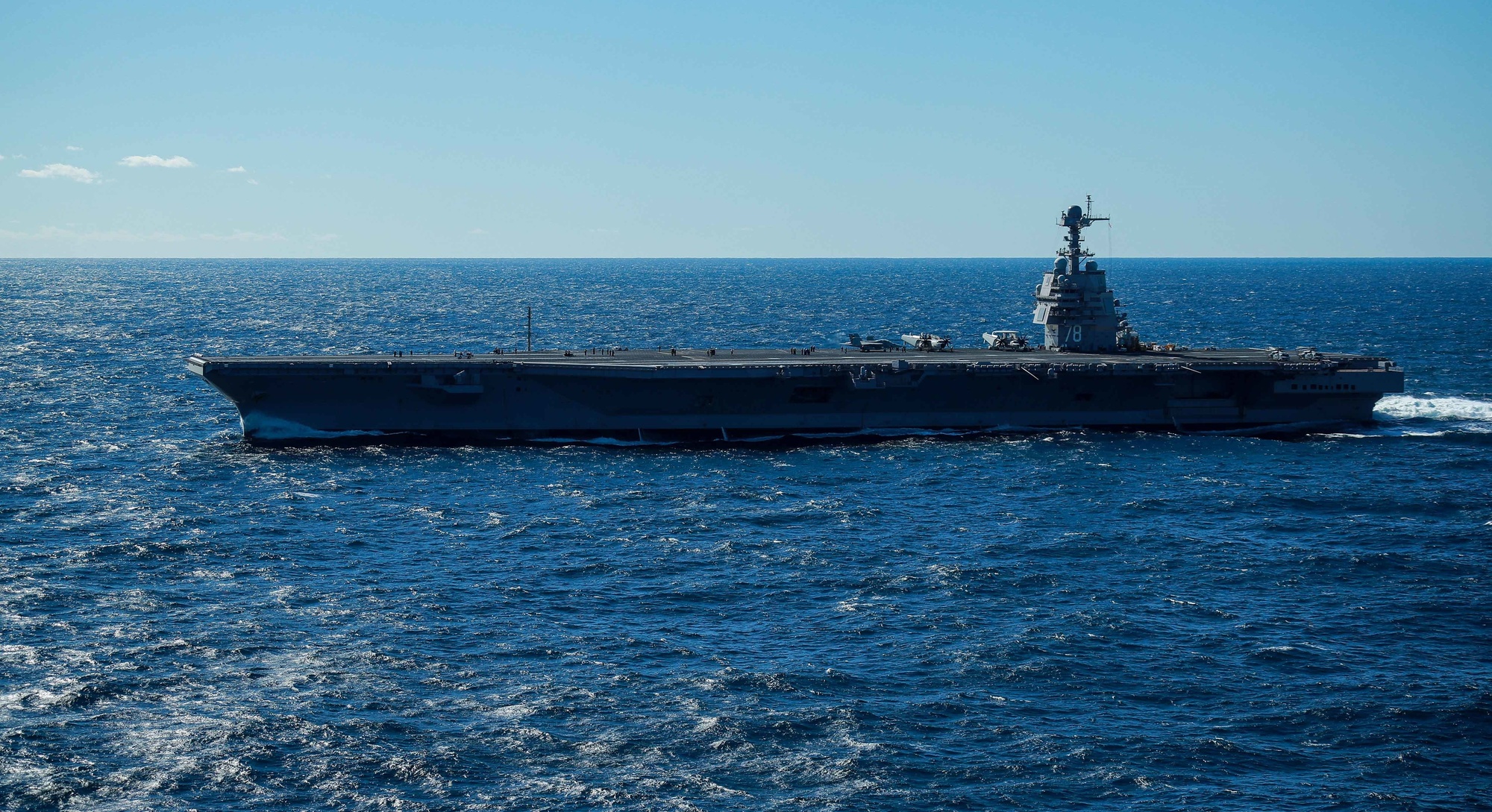
The USS Gerald R. Ford (CVN-78) underway. Nuclear propulsion, four EMALS catapults, and an air wing of 75+ aircraft make the Ford class the most capable carrier ever built. The U.S. Navy operates 11 carriers of this caliber. (U.S. Navy photo)
Air Wing Comparison: J-15 and J-35 vs. Super Hornet and F-35C
A carrier is only as effective as the aircraft it puts in the sky. This is where the comparison gets most revealing.
The J-15 Flying Shark
The J-15 is the backbone of Chinese carrier aviation today. It is a fourth-generation fighter derived from the Sukhoi Su-33, itself a carrier-adapted variant of the Su-27. Jane's Defence lists the J-15's maximum takeoff weight at approximately 33 tons in its land-based configuration. When operating from a ski-jump carrier, that figure drops significantly. The aircraft has been plagued by development issues, including reported structural concerns and weight problems that have limited its effectiveness as a strike platform. Chinese military commentary and state media have occasionally acknowledged the J-15's limitations, with the aircraft sometimes described as a stepping stone rather than a long-term solution.
The J-15T, a catapult-compatible variant, has been developed for the Fujian. Freed from the ski-jump's weight constraints, the J-15T should be able to carry its full weapons and fuel load, substantially improving its combat effectiveness compared to the same airframe operating from the Liaoning or Shandong.
The J-35: China's Carrier Stealth Fighter
The J-35, also known in earlier development as the FC-31 or J-31, is a twin-engine, medium-weight stealth fighter designed for carrier operations. It is roughly comparable in size and role to the F-35C, though direct comparison requires caution given how little is publicly known about the J-35's actual performance. The aircraft features conventional stealth shaping with canted vertical stabilizers, internal weapons bays, and an AESA radar. It first flew in prototype form in 2012, and a carrier-adapted variant has been in development for several years.
If the J-35 deploys aboard the Fujian, the PLAN would gain a fifth-generation carrier-based fighter, a capability that currently only the U.S. Navy possesses with the F-35C Lightning II. The strategic significance here is hard to overstate. Stealth aircraft fundamentally change the air combat equation by allowing a carrier to project offensive power into environments defended by modern surface-to-air missile systems. A non-stealth carrier air wing, like the current J-15 force, is increasingly vulnerable to advanced air defenses. A stealth air wing is not invulnerable, but it forces the defender to solve a much harder detection and engagement problem.
Germany's Leopard 2A4 in NATO three-tone camouflage. Same Panzerkampf build quality as the Abrams with a rotating turret and the Leopard's distinctive flat turret profile.
How the J-35 compares to the F-35C in actual performance (radar cross-section, sensor fusion, electronic warfare capability, weapons integration, engine reliability) is unknown outside classified channels. What is known is that Shenyang Aircraft Corporation developed the J-35 over a much shorter timeline than Lockheed Martin's F-35 program, which faced years of delays, cost overruns, and software development challenges well documented by the Government Accountability Office. Whether China's faster development timeline reflects greater efficiency or shortcuts that will manifest as operational problems remains to be seen.
The American Air Wing
According to CRS, a Ford-class carrier's air wing typically includes approximately 44 F/A-18E/F Super Hornets and F-35Cs for strike and air superiority, 5 EA-18G Growlers for electronic warfare, 5 E-2D Advanced Hawkeyes for airborne early warning, 2 C-2A Greyhounds or CMV-22B Ospreys for carrier onboard delivery, and a mix of MH-60R and MH-60S helicopters for anti-submarine and logistics missions. The total exceeds 75 aircraft.
The F-35C is the centerpiece of the modernized air wing. Its combination of stealth, sensor fusion, and network connectivity transforms the carrier from a strike platform into a node in a distributed sensor network. The F-35C can detect, identify, and share targeting data on threats at ranges and in conditions where the J-15 cannot operate. The EA-18G Growler provides dedicated electronic attack capability, jamming enemy radars and communications, that no Chinese carrier aircraft currently replicates. The E-2D Hawkeye provides a level of airborne battle management that helicopter-based AEW cannot approach.
The air wing advantage is where the U.S. Navy's lead is most pronounced, and where the gap will be slowest to close. Building stealth fighters and AEW aircraft is necessary but not sufficient. The U.S. Navy has spent decades integrating these platforms into a coherent strike package, developing the tactics, training, and procedures that allow an air wing to conduct complex operations in contested environments. The PLAN is starting this process from scratch. For a deeper look at how American carriers defend themselves and their strike groups, see our breakdown of how aircraft carriers are defended.
The Experience Gap
The most important advantage the U.S. Navy holds over the PLAN is not a weapons system. It is institutional experience. The U.S. Navy has operated aircraft carriers continuously since World War II. Eight decades of carrier operations have produced a body of knowledge, accumulated through combat, accidents, near-misses, and countless exercises, that cannot be replicated on a shorter timeline.
The U.S. Navy knows how to conduct sustained carrier air operations in hostile environments because it has done so in Korea, Vietnam, the Gulf Wars, Libya, Afghanistan, and Syria. It knows how to recover from flight deck fires, manage ordnance in combat, coordinate multi-carrier operations, and sustain a carrier strike group on deployment for eight or nine months at a time, thousands of miles from home port. This knowledge is embedded not just in doctrine manuals but in the judgment of thousands of officers, chiefs, and sailors who have lived it.
The PLAN has operated fixed-wing carrier aviation since 2012, roughly 14 years. It has never conducted combat flight operations from a carrier. It has never sustained a carrier deployment lasting more than a few weeks. It has never coordinated carrier operations with allied navies in a combat environment. The Liaoning and Shandong have trained intensively, and as the DoD's annual China Military Power Report has noted, the pace and complexity of their exercises have increased markedly each year. But training is not combat, and a decade of peacetime operations cannot substitute for the institutional knowledge that comes from actually fighting at sea.
This gap is real but not permanent. Every navy that has operated carriers started without experience and built it over time. The U.S. Navy itself suffered catastrophic carrier losses early in World War II and learned from them. China's military leadership is acutely aware of this deficit and is investing heavily in realistic training, including what CSIS analysts have described as increasingly complex "blue vs. red" exercises that simulate contested operations. The experience gap is narrowing, but it remains substantial.
The Numbers: 11 vs. 3
No analysis of the carrier balance is complete without addressing the raw numerical disparity. The United States operates 11 nuclear-powered supercarriers, 10 Nimitz-class and 1 Ford-class, with additional Ford-class ships under construction. China operates 3 conventionally powered carriers, one of which (the Fujian) is not yet fully operational. For a full accounting of every operational carrier worldwide, see our complete guide to active aircraft carriers.
A complete box with kit, Humbrol paints matched to the color scheme, poly cement, and a brush. No separate purchases needed. The Wellington builds into an 11-inch-wingspan twin-engine bomber at 1/72. 1,039 reviews at 4.6 stars.
In aggregate tonnage, the U.S. carrier fleet displaces more than one million tons. China's three carriers displace roughly 206,000 tons combined. The U.S. fleet carries more than 800 carrier-based aircraft. China's fleet, at full capacity, carries approximately 100-120. The U.S. has four carrier strike groups that can deploy simultaneously to different theaters worldwide. China has, at most, two deployable carrier groups, and that assumes the Fujian is operational.
The disparity is overwhelming in global terms. But strategy is not global in the abstract; it is local in practice. In a Taiwan contingency, the U.S. would likely deploy two to three carrier strike groups to the Western Pacific. China would operate its carriers under the protective umbrella of land-based aircraft, land-based anti-ship missiles (including the DF-21D and DF-26, which the DoD has labeled "carrier killer" ballistic missiles), and shore-based radar and electronic warfare systems. In that specific geographic context, the three-to-eleven ratio matters less than the question of whether American carriers can operate within range of Chinese land-based firepower at all.
This is the strategic logic behind China's carrier program. The PLAN does not need to match the U.S. Navy carrier for carrier across the globe. It needs enough carrier capability to extend its air defense and strike envelope beyond the range of land-based assets, complicate American operational planning, and assert sea control in the waters closest to China. Three carriers, operating with land-based support, may be sufficient for those objectives even if they could never match 11 American supercarriers in open-ocean combat. For a broader analysis of China's overall military buildup, including its missile forces and the A2/AD strategy that shapes how its carriers would actually be employed, see our companion piece.
Looking Ahead: Type 004 and the J-35
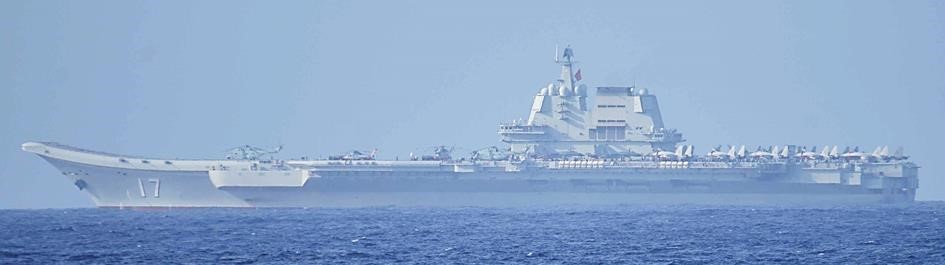
The Shandong (CV-17) operating in the South China Sea with PLAN escort vessels. As China's first domestically built carrier, the Shandong represents the middle step in a rapid three-ship evolution from refurbished Soviet hull to indigenous EMALS-equipped supercarrier. (Photo via Chinese state media)
The trajectory of China's carrier program points toward a fourth carrier, designated the Type 004, that could close several of the remaining gaps with the U.S. Navy. Satellite imagery analyzed by CSIS and other organizations shows construction activity at Chinese shipyards consistent with early-stage carrier construction. The DoD's 2025 China Military Power Report assesses that the PLAN intends to operate a fleet of at least six carriers.
The key question surrounding the Type 004 is propulsion. If it is nuclear-powered, as some analysts at IISS and elsewhere have assessed, it would give the PLAN a carrier with effectively unlimited range and the ability to sustain high-tempo operations without fuel constraints. China has experience with naval nuclear reactors through its submarine fleet, but scaling that technology to a carrier of 80,000-100,000 tons is a significant engineering challenge that should not be underestimated. The U.S. Navy's experience with the A1B reactor for the Ford class involved decades of development building on a half-century of carrier nuclear propulsion experience. Whether China can compress that timeline is an open question.
The J-35's integration into carrier operations will be equally consequential. A fifth-generation stealth fighter operating from an EMALS-equipped carrier, supported by a fixed-wing AEW platform, would give the PLAN a qualitatively different capability than anything it has fielded before. It would transform the Fujian from a large conventional carrier into something approaching the strike and air defense capability that has long been the exclusive domain of U.S. Navy carrier aviation. The J-35's actual performance in this role, its radar cross-section, sensor capability, weapons integration, and pilot training, will determine whether this potential becomes reality.
The United States is not standing still. The Ford class will eventually include four ships: the Gerald R. Ford (CVN-78), the John F. Kennedy (CVN-79, under construction), the Enterprise (CVN-80, under construction), and the Doris Miller (CVN-81, under construction). The F-35C is deploying in increasing numbers across the carrier fleet. The MQ-25 Stingray, an unmanned tanker designed to extend the range of carrier-based fighters, is in development and will address one of the carrier air wing's most significant limitations. The Navy is also investing in the Next Generation Air Dominance (NGAD) program, elements of which could eventually deploy aboard carriers, though the current F/A-XX effort remains in its early stages. For more on America's latest carrier, see our deep dive on the Ford-class supercarrier.
Where the Gap Is Closing Fastest
Not all aspects of the carrier competition are moving at the same speed. In some areas, China's progress has been remarkably fast. In others, the gap remains vast.
Closing fast: Shipbuilding capacity. China builds more ships, faster, than any other nation. According to the DoD's China Military Power Report, Chinese shipyards can construct carriers, destroyers, frigates, and submarines simultaneously at a pace the U.S. cannot match. The Fujian went from keel-laying to launch in approximately three years. The Ford took over a decade from keel-laying to commissioning. China's industrial capacity is its single greatest structural advantage in the carrier competition.
The twin-boom P-38L in the Pacific Theater livery of the 475th Fighter Group. Features the "Putt Putt Maru" nose art, counter-rotating props, and Corgi's Aviation Archive packaging.
Closing fast: Launch technology. The Fujian's EMALS puts China in a category that, until now, only the United States occupied. The technology gap in catapult launch systems has effectively been closed, at least on paper. Whether China's EMALS achieves the reliability and sortie rates of the Ford's system under operational conditions remains to be demonstrated.
Closing: Air wing modernization. The J-35 and KJ-600 represent a qualitative leap. If both platforms deliver as expected, the Fujian's air wing will be comparable in concept, if not yet in sophistication, to an American carrier air wing. The transition from a J-15-only force to a J-35/KJ-600 force is the most significant single upgrade in PLAN carrier aviation capability.
Not closing fast: Nuclear propulsion. China has not yet demonstrated the ability to build a nuclear-powered carrier. This gap, if and when it closes, will likely take a decade or more from the Type 004's keel-laying to an operational nuclear carrier. The U.S. Navy has over 60 years of carrier nuclear propulsion experience.
Not closing fast: Operational experience. There is no shortcut for this. Every year of PLAN carrier operations narrows the experience gap incrementally, but catching up to 80 years of American carrier aviation will take a generation, not a decade.
Not closing fast: Global logistics. The U.S. Navy maintains a worldwide network of bases, replenishment ships, and allied partnerships that sustain carrier operations in every ocean. As the IISS has documented, China has one overseas military base (Djibouti) and limited underway replenishment capability compared to the U.S. Navy's Military Sealift Command. Sustaining carrier operations far from Chinese waters remains a fundamental constraint.
The Honest Assessment
China's carrier program deserves to be taken seriously. In 14 years, the PLAN has gone from zero fixed-wing carrier capability to operating three carriers, including one that features the same electromagnetic launch technology as America's most advanced warship. The pace of this development has no peacetime equivalent. China's shipbuilding capacity, willingness to invest, and systematic approach to closing capability gaps are real advantages that will continue to produce results.
But taking the program seriously also means being honest about what it has not yet achieved. China's carrier force has never launched a combat sortie. Its air wings are small, built around a fourth-generation fighter with known limitations, and have not yet integrated the stealth fighters and fixed-wing AEW aircraft that would transform their capability. The PLAN lacks nuclear-powered carriers, which constrains its ability to project carrier power globally. And the United States operates 11 supercarriers with decades of combat experience, a massive advantage that no amount of shipbuilding can neutralize quickly.
The most accurate way to characterize the current balance is this: in the waters closest to China, the Taiwan Strait, the South China Sea, the East China Sea, the PLAN's carrier force, operating under the protection of land-based missiles and aircraft, is becoming a credible factor that U.S. planners must account for. In open-ocean, blue-water carrier operations far from Chinese shores, the U.S. Navy's advantage remains overwhelming and will not be seriously challenged for years, possibly decades. The carrier gap is narrowing in the geographic area that matters most to Beijing, and widening or holding steady everywhere else.
Frequently Asked Questions
How many aircraft carriers does China have?
China operates three aircraft carriers as of early 2026: the Liaoning (CV-16), commissioned in 2012; the Shandong (CV-17), commissioned in 2019; and the Fujian (CV-18), which was launched in 2022 and is undergoing sea trials. A fourth carrier, designated the Type 004, is reportedly in early stages of construction. The DoD assesses China intends to operate a fleet of at least six carriers.
Does China have electromagnetic catapults on its carriers?
Yes, but only on the Fujian (CV-18). The Fujian is equipped with three electromagnetic aircraft launch systems (EMALS), making China only the second country after the United States to install this technology on a carrier. The Liaoning and Shandong use ski-jump ramps instead of catapults. EMALS allows the Fujian to launch heavier aircraft with greater weapons and fuel loads, including fixed-wing airborne early warning aircraft that ski-jump carriers cannot support.
How does the Fujian compare to the USS Gerald R. Ford?
The Fujian is approximately 80,000 tons compared to the Ford's 100,000 tons. Both use electromagnetic catapults, but the Ford has four EMALS tracks to the Fujian's three. The Ford is nuclear-powered; the Fujian is conventionally powered. The Ford carries 75+ aircraft; the Fujian is estimated to carry 40-50. The Ford's air wing includes the F-35C stealth fighter and E-2D Hawkeye AEW aircraft, both mature and combat-proven. The Fujian's projected air wing, the J-35 and KJ-600, have not yet completed carrier integration. The Fujian is a significant ship, but it remains smaller, conventionally powered, and reliant on aircraft still in development.
What is the J-35 and will it fly from Chinese carriers?
The J-35 (also known in earlier development as the FC-31 or J-31) is a twin-engine, medium-weight stealth fighter developed by Shenyang Aircraft Corporation. It is designed for carrier operations aboard the Fujian and is roughly comparable in size and role to the U.S. Navy's F-35C. If successfully deployed, it would make China only the second nation to operate stealth fighters from aircraft carriers. The J-35's actual radar cross-section, sensor fusion capability, and combat effectiveness relative to the F-35C are unknown from open sources.
Will China build a nuclear-powered aircraft carrier?
Possibly. The Type 004, China's fourth carrier reportedly in early construction, may feature nuclear propulsion. China has experience with naval nuclear reactors through its submarine fleet, but scaling that technology to a carrier of 80,000-100,000 tons is a major engineering challenge. A nuclear-powered carrier would give the PLAN unlimited range and the ability to sustain high-tempo operations without refueling, closing one of the most significant remaining gaps with U.S. carriers. However, this has not been confirmed by official Chinese sources, and even optimistic timelines suggest an operational nuclear carrier is a decade or more away.
Could China's carriers threaten U.S. Navy carriers in a conflict?
In open ocean, no. The U.S. Navy's advantage in carrier numbers, air wing capability, nuclear propulsion, and operational experience makes a direct carrier-vs-carrier engagement highly unfavorable for the PLAN. However, China's carriers are not designed to fight American carriers in the open Pacific. They are designed to operate under the protective umbrella of China's land-based missiles, aircraft, and anti-access/area-denial systems in waters close to the Chinese mainland. In that context, PLAN carriers extend China's defensive and offensive envelope, complicate U.S. planning, and force American commanders to account for additional threat axes. The threat is indirect: not a carrier duel, but a layered defense system in which carriers play one important role among many.