Skip to content
May 5:Battle of Puebla: Cinco de Mayo164yr ago

USS Gerald R. Ford: Inside the Most Advanced Aircraft Carrier Ever Built

Michael Trent · · 18 min read
Save
Share:
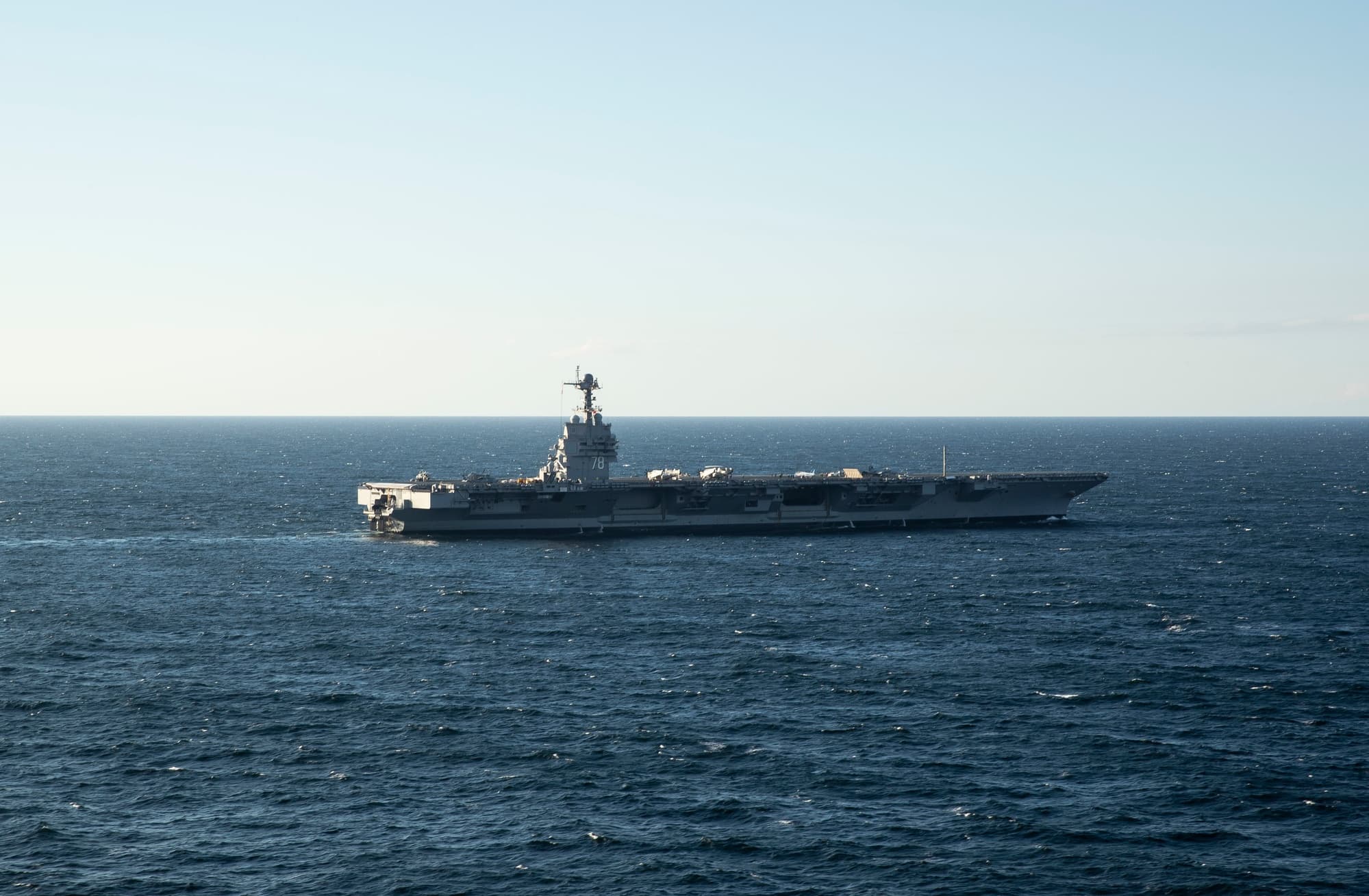
USS Gerald R. Ford aircraft carrier underway at sea with aircraft on the flight deck
Michael Trent
Michael Trent

Defense Systems Analyst

Michael Trent covers military aircraft, weapons systems, and defense technology with an emphasis on cost, maintenance, and real-world performance. He focuses less on specifications and more on how systems hold up once they are deployed, maintained, and operated at scale.

The USS Gerald R. Ford (CVN-78) is either the most impressive engineering achievement in naval history or the most expensive lesson in defense procurement ever funded by American taxpayers. The truth, as it usually does, lands somewhere between those poles. At a final construction cost of approximately $13.3 billion, according to the Government Accountability Office (GAO), the Ford is the most expensive warship ever built. It is also, by virtually every technical measure, the most capable. What makes the Ford story worth examining in detail is not the price tag alone but what the Navy actually got for the money, and what it cost in time, political capital, and institutional patience to get there.

The Ford-class represents the first clean-sheet aircraft carrier design the United States has produced in over four decades. Every major system aboard CVN-78, from the way it launches aircraft to the way it moves weapons from magazine to flight deck, was redesigned from the ground up. Some of those new systems worked as promised. Others took years longer than anyone projected. Understanding the Ford requires looking honestly at both sides of that ledger.

Origins: Why the Navy Needed a New Carrier Design

The Nimitz-class aircraft carrier has been the backbone of American naval power since USS Nimitz (CVN-68) was commissioned in 1975. Ten ships in the class were built over a span of more than three decades, with the final ship, USS George H.W. Bush (CVN-77), commissioned in 2009. By the time CVN-77 was under construction, the Navy recognized that the Nimitz design, excellent as it was, had been pushed to its practical limits. The steam catapult systems, hydraulic arresting gear, and legacy reactor plants could not easily accommodate the increasing electrical demands of modern sensors, weapons, and aircraft.

The CVN-21 program, which eventually became the Ford-class, was initiated in the early 2000s with an ambitious goal: design a carrier that could generate significantly more combat power with fewer sailors, lower operating costs, and enough built-in electrical and physical capacity to absorb technologies that had not yet been invented. According to Congressional Research Service (CRS) reports on the program, the Navy set a target of a 25% increase in sortie generation rate (the number of aircraft missions launched per day) compared to the Nimitz-class. The Navy also wanted a crew reduction of roughly 600 to 800 sailors per ship, which would save billions in personnel costs across a 50-year service life. And it wanted a power plant that could produce three times the electrical power of the Nimitz's reactors, anticipating the energy demands of future directed-energy weapons, advanced radar systems, and electromagnetic launch technology.

These were not incremental improvements. They required replacing virtually every major system on the ship with something new. The decision to develop multiple first-of-kind technologies simultaneously and integrate them into a single platform is the root cause of both the Ford's remarkable capabilities and its well-documented struggles.

Construction and Cost

Huntington Ingalls Industries (HII) at Newport News Shipbuilding in Newport News, Virginia, is the only shipyard in the United States capable of building nuclear-powered aircraft carriers. The keel for CVN-78 was laid on November 13, 2009, and the ship was christened on November 9, 2013. President Donald Trump commissioned the vessel on July 22, 2017, at Naval Station Norfolk.

The cost numbers require some context. The Navy's original estimate for the lead ship was approximately $10.5 billion in then-year dollars. By the time CVN-78 was delivered, the construction cost had grown to roughly $13.3 billion. The GAO attributed approximately $2.4 billion of that overrun to the concurrent development and integration of new technologies, particularly EMALS, the Advanced Arresting Gear, the Dual Band Radar, and the Advanced Weapons Elevators. Developing these systems while simultaneously building the ship they were intended for proved far more complex than initial planning assumed.

For perspective, the final Nimitz-class carrier, CVN-77, cost approximately $6.2 billion. But that ship used mature, well-understood systems refined across nine previous hulls. The Ford carried the entire non-recurring engineering cost of a new class, a burden that will not be repeated on subsequent ships. According to the Navy's FY2025 budget documents, CVN-79 (USS John F. Kennedy) and CVN-80 (USS Enterprise) are projected to cost substantially less per hull as the new technologies mature and production efficiencies are realized.

The A1B Nuclear Reactor: Power for the Next 50 Years

At the heart of CVN-78 sit two Bechtel A1B nuclear reactors. These are not upgraded versions of the Nimitz-class A4W reactor. They are an entirely new design, engineered to produce approximately 250% more electrical power than the Nimitz plant while requiring significantly fewer personnel to operate and maintain.

The exact power output is classified, but Naval Reactors program documentation states that the A1B plant generates roughly 600 megawatts of thermal energy, translating to approximately 200 megawatts of usable electrical power. For context, this is enough electricity to power a city of 100,000 people. The Nimitz-class reactors produced enough surplus electricity for the ship's existing systems but had little margin for growth. The Ford's reactors were deliberately oversized to provide a massive reserve of electrical capacity.

That reserve is not academic. It exists specifically to power systems that are already in development or projected for future installation: directed-energy weapons such as high-energy lasers, advanced electronic warfare systems, and the electromagnetic catapults that replace steam. The A1B also features a simplified design that reduces the number of reactor plant components, which Naval Sea Systems Command estimates will cut maintenance requirements and the number of sailors needed in the reactor department.

Like all U.S. Navy reactor plants, the A1B is designed for the expected 50-year service life of the carrier. Because the reactor cores contain enough enriched uranium to power the ship for its entire operational life, the Ford will never need to be refueled. This eliminates the costly Refueling and Complex Overhaul (RCOH) that Nimitz-class carriers undergo at the midpoint of their service lives, a process that takes approximately four years and costs several billion dollars.

USS Gerald R. Ford under construction at Newport News Shipbuilding
CVN-78 under construction at Huntington Ingalls Industries Newport News Shipbuilding. The Ford-class is the first new carrier design since the Nimitz-class, requiring the development of multiple first-of-kind technologies simultaneously. U.S. Navy photo.

EMALS: Replacing Steam with Electromagnetism

The Electromagnetic Aircraft Launch System (EMALS) is arguably the single most consequential technology aboard the Ford. For more than six decades, every American aircraft carrier launched planes using steam catapults. These systems harness high-pressure steam from the ship's reactor plant and channel it through massive cylinders to accelerate aircraft from zero to flying speed in roughly two seconds across 300 feet of flight deck. Steam catapults work, but they are brutally powerful, mechanically complex, maintenance-intensive, and limited in their ability to precisely control the energy delivered to each launch.

EMALS replaces all of that with a linear induction motor, essentially a scaled-up version of the electromagnetic technology used in maglev trains and roller coasters. Instead of steam pressure, EMALS uses stored electrical energy, discharged through a sequence of electromagnetic coils, to accelerate a shuttle along the catapult track. The advantages are significant and measurable.

First, energy precision. Steam catapults deliver a fixed amount of energy to every launch, regardless of whether the aircraft weighs 20,000 pounds or 60,000 pounds. The excess energy on lighter aircraft translates to greater structural stress, which is one reason naval aircraft require heavier, more expensive airframes than their land-based equivalents. EMALS can dial its energy output up or down for each individual launch, reducing stress on lighter aircraft and enabling the launch of unmanned aerial vehicles that are too fragile for steam catapult forces. This capability is critical for integrating the next generation of carrier-based drones.

Second, sortie rate. EMALS recharges faster than a steam catapult can recycle. The system stores energy in a flywheel-based energy storage system that can be recharged in minutes, enabling a higher launch tempo. According to the Navy's program office, EMALS contributes directly to the Ford's goal of generating 25% more sorties per day than a Nimitz-class carrier.

Third, maintenance. Steam catapults require enormous infrastructure below decks: boiler systems, steam accumulators, miles of high-pressure piping, and dedicated maintenance crews. EMALS has a significantly smaller footprint and fewer moving parts. General Atomics, the system's manufacturer, reports a 20% reduction in catapult maintenance man-hours compared to the steam systems it replaces.

The development path for EMALS was not smooth. The system experienced reliability problems during early testing, with a mean cycles between critical failure rate that was well below the Navy's requirement. The Department of Defense's Director of Operational Test and Evaluation (DOT&E) flagged these shortfalls in multiple annual reports. General Atomics worked through multiple design iterations to address the issues. By the time the Ford completed its first deployment in 2023, EMALS had demonstrated substantial reliability improvements, successfully launching thousands of aircraft during both testing and operational use. The system is not yet at the reliability level the Navy ultimately requires for mature production, but it has proven the fundamental concept works at operational scale.

Advanced Arresting Gear: The Other Side of the Flight Deck

Less discussed than EMALS but equally important is the Advanced Arresting Gear (AAG), which replaces the Mk 7 hydraulic arresting system used on Nimitz-class carriers. The existing system uses massive hydraulic rams to absorb the kinetic energy of a landing aircraft, a proven but mechanically brutal approach that delivers punishing deceleration forces to both aircraft and aircrew.

AAG uses a water turbine and an induction motor to absorb landing energy with far greater precision. Like EMALS, it can adjust its energy absorption for each individual recovery, reducing peak loads on lighter aircraft by as much as 15%. This is not a minor consideration: the repeated stress of carrier landings is one of the primary factors limiting the structural life of naval aircraft. Reducing those loads means longer airframe life, lower maintenance costs, and the ability to recover a broader range of aircraft types, including unmanned platforms that cannot survive the brutal deceleration of legacy arresting gear.

AAG also experienced development challenges, including reliability issues and cost growth. As with EMALS, these problems were real but have been progressively addressed through engineering iteration. The system performed operationally during the Ford's 2023 deployment.

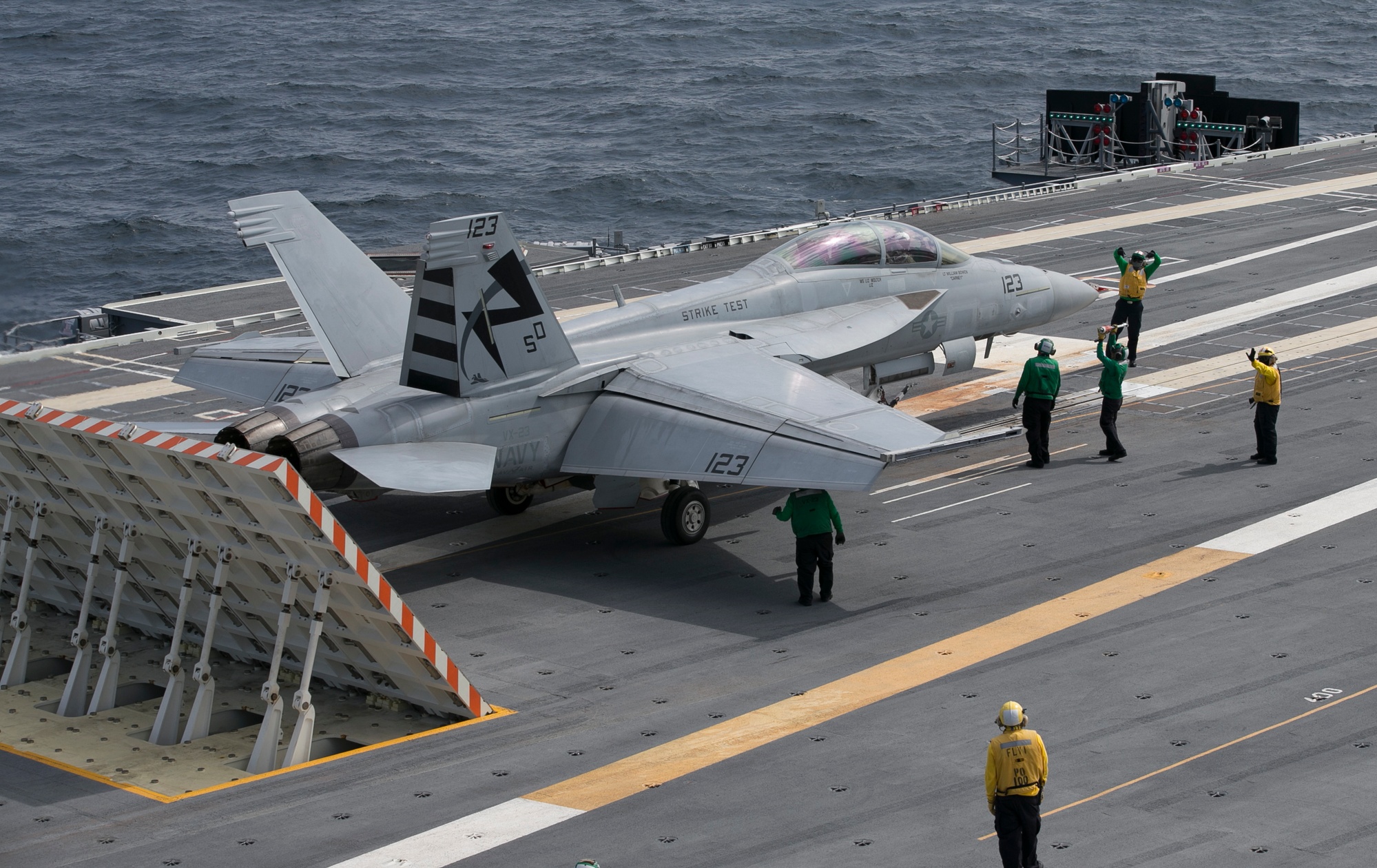
Aircraft launching from USS Gerald R. Ford using the EMALS electromagnetic catapult system
An F/A-18 Super Hornet launches from USS Gerald R. Ford using the Electromagnetic Aircraft Launch System (EMALS). The system replaces steam catapults with electromagnetic technology, enabling more precise launches and higher sortie rates. U.S. Navy photo.

The Advanced Weapons Elevator Saga

If there is a single system that became the symbol of the Ford's development struggles, it is the Advanced Weapons Elevator (AWE). The Ford was designed with 11 electrically powered weapons elevators to replace the traditional hydraulic elevators used on Nimitz-class carriers. These elevators move ordnance (bombs, missiles, and ammunition) from the ship's magazines deep in the hull up to the flight deck and the aircraft that need them. The speed and reliability of weapons elevators directly affect sortie generation rate, because aircraft cannot fly combat missions without ordnance.

The new elevators use electromagnetic linear synchronous motors, similar in principle to EMALS, to move ordnance at significantly higher speeds than hydraulic systems. They are designed to be faster, more reliable, and easier to maintain. In concept, they represent a genuine improvement. In practice, they became the Ford's most visible and politically embarrassing problem.

When CVN-78 was delivered to the Navy in May 2017, none of the 11 Advanced Weapons Elevators were operational. This was an extraordinary situation: the Navy accepted delivery of its most expensive warship without a functional ordnance handling system. Over the following years, the elevators were completed and tested one by one, a painstaking process that involved redesigning electrical components, replacing faulty motors, and resolving integration issues that had not been anticipated during the design phase. Huntington Ingalls Industries confirmed that the final elevator was completed in late 2023, roughly six years after the ship was commissioned.

The delay was caused by a combination of factors: immature technology pushed into production before testing was complete, integration challenges between the elevators and the ship's broader electrical distribution system, and quality control issues with components from multiple suppliers. In its annual assessments, the GAO cited the weapons elevators as the most significant example of the risks inherent in concurrent development, where a ship is being built while the systems that go inside it are still being designed.

The good news is that once operational, the Advanced Weapons Elevators performed as designed. They move ordnance faster than legacy hydraulic elevators, and they eliminate the maintenance-intensive hydraulic systems that require constant attention on Nimitz-class ships. The bad news is that the six-year delay to achieve full capability was a self-inflicted wound that consumed political capital and provided ammunition to critics of the Ford program.

Dual Band Radar and Sensors

The Ford's sensor suite is built around the Dual Band Radar (DBR), which combines two radar systems into an integrated architecture: the AN/SPY-3 X-band multifunction radar and the AN/SPY-4 S-band volume search radar. The X-band radar provides precision tracking and missile illumination at shorter ranges, while the S-band radar provides long-range volume search and air traffic control capability. Together, they give the Ford a more comprehensive air picture than any previous carrier.

However, in one of the program's cost-reduction decisions, the Navy elected to remove the AN/SPY-4 S-band radar from CVN-78 and install only the AN/SPY-3. The full Dual Band Radar configuration is planned for future Ford-class ships. For CVN-78, the AN/SPY-3 operates alongside the existing AN/SPS-48E long-range air search radar to provide adequate coverage. Congressional Research Service analysis shows this decision reduced the cost of the lead ship but means the Ford does not yet carry the full sensor suite originally envisioned for the class.

The ship also features the Ship Self-Defense System (SSDS), which integrates data from all onboard sensors to provide automated threat detection and weapons coordination. Defensive armament includes two Rolling Airframe Missile (RAM) launchers, two Evolved Sea Sparrow Missile (ESSM) launchers, and three Phalanx Close-In Weapon System (CIWS) mounts.

Flight Deck and Air Wing

The Ford's flight deck covers approximately 4.5 acres and is configured to operate an air wing of 75 or more aircraft. The current Carrier Air Wing composition typically includes:

  • F/A-18E/F Super Hornets: The primary strike fighter, typically four squadrons
  • F-35C Lightning II: The Navy's fifth-generation stealth fighter, now integrating into carrier air wings
  • EA-18G Growlers: Electronic warfare aircraft for jamming and suppression of enemy air defenses
  • E-2D Advanced Hawkeye: Airborne early warning and battle management aircraft
  • CMV-22B Osprey: Carrier onboard delivery tiltrotor, replacing the retired C-2 Greyhound
  • MH-60R/S Seahawk helicopters: Anti-submarine warfare, search and rescue, and logistics
  • MQ-25 Stingray: Unmanned aerial refueling tanker, currently in testing and integration

The flight deck layout has been reconfigured compared to the Nimitz-class. The island (the superstructure that sits atop the flight deck) was moved approximately 140 feet further aft and reduced in size. This seemingly minor change has significant operational impact: it opens additional deck space forward, reduces interference with launch and recovery operations, and positions the island closer to the landing area for improved aircraft marshaling. Three of the four EMALS catapults are positioned forward, with the fourth on the waist, matching the Nimitz configuration but with the improved electromagnetic systems.

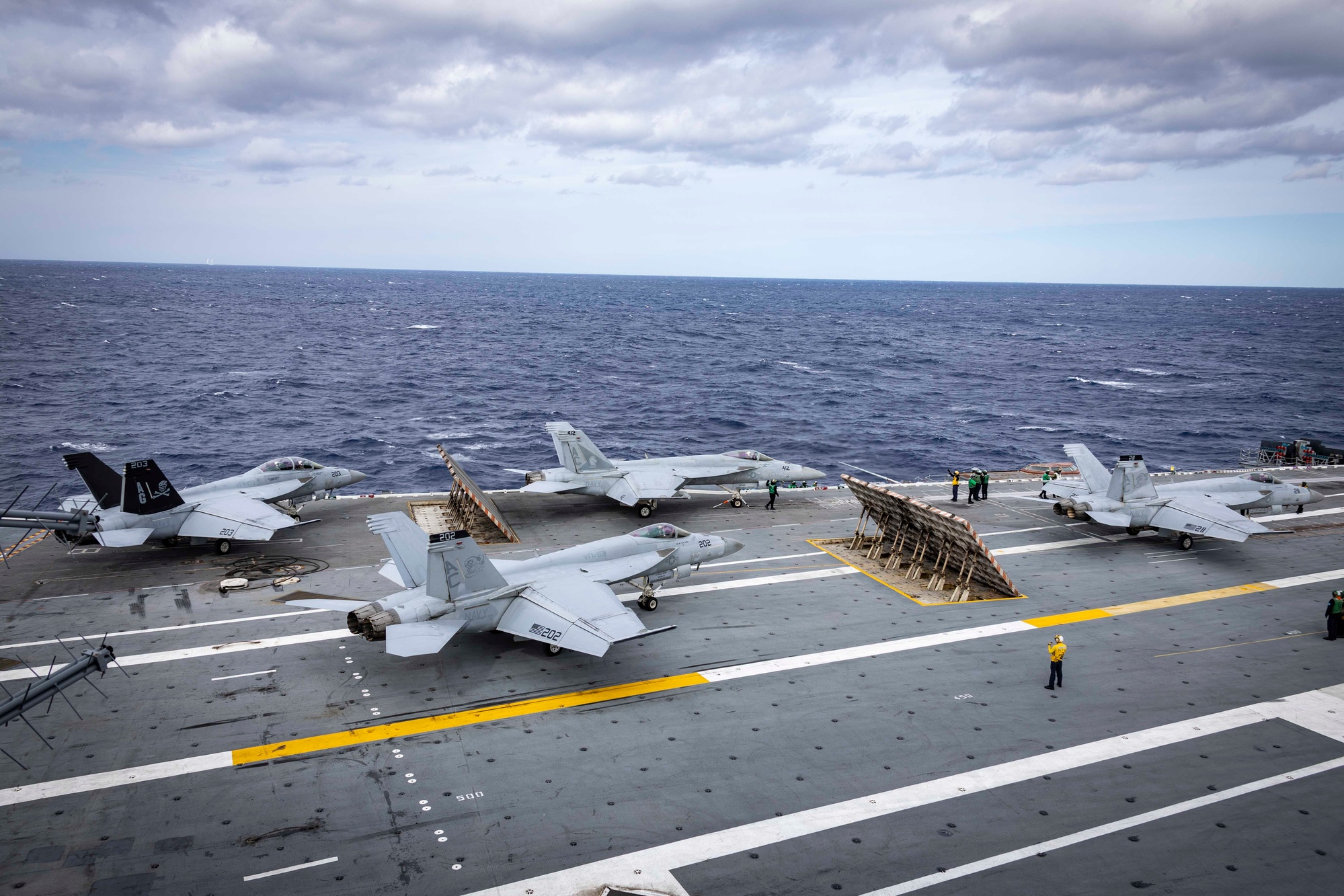
Aerial view of USS Gerald R. Ford flight deck with aircraft operations underway
The Ford's reconfigured flight deck features a smaller, repositioned island and electromagnetic catapults designed to increase sortie generation rate by 25% compared to Nimitz-class carriers. U.S. Navy photo.

Crew Reduction and Quality of Life

One of the Ford's less glamorous but financially critical design goals was reducing the crew. A Nimitz-class carrier operates with a ship's company of approximately 3,200, plus an air wing of roughly 2,480, for a total of about 5,680 personnel. The Ford was designed to reduce the ship's company to approximately 2,600, with the total crew (including air wing) at approximately 4,539. That reduction of over 1,100 sailors per ship translates to enormous savings over a 50-year service life. The Congressional Budget Office estimated crew-related cost savings of approximately $4 billion per hull across the ship's operational life.

The reduction is achieved through automation of systems that previously required manual operation: automated ordnance handling, reduced reactor plant manning, computerized damage control systems, and the elimination of the steam distribution infrastructure that required constant maintenance on Nimitz-class ships. The ship also features improved berthing compartments, better mess facilities, expanded gym spaces, and a modernized medical suite, all quality-of-life improvements that aid in recruitment and retention.

Ford-Class vs. Nimitz-Class: A Direct Comparison

Specification Nimitz-Class (CVN-68) Ford-Class (CVN-78)
Displacement (full load) ~97,000 long tons ~100,000 long tons
Length (overall) 1,092 feet 1,106 feet
Beam (flight deck) 252 feet 256 feet
Reactor Plant 2x Westinghouse A4W 2x Bechtel A1B
Electrical Generation ~64 MW ~200 MW (est.)
Speed 30+ knots 30+ knots
Aircraft Launch System 4x C-13 Steam Catapults 4x EMALS (electromagnetic)
Arresting Gear Mk 7 Hydraulic AAG (electromagnetic/turbine)
Weapons Elevators Hydraulic 11x Electromagnetic AWE
Aircraft Capacity 75+ 75+
Total Crew ~5,680 ~4,539
Sortie Rate ~120/day (surge) ~160/day (surge, projected)
Lead Ship Cost ~$4.5 billion (CVN-68, adjusted) ~$13.3 billion (CVN-78)
Designed Service Life 50 years 50 years
Mid-Life Refueling Required (RCOH) Not required

First Deployment: Proving Ground in the Eastern Mediterranean

USS Gerald R. Ford departed Naval Station Norfolk on May 2, 2023, for what the Navy designated its first operational deployment. The ship was initially deployed as part of a scheduled presence mission, but events overtook the original plan. Following the Hamas attack on Israel on October 7, 2023, the Ford Carrier Strike Group was ordered to the Eastern Mediterranean as a demonstration of American commitment to regional stability and as a deterrent against escalation by state actors, particularly Hezbollah and Iran.

The deployment marked the first time a Ford-class carrier conducted sustained combat-relevant operations in a real-world crisis. The Ford Strike Group, which included the guided-missile cruiser USS Normandy (CG-60) and several Arleigh Burke-class destroyers, maintained a presence in the Eastern Mediterranean for months, conducting flight operations and providing the National Command Authority with options in a rapidly evolving situation. While the Ford did not conduct offensive combat strikes during this deployment, its presence served as a tangible signal of American power projection capability.

From a systems perspective, the deployment provided invaluable data on the performance of EMALS, AAG, and the ship's other new technologies under sustained operational conditions. Per the Navy's post-deployment assessment, the ship's systems performed well, though specific reliability metrics were not publicly released. The deployment demonstrated that CVN-78, despite its protracted development, could function as an operational warship in a high-stakes environment.

The Ford-Class Program: What Comes Next

CVN-78 is the lead ship of a planned class of at least four carriers:

  • CVN-78, USS Gerald R. Ford: Commissioned July 22, 2017. First deployment completed 2023.
  • CVN-79, USS John F. Kennedy: Under construction at Newport News. Expected delivery in the mid-2020s. Benefits from lessons learned on CVN-78, with projected cost reductions of approximately 18%.
  • CVN-80, USS Enterprise: Construction underway. Named after the legendary CV-6 and CVN-65. Authorized alongside CVN-81 in a two-ship procurement deal designed to reduce cost through economies of scale.
  • CVN-81, USS Doris Miller: Named after the Pearl Harbor hero. Authorized for construction.

Each subsequent ship is expected to incorporate improvements based on the Ford's operational experience. CVN-79 and beyond will include the full Dual Band Radar, improved EMALS and AAG reliability, and refined weapons elevator systems. The Navy anticipates that mature Ford-class carriers will achieve substantial per-unit cost reductions compared to CVN-78, which bore the full non-recurring engineering burden for the class.

Honest Assessment: What Went Right and What Went Wrong

The Ford program's development history has been extensively documented by the GAO, the Congressional Research Service, the Navy's own testing organizations, and the Department of Defense's Director of Operational Test and Evaluation (DOT&E). Drawing from these sources, the ledger looks something like this.

What Went Right

  • The A1B reactor: Performed well from the start. Provides the electrical capacity the ship needs and eliminates mid-life refueling. This alone is worth billions in avoided lifecycle costs.
  • EMALS concept validation: Despite early reliability problems, EMALS has demonstrated that electromagnetic launch is operationally viable and superior in precision to steam catapults. The technology works.
  • Crew reduction: The automated systems that enable a smaller crew have largely performed as intended, validating the design philosophy of trading capital investment for reduced manning.
  • Ship design flexibility: The Ford's electrical architecture provides genuine margin for future growth. Directed-energy weapons, advanced sensors, and unmanned systems can be integrated without the wrenching modifications that would be required on a Nimitz hull.

What Went Wrong

  • Concurrent development: Building the ship while simultaneously developing its key technologies created schedule and cost risk that materialized exactly as critics predicted. The weapons elevators are the most prominent example, but EMALS and AAG also required more development time than planned.
  • Reliability shortfalls: Early testing revealed that EMALS and AAG were not meeting reliability requirements. While both systems have improved substantially, achieving the full design reliability remains an ongoing effort.
  • Cost growth: The roughly $2.8 billion in cost growth over the original estimate was driven primarily by technology maturation and integration challenges. While understandable in context, it eroded Congressional and public confidence in Navy cost estimates.
  • Schedule delays: CVN-78 was delivered approximately two years later than originally planned. The weapons elevators were not fully operational until roughly six years after commissioning.

The critical question is whether the Ford's development struggles reflect a fundamentally flawed acquisition strategy or the inevitable growing pains of a genuinely revolutionary platform. The evidence suggests the latter. The Navy attempted to develop too many new technologies concurrently, which created cascading integration problems. But the technologies themselves, including electromagnetic launch, precision arresting, and electromagnetic ordnance handling, represent genuine advances that will define carrier operations for the next half-century. The investment, while painful, was not wasted.

Strategic Context: Why Carriers Still Matter

The Ford enters service at a moment when the relevance of aircraft carriers is debated more intensely than at any time since the famous "Revolt of the Admirals" in 1949. Anti-ship ballistic missiles, hypersonic weapons, advanced submarines, and undersea threats all pose genuine challenges to carrier operations. Critics argue that a $13 billion ship is too valuable to risk and too expensive to lose.

Proponents counter that no other platform provides the combination of sustained air power, command and control capability, and political signaling that an aircraft carrier delivers. When the Ford Carrier Strike Group moved to the Eastern Mediterranean in October 2023, it communicated American resolve in a way that no land-based air wing, submarine force, or diplomatic statement could replicate. A carrier can operate in international waters without basing rights, host nation agreements, or overflight permissions. It brings its own airfield, its own fuel supply, and its own defensive systems. That sovereign capability remains uniquely valuable in an uncertain world.

The Ford-class was designed to maintain that capability against evolving threats. Its improved sensors, higher sortie rate, and capacity for future defensive systems are direct responses to the anti-access/area-denial (A2/AD) challenge posed by peer competitors. Whether those responses prove sufficient will be tested by time and circumstances. But the Ford represents the Navy's considered answer to the question of how to keep carrier aviation relevant for the next five decades.

Specifications: USS Gerald R. Ford (CVN-78)

Hull Number CVN-78
Class Gerald R. Ford-class (first of class)
Builder Huntington Ingalls Industries, Newport News, VA
Commissioned July 22, 2017
Home Port Naval Station Norfolk, Virginia
Displacement ~100,000 long tons (full load)
Length 1,106 feet (337 m)
Beam (flight deck) 256 feet (78 m)
Draft 39 feet (12 m)
Propulsion 2x Bechtel A1B nuclear reactors, 4 shafts
Speed 30+ knots
Total Crew ~4,539 (ship's company + air wing)
Aircraft Capacity 75+ fixed-wing and rotary-wing aircraft
Catapults 4x EMALS (Electromagnetic Aircraft Launch System)
Arresting Gear AAG (Advanced Arresting Gear)
Armament 2x RIM-116 RAM, 2x ESSM, 3x Phalanx CIWS
Construction Cost ~$13.3 billion
Designed Service Life 50 years

Frequently Asked Questions

How much did the USS Gerald R. Ford cost to build?

The construction cost of CVN-78 was approximately $13.3 billion, making it the most expensive warship ever built. This figure includes roughly $2.4 billion in cost growth beyond the original estimate, driven primarily by the concurrent development and integration of new technologies including EMALS, Advanced Arresting Gear, and the Advanced Weapons Elevators. The Navy projects that subsequent Ford-class carriers will cost significantly less per hull, as the non-recurring engineering costs were largely borne by the lead ship.

What is EMALS and why does the Ford use it instead of steam catapults?

EMALS (Electromagnetic Aircraft Launch System) is a linear induction motor that uses stored electrical energy to launch aircraft from the carrier's flight deck. It replaces the steam catapults that have been used on American carriers since the 1950s. EMALS offers several advantages: it can precisely control the energy delivered to each launch (reducing stress on lighter aircraft and unmanned systems), it recharges faster than steam catapults (increasing sortie rate), it has a smaller physical footprint below decks, and it requires fewer maintenance man-hours. EMALS was built by General Atomics.

How does the Ford compare in size to a Nimitz-class carrier?

The Ford is slightly larger than the Nimitz-class. CVN-78 is 1,106 feet long with a flight deck beam of 256 feet and a full-load displacement of approximately 100,000 long tons. A Nimitz-class carrier is 1,092 feet long with a 252-foot beam and displaces roughly 97,000 long tons. The external dimensions are similar, but the Ford's interior layout was substantially redesigned to accommodate new technologies and improve operational efficiency. The Ford also operates with approximately 1,100 fewer crew members than a Nimitz-class carrier.

What happened with the Ford's weapons elevators?

The Ford was designed with 11 Advanced Weapons Elevators (AWEs) using electromagnetic linear motors to move ordnance from magazines to the flight deck. When the ship was delivered in 2017, none of the elevators were operational, a significant embarrassment for the program. The elevators were completed incrementally over the following years, with the final unit becoming operational in late 2023. The delays were caused by immature technology, integration challenges with the ship's electrical systems, and component quality issues. Once operational, the elevators performed as designed, moving ordnance faster than the hydraulic systems they replaced.

Has the USS Gerald R. Ford seen combat?

The Ford completed its first operational deployment from May to October 2023. The deployment included sustained presence operations in the Eastern Mediterranean following the October 7, 2023, Hamas attack on Israel. The Ford Carrier Strike Group was positioned to deter escalation by regional actors and provide the National Command Authority with military options. While the Ford conducted extensive flight operations during this period, the ship did not conduct offensive combat strikes. The deployment nonetheless validated the ship's ability to operate in a high-stakes, real-world crisis environment.

How many Ford-class carriers will the Navy build?

The Navy currently plans to build at least four Ford-class carriers: CVN-78 (Gerald R. Ford), CVN-79 (John F. Kennedy), CVN-80 (Enterprise), and CVN-81 (Doris Miller). The Ford-class is intended to replace the Nimitz-class on a one-for-one basis as the older ships reach the end of their service lives, which could ultimately mean up to 10 or 11 Ford-class carriers if the Navy maintains its current force structure goal of 11 carrier strike groups.

For more on the Ford-class program, see our overview of the Ford-class carrier design. For a broader look at naval power, explore our guide to every active aircraft carrier in the world or our ranking of the most powerful attack submarines in 2026.

Share this article

Share:

Recommended

Ace of The Skies: Can You Identify These Military Aircraft Throughout The Years?
Test Yourself

Ace of The Skies: Can You Identify These Military Aircraft Throughout The Years?

Can you identify these aircraft?

Take the Quiz

Get Military News & History in Your Inbox

Join thousands of readers receiving our weekly digest of military technology, history, and analysis.

Test Your Knowledge