Skip to content
April 30:The Fall of Saigon51yr ago

Why the Next War Will Be Won by Whoever Builds the Better Logistics Network, Not the Better Weapon

James Holloway · · 12 min read
Save
Share:
U.S. Marines use a Norwegian cargo ship to transport military equipment for an Arctic exercise, demonstrating modern military logistics
James Holloway
James Holloway

Military Logistics & Sustainment Analyst

James Holloway writes about military readiness, logistics, and the practical limits of modern forces. His work focuses on how training, sustainment, and organizational decisions shape what militaries can actually do -- not just what they are designed to do on paper.

Amateurs study tactics. Professionals study logistics. The most quoted military truism is also the most ignored, until the supply chain breaks and the war is lost.

Defense analysts, media commentators, and even many military officers spend most of their time debating weapons platforms. Which fighter jet is faster. Which tank has thicker armor. Which missile flies farther. These comparisons dominate the discourse because they're dramatic and easy to understand. A stealth bomber is more interesting than a cargo ship.

But history delivers the same verdict, conflict after conflict: wars are decided not by who has the best weapons, but by who can sustain their forces in the field. The side that runs out of ammunition, fuel, food, or spare parts first loses, regardless of how advanced their equipment is. This was true in 1944, it was true in 1991, and it was brutally reconfirmed in Ukraine in 2022.

The Industrial Avalanche: How America Won WWII

The United States did not win World War II by building better weapons. German tanks were generally superior to American tanks. The Me 262 was the world's first operational jet fighter. Japanese Zero pilots were initially better trained than their American counterparts. By most qualitative measures, the U.S. military started the war at a technological and tactical disadvantage.

America won through industrial production on a scale that overwhelmed the enemy's ability to fight. Between 1941 and 1945, the United States produced 300,000 aircraft, 86,000 tanks, 2.7 million machine guns, and 41 billion rounds of ammunition. American shipyards launched a new Liberty cargo ship every 42 days at the program's peak. By 1944, the U.S. was outproducing Germany and Japan combined by a factor of roughly 10 to 1.

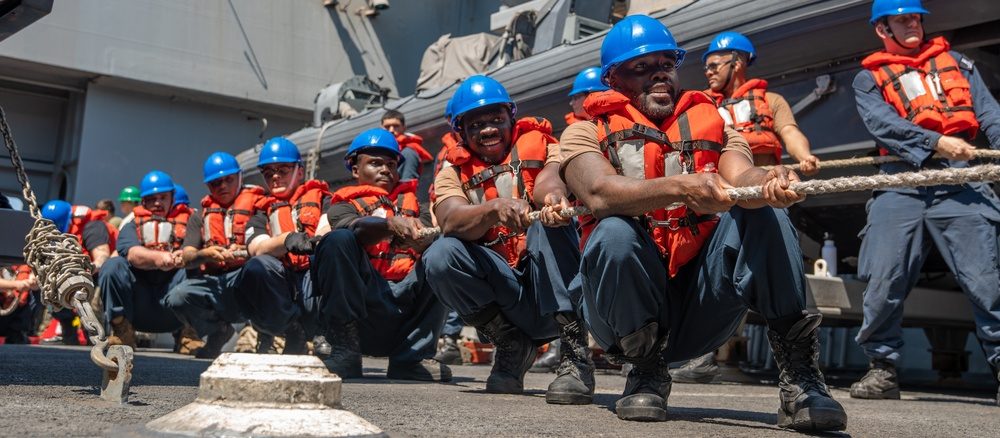
U.S. Navy sailors conduct an underway replenishment at sea between warships
Sailors steady heaving lines during an underway replenishment, the naval logistics capability that allows warships to stay on station for weeks without returning to port (U.S. Navy photo)

The German military recognized this problem. Field Marshal Erwin Rommel reportedly said: "The Americans know less about fighting than the British, but they know more about the supply of armies." Even when German units won tactical engagements, they couldn't replace their losses. Every Tiger tank destroyed took months and skilled craftsmen to replace. Every Sherman destroyed was replaced by three more coming off the assembly line.

The Soviet Union performed its own logistics miracle. In 1941, as German forces advanced, the Soviets relocated more than 1,500 factories east of the Ural Mountains, dismantling entire industrial complexes, loading them onto trains, and reassembling them in Siberia. By 1943, Soviet war production exceeded Germany's. The Soviets didn't have better factories. They had the logistical will to move their entire industrial base rather than let it be captured.

Desert Storm: The Logistics Rehearsal

Operation Desert Shield/Desert Storm demonstrated what modern American logistics could achieve when fully mobilized. Between August 1990 and February 1991, the U.S. military deployed over 500,000 troops, their equipment, and their supplies to Saudi Arabia, the largest military deployment since World War II.

The numbers are staggering. Military Sealift Command moved 9.7 million tons of cargo. Air Mobility Command flew 15,800 missions. The XVIII Airborne Corps, an entire corps of paratroopers and light infantry, shifted from defensive positions in the east to an assault position 300 miles west in a single movement, dragging their supply lines with them, to execute the famous "left hook" that outflanked Iraqi defenses.

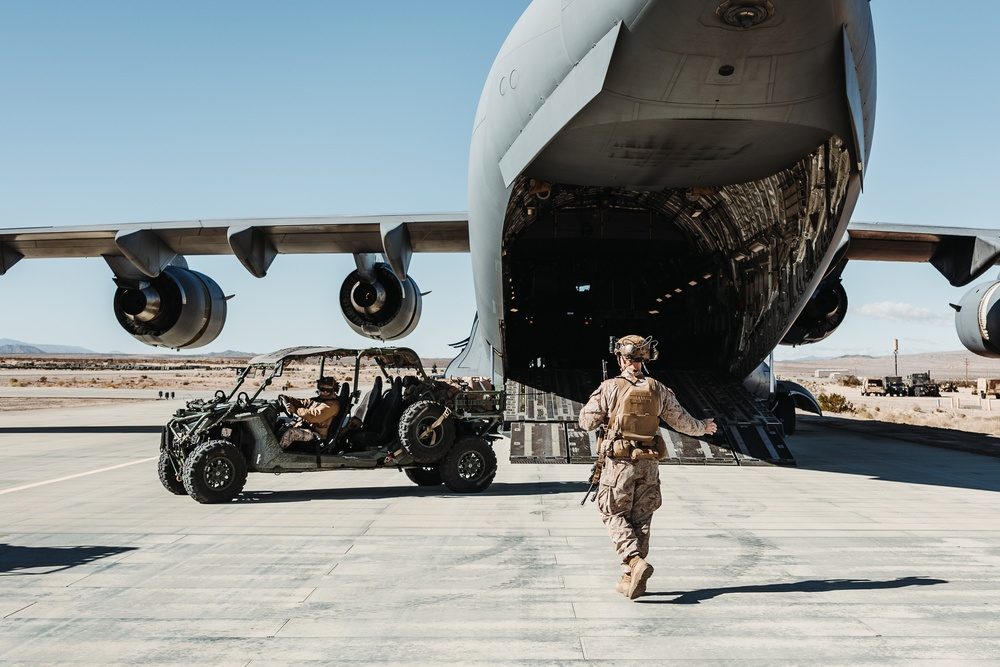
Marines load tactical vehicles onto a C-17 Globemaster III cargo aircraft
Marines with 3rd Light Armored Reconnaissance Battalion load tactical vehicles onto a C-17 during a strategic mobility exercise, rapid deployment capability is the foundation of American power projection (U.S. Marine Corps photo)

The 100-hour ground war was not won by superior American tanks or aircraft, though both were excellent. It was won because the entire logistical apparatus worked. Fuel depots were pre-positioned. Ammunition was distributed forward. Medical evacuation chains were established. Communication networks were redundant. When the ground assault began, American forces could sustain continuous offensive operations because the supply chain never broke.

Iraq's military, by contrast, had competent equipment, Soviet-made T-72 tanks, modern air defense systems, experienced troops, but its logistics collapsed under the air campaign. Supply depots were bombed. Communication lines were cut. Units were isolated from their supply chains. The Iraqi military didn't lose because its weapons were inferior. It lost because it couldn't feed, fuel, or resupply its forces.

Ukraine 2022: The 40-Mile Traffic Jam

Russia's invasion of Ukraine in February 2022 provided the most vivid modern demonstration of logistics failure. The initial Russian advance on Kyiv saw a convoy stretching 40 miles along the highway north of the capital, a column of tanks, armored vehicles, fuel trucks, and supply vehicles that simply stopped moving.

The Russian military had enough combat power to take Kyiv, on paper. What it lacked was the logistical infrastructure to sustain a 200-kilometer advance from the Belarusian border. Russian military doctrine relies heavily on rail logistics, but Ukrainian railways use a different gauge, and the rail infrastructure near Kyiv was quickly disabled. Russian trucks, many poorly maintained, broke down on muddy roads. Fuel couldn't reach forward units. Food ran out. Soldiers began looting Ukrainian stores for sustenance.

Military personnel at the Normandy American Cemetery during a D-Day anniversary event
Modern service members at the Normandy American Cemetery, where the logistics miracle of D-Day delivered 156,000 troops across the English Channel in a single day, an operation where failure in supply would have meant failure on the beach (U.S. Army photo)

The withdrawal from Kyiv in early April 2022 was not a tactical defeat, Russian forces were rarely engaged in decisive ground combat around the capital. It was a logistics defeat. The Russian military could not sustain its forces at that distance from their railheads and depots. The combat power was present. The supply chain was not.

The subsequent war of attrition has reinforced the lesson. Ukraine consumes 6,000 to 8,000 artillery rounds per day during active operations. At peak intensity, daily consumption has reached 10,000 rounds. Neither Ukraine nor its Western suppliers can sustain that rate indefinitely. The war has become a contest of industrial production and logistics throughput as much as tactical skill.

The Pacific Problem: Can America Sustain a Fight Against China?

Every lesson of Ukraine applies, with greater intensity, to a potential conflict in the Western Pacific. And the answers should concern every defense planner in Washington.

The core problem is distance. The nearest major U.S. base to the Taiwan Strait is Okinawa, roughly 400 miles away. The primary sustainment bases, Guam, Hawaii, continental United States, are 1,800, 5,000, and 6,000+ miles from the likely area of operations. In a conflict with China, the U.S. military would need to sustain combat forces across the widest ocean on Earth, through supply lines threatened by Chinese anti-ship missiles, submarines, and long-range strike aircraft.

U.S. and French military aircraft fly over Omaha Beach during a D-Day commemoration
U.S. and French Marines fly over Omaha Beach during a D-Day commemoration, the Normandy landings remain the definitive example of how logistics enable or prevent military success (U.S. Marine Corps photo)

China's anti-access/area-denial (A2/AD) strategy is explicitly designed to sever these supply lines. The DF-21D and DF-26 anti-ship ballistic missiles can target ships at ranges exceeding 1,500 miles. Chinese submarine forces can interdict cargo convoys. Long-range bombers can strike airfields and port facilities throughout the Western Pacific. The strategy doesn't require China to defeat the U.S. Navy in open battle, it only requires disrupting the logistics chain enough that American forces cannot sustain operations.

The U.S. military's "just in time" logistics model, adopted from commercial supply chain management to reduce costs, compounds the problem. In peacetime, just-in-time logistics is efficient: maintaining large forward-deployed stockpiles is expensive, and modern information systems can track and route supplies with precision. In wartime, just-in-time logistics is fragile. If the supply chain is disrupted, by enemy action, by natural disaster, by system failure, there are no warehouses full of spare parts and ammunition waiting as a buffer.

What the U.S. Military Is Doing About It

The Department of Defense has begun adapting, though progress is slow. Several initiatives address the logistics gap:

Pre-positioning. The military is increasing pre-positioned stocks throughout the Pacific, ammunition, fuel, spare parts, and medical supplies stored in hardened facilities on allied territory. The idea is to have enough materiel already in theater to sustain initial combat operations while the longer supply chain spins up.

Distributed logistics. Rather than relying on a few major ports and airfields (which are easy to target), the Marine Corps and Navy are developing concepts for distributing supplies across many smaller, harder-to-target locations. The Marine Littoral Regiment concept envisions small units operating from dispersed island positions, sustained by a network of small vessels and aircraft rather than a single large supply line.

Industrial base capacity. The war in Ukraine exposed severe shortages in American ammunition production capacity. The U.S. was producing roughly 14,000 155mm artillery shells per month in early 2023, far less than Ukraine was consuming in a single day. By 2025, monthly production had increased to approximately 40,000 rounds, with a target of 100,000 per month by 2028. But even that rate may be insufficient for a major Pacific conflict.

Autonomous logistics. The military is investing in unmanned cargo systems, autonomous ships, cargo drones, and robotic ground vehicles, that can deliver supplies in contested environments without risking human crews. The Marine Corps' Tactical Resupply Unmanned Aircraft System (TRUAS) is designed to deliver 500-pound payloads to forward units via autonomous drone flights.

The Lesson That Never Sticks

Every generation of military leaders learns the same lesson: logistics wins wars. And every generation promptly forgets it, returning to debates about weapons performance and force structure that treat supply as someone else's problem.

The next major conflict will not be decided by whether the F-35 is better than the J-20, or whether the Abrams is superior to the Type 99. It will be decided by whether the force with the better weapons can keep them armed, fueled, maintained, and manned for weeks and months of sustained combat. History has answered this question the same way every time.

The best weapon in the world is useless without ammunition. The fastest jet can't fly without fuel. The most advanced tank can't fight without spare parts. Logistics isn't the glamorous part of war. It's just the part that determines who wins.

Share this article

Share:

Recommended

Ace of The Skies: Can You Identify These Military Aircraft Throughout The Years?
Test Yourself

Ace of The Skies: Can You Identify These Military Aircraft Throughout The Years?

Can you identify these aircraft?

Take the Quiz

Get Military News & History in Your Inbox

Join thousands of readers receiving our weekly digest of military technology, history, and analysis.

Test Your Knowledge