Daniel Mercer writes about military history with a focus on the 20th century, including World War II, the Cold War, and Vietnam. His work looks at how decisions made decades ago still influence doctrine, planning, and assumptions today.
At 14:23 on April 7, 1945, the largest warship ever built disappeared. A column of fire and smoke erupted from the East China Sea south of Kyushu, rising six kilometers into the sky. American pilots seventy miles away watched a mushroom cloud bloom over the water, not from a nuclear weapon, but from the detonation of Yamato's forward magazines. The blast was so violent that it registered on seismographs.
Two hours earlier, Yamato had been steaming south with nine escort vessels, ordered on a mission everyone aboard knew was suicidal. By the time the smoke cleared, 3,055 men were dead, the pride of the Imperial Japanese Navy lay broken on the seabed, and the age of the battleship was irrevocably finished. The instrument of destruction was not another fleet of warships. It was 386 aircraft: fighters, dive bombers, and torpedo planes launched from fifteen American carriers that never came within a hundred miles of the Japanese formation.
The sinking of Yamato was not just a naval engagement. It was a verdict. And it had been coming for a long time.
The Suicide Order
By the spring of 1945, the Imperial Japanese Navy barely existed as a fighting force. The catastrophes at Midway, the Philippine Sea, and Leyte Gulf had consumed its carrier aviation, most of its capital ships, and tens of thousands of trained sailors. What remained was a fleet in name only: scattered remnants hugging port, desperately short of fuel, waiting for orders that had no strategic logic left to justify them.
Yamato was the most conspicuous of these remnants. She had survived the war largely by avoiding it, her enormous fuel consumption making every sortie a logistical crisis. Now she sat at Tokuyama anchorage, and the question facing the Naval General Staff was brutally simple: what do you do with the world's largest battleship when you have already lost the war?
The answer was Operation Ten-Go, a one-way mission to Okinawa, where American forces had landed on April 1. Yamato would steam south with a light cruiser, Yahagi, and eight destroyers. She would force her way through the American naval cordon, beach herself on the Okinawan shore, and use her massive guns as a fixed coastal battery until she was destroyed. There was no plan for return. The fuel loaded, roughly 2,500 tons, was enough for a one-way trip. Even that had been scraped together with difficulty, siphoned from reserves across multiple facilities.
Vice Admiral Seiichi Ito, commander of the Second Fleet, understood exactly what the order meant. He objected. So did most of his staff. The mission had no air cover, since Japan had no carrier aircraft left to provide it, and no realistic prospect of reaching Okinawa through waters dominated by American carrier task forces. Senior officers argued the fuel would be better spent on other operations. They were overruled. The order came from the very top: Yamato would sortie, and she would die fighting.
There was, beneath the operational insanity, a cultural logic. The Navy could not allow its greatest ship to sit in port and be sunk by bombing, the way the remnants of the fleet at Kure would be destroyed in July. If Yamato was going to die, she would die at sea, under the battle flag, in a manner befitting the samurai tradition that the Imperial Navy had wrapped around itself since its founding. The crew understood this. When Yamato weighed anchor at 15:20 on April 6, many of the 3,332 men aboard had already written their death poems.
The Ship They Built in Secret
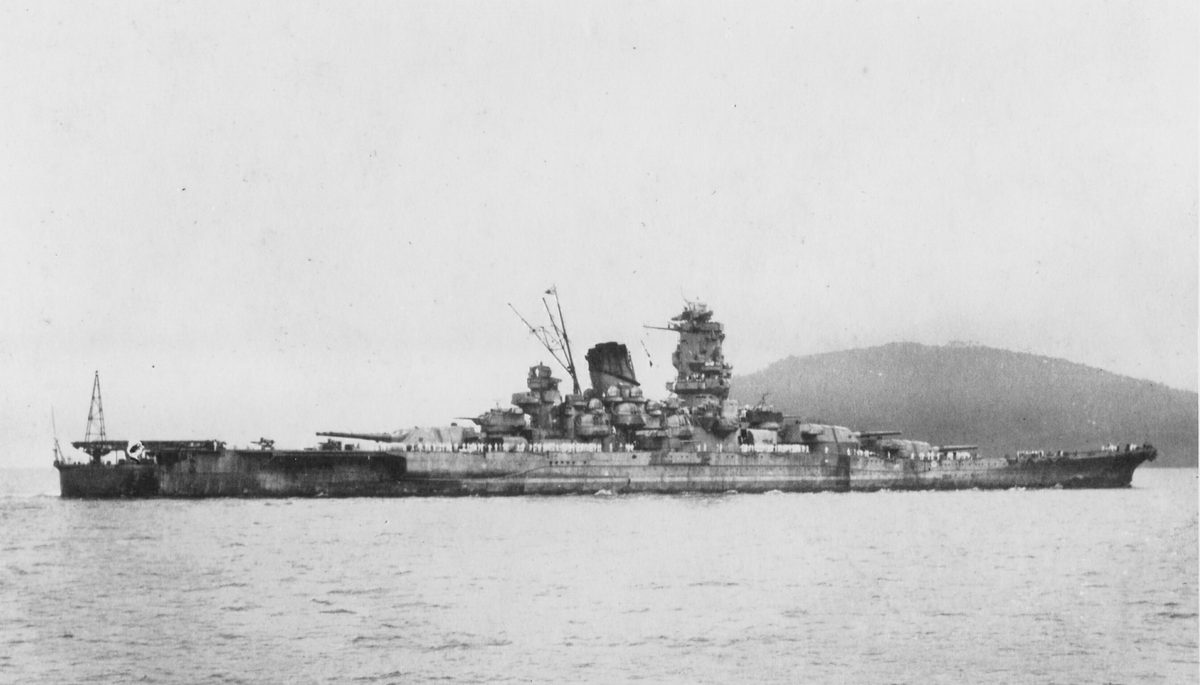
Yamato's profile was unmistakable: 263 meters of armored hull capped by the largest gun turrets ever mounted on a warship.
To understand why Yamato's loss carried such symbolic weight, you have to understand what she was. Not just a large warship, but the largest, by a margin that has never been matched.
Yamato displaced 72,000 tons fully loaded. For context, an Iowa-class battleship, the largest the United States ever built, displaced 57,000 tons. Yamato was wider, heavier, and more heavily armored than anything afloat. Her hull stretched 263 meters bow to stern, and her beam of 38.9 meters was so wide that the Kure Naval Arsenal had to widen its drydock to build her.
She had been constructed under extraordinary secrecy between 1937 and 1941. The Japanese government classified every detail of her design, erected enormous camouflage screens over the construction dock, and restricted access so tightly that even many naval officers did not know her true specifications. Workers at the shipyard were forbidden from discussing any aspect of the project. Japan's censors scrubbed references to the ship from every publication. The world would not learn Yamato's actual displacement and armament specifications until after the war.
The secrecy existed for good reason. Yamato's main armament was staggering.
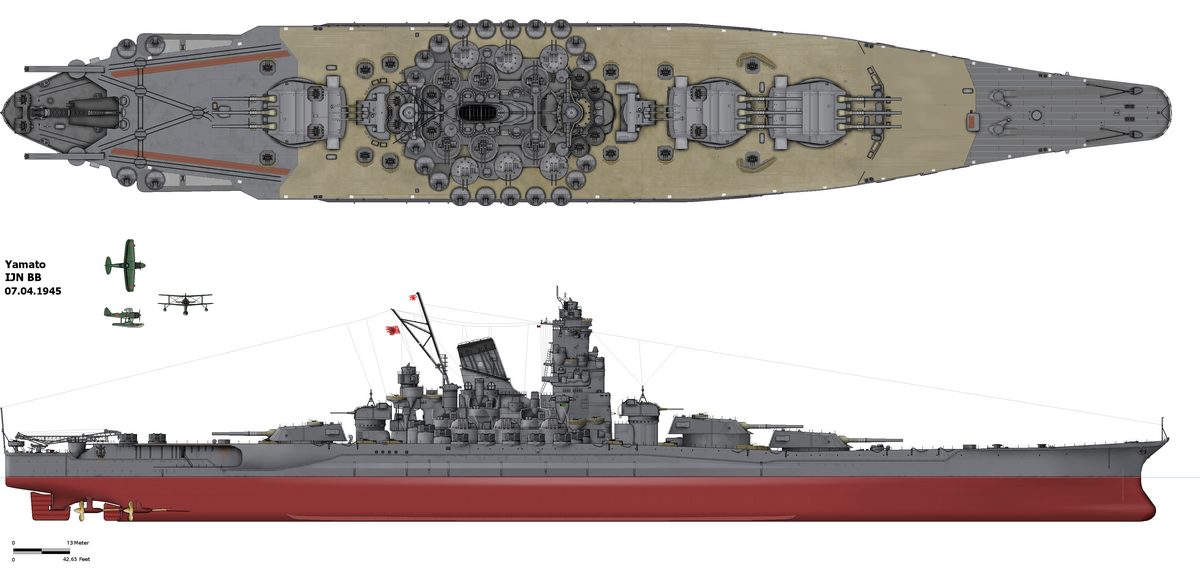
By 1945, Yamato bristled with anti-aircraft guns added in successive refits, but they would prove insufficient against the scale of the American attack.
Nine 460mm guns, 18.1 inches in bore diameter, arranged in three triple turrets. They were the largest naval guns ever mounted on a warship, before or since. Each turret weighed 2,774 tonnes, heavier than many destroyers of the era. The guns could hurl a 1,460-kilogram armor-piercing shell over 42 kilometers, and they could penetrate the armor of any warship in existence at combat range. No Allied battleship carried anything close. The American 16-inch/50-caliber guns on the Iowa class were formidable weapons, but the 460mm guns outranged and outpunched them.
Britain's fastest WW2 tank, powered by a detuned Rolls-Royce Merlin engine and capable of 40 mph on roads. 314 reviews at 4.6 stars. Led the Normandy breakout.
Yamato's armor was equally extraordinary. Her main belt was 410mm of cemented steel, angled to maximize deflection. Her turret faces were protected by 650mm of armor, over two feet of hardened steel. Her armored deck was 200mm thick amidships. The ship had been designed around a single premise: she would be unsinkable by gunfire from any ship the Americans could build, because treaty limitations (which Japan had secretly abandoned) would prevent the construction of anything large enough to carry guns that could hurt her.
It was elegant logic, and by 1945 it was catastrophically obsolete. The threat had never come from enemy battleships. It came from the sky.
The Americans Are Watching
Yamato's sortie was detected almost immediately. American submarines Threadfin and Hackleback were patrolling the Bungo Strait between Kyushu and Shikoku, the only exit route from the Inland Sea, and spotted the Japanese force shortly after it cleared the strait on the evening of April 6. Contact reports flashed to Vice Admiral Marc Mitscher, commanding Task Force 58, the fast carrier force supporting the Okinawa landings.
Mitscher's reaction was swift and decisive. He had fifteen carriers and roughly 900 aircraft at his disposal. The question was not whether he could stop Yamato. It was whether anyone else would get the chance. Admiral Raymond Spruance, commanding the Fifth Fleet, briefly considered detaching a battle line of fast battleships under Vice Admiral Willis Lee to engage Yamato in a surface action. Lee's six battleships and their escorts would have made for a titanic gun duel. But Mitscher wanted the kill for his aviators, and Spruance, who understood the strategic calculus perfectly well, agreed. The carriers would handle it.
Through the night and into the morning of April 7, American reconnaissance aircraft shadowed the Japanese force as it steamed southwest through the East China Sea. Yamato and her escorts were making 22 knots, zigzagging to complicate submarine attacks. They had no air cover whatsoever. The sky belonged entirely to the Americans.
At dawn, Mitscher began launching his strike. The aircraft would fly in waves: fighters to suppress anti-aircraft fire, dive bombers to damage the superstructure and knock out fire-control systems, and torpedo planes to put holes below the waterline where no amount of armor could help.
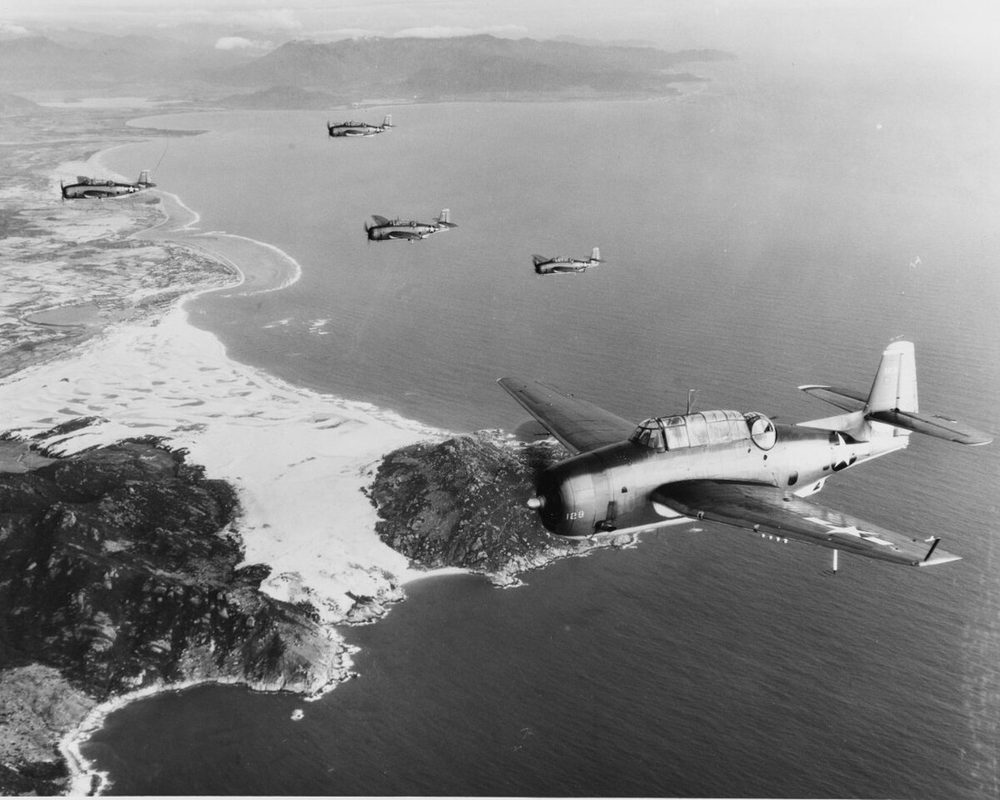
TBF Avengers like these carried the Mark 13 torpedoes that would tear open Yamato's hull below the waterline, the one place her armor could not protect her.
A total of 386 aircraft launched from those fifteen carriers: F6F Hellcats and F4U Corsairs for fighter escort and strafing, SB2C Helldivers for dive bombing, and TBF Avengers carrying Mark 13 torpedoes. It was the largest concentration of naval airpower ever directed at a single surface target.
Two Hours
The first wave found Yamato at 12:32 on April 7. The weather was overcast with a low ceiling of roughly 450 meters, and intermittent rain squalls. Visibility was poor, but it didn't matter. The Japanese force was easily spotted, Yamato's enormous wake unmistakable even through the murk.
The Panzer IV was the workhorse of the German armored divisions, and Tamiya's 1/35 kit captures the Ausf. H variant with its characteristic Schurzen side skirts and long-barrel 75mm gun.
The initial strikes hit Yamato's escorts first. The destroyer Hamakaze took a torpedo and broke apart within minutes. Yahagi, the light cruiser, was swarmed by Avengers and Helldivers; she absorbed twelve bomb hits and seven torpedoes before capsizing. But the primary target was always the battleship.
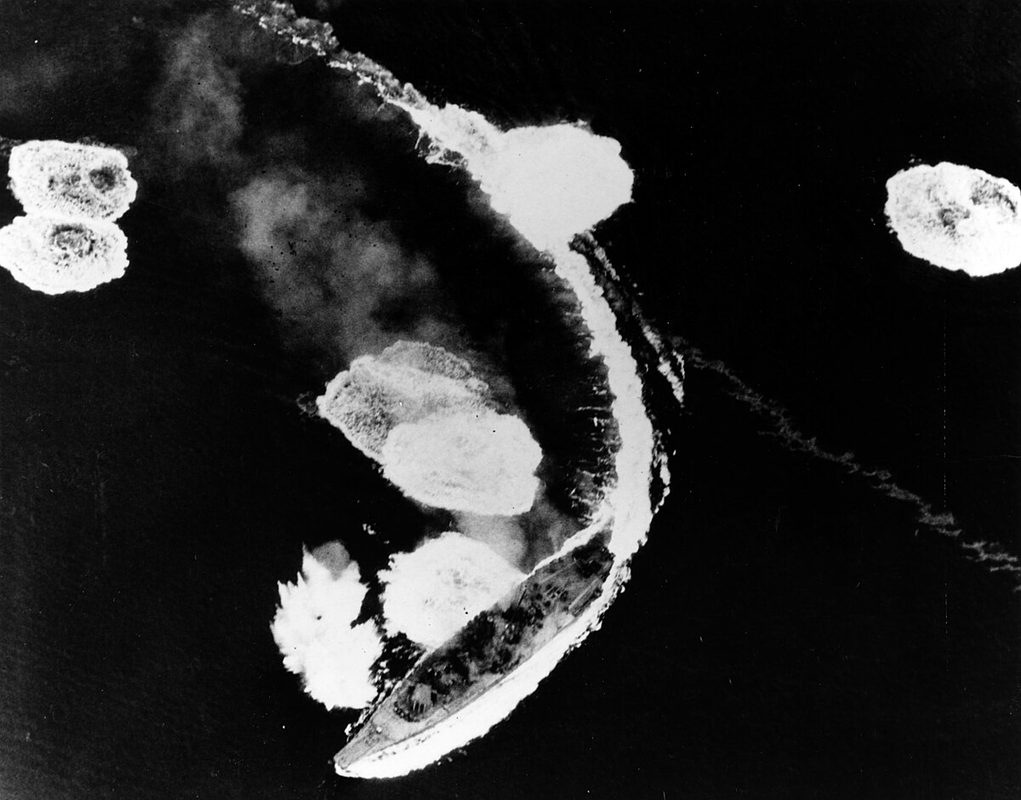
Yamato writhes under attack as bomb splashes erupt around her hull. Despite firing every anti-aircraft gun she had, the sheer number of attacking aircraft overwhelmed her defenses.
Yamato fought back with everything she had. By 1945, she carried 162 anti-aircraft guns: twenty-four 127mm dual-purpose guns, 152 25mm automatic cannons, and her main battery itself, which could fire a special anti-aircraft shell called sanshikidan, or "beehive" rounds, designed to burst and scatter incendiary shrapnel across a wide area. The barrage was ferocious. Pilots described the sky around Yamato as a solid wall of flak.
It was not enough. The American aviators had been trained for exactly this kind of attack, and they executed with devastating coordination. Hellcats and Corsairs swept in first, strafing the anti-aircraft positions to suppress fire. Then the Helldivers dove through the flak to plant bombs on the superstructure, wrecking fire-control directors and radar arrays. And the Avengers came in low, skimming the wave tops at 200 feet, boring through the curtain of tracers to drop their torpedoes at close range.
The torpedo pilots concentrated their attacks on Yamato's port side. This was deliberate: by hitting one side repeatedly, they could overwhelm the ship's counter-flooding systems and induce an uncontrollable list. The tactic worked with lethal efficiency. Torpedo after torpedo slammed into Yamato's port hull below the armored belt. The first hits were absorbed by the torpedo defense system, a layered series of voids and liquid-filled compartments designed to dissipate the force of an underwater explosion. But the system had been designed to withstand four or five torpedo hits. Yamato took eleven.
By 13:30, less than an hour into the attack, Yamato was listing heavily to port. Counter-flooding on the starboard side partially corrected the list but cost speed and flooded compartments that housed damage-control teams and machinery. Her speed dropped from 22 knots to 18, then to 12. The steering gear was damaged. She began circling to port, unable to hold course.
The second and third attack waves hit a ship that was already dying. Bombs cratered the upper works, killing exposed crew and destroying the remaining anti-aircraft directors. More torpedoes punched into the port side. The list increased past 15 degrees, then past 20. At angles beyond 20 degrees, the main battery turrets could no longer train. The 2,774-tonne turrets could not elevate against gravity on the tilted ship. Yamato's greatest weapons fell silent.
At 14:05, the order came to abandon ship. Many of the crew could not comply. They were trapped below decks in flooded compartments, or already dead at their stations. The list continued to steepen.
At 14:20, Yamato rolled over.
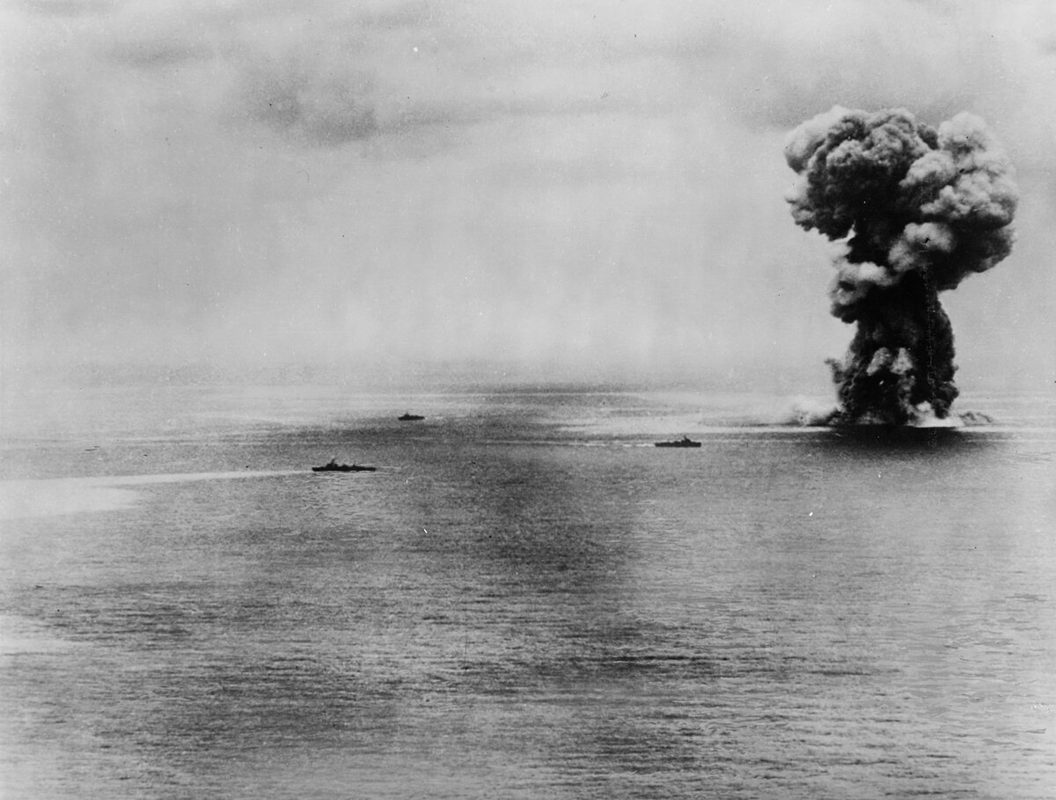
Three minutes later, at 14:23, the forward magazines detonated. The explosion was cataclysmic. An estimated 500 tonnes of ammunition ignited simultaneously, producing a fireball that climbed six kilometers into the sky. The mushroom cloud was visible from the Kagoshima coast, over 160 kilometers away. The blast wave knocked American aircraft from their attack runs. When the smoke cleared, there was nothing left of the largest battleship ever built but an oil slick and debris.
Yamato's magazine detonation produced a mushroom cloud visible over 100 miles away, the final exclamation point on the battleship era.
The Butcher's Bill
Of Yamato's crew of approximately 3,332 men, 3,055 were killed, a mortality rate exceeding 91 percent. Among the dead was Vice Admiral Ito, who went down with the ship. Only 277 men were rescued, most of them pulled from the water by the surviving destroyers.
The escorts fared little better. Yahagi was sunk with 446 of her crew. The destroyers Asashimo, Hamakaze, Isokaze, and Kasumi were all lost. Only four of the ten Japanese ships that sortied returned to port, and all four were damaged. Total Japanese dead exceeded 4,000.
American losses were ten aircraft and twelve airmen.
The disparity was not a reflection of cowardice or incompetence on the Japanese side. Yamato's crew fought with extraordinary determination, manning their guns until the ship rolled beneath them. The disparity was a reflection of something more fundamental: the absolute dominance of carrier-based airpower over surface warships operating without air cover. The Japanese sailors had been sent into a battle they could not win, against an enemy they could not reach, to fulfill an order that served no strategic purpose.
The Verdict on the Battleship
The sinking of Yamato was not the first time aircraft had destroyed a battleship. Prince of Wales and Repulse had been sunk by Japanese land-based aircraft off Malaya in December 1941, just two days after Pearl Harbor, demonstrating the vulnerability of capital ships without air cover. The Battle of Midway in 1942 had proven that carriers, not battleships, were the decisive instruments of naval power. By 1944, the Battle of Leyte Gulf had shown that even with escort, battleships were subordinate to carrier task forces.
But Yamato's destruction had a finality that those earlier actions lacked. She was not just any battleship. She was the ultimate expression of the type. The biggest, the most heavily armed, the most thickly armored warship in history. If Yamato could not survive, nothing could. Her 410mm belt armor, her 650mm turret faces, her 2,774-tonne gun turrets: none of it mattered against torpedoes running beneath the waterline and bombs falling from above. The qualities that made her supreme in a surface engagement were irrelevant against an enemy that attacked from the air.
The lesson was absolute, and every navy in the world absorbed it. No nation has laid down a battleship since. The aircraft carrier, the weapon that killed Yamato, became the capital ship of every major fleet, a position it holds to this day. The battleship era, which had dominated naval warfare since the launch of HMS Dreadnought in 1906, ended in the East China Sea on the afternoon of April 7, 1945, in a pillar of smoke six kilometers tall.
Yamato rests today in 340 meters of water, broken into two main sections. Her wreck was located in 1985 and has been surveyed several times since. The bow section lies upside down, the massive turrets having fallen from their barbettes when the ship capsized, each 2,774-tonne assembly simply dropping free under its own weight. A memorial at Tokuyama honors the crew, and a full-scale museum ship replica of her bow and superstructure stands at the Yamato Museum in Kure, the city where she was built.
She was the largest, the most powerful, and the most futile warship ever constructed, a floating monument to an idea that the world had already moved past. Her last voyage proved it beyond any argument.