Skip to content
April 25:The Gallipoli Landings, ANZAC Day111yr ago

The Zumwalt Destroyer: The Most Advanced Warship That Couldn't Find a Mission

Ryan Caldwell · · 12 min read
Save
Share:
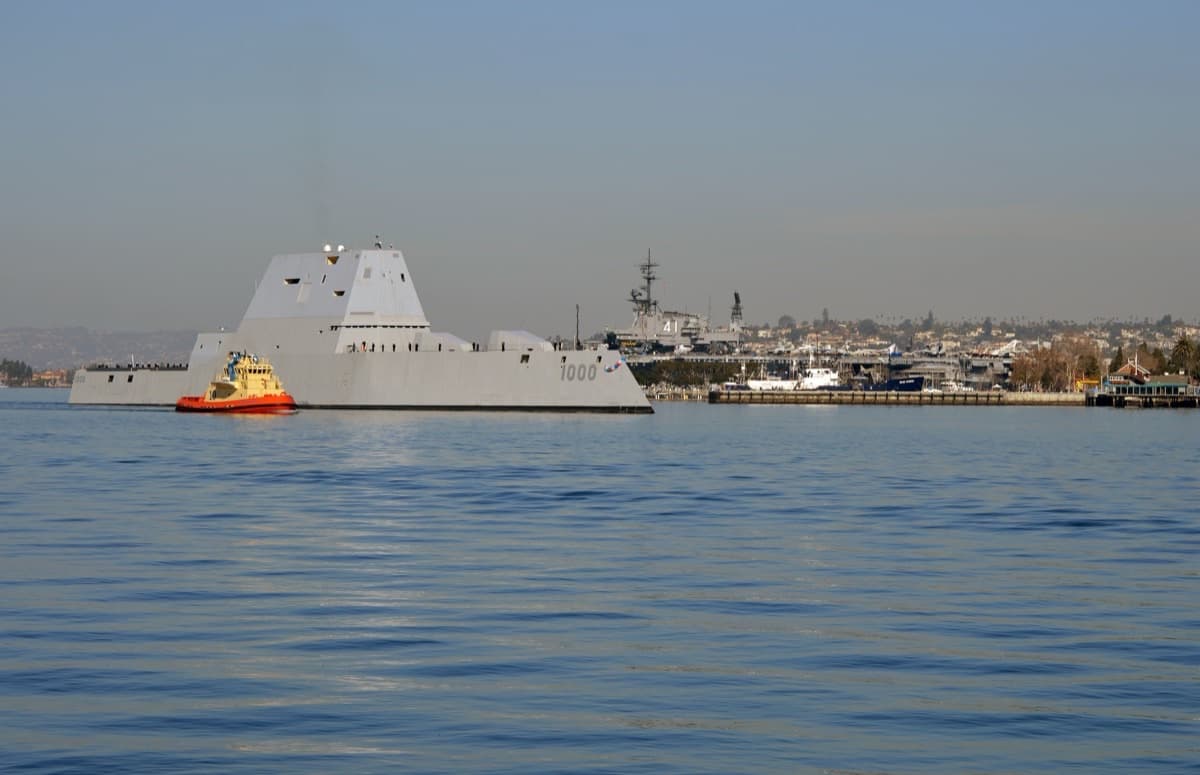
USS Zumwalt DDG-1000 stealth destroyer in San Diego Bay showing its angular tumblehome hull and composite deckhouse
Ryan Caldwell
Ryan Caldwell

Defense Analysis Editor

Ryan Caldwell writes about military decision-making, failed programs, and the tradeoffs behind major defense choices. His work is focused on understanding why systems succeed or fail beyond headlines, promises, and initial expectations.

Imagine spending $800,000 on a single artillery round. Not a cruise missile. Not a precision-guided bomb. A cannon shell, fired from a gun that only exists on three ships that cost $8 billion each. That was the Long Range Land Attack Projectile, the GPS-guided round designed exclusively for the Zumwalt-class destroyer's Advanced Gun System. When the Navy cut the class from 32 ships to 3, the per-round cost of the LRLAP spiraled so high that each shot cost more than a Tomahawk cruise missile. The ammunition program was cancelled in 2016. The guns had no rounds to fire. And the most technologically ambitious surface warship the United States had ever built was left, quite literally, without a purpose.

What the Zumwalt Was Supposed to Be

The DD(X) program, which became the DDG-1000 Zumwalt class, began in the late 1990s as the Navy's answer to a post-Cold War question: what should a destroyer do when the Soviet fleet is gone? The answer was land attack. The Zumwalt was designed as a littoral combat ship that would operate close to hostile coastlines, providing precision fire support to Marines storming beaches and Army forces operating inland. The ship's primary weapon was the Advanced Gun System, a pair of 155mm guns that could hurl GPS-guided projectiles 83 nautical miles, far beyond the range of any existing naval gun, with the accuracy of a precision-guided munition.
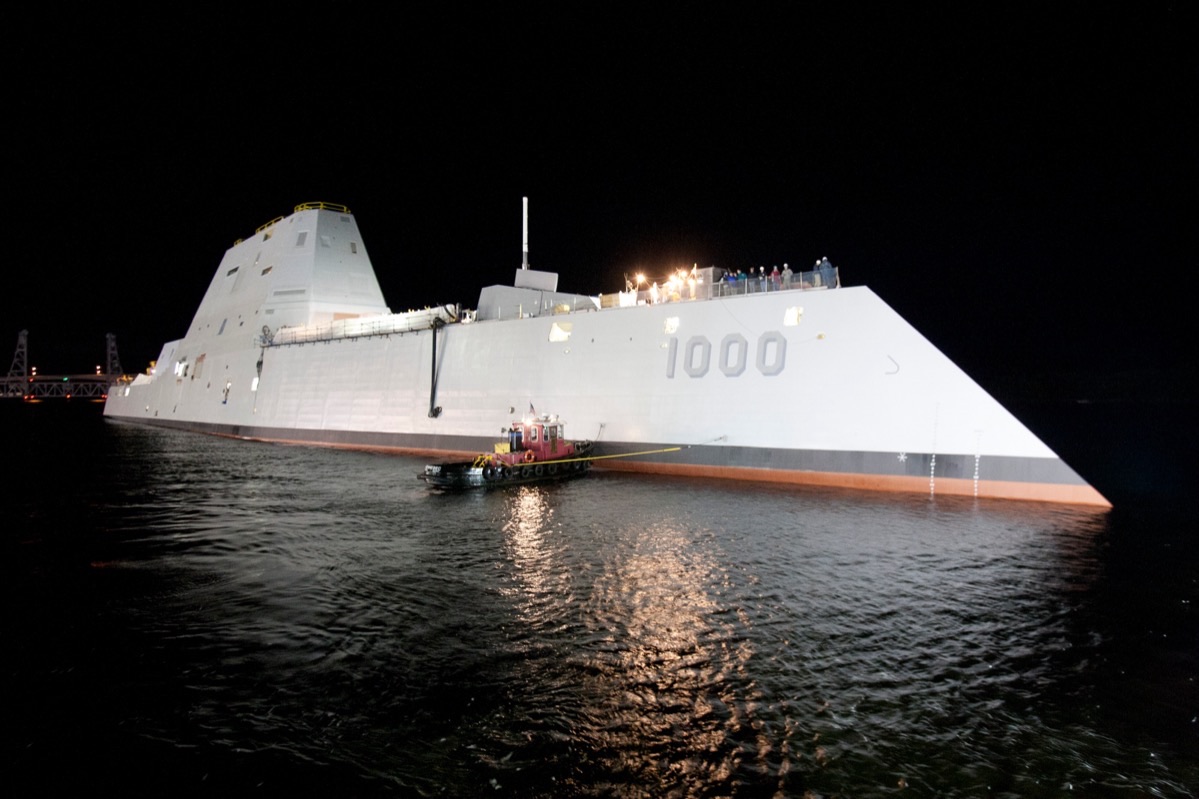
USS Zumwalt's distinctive wave-piercing tumblehome bow cutting through Pacific waters
The Zumwalt's inverted bow and tumblehome hull form are immediately recognizable, and controversial. The design reduces radar cross-section but raised concerns about stability in heavy seas. (U.S. Navy photo)

The original plan called for 32 ships at roughly $1.4 billion each, expensive but within the range of a major surface combatant program. Each ship would carry two AGS guns with a combined magazine of 600 LRLAP rounds, giving a single destroyer the firepower to support an amphibious assault for days. The guns would replace the fire support role that retired battleships once filled, delivering sustained, accurate fire at a fraction of the cost of Tomahawk missiles.

At least, that was the theory.

The Design: Stealth, Electric Power, and Automation

Whatever its programmatic failures, the Zumwalt-class represents genuine engineering ambition. The ship introduced technologies that had never been combined in a surface combatant before.

Zumwalt-class composite deckhouse and integrated mast showing the ship's angular stealth design
The Zumwalt's composite deckhouse integrates radar arrays and communications into a single angular structure designed to minimize radar returns. (U.S. Navy photo)

The tumblehome hull, where the sides slope inward from the waterline rather than outward, is the ship's most distinctive feature. Combined with the angular composite deckhouse and wave-piercing bow, the hull form gives the 610-foot, 15,000-ton destroyer a radar cross-section comparable to a fishing boat. The design is genuinely stealthy, but it came with trade-offs. Naval architects have debated the tumblehome form's stability characteristics in heavy seas for centuries. The inward-sloping sides reduce the hull's righting moment compared to a conventional flared hull. The Navy conducted extensive model testing and concluded the design was safe, but the debate never fully went away.

The Integrated Power System (IPS) made the Zumwalt the first fully electric U.S. surface combatant. Two Rolls-Royce MT30 gas turbines and two auxiliary turbines generate 78 megawatts of electrical power, enough to supply a small city. Instead of mechanical drive shafts connecting engines to propellers, the power is routed through an electric grid to advanced induction motors. This architecture allows the ship to redirect power dynamically between propulsion, sensors, and weapons, a feature designed with future directed-energy weapons in mind. The Navy always envisioned the Zumwalt as a platform that could eventually carry railguns or high-energy lasers, systems that demand enormous bursts of electrical power.

Automation was the third pillar. The Zumwalt was designed for a crew of just 147, roughly half the complement of an Arleigh Burke-class destroyer, which carries over 300. The reduced manning was supposed to generate lifecycle cost savings that would partially offset the ship's high construction cost. Automated damage control, reduced maintenance requirements, and consolidated watch stations allowed fewer sailors to operate a larger, more complex ship, at least in theory.

The Death Spiral: 32 Ships Become 3

The Zumwalt program is a textbook case of what defense analysts call a "death spiral," a feedback loop where rising costs lead to quantity cuts, which raise per-unit costs further, which trigger more cuts, until the program collapses to a fraction of its original size.

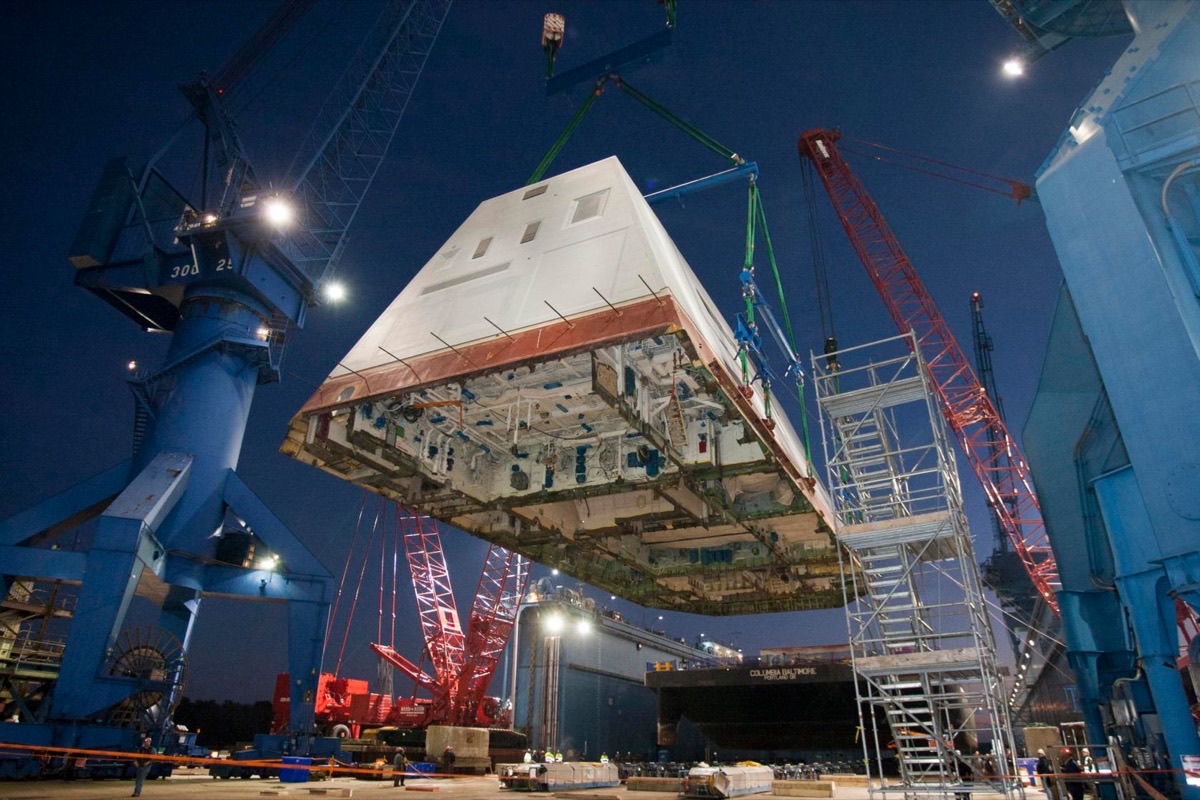
Zumwalt-class destroyer under construction at Bath Iron Works showing the hull structure taking shape
Construction of the Zumwalt class at Bath Iron Works in Maine. The program sustained the shipyard's workforce but delivered only three hulls instead of the planned thirty-two. (U.S. Navy photo)

The original 32-ship buy was cut to 24, then to 7, then to 3. Each cut redistributed the program's fixed development costs, billions already spent on designing the hull, developing the combat system, engineering the IPS, and qualifying the AGS, across fewer and fewer hulls. By the time the class was capped at three ships, the cost per hull had ballooned to between $7.5 billion and $8 billion, depending on how you allocate research and development costs. The total program cost reached $22.5 to $24.5 billion for three ships. The program breached the Nunn-McCurdy threshold, the statutory limit for unit cost growth, by 81%, triggering a mandatory congressional review.

The reasons for the cuts were multiple and reinforcing. The ship's cost growth made it harder to justify in budget competitions with the proven, cheaper Arleigh Burke class. The post-9/11 shift in naval priorities from land attack to ballistic missile defense favored the Burke's Aegis combat system, which the Zumwalt did not carry. The littoral fire support mission that justified the Zumwalt's entire design became less central to Navy planning as the wars in Iraq and Afghanistan demonstrated the limits of amphibious assault doctrine. And each time the buy was cut, the economics got worse, which made the next cut easier to justify.

The AGS Disaster: A Gun Without Ammunition

The Advanced Gun System was supposed to be the Zumwalt's reason for existing. Each ship carries two 155mm AGS guns in stealth housings forward of the deckhouse. The guns were designed to fire the LRLAP, a rocket-assisted, GPS-guided projectile that could reach targets 83 nautical miles away with near-precision accuracy. A single Zumwalt could deliver sustained fire comparable to a battery of Army artillery, from the relative safety of a position far offshore.

Close-up of the Zumwalt's forward gun housing showing the stealthy enclosure for the 155mm Advanced Gun System
The AGS gun housings on the Zumwalt's foredeck, stealth enclosures for 155mm guns that were built without usable ammunition. The guns are now being removed to make way for hypersonic missile launchers. (U.S. Navy photo)

The LRLAP worked. It was tested, it flew, it hit targets. The problem was cost. Lockheed Martin developed the LRLAP for a fleet of 32 ships, each carrying magazines for 600 rounds, creating a production run large enough to bring the per-round cost down to a manageable level. When the fleet shrank to 3 ships, the production run collapsed, and the per-round cost rose to between $800,000 and $1 million. Each LRLAP cost more than a Tomahawk cruise missile, which could fly ten times farther with a much larger warhead.

The Navy cancelled the LRLAP program in 2016. The guns remained on the ships, two per hull, six total, but there was nothing to shoot. The most advanced naval gun system ever built was, functionally, a pair of very expensive sculptures. Various alternative munitions were proposed, including a hypervelocity projectile derived from the electromagnetic railgun program, but none reached production. The AGS became the single most visible symbol of the Zumwalt program's dysfunction: a weapon system designed, built, installed, and delivered to the fleet with no usable ammunition.

Breakdowns and the Long Road to Capability

USS Zumwalt (DDG-1000) was commissioned in October 2016. Within weeks, the ship suffered an engineering casualty in the Panama Canal when its port shaft bearing failed, requiring the ship to be towed. The breakdown was not catastrophic. New ships frequently experience mechanical issues during their shakedown period. But the optics were devastating. The most expensive surface warship ever built, disabled in a canal, being towed to port. The incident became a media metaphor for the entire program.

Subsequent years brought a slow, grinding process of testing, fixing, and retesting. The ship's combat system integration proved challenging, its software required continuous updates, and the novel engineering systems demanded extensive debugging. USS Michael Monsoor (DDG-1001) and USS Lyndon B. Johnson (DDG-1002) followed, each incorporating lessons from the previous hull but each encountering its own integration challenges. The class spent more time in shipyards than at sea.

USS Zumwalt completed sea trials in January 2026 after spending approximately three years in dry dock at Ingalls Shipbuilding in Mississippi, where the ship was being modified to carry the Conventional Prompt Strike (CPS) hypersonic missile system. The AGS guns are being removed, their stealth housings cut open to install four large-diameter missile tubes capable of carrying up to 12 CPS hypersonic boost-glide weapons. The ship that was designed to shoot $800,000 cannon shells at beaches will instead lob hypersonic missiles at targets thousands of miles away.

The Hypersonic Pivot: A New Mission for an Old Problem

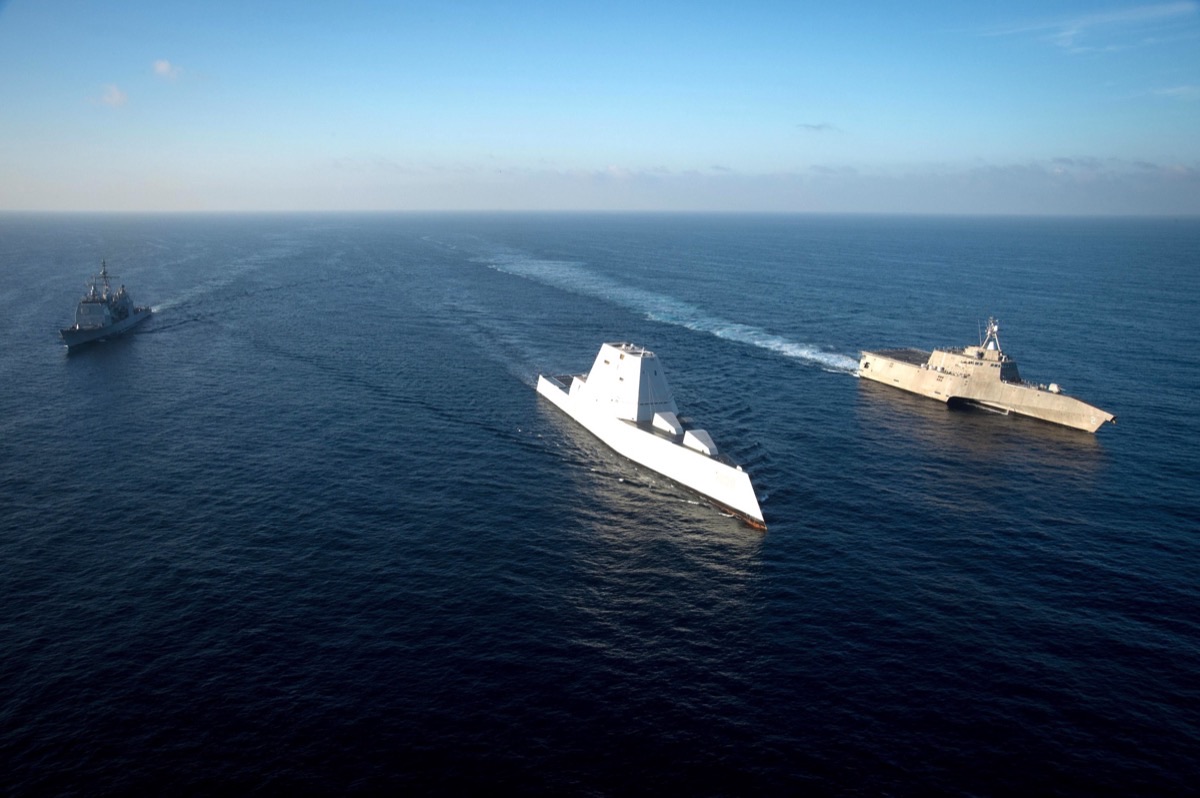
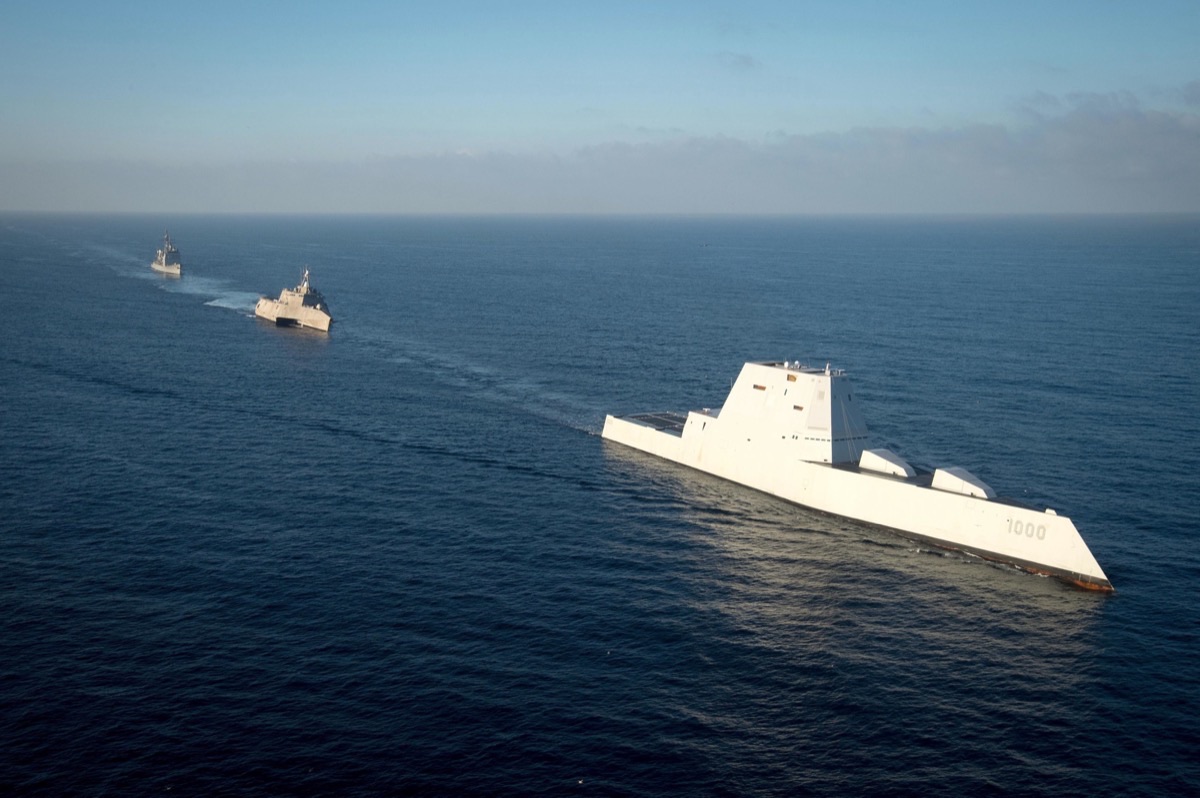
Aerial view of a Zumwalt-class destroyer alongside other Navy warships showing the dramatic size and design differences
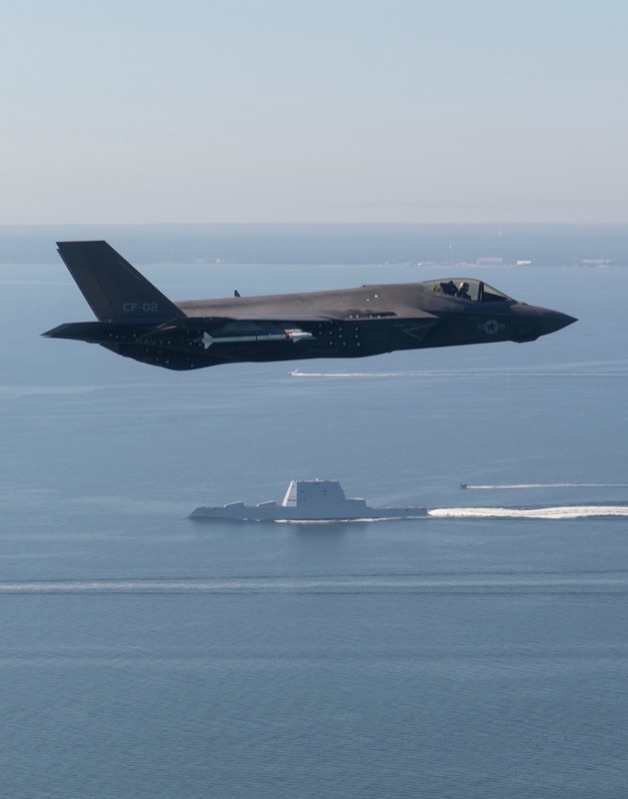
The Zumwalt dwarfs conventional warships and looks nothing like them, a physical manifestation of a program that tried to reinvent surface warfare from scratch. (U.S. Navy photo)

The conversion to a hypersonic strike platform is the Navy's attempt to salvage operational value from a $24 billion investment. The CPS system, a two-stage boost-glide weapon capable of reaching speeds above Mach 5, gives the Zumwalt a genuine capability that no other surface combatant in the U.S. fleet currently possesses. The Zumwalt's massive electrical generating capacity, originally designed to power future railguns or lasers, provides ample power for the CPS system's support requirements. The ship's stealth characteristics, originally designed for close-in littoral operations, are arguably more valuable for a platform that needs to survive long enough to launch hypersonic strikes in a contested environment.

There is an irony here that the program's critics and defenders alike acknowledge. The Zumwalt may finally become operationally relevant, not because of any of the capabilities it was designed around, but because its hull has enough room and power to carry a weapon system that didn't exist when the ship was conceived. The world's most advanced gun destroyer will go to sea without functioning guns, armed instead with missiles. It is a $8 billion missile truck with a crew of 147 and a radar signature the size of a fishing boat.

Lessons from the Zumwalt

The Zumwalt program offers several lessons, none of them new, all of them apparently unlearnable.

First, unit cost and production quantity are inseparable. A weapon system designed for a fleet of 32 cannot be scaled down to 3 without the economics collapsing. The LRLAP worked at $50,000 per round across 32 ships. It was absurd at $800,000 per round across 3. The gun, the ship, and the ammunition were designed as an integrated system. Pull one leg out, and the whole structure falls.

Second, designing a ship around a single mission in a strategic environment that is actively shifting is a gamble. The Zumwalt was optimized for littoral fire support at exactly the moment the Navy's focus was shifting to blue-water great-power competition. By the time the first hull hit the water, the mission it was built for had been deprioritized.

Third, technological ambition and programmatic discipline exist in tension. The Zumwalt tried to introduce a new hull form, a new propulsion architecture, a new gun system, a new ammunition type, a new combat system, and unprecedented automation, all simultaneously, all on the same platform. Any one of those innovations would have been a significant risk. Combining all of them on a single class guaranteed delays, cost growth, and integration challenges. The Arleigh Burke class, by contrast, has been incrementally upgraded over 30 years, each Flight incorporating modest improvements on a proven baseline. It is less glamorous and vastly more effective as a program.

The Zumwalt-class destroyer is the most technologically sophisticated surface warship ever built. It is also, by any reasonable programmatic measure, a failure: a ship that cost more than an aircraft carrier, delivered a decade late, arrived without a functioning primary weapon, broke down on its maiden voyage, and spent years in drydock being converted to a role it was never designed for. It is a monument to what happens when ambition outpaces discipline, when requirements shift beneath a program's feet, and when the Pentagon's acquisition system produces a weapon that nobody asked for by the time it finally arrives. The $800,000 artillery round, the bullet that cost more than a cruise missile, is the detail that will follow this program into history. It captures everything: the ambition, the dysfunction, and the absurdity of building the world's most advanced gun and then discovering there is nothing affordable to shoot.

Share this article

Share:

Recommended

Ace of The Skies: Can You Identify These Military Aircraft Throughout The Years?
Test Yourself

Ace of The Skies: Can You Identify These Military Aircraft Throughout The Years?

Can you identify these aircraft?

Take the Quiz

On This Day in Military History

April 5

Siege of Sarajevo Begins (1992)

Bosnian Serb forces began the siege of Sarajevo, which would last 1,425 days, the longest siege of a capital city in modern warfare. Snipers opened fire on a peace march of 100,000 demonstrators, killing six, marking the start of a conflict that claimed over 11,500 lives in the city alone.

1964, General Douglas MacArthur Dies

1945, Soviet Union Denounces the Neutrality Pact with Japan

See all 11 events on April 5

Get Military News & History in Your Inbox

Join thousands of readers receiving our weekly digest of military technology, history, and analysis.

Test Your Knowledge