Skip to content
April 20:Robert E. Lee Resigns from the US Army165yr ago

10 Fastest Military Aircraft Ever Built

Michael Trent · · 12 min read
Save
Share:
SR-71 Blackbird in flight at high altitude showing its dark titanium airframe against the curvature of the earth
Michael Trent
Michael Trent

Defense Systems Analyst

Michael Trent covers military aircraft, weapons systems, and defense technology with an emphasis on cost, maintenance, and real-world performance. He focuses less on specifications and more on how systems hold up once they are deployed, maintained, and operated at scale.

Speed has been the defining obsession of military aviation since the Wright brothers' first flight. Faster aircraft survive longer, intercept more effectively, and gather intelligence that slower platforms cannot. The pursuit of speed drove engineers to build rocket planes that touched the edge of space, reconnaissance aircraft made of titanium that outran missiles, and interceptors designed to chase nuclear bombers at three times the speed of sound. These are the ten fastest military aircraft ever built — ranked by their maximum confirmed speed — and the engineering that made each one possible.

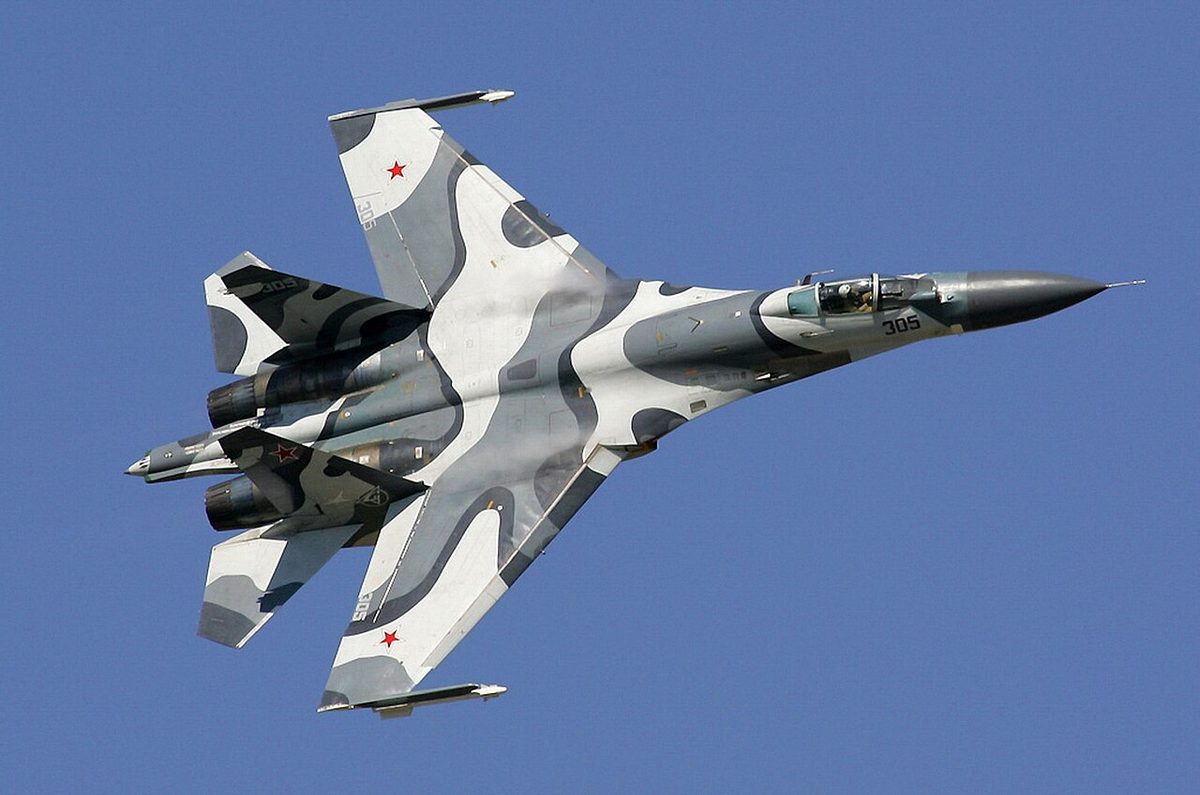
10. Sukhoi Su-27 Flanker — Mach 2.35 (1,553 mph)

Su-27 Flanker in flight showing its twin-engine air superiority configuration
Su-27 Flanker air superiority fighter. (Photo via Wikimedia Commons)

The Su-27 was the Soviet Union's answer to the F-15 Eagle — a large, twin-engine air superiority fighter designed to outmaneuver and outrange anything NATO could field. Two Saturn/Lyulka AL-31F afterburning turbofans produce 27,560 pounds of thrust each, pushing the blended wing-body airframe to Mach 2.35 at altitude. The Su-27's most famous trait is its extreme agility: at the 1989 Paris Air Show, Viktor Pugachev pitched the nose to 120 degrees while maintaining forward flight — the "Pugachev's Cobra" — shocking Western observers who had assumed such post-stall maneuvering was impossible.

The Flanker's massive internal fuel capacity — 20,700 pounds — gives it exceptional range without external tanks, a critical advantage for defending the vast Soviet interior. The Su-27 has spawned more variants than almost any modern fighter: the Su-30, Su-33, Su-34, Su-34 Fullback, Su-35, and the Chinese J-11, J-15, and J-16 families.

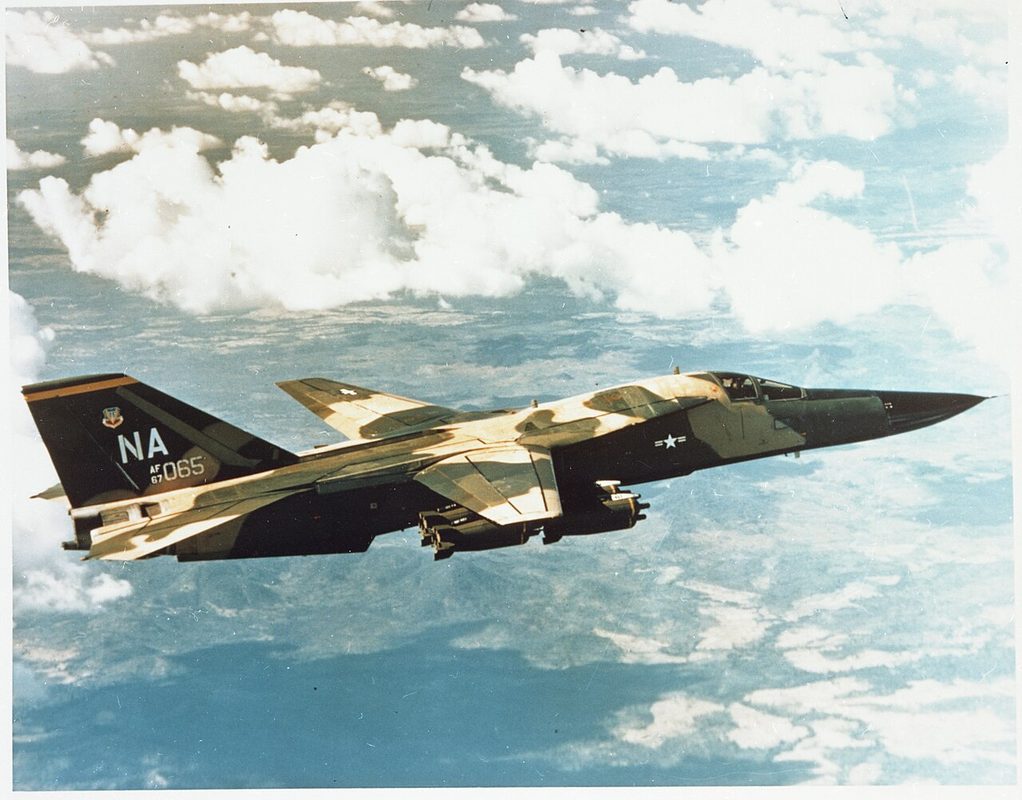
9. General Dynamics F-111 Aardvark — Mach 2.5 (1,650 mph)

F-111 Aardvark with variable-geometry wings in flight
F-111 Aardvark with wings swept back for high-speed flight. (U.S. Air Force photo)

The F-111 Aardvark was the first production aircraft with variable-sweep wings — extending for takeoff and low-speed flight, sweeping back for high-speed dash. Two Pratt & Whitney TF30 afterburning turbofans — the first afterburning turbofans on any production aircraft — pushed the F-111 to an official Mach 2.5. It was also the first production aircraft with terrain-following radar, enabling automatic low-altitude flight following ground contours at night and in bad weather.

During Operation El Dorado Canyon in 1986, F-111Fs flew 6,400 miles round-trip from England to Libya and back — the longest fighter combat mission in history at that time. Instead of ejection seats, the F-111 used an escape capsule: the entire cockpit detached as a unit with its own parachute and flotation bags. Australia operated F-111Cs until 2010, where the RAAF nicknamed them "the Pig" and made them famous for the "dump and burn" — igniting fuel from the dump nozzle to create a spectacular trail of flame.

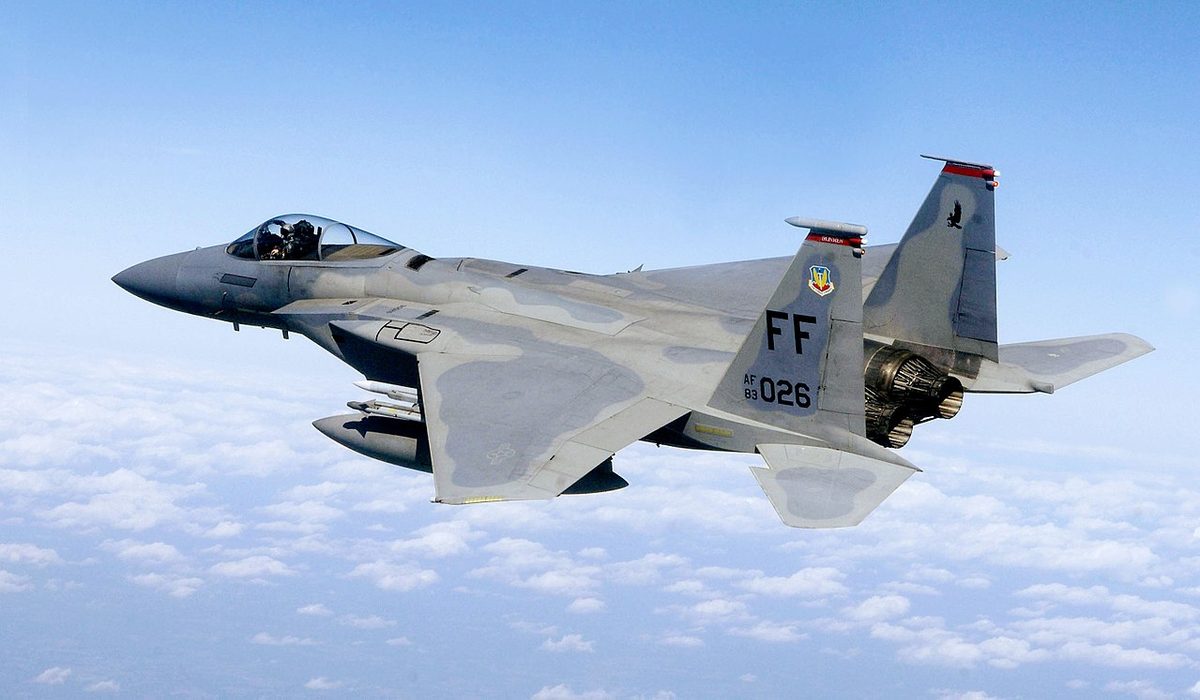
8. McDonnell Douglas F-15 Eagle — Mach 2.5 (1,650 mph)

F-15 Eagle in high-speed flight over terrain
F-15 Eagle in flight. (U.S. Air Force photo)

The F-15 Eagle was developed as a direct response to the MiG-25 Foxbat — when NATO intelligence overestimated the Foxbat's dogfighting capability and demanded a fighter that could beat it in every regime. Two Pratt & Whitney F100 afterburning turbofans give the F-15 a thrust-to-weight ratio near 1:1 at combat weight — the first production fighter to achieve this — enabling it to accelerate while climbing vertically. Maximum speed reaches Mach 2.5 at altitude.

The F-15's air-to-air combat record is unmatched: 104 kills to zero losses across all operators. In 1985, an F-15A launched an ASM-135 ASAT missile and destroyed a satellite in low Earth orbit — the only fighter to achieve a confirmed satellite kill. The newest variant, the F-15EX Eagle II, maintains Mach 2.5 capability while carrying up to 29,500 pounds of ordnance — the highest payload of any U.S. fighter.

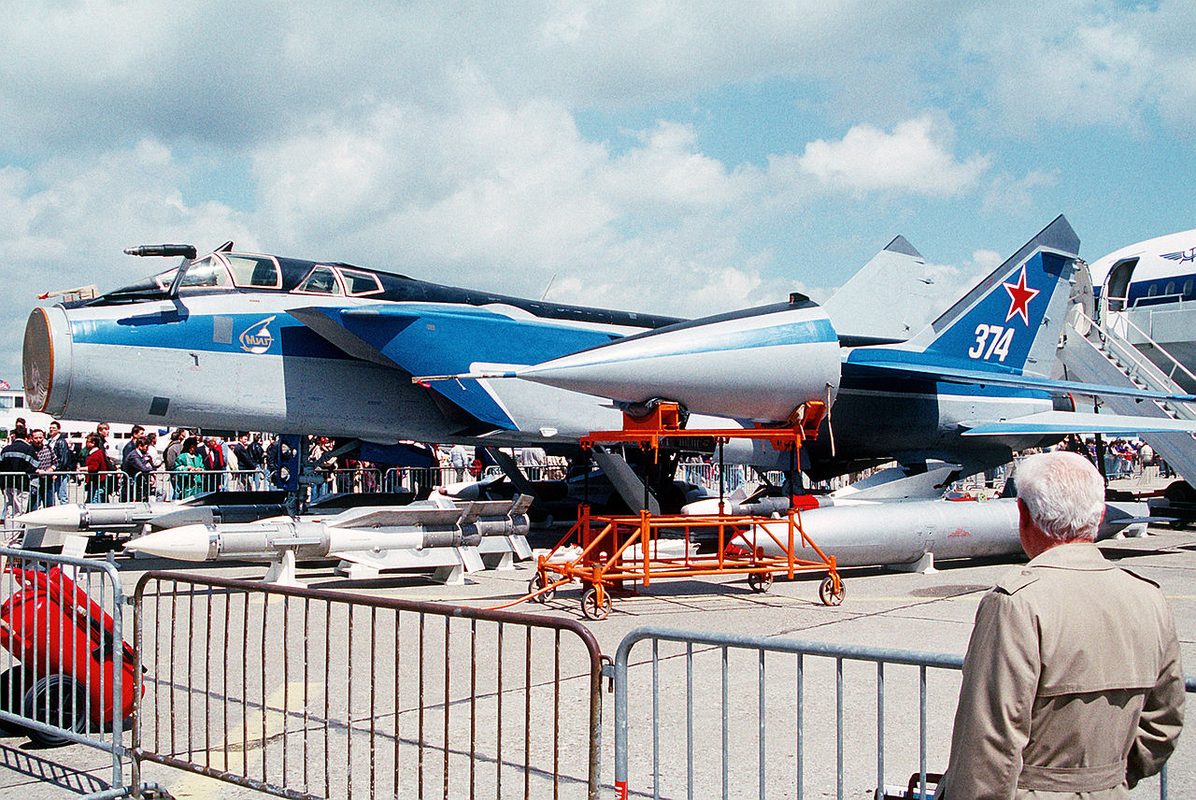
7. Mikoyan MiG-31 Foxhound — Mach 2.83 (1,860 mph)

MiG-31 Foxhound interceptor in flight showing its massive airframe
MiG-31 Foxhound interceptor. (Photo via Wikimedia Commons)

The MiG-31 is the fastest combat aircraft currently in active service anywhere in the world. Evolved from the MiG-25 Foxbat with significantly improved materials — 49 percent nickel steel, 33 percent light alloy, 16 percent titanium — the Foxhound is powered by two Soloviev D-30F6 afterburning turbofans producing 34,172 pounds of thrust each, among the most powerful fighter engines ever built. Operational top speed is Mach 2.83, temperature-limited — the engines and airframe could theoretically sustain higher speeds.

The MiG-31 was the first fighter aircraft with a phased-array radar — the Zaslon system, capable of tracking 10 targets and engaging four simultaneously at ranges up to 200 kilometers. Four MiG-31s flying in formation can monitor a front of 900 kilometers, sharing data via datalink — a networked combat capability decades ahead of its time. Russia has adapted the MiG-31 as the launch platform for the Kinzhal hypersonic missile, making it the world's only fighter-launched hypersonic weapons platform.

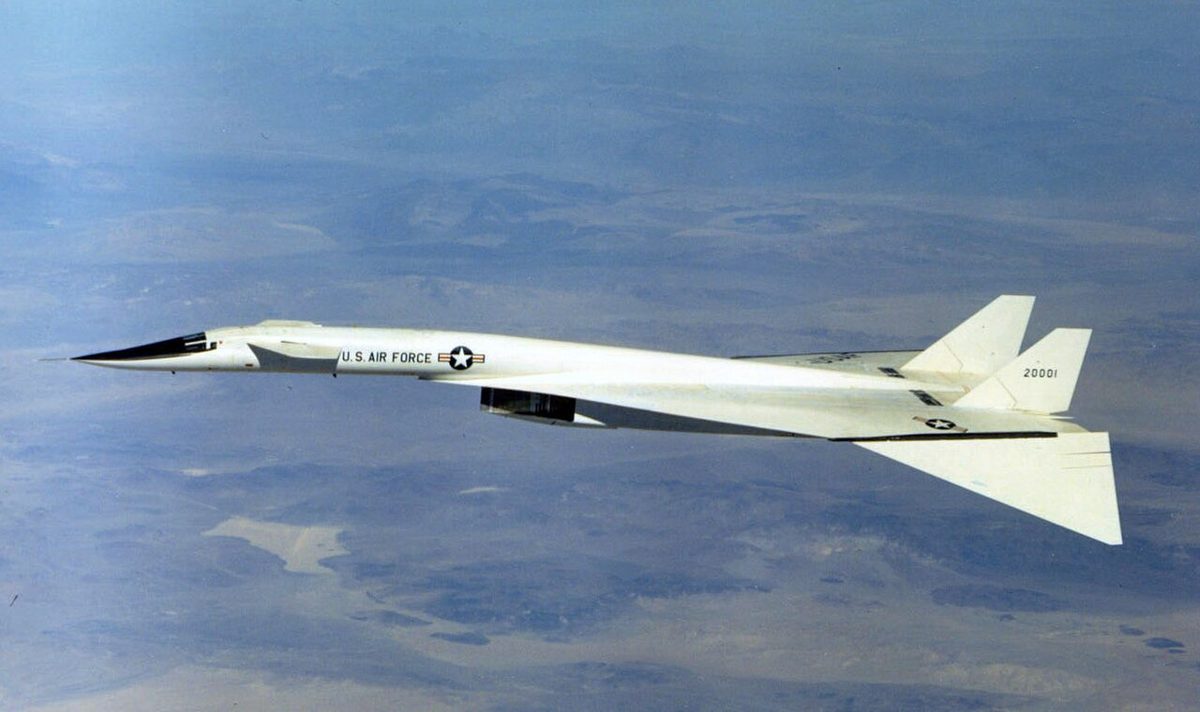
6. North American XB-70 Valkyrie — Mach 3.08 (2,056 mph)

XB-70 Valkyrie experimental Mach 3 bomber in flight
XB-70 Valkyrie in flight with wingtips folded down for compression lift. (NASA photo)

The XB-70 Valkyrie was the largest aircraft ever to fly at Mach 3. Six General Electric YJ93 turbojet engines produced a combined 172,000 pounds of thrust, pushing the 521,000-pound bomber to sustained Mach 3 flight for 32 minutes at a time. The XB-70 pioneered "compression lift" — its wingtips folded downward at high speed to trap the aircraft's own shock wave beneath the fuselage, generating additional lift from the very phenomenon that was supposed to create drag.

Only two were built. The program was cancelled when ICBMs and improving surface-to-air missiles made high-altitude penetration bombing obsolete. The second prototype was destroyed on June 8, 1966, when an F-104 Starfighter flying in close formation was caught in the Valkyrie's wingtip vortex and collided with it, killing NASA pilot Joe Walker and XB-70 co-pilot Carl Cross.

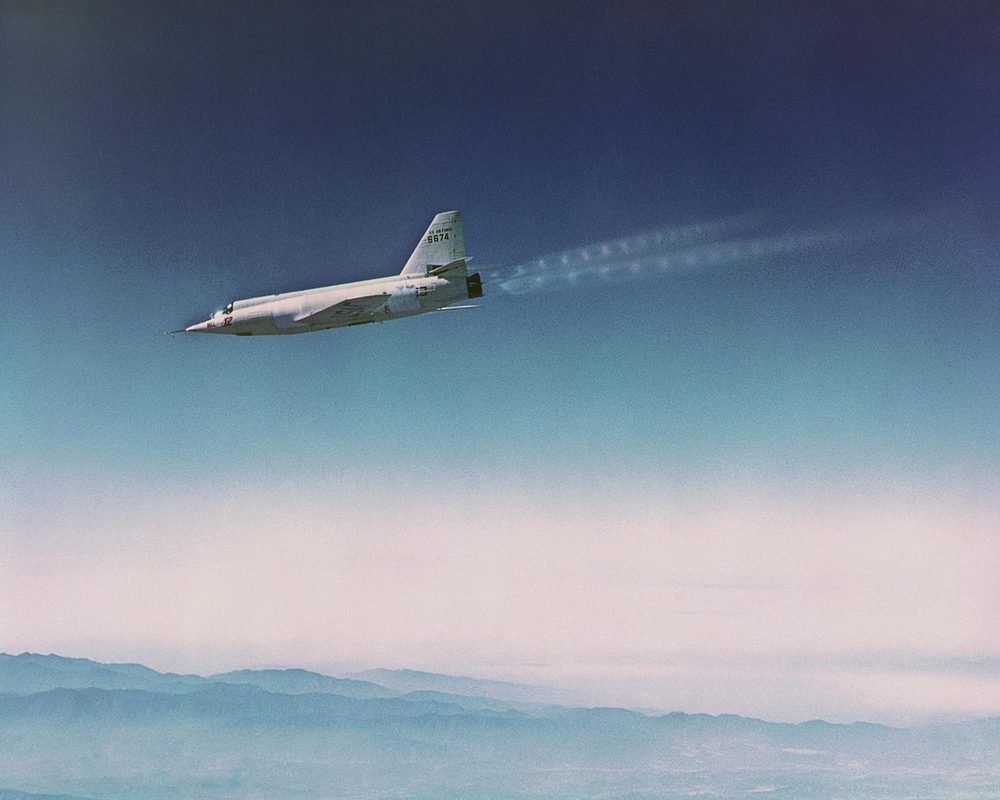
5. Bell X-2 Starbuster — Mach 3.196 (2,094 mph)

Bell X-2 Starbuster rocket-powered research aircraft
Bell X-2 Starbuster research aircraft. (NASA photo)

The Bell X-2 was built to investigate aerodynamic problems beyond Mach 2 — the region where aluminum airframes fail from aerodynamic heating. Constructed of stainless steel and K-Monel (a copper-nickel alloy), it was powered by a throttleable Curtiss-Wright XLR25 rocket engine producing up to 15,000 pounds of thrust. Air-launched from a modified B-50 bomber, the X-2 used swept wings specifically designed for the extreme speeds where straight-wing research aircraft like the X-1 became uncontrollable.

On September 27, 1956, Captain Milburn "Mel" Apt became the first person to exceed Mach 3, reaching 2,094 mph. He was killed on the same flight. After reaching peak speed, Apt attempted a banking turn while still above Mach 3, triggering inertia coupling — the aircraft tumbled violently out of control. The entire X-2 flight program consisted of only 20 powered flights, but its data on thermal heating and high-speed stability directly informed the X-15 program that would shatter its records.

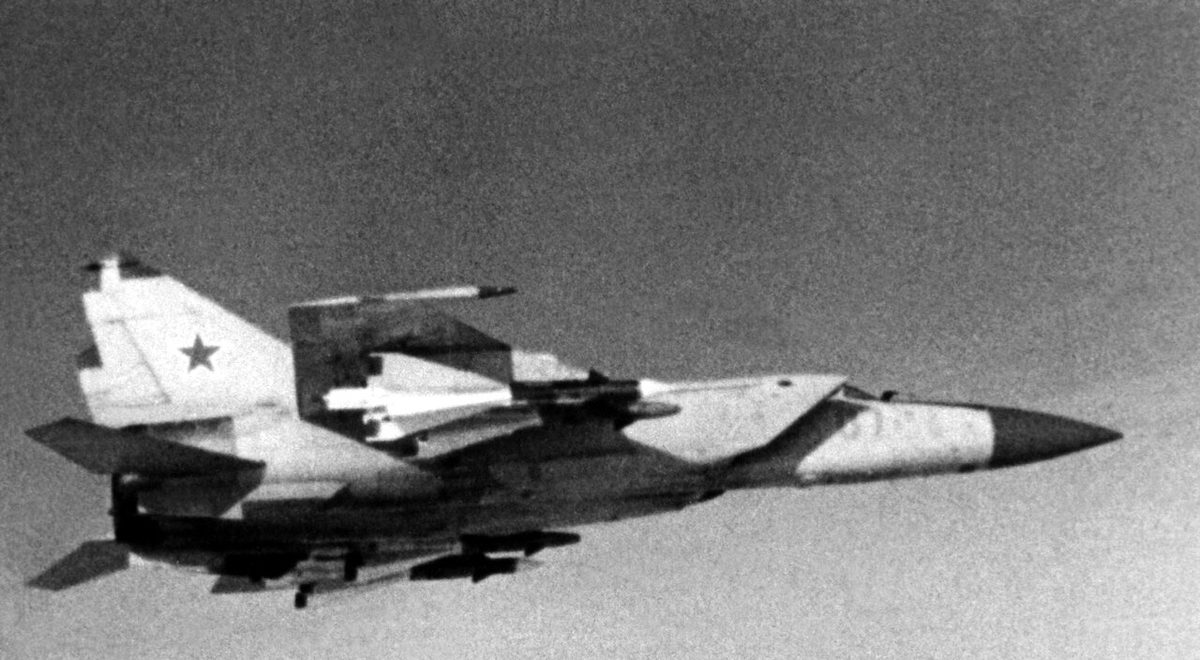
4. Mikoyan-Gurevich MiG-25 Foxbat — Mach 3.2 (2,170 mph)

MiG-25 Foxbat interceptor in flight
MiG-25 Foxbat high-altitude interceptor. (Photo via Wikimedia Commons)

The MiG-25 terrified NATO. Early reconnaissance photos showed a massive twin-engine fighter with enormous air intakes, and Western intelligence concluded the Soviets had built a Mach 3 super-fighter that could outrun and outfight anything in the Western arsenal. The truth was more nuanced: the Foxbat was a high-altitude interceptor optimized purely for speed and ceiling, with the agility of a freight train. Its operational limit was Mach 2.83 — pushing beyond that risked the Tumansky R-15B-300 engines accelerating out of control — but the aircraft could reach Mach 3.2 in short bursts at the cost of destroying the engines.

Eighty percent of the MiG-25's airframe was arc-welded nickel steel — not because it was optimal, but because the Soviet Union lacked the industrial capacity to produce enough titanium. When Lieutenant Viktor Belenko defected to Japan in a MiG-25 in 1976, Western intelligence was shocked to find vacuum-tube avionics instead of transistors. The Soviets used tubes deliberately — they were more resistant to electromagnetic pulse from nuclear detonations. The MiG-25 holds the absolute altitude record for a jet aircraft: 123,523 feet, achieved in a zoom climb. NATO's alarm over the Foxbat directly accelerated development of the F-15 Eagle.

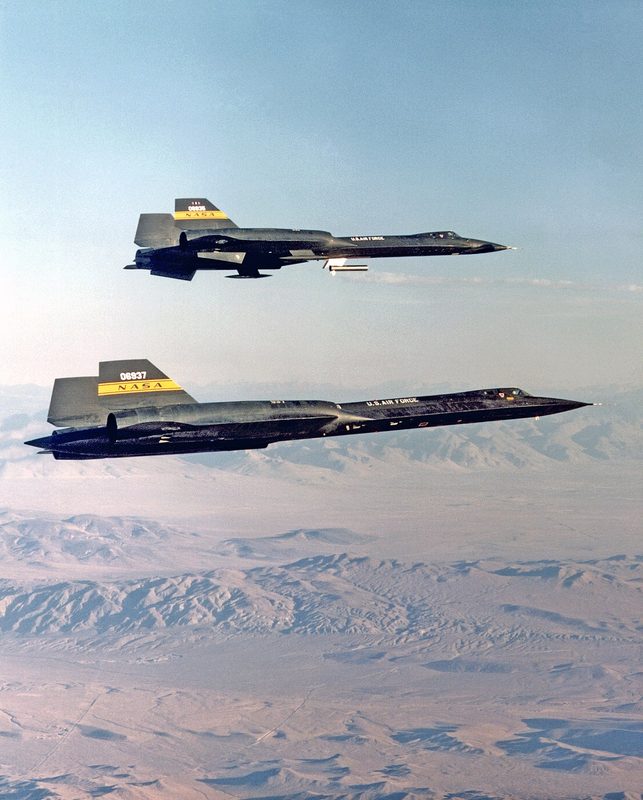
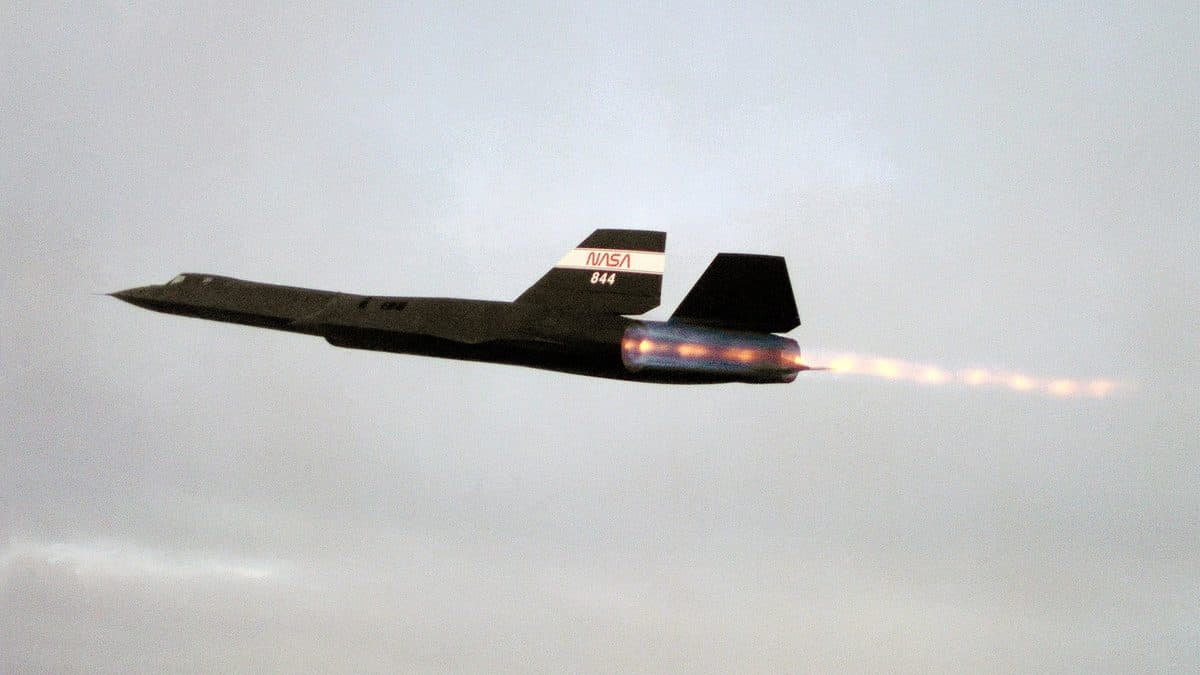
3. Lockheed YF-12 — Mach 3.35 (2,275 mph)

YF-12 interceptor prototype in flight showing its SR-71-derived airframe
YF-12 interceptor in flight. (NASA photo)

The YF-12 was the interceptor variant of the CIA's A-12 Oxcart reconnaissance aircraft — the predecessor to the SR-71 Blackbird. Only three were built, modified with a second cockpit and a weapons bay carrying the Hughes AN/ASG-18 fire control radar — the largest fighter radar ever built — and three AIM-47 Falcon missiles. The YF-12 shared the SR-71's Pratt & Whitney J58 turbo-ramjet engines and titanium construction, reaching Mach 3.35 at 80,000 feet.

In testing, an AIM-47 missile was fired at Mach 3.2 from 74,000 feet at a drone flying at 500 feet — and scored a direct hit, tearing a four-foot section off the target's tail. The program was cancelled partly because ICBMs rendered the high-altitude bomber threat less urgent. The YF-12's public existence served as a cover story for the classified A-12 and SR-71 programs — its announcement explained the mysterious high-speed aircraft sightings that were actually the CIA's reconnaissance planes.

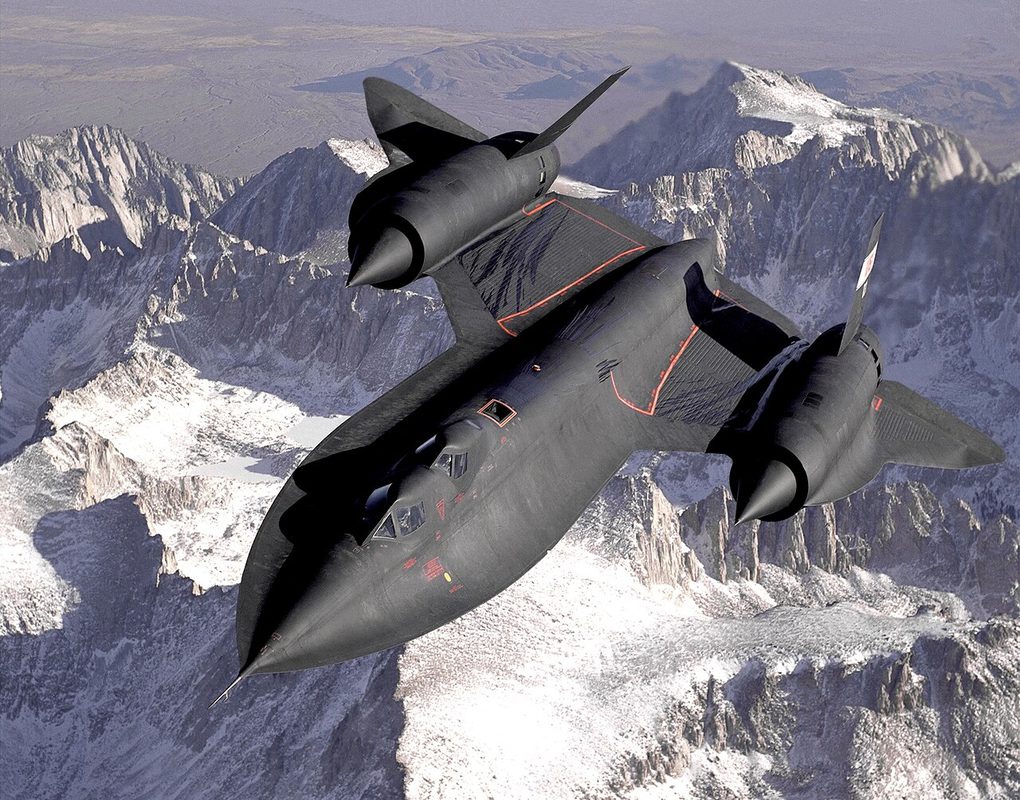
2. Lockheed SR-71 Blackbird — Mach 3.3+ (2,193 mph)

SR-71 Blackbird reconnaissance aircraft in high-altitude flight
SR-71 Blackbird in high-altitude flight. (U.S. Air Force photo)

The SR-71 Blackbird set the official absolute speed record for a manned, air-breathing aircraft on July 28, 1976: 2,193.2 miles per hour. Unofficial accounts from pilots — including Brian Shul's report of exceeding Mach 3.5 over Libya in 1986 — suggest the aircraft was capable of significantly more. The Blackbird flew strategic reconnaissance missions from 1966 to 1999, and in its entire career, over 4,000 missiles were fired at SR-71s. None ever hit one. The standard evasive maneuver was simply to accelerate.

The airframe was built almost entirely of titanium — much of it sourced covertly from the Soviet Union through CIA front companies. Two Pratt & Whitney J58 turbo-ramjet engines operated as conventional turbojets below Mach 2, then transitioned to function effectively as ramjets above Mach 2. At Mach 3, less than 20 percent of thrust came from the turbojet core — the rest came from the inlet and nacelle acting as a ramjet. The aircraft required custom JP-7 fuel with extremely low vapor pressure, ignited by triethylborane — each engine carried only 16 shots of this chemical igniter. The SR-71 leaked fuel on the ground because its titanium panels were designed to expand and seal at operational temperature.

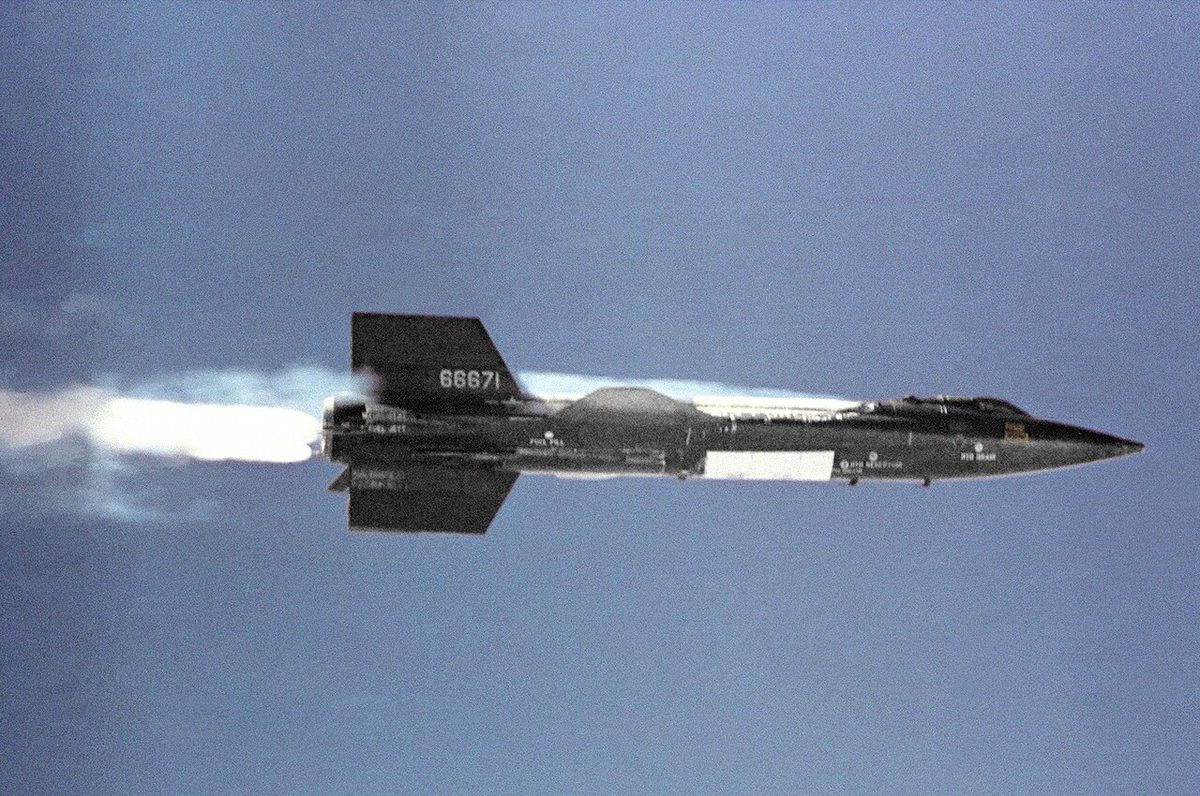
1. North American X-15 — Mach 6.7 (4,520 mph)

X-15 hypersonic rocket plane in powered flight with exhaust plume
X-15 hypersonic research aircraft in powered flight. (NASA photo)

The X-15 holds the absolute speed record for a crewed, powered aircraft — Mach 6.7, set on October 3, 1967, by pilot William J. "Pete" Knight at 102,100 feet. That record has stood for nearly six decades. No crewed aircraft has flown faster.

The X-15 was powered by the Reaction Motors XLR99 rocket engine — the first large, man-rated, throttleable, restartable liquid-propellant rocket engine ever built — producing 57,000 pounds of thrust. The airframe was constructed primarily of Inconel X, a nickel-chromium-iron alloy that maintains structural strength at temperatures up to 1,200 degrees Fahrenheit. This "hot structure" approach let the aircraft endure aerodynamic heating of up to 1,300 degrees on its nose and wing leading edges — temperatures that would melt aluminum. Later flights added ablative heat shields for even higher temperatures.

Like the Bell X-1 before it, the X-15 was air-launched — dropped from a B-52 mothership at approximately 45,000 feet. It could not take off under its own power. The program flew 199 missions with 12 pilots, including Neil Armstrong before his Apollo 11 mission. Eight pilots earned astronaut wings by exceeding 50 miles altitude. The highest flight reached 354,200 feet — 67 miles — above the internationally recognized boundary of space.

Data from the X-15 program directly informed the design of the Space Shuttle, particularly re-entry aerodynamics and thermal protection. The aircraft bridged the gap between atmospheric flight and spaceflight, proving that a winged vehicle could fly to the edge of space, re-enter the atmosphere, and land on a runway. Sixty years later, no crewed aircraft has flown faster — and few have contributed more to the advancement of aerospace engineering.

The Common Thread

Every aircraft on this list solved the same fundamental problem: how to survive at speeds that turn air into an enemy. At Mach 2, aerodynamic heating softens aluminum. At Mach 3, it reaches temperatures that require titanium or nickel alloys. At Mach 6, the aircraft's skin approaches the melting point of steel. Each of these machines — from the Su-27 at Mach 2.35 to the X-15 at Mach 6.7 — represents an engineering solution to the physics of extreme speed: new materials, new engines, new aerodynamic concepts, and pilots willing to fly them to the edge of what was known.

The era of extreme-speed manned aircraft may be passing. No new aircraft has joined this list since the MiG-31 entered service in 1981. The future of extreme speed belongs to hypersonic missiles and unmanned vehicles. But the machines on this list — and the pilots and engineers who built and flew them — defined the limits of what was possible in the sky. Some of those limits still stand.

Share this article

Share:

Recommended

Ace of The Skies: Can You Identify These Military Aircraft Throughout The Years?
Test Yourself

Ace of The Skies: Can You Identify These Military Aircraft Throughout The Years?

Can you identify these aircraft?

Take the Quiz

On This Day in Military History

March 31

British Guarantee to Poland (1939)

Prime Minister Neville Chamberlain announced that Britain would guarantee Poland's independence, drawing a line in the sand against further Nazi aggression and setting the stage for World War II.

1865Battle of Dinwiddie Court House

1968LBJ Announces He Will Not Seek Re-election

1991Warsaw Pact Formally Dissolved

See all 10 events on March 31

Get Military News & History in Your Inbox

Join thousands of readers receiving our weekly digest of military technology, history, and analysis.

Test Your Knowledge