



50 Military Decisions That Quietly Shaped Modern Warfare
Decisions that shaped modern military power across history.
ryan-caldwell··45 min read

The United States and Great Britain signed the Treaty of Ghent in present-day Belgium, ending nearly three years of war. The treaty restored the status quo ante bellum, but the war shattered Native American confederacies and forged an American national identity that would fuel westward expansion.
General George Washington finalized plans for his daring Christmas night crossing of the Delaware River, issuing orders that divided the Continental Army into three columns for a surprise attack on the Hessian garrison at Trenton.
Decisions that shaped warfareThe United States and Great Britain signed the Treaty of Ghent, ending the War of 1812 and restoring pre-war borders, though the bloodiest battle of the war at New Orleans would be fought two weeks later before news arrived.
American and British commissioners signed the Treaty of Ghent in the Belgian city of Ghent, ending the War of 1812. The treaty restored the prewar status quo with no territorial changes and no explicit resolution of the maritime issues that had caused the war. News of the signing traveled slowly enough that the Battle of New Orleans was fought on January 8, 1815, more than two weeks after peace had been agreed.
The first Union assault on Fort Fisher, North Carolina, began with a massive naval bombardment. The fort guarded the last major Confederate port at Wilmington, and its eventual fall would sever the final lifeline of the Confederacy.
Military mistakes that changed historySoldiers on both sides of the Western Front began an unofficial Christmas truce, with German troops placing candles on trees along their trenches and singing "Stille Nacht", the opening of the most remarkable episode of humanity amid the industrialized slaughter of World War I.
Chilling quotes from the trenchesGerman and British soldiers along sections of the Western Front stopped shooting, climbed out of their trenches, and met in No Man's Land to exchange gifts, sing carols, and bury their dead. The informal truce spread to perhaps two-thirds of the British sector between Ypres and Armentieres. Staff officers on both sides issued orders suppressing any repetition in subsequent years, and no comparable spontaneous ceasefire occurred on this scale during the remaining four years of the war.
President Franklin D. Roosevelt appointed General Dwight D. Eisenhower as Supreme Allied Commander of the Allied Expeditionary Force for Operation Overlord, the planned invasion of Normandy that would open the Second Front in Europe.
WWII facts you may not knowPresident Franklin D. Roosevelt announced from Tunis that General Dwight D. Eisenhower would serve as Supreme Allied Commander for the cross-channel invasion of Europe, code-named Operation Overlord. The appointment settled months of Anglo-American negotiation and placed Eisenhower in charge of the largest amphibious operation ever attempted, with more than 2.8 million troops eventually assembled in Britain for the Normandy landings.
The crew of Apollo 8, all military test pilots, broadcast a Christmas Eve reading of Genesis from lunar orbit and captured the iconic "Earthrise" photograph, demonstrating American technological superiority during the Cold War space race.
Soviet Air Force Il-76, An-22, and An-12 transport aircraft began a 48-hour airlift of elements of the 103rd Guards Airborne Division into Kabul and Bagram Air Base in Afghanistan, the opening move of the Soviet Union's nine-year intervention in the Afghan civil war. The airlift delivered approximately 5,000 paratroopers and a KGB Alpha Group that would seize key installations in Kabul on December 27.

Brevet Brigadier General
American frontiersman, fur trapper, wilderness guide, Indian agent, and U.S. Army officer who became one of the most famous figures of the American West. Carson fought at the Battle of Valverde during the Civil War as lieutenant colonel of the 1st New Mexico Volunteer Infantry and led controversial campaigns against the Navajo, Mescalero Apache, Kiowa, and Comanche nations. His forced relocation of 8,000 Navajo on the "Long Walk" remains one of the most debated episodes in frontier military history.

Founding Father, signer of the Declaration of Independence, and Surgeon General of the Continental Army's Middle Department during the Revolutionary War. Rush was one of the most prominent physicians in early America, advocating for medical reforms in the Continental Army and establishing military hospitals for wounded soldiers. His observations on battlefield medicine and military hygiene pioneered the field of military medical care in the United States.

Viceroy of India
Portuguese explorer and naval commander who led the first European expedition to reach India by sea in 1498, opening a maritime route that transformed global trade and warfare. Da Gama commanded armed fleets that established Portuguese dominance in the Indian Ocean through a combination of diplomacy and naval bombardment, including the controversial destruction of the merchant vessel Miri in 1502. He served three voyages to India and was appointed Viceroy shortly before his death in Cochin on this date in 1524.
Wear the Timeline
10 military events occurred on December 24, spanning multiple centuries. Key events include: Treaty of Ghent Ends the War of 1812 (1814), Washington Prepares the Delaware Crossing (1776), Eisenhower Named Supreme Allied Commander (1943), Christmas Truce Begins Along the Western Front (1914), Eisenhower Named Supreme Commander for Overlord (1943).
The most significant military event on December 24 is Treaty of Ghent Ends the War of 1812 (1814). The United States and Great Britain signed the Treaty of Ghent in present-day Belgium, ending nearly three years of war. The treaty restored the status quo ante bellum, but the war shattered Native American confederacies and forged an American national identity that would fuel westward expansion.
Notable military figures born on December 24 include Kit Carson (1809–1868), Benjamin Rush (1746–1813).
Events on December 24 span the Colonial & Revolutionary era, World War II, the Civil War, World War I, the Cold War, covering 10 events across 3 centuries of military history.
Events on December 24 involve 5 branches of the U.S. and allied armed forces, reflecting the global scope of military operations throughout history.
Explore military history from the day you were born.
June 6
The Allied invasion of Normandy, the largest amphibious assault in history.
December 7
Japan attacks the U.S. Pacific Fleet, bringing America into World War II.
September 11
The deadliest terrorist attack in history transforms U.S. national security.
August 6
The first atomic bomb is dropped on a city, ushering in the nuclear age.
May 8
Nazi Germany surrenders unconditionally, ending World War II in Europe.
November 11
Armistice Day marks the end of World War I and honors all who served.
June 4
The turning point of the Pacific War as the U.S. Navy destroys four Japanese carriers.
July 4
The Declaration of Independence is adopted, sparking the American Revolution.
Decisions that shaped modern military power across history.
Calvin Graham Was Youngest Decorated US Soldier at 12 Pearl Harbor Visitors Bureau “Green Boys” was a term given to soldiers who…

From wrong turns to unlocked gates - real mistakes that shaped the course of history.
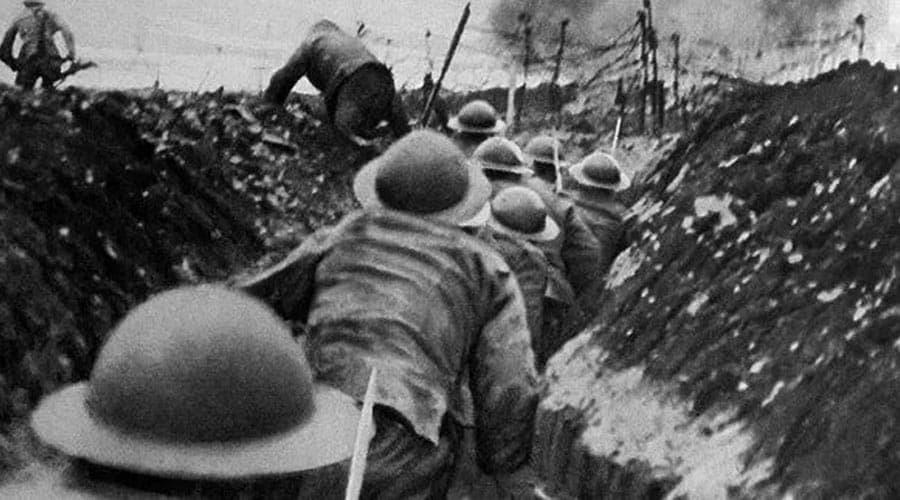
Harrowing first-person accounts from soldiers who endured the mud, gas, and constant shelling of World War I's Western Front.