

50 Military Decisions That Quietly Shaped Modern Warfare
Decisions that shaped modern military power across history.
ryan-caldwell··45 min read

The lead elements of Patton's 4th Armored Division broke through German lines to relieve the besieged 101st Airborne Division at Bastogne, ending one of the most critical sieges of the Battle of the Bulge and marking the beginning of the German offensive's collapse.
Washington's Continental Army attacked the Hessian garrison at Trenton following the Christmas night crossing of the Delaware, killing 22 Hessians including their commander Colonel Rall and capturing nearly 900, with zero American combat deaths.
Decisions that shaped warfareContinental Army soldiers under General George Washington attacked and defeated the Hessian garrison at Trenton, New Jersey, in a 45-minute engagement that produced one of the most lopsided tactical victories of the Revolutionary War. Washington's force captured 918 prisoners, six artillery pieces, and the stores of a full Hessian brigade, at a cost of two dead and four wounded.
Thirty-eight Dakota Sioux men were hanged simultaneously at Mankato, Minnesota, in the largest mass execution in United States history. The men had been condemned by a military tribunal for their roles in the Dakota War of 1862. President Abraham Lincoln had personally reviewed the 303 death sentences initially handed down and commuted all but 39, one of whom received a last-minute reprieve.
The British Crown Colony of Hong Kong surrendered to Japanese forces after eighteen days of combat that killed approximately 2,000 defenders and wounded thousands more. The garrison of 14,000 British, Canadian, Indian, and Hong Kong Volunteer Defence Force troops had been overwhelmed by the Japanese 38th Division's assault across the harbor and through the New Territories. The loss of Hong Kong removed a key British base in East Asia for the remainder of the war.
The Royal Navy sank the German battlecruiser Scharnhorst off the coast of Norway after decoded signals revealed her mission to attack an Allied convoy to Russia. Of her crew of nearly 2,000, only 36 survived.
WWII facts you may not knowThe 4th Armored Division broke through German lines to relieve the besieged 101st Airborne at Bastogne, culminating Patton's audacious 90-degree turn of the Third Army through winter conditions.
Ground forces of the Soviet 40th Army crossed the Amu Darya River at Termez, Uzbekistan, into Afghanistan, completing the invasion begun by airborne and special operations units two days earlier. Over the following week, Soviet motor rifle divisions and the 103rd Guards Airborne Division consolidated control of Kabul, Bagram, Herat, Kandahar, and the main highways of the country, beginning the nine-year war that would contribute to the eventual collapse of the Soviet Union.
The Soviet of the Republics formally dissolved the Union of Soviet Socialist Republics, ending the existence of the superpower that had maintained the world's largest conventional military and a nuclear arsenal of over 10,000 warheads.
Decisions that shaped warfareA magnitude 9.1 earthquake off the coast of Sumatra triggered a devastating tsunami that killed over 230,000 people across fourteen countries, sparking the largest international military humanitarian operation in history, Operation Unified Assistance.
A magnitude 9.1 earthquake off the coast of Sumatra triggered a tsunami that killed approximately 228,000 people across fourteen countries and displaced 1.7 million more. The American military response, Operation Unified Assistance, deployed the USS Abraham Lincoln carrier strike group, the USS Bonhomme Richard expeditionary strike group, and more than 15,000 military personnel in the largest U.S. humanitarian assistance operation since the Berlin Airlift.

Admiral of the Navy
The only person in United States history to hold the rank of Admiral of the Navy, Dewey achieved fame by destroying the entire Spanish Pacific fleet at the Battle of Manila Bay on May 1, 1898, with the loss of only a single American crewman. His victory secured the Philippines for the United States and made Dewey a national hero overnight. He served on the influential General Board of the Navy from 1900 until his death, shaping U.S. naval policy during a period of rapid fleet expansion.

Chinese revolutionary leader and military strategist who founded the People's Republic of China in 1949 after leading the Communist Red Army through the Long March, the Chinese Civil War, and the war against Japanese occupation. Mao's theories of guerrilla warfare, particularly "people's war," the use of rural bases, and the integration of political and military struggle, influenced insurgent movements worldwide from Vietnam to Cuba. As commander-in-chief, he committed Chinese forces to the Korean War in 1950, fundamentally altering the course of that conflict.

Captain
U.S. Army artillery captain in World War I who rose to become the 33rd President of the United States. As commander-in-chief, Truman made some of the most consequential military decisions in history: authorizing the atomic bombings of Hiroshima and Nagasaki, ordering the Berlin Airlift, committing forces to Korea, firing General MacArthur, establishing the CIA and the Department of Defense, and integrating the armed forces through Executive Order 9981. He died on this date in 1972 at age 88.
Wear the Timeline
10 military events occurred on December 26, spanning multiple centuries. Key events include: Patton's 4th Armored Division Relieves Bastogne (1944), Battle of Trenton (1776), Sinking of the Scharnhorst at the Battle of the North Cape (1943), Soviet Union Formally Dissolved by the Supreme Soviet (1991), Battle of Trenton (1776).
The most significant military event on December 26 is Patton's 4th Armored Division Relieves Bastogne (1944). The lead elements of Patton's 4th Armored Division broke through German lines to relieve the besieged 101st Airborne Division at Bastogne, ending one of the most critical sieges of the Battle of the Bulge and marking the beginning of the German offensive's collapse.
Notable military figures born on December 26 include George Dewey (1837–1917), Mao Zedong (1893–1976).
Events on December 26 span World War II, the Colonial & Revolutionary era, the Cold War, the Modern Era, the Civil War, covering 10 events across 4 centuries of military history.
Events on December 26 involve 5 branches of the U.S. and allied armed forces, reflecting the global scope of military operations throughout history.
Explore military history from the day you were born.
June 6
The Allied invasion of Normandy, the largest amphibious assault in history.
December 7
Japan attacks the U.S. Pacific Fleet, bringing America into World War II.
September 11
The deadliest terrorist attack in history transforms U.S. national security.
August 6
The first atomic bomb is dropped on a city, ushering in the nuclear age.
May 8
Nazi Germany surrenders unconditionally, ending World War II in Europe.
November 11
Armistice Day marks the end of World War I and honors all who served.
June 4
The turning point of the Pacific War as the U.S. Navy destroys four Japanese carriers.
July 4
The Declaration of Independence is adopted, sparking the American Revolution.
Decisions that shaped modern military power across history.
Calvin Graham Was Youngest Decorated US Soldier at 12 Pearl Harbor Visitors Bureau “Green Boys” was a term given to soldiers who…
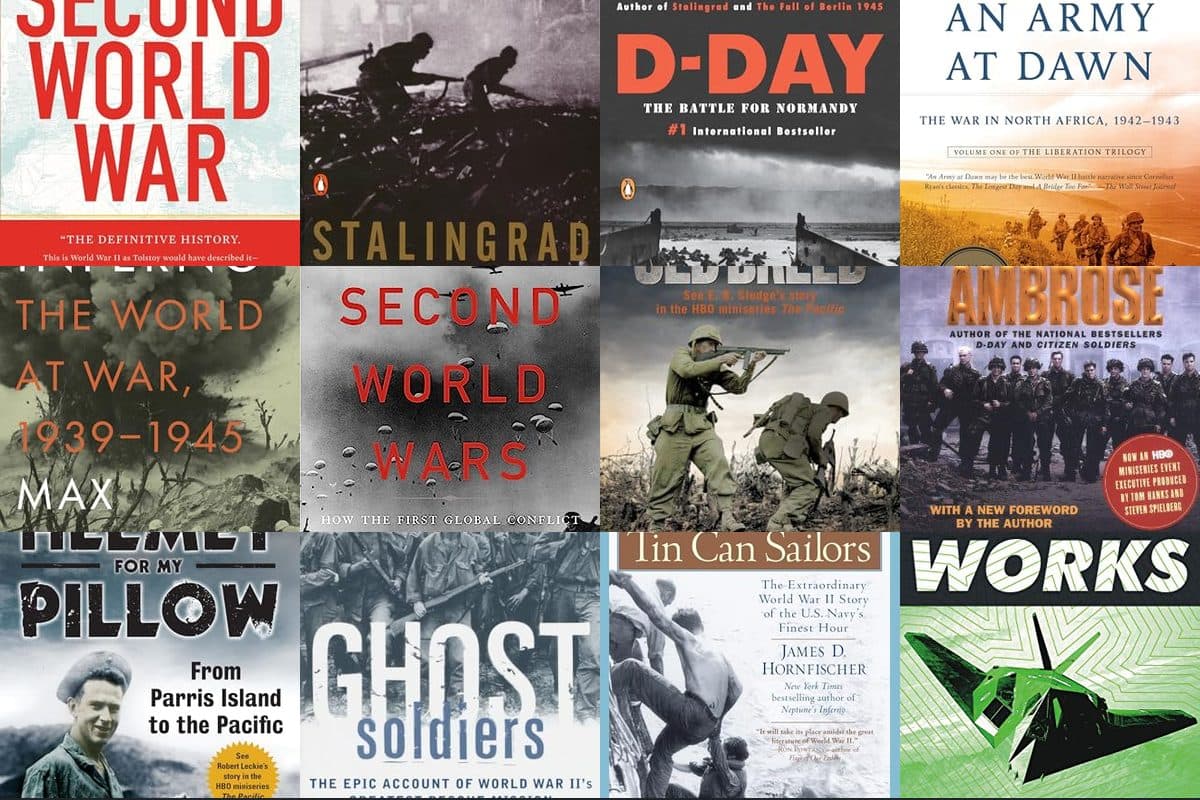
15 essential WW2 books covering every theater. Narrative histories, memoirs, and visual references ranked.
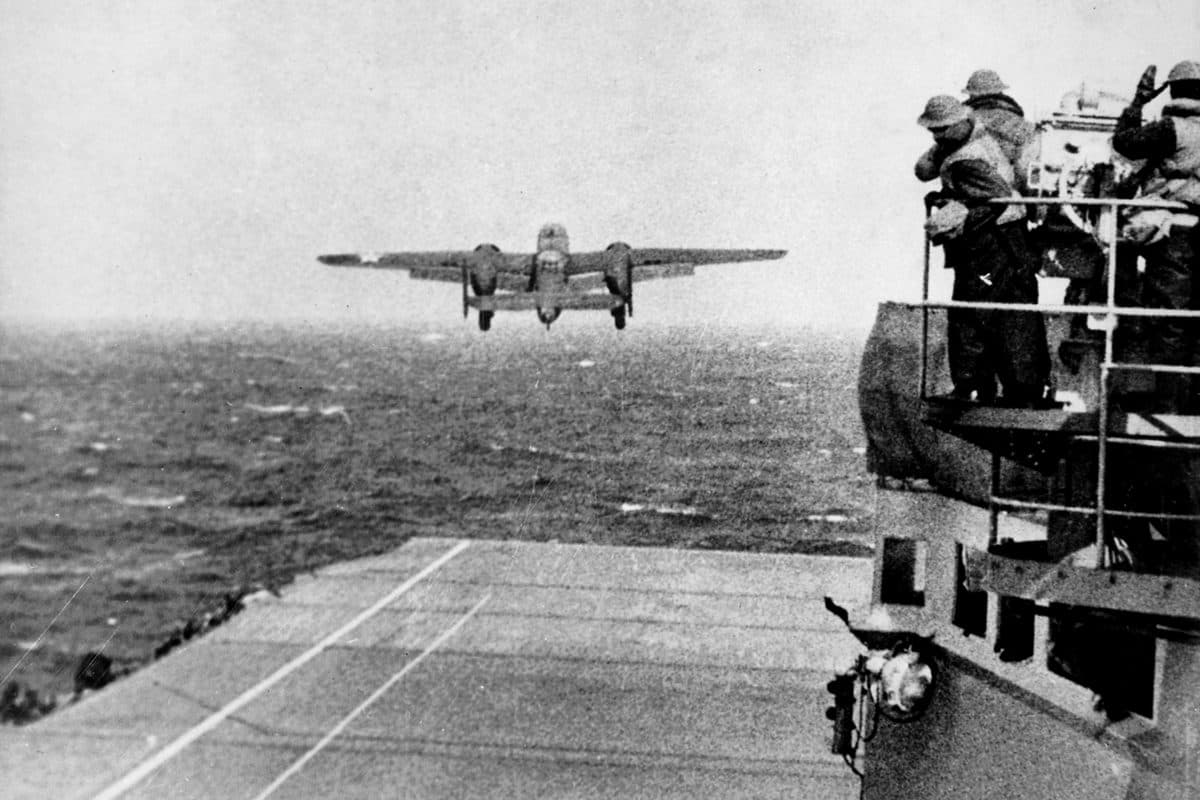
On April 18, 1942, sixteen B-25 Mitchell bombers did something no one thought possible: they launched from the deck of an aircraft carrier, flew 650 miles to Japan, and bombed Tokyo. Every aircraft was lost. The damage was negligible. The consequences changed the war.